

Most new interns waste their transition month and pay for it for the next 12. You do not have to be one of them.
You are standing between two very different lives: student and physician. This “gap” month is not a vacation. It is your buffer. Your setup window. Used well, it will make PGY‑1 survivable instead of chaotic.
I will walk you through this week by week and then day by day in the final 10 days. Logistical and mental prep woven together. At each point: do this, ignore that, and stop obsessing over the wrong things.
Big Picture: What This Transition Month Is Actually For
There are four jobs this month:
- Lock down logistics: housing, licenses, HR paperwork, banking, benefits.
- Build your physical and digital “intern kit”: gear, templates, resources.
- Reset your life: health, finances, relationships, sleep.
- Reframe your mind: you are no longer “student helping out.” You are the doctor of record at 3 a.m.
Interns who skip #3 and #4 usually burn out by October. I have watched it too many times.
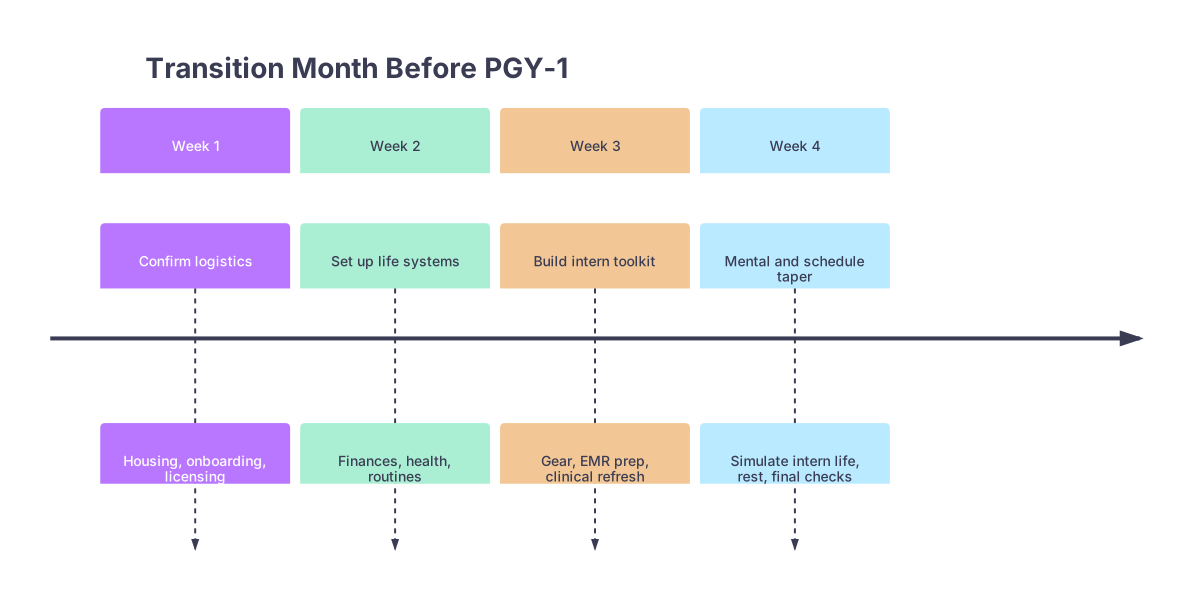
To keep you oriented, here is the overall structure:
| Period | Event |
|---|---|
| Week 1 - Confirm logistics | Housing, onboarding, licensing |
| Week 2 - Set up life systems | Finances, health, routines |
| Week 3 - Build intern toolkit | Gear, EMR prep, clinical refresh |
| Week 4 - Mental and schedule taper | Simulate intern life, rest, final checks |
Week 1: Lock Down the Non‑Negotiables
At this point you should stop pretending this is far away. Pull up your contract, onboarding emails, and any residency portal. You are now in execution mode.
Day 1–2: Confirm Where You Will Sleep and What You Will Get Paid
Housing finalized (or at least truly real).
- Lease signed or offer accepted.
- Move‑in date confirmed. Compare it to orientation start.
- If there is a gap, line up:
- Short‑term rental (Furnished Finder, Airbnb month‑long rentals).
- Or stay with friends/family near the hospital.
Understand your first paycheck. Actually understand it.
- Log into GME/HR portal.
- Confirm:
- Salary.
- Pay schedule (biweekly vs monthly).
- Direct deposit setup.
- Estimate your first paycheck timing. Many interns get burned when the first check arrives 4–6 weeks in.
Run your cash‑flow math for July–September.
- Fixed costs: rent, utilities, car payment, minimum student loans, phone, internet.
- Variable: food, gas, basic fun.
- Decide:
- How much to keep in checking as an emergency buffer (ideally 1–2 months of bare‑bones expenses).
- Whether to pause aggressive loan payments and just stay on income‑driven until after intern year.
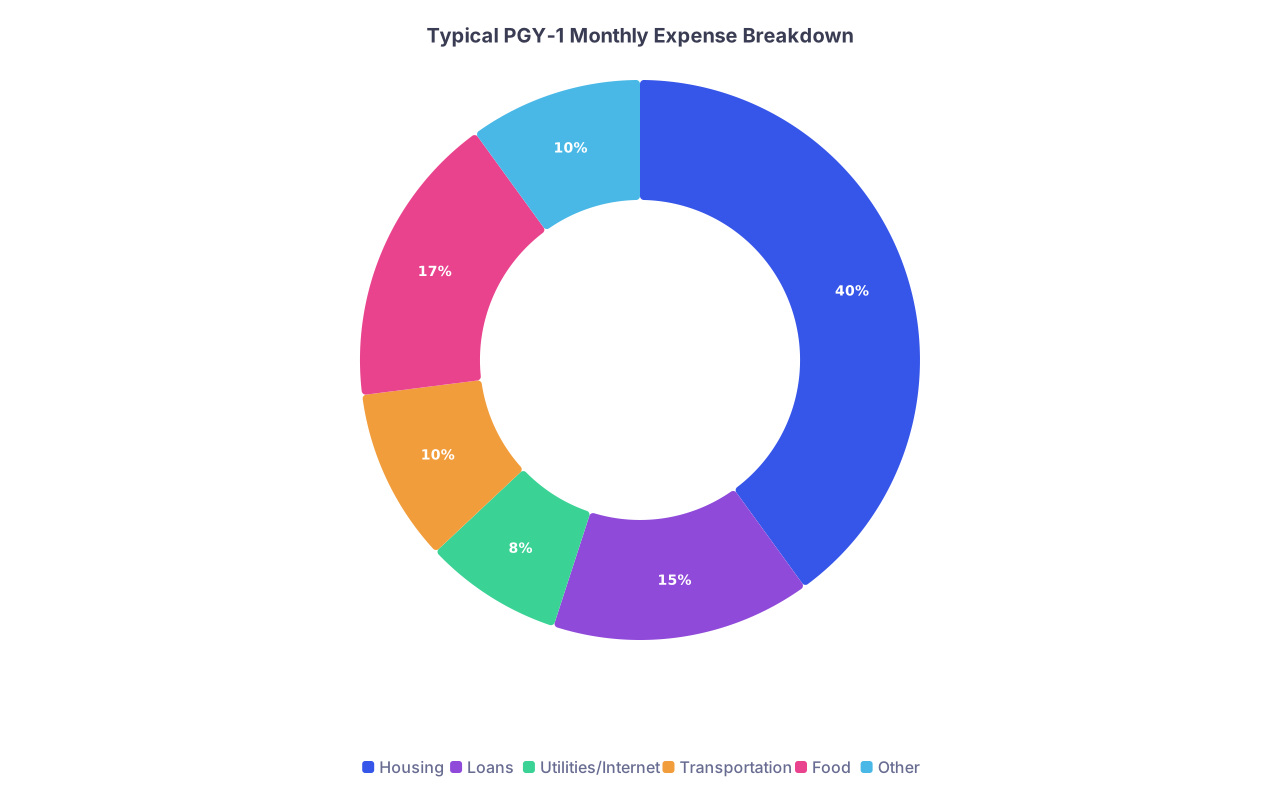
| Category | Value |
|---|---|
| Housing | 40 |
| Loans | 15 |
| Utilities/Internet | 8 |
| Transportation | 10 |
| Food | 17 |
| Other | 10 |
Day 3–4: Licensing, Credentialing, HR
This is the boring, absolutely critical part.
By this point you should:
State license or training license:
- Check status online.
- If “pending” for more than 2–3 weeks, call the board. Not email. Call.
- Make sure all verifications (school, USMLE, etc.) have been received.
DEA / controlled substance number:
- Many programs do not require this at the start. Some do.
- Verify what your program expects and when. Put a reminder on your calendar to apply once your state license is granted if necessary.
-
- Re‑open every email from GME / Medical Staff Office.
- Confirm:
- Background check completed.
- Drug screen scheduled or done.
- Immunizations uploaded (MMR, Varicella, Hep B, TB, COVID, flu, etc.).
- If immunizations are incomplete, book an appointment this week.
Day 5–7: Health, Insurance, and Safety Net
At this point you should secure your physical and financial safety nets.
Insurance coverage gaps.
- Medical school insurance end date vs residency benefits start.
- If there is a gap:
- COBRA (usually expensive).
- Short‑term plan.
- Or a marketplace plan for 1–2 months.
- Do not go into intern year uninsured. I have watched an intern tear an ACL in week 2.
PCP, dentist, therapy.
- PCP: schedule annual visit before intern year if you are due.
- Dentist: get cleaning/urgent work done now. You will not have two afternoons free later.
- Mental health:
- If you already have a therapist, align follow‑up cadence for PGY‑1 (telehealth if moving).
- If not, identify at least one option in your new city and save their number.
Emergency info packet.
- List of:
- Insurance policy numbers.
- PCP, therapist, nearest urgent care/ED.
- Emergency contacts.
- Share with one trusted person (partner, family, close friend).
- List of:
Week 2: Build Systems So Your Life Does Not Collapse
The second week is about infrastructure—financial, practical, and health‑related. You are building autopilot.
Day 8–9: Banking, Budgeting, Automation
At this point you should:
Set up or clean up your primary bank account.
- Ensure direct deposit info is correct with HR.
- Open a separate savings account labelled “3–Month Buffer” or “Emergency.”
Automate the boring stuff.
- Autopay:
- Minimum student loan payment (if not in forbearance).
- Credit cards (at least minimum).
- Rent (if possible).
- Calendar reminders for:
- License renewal.
- DEA renewal.
- Annual required modules.
- Autopay:
Create a simple PGY‑1 budget you will actually follow.
- You do not need an app that looks like a NASA dashboard.
- Just a simple monthly breakdown and a quick weekly check‑in.
| Category | Target % of Take-Home |
|---|---|
| Housing | 35–45% |
| Debt Payments | 10–20% |
| Savings/Buffer | 5–10% |
| Transportation | 5–10% |
| Food | 15–20% |
| Everything Else | 10–15% |
Day 10–11: Health Routines and Sleep Reset
At this point you should begin shifting from “student sleep” to “intern resilience.”
Baseline sleep schedule.
- Identify what your first month rotation will look like (days vs nights).
- If days: start stabilizing a consistent wake time now (e.g., 5:30–6:00 a.m.).
- If nights: the last 7–10 days of this month you will gradually flip; for now, protect 7–8 hours regardless of when.
Movement and nutrition baselines.
- Choose:
- One realistic physical routine (20–30 minutes, 3–4 times per week).
- One nutrition upgrade (meal prep on one day, or always pack snacks).
- The point is not to “get fit” this month. It is to engrain a floor you will not drop below when life gets busy.
- Choose:
Caffeine strategy.
- If you are slamming 400+ mg/day, taper a bit.
- You want room to go up when you hit nights, not already be maxed out.
Day 12–14: Social and Support Structure
At this point you should deliberately plan your support network instead of hoping it magically appears.
Coordinate with co‑interns.
- If your program has a GroupMe / WhatsApp / Slack, join it.
- Ask:
- Who is living nearby?
- Anyone interested in carpooling / sharing rides on call days?
- Group grocery runs or Costco split.
Family and partner expectations.
- Have one explicit conversation:
- What your hours will probably look like (range, not fantasy).
- When you will be reliably reachable (e.g., quick check‑ins on commute, not mid‑rounds).
- How you handle post‑call (you will be exhausted; you will not be fun).
- Have one explicit conversation:
Plan small anchors.
- 1 weekly call with close friend/partner.
- 1 standing small joy: Sunday coffee shop, Friday evening walk, whatever.
- They seem trivial now. They will keep you human later.
Week 3: Build Your Practical “Intern Toolkit”
Now we stack the clinical and logistical tools you will reach for daily.
Day 15–16: Physical Gear
At this point you should assemble your actual, physical intern kit. Not a Pinterest fantasy bag. The real thing.
Essentials:
- 2–3 pairs of comfortable professional shoes (you will destroy at least one).
- Compression socks (especially for surgery/IM).
- 3–5 sets of scrubs (if not supplied by hospital).
- 1–2 white coats if your program requires them.
- Durable, small backpack or sling bag.
- Clipboard or pocket notebook system.
Clinical tools:
- Quality stethoscope (already engraved or labeled).
- Penlight.
- Multiple pens and a highlighter.
- Small portable charger + extra cables.
- Badge reel or lanyard with breakaway safety.

Day 17–18: Digital Setup and EMR Prep
At this point you should set up your digital environment so you are not fighting your tools on day 1.
Email hygiene.
- Create filters:
- All hospital listserv traffic → separate folder.
- GME / Program Director emails → “Priority” folder with notifications.
- Unsubscribe from student‑only lists that no longer apply.
- Create filters:
Cloud storage and note system.
- Pick one: OneNote, Notion, Apple Notes, Google Drive, whatever.
- Create folders:
- “Intern Year – Cheat Sheets”
- “Policies and Protocols”
- “Evaluations & Feedback”
- “Wellness / Schedules”
- Save:
- Program handbooks.
- Orientation schedules.
- Local clinical guidelines if provided.
EMR pre‑work.
- If you already know the EMR (Epic, Cerner, etc.), great:
- Set up order sets, preference lists, favorite meds, preferred note templates during orientation, not in the middle of a code.
- If it is new:
- Watch the official training videos once, but more importantly:
- Ask upper levels for screenshot cheat sheets.
- Keep a 1‑page list of “how to” (admit, place consult, discharge, write orders).
- Watch the official training videos once, but more importantly:
- If you already know the EMR (Epic, Cerner, etc.), great:
Day 19–20: Clinical Brain Refresh (Targeted, Not Neurotic)
You do not need to relearn all of medicine. You should refresh intern‑level high‑yield items.
Focus on:
- How to structure:
- Admit note.
- Daily progress note.
- Discharge summary.
- Basic orders:
- Maintenance fluids.
- VTE prophylaxis.
- Typical home med reconciliation approach.
- Core emergencies in your field:
- For IM: DKA, sepsis, CHF exacerbation, COPD flare, chest pain, GI bleed.
- For surgery: post‑op fever, bleeding, hypotension, ileus.
- For peds: bronchiolitis, dehydration, asthma.
Spend 30–60 minutes per day this week on:
- A simple handbook (e.g., Pocket Medicine, Harriet Lane for peds).
- Short EMcrit/UpToDate summaries for common issues.
- Writing 1–2 “model” notes to practice structure.
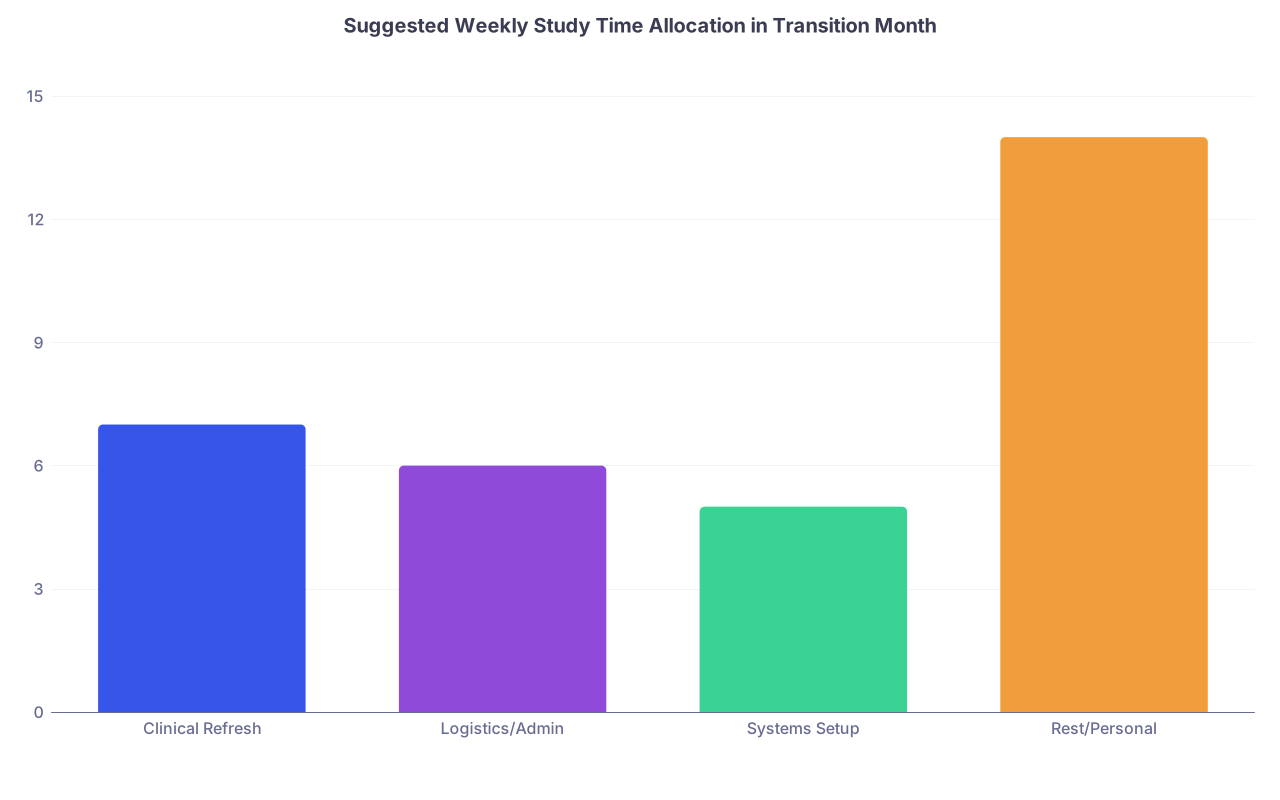
| Category | Value |
|---|---|
| Clinical Refresh | 7 |
| Logistics/Admin | 6 |
| Systems Setup | 5 |
| Rest/Personal | 14 |
Week 4: Mental Rehearsal, Schedule Taper, and Final Checks
This last week is where you mentally shift from “I am preparing” to “I am ready.” You taper your social life, dial in your sleep, and walk through your first days in your head.
Day 21–23: Move, Settle, and Walk the Space
If you are relocating, this is the move window.
At this point you should:
Complete your move (or at least the essentials).
- Bed, basic kitchen setup, shower curtain, laundry solution.
- Do not waste your first 3 days as an intern chasing a can opener and towels.
Visit the hospital if possible.
- Walk:
- From your parking or public transit stop to your main entrance.
- From main entrance to:
- GME office.
- Your main work area (wards, ED, OR locker room).
- Cafeteria.
- Call rooms if accessible.
- This reduces cognitive load on day 1 more than you realize.
- Walk:
Test commute.
- Drive or take public transport at the actual time you will commute.
- Add 15–20 minutes buffer to whatever Google Maps says. Traffic is rarely kind at 6:45 a.m.

Day 24–25: Mental Reframe and Expectation Setting
Now we get into the mental side. This is not fluff. It is survival.
At this point you should:
Accept the role shift explicitly.
- You are no longer there “to learn” only. You are there to be responsible.
- Write down:
- “What kind of intern do I want to be?” in three bullets:
- Reliable.
- Calm under pressure.
- Teachable.
- Post it near your desk.
- “What kind of intern do I want to be?” in three bullets:
Plan how you will ask for help.
- Script it now so you can say it when stressed:
- “I am concerned about this patient because…”
- “I am not comfortable with X; can you walk me through how you would approach it?”
- Your seniors would rather you call “too early” than “too late.” The only interns who get in trouble are the ones who hide.
- Script it now so you can say it when stressed:
Clarify your minimum self‑care contract.
- Non‑negotiables:
- I will eat something on each shift.
- I will drink water.
- I will not chart in bed for more than X minutes at home.
- I will ask for help if I am feeling unsafe, suicidal, or unable to function.
- Non‑negotiables:
Day 26–27: Simulate an Intern Day
This sounds silly. It is not.
Pick one day and treat it like a light intern shift.
At this point you should:
Practice your morning.
- Wake at your planned time.
- Get dressed quickly. No indecision.
- Pack your bag as if for work:
- ID, stethoscope, notebook, charger, snacks, water.
- Do a mock commute, even if you end at a coffee shop to study.
Practice cognitive switching.
- Give yourself a “work block” (4–6 hours of focused tasks: reading, setting up systems, note practice).
- Then a decompression block: walk, shower, 30–60 minutes of something non‑medical.
- Notice how your brain feels. This is the rhythm you will live in.
Run “what if” drills for mental rehearsal.
- In your notes app, create a page called “Scripts.”
- Write quick templates for:
- Calling a consult.
- Presenting on rounds.
- Calling your senior overnight.

| Step | Description |
|---|---|
| Step 1 | Recognize concern |
| Step 2 | Assess vitals & basics |
| Step 3 | Check orders & chart |
| Step 4 | Formulate 1-2 line summary |
| Step 5 | Call senior with SBAR |
| Step 6 | Document plan |
| Step 7 | Need help now? |
Day 28–30: Final Checklist and Mental Quieting
Now we close loops. The goal is to start PGY‑1 with as few open threads as possible.
At this point you should run a final checklist:
Logistics:
- Housing: keys in hand, rent autopay set.
- Utilities: electricity, water, internet accounts active or scheduled.
- Mail: forwarding set from your old address.
- Banking: direct deposit confirmed, emergency savings buffer in place.
Professional:
- License: confirmed active or guaranteed by start date.
- Credentials: badge appointment/orientation details in calendar.
- BLS/ACLS/PALS: current and uploaded to portal.
- First‑week schedule: know where to be, when, and dress code.
Digital / Gear:
- Backpack packed and staged.
- EMR training date/time known.
- Key documents downloaded offline:
- Orientation schedule.
- Resident handbook.
- First rotation contact info.
Personal:
- Goodbyes / see‑you‑laters done with family and close friends.
- One or two simple meals prepped in freezer or pantry staples stocked.
- First 2–3 days of outfits decided. No 5 a.m. fashion show.
Then, in the last 24–48 hours before orientation:
- Stop heavy clinical studying.
- Do something deliberately non‑medical: hike, museum, trash TV, whatever.
- Go to bed at a reasonable hour. Do not launch intern year with sleep debt. That is amateur hour.

Quick Reference: 10‑Day Countdown Snapshot
For your last 10 days, here is the stripped‑down view:
| Day Range | Focus |
|---|---|
| 10–8 | Move, set up apartment, test commute |
| 7–6 | Final admin checks, badge/ID, EMR training times |
| 5–4 | Mock intern day, script calls & consults |
| 3–2 | Light clinical review, meal prep, pack bag |
| 1 | Rest, early night, confirm alarms & route |
FAQ (Exactly 4 Questions)
1. How much should I study clinically during the transition month?
Aim for consistency, not volume. Around 5–7 hours per week of focused, high‑yield review is plenty if you just finished MS4. Prioritize structure (how to write notes, how to admit/discharge) and common problems in your specialty. If you are more than a year out of clinical work, increase to 8–10 hours per week but still avoid trying to read “all of medicine.” Overstudying at the cost of sleep and logistics is a bad trade.
2. I do not have my license yet and start in a few weeks. Should I panic?
No, you should act, not panic. Many interns start on a training license that is finalized very close to July 1. Check the board status online, confirm they have all required documents, and involve your program coordinator. If anything is missing (notarized copy, transcript, background check), handle it in the next 48 hours. Programs are used to riding the edge on this and will usually help push things through if you are responsive.
3. How much money should I have saved before starting PGY‑1?
Ideal: 1–3 months of bare‑bones expenses in cash. Reality for many: far less. If you have under one month of expenses saved, be very conservative in your first 3–6 months—no big purchases, no aggressive loan payments, avoid new high‑interest debt. Focus on stabilizing, then gradually build a small emergency fund. Do not let shame about finances keep you from looking at your numbers honestly; avoidance is how spirals start.
4. What is the single most important mental shift to make before intern year?
Stop aiming to be impressive and start aiming to be reliable. Interns get into trouble not because they do not know a rare diagnosis, but because they fail to call, fail to show up on time, or fail to own their patients. Your goal is not to be the smartest person on the team; it is to be the one people trust. Show up, communicate concerns early, follow through on tasks, and protect just enough of your life outside the hospital that you remain a functioning human being, not a husk.
Three key points to walk away with:
- Use this month to solve future problems in advance—housing, money, licensing, EMR, not just textbooks.
- Build simple, durable systems and routines you can maintain when you are tired, not idealized plans that collapse by week two.
- Enter PGY‑1 with a clear mental script: you are there to be reliable, to ask for help early, and to protect the minimum habits that keep you sane.


