

The most dangerous month of your gap year is May. Not July. Not September. May. Because by the time you feel the panic, you are already behind.
You are six months out from ERAS opening. At this point you should not be “starting to think about” your residency application. You should be finishing key pieces and forcing decisions. By May–June of your gap year, the window for leisurely exploration is closed. This is execution season.
Here is exactly what must be completed by late May and locked in by the end of June, if you want to look like a serious applicant rather than someone who woke up in August.
Big-Picture Timeline: Where You Are in the Cycle
Let me anchor you in time first.
Assume a typical U.S. cycle:
- ERAS opens: early June
- You can start submitting: early–mid September
- Programs start downloading apps: mid–late September
You are now:
- 6–7 months before submissions
- 0–1 month before ERAS portal opens
- Roughly 3–4 months before heavy interview invite season prep starts
You are at the point where exploration must give way to commitment. Shadowing something new “just to see” is not the priority anymore. Strong, completed application components are.
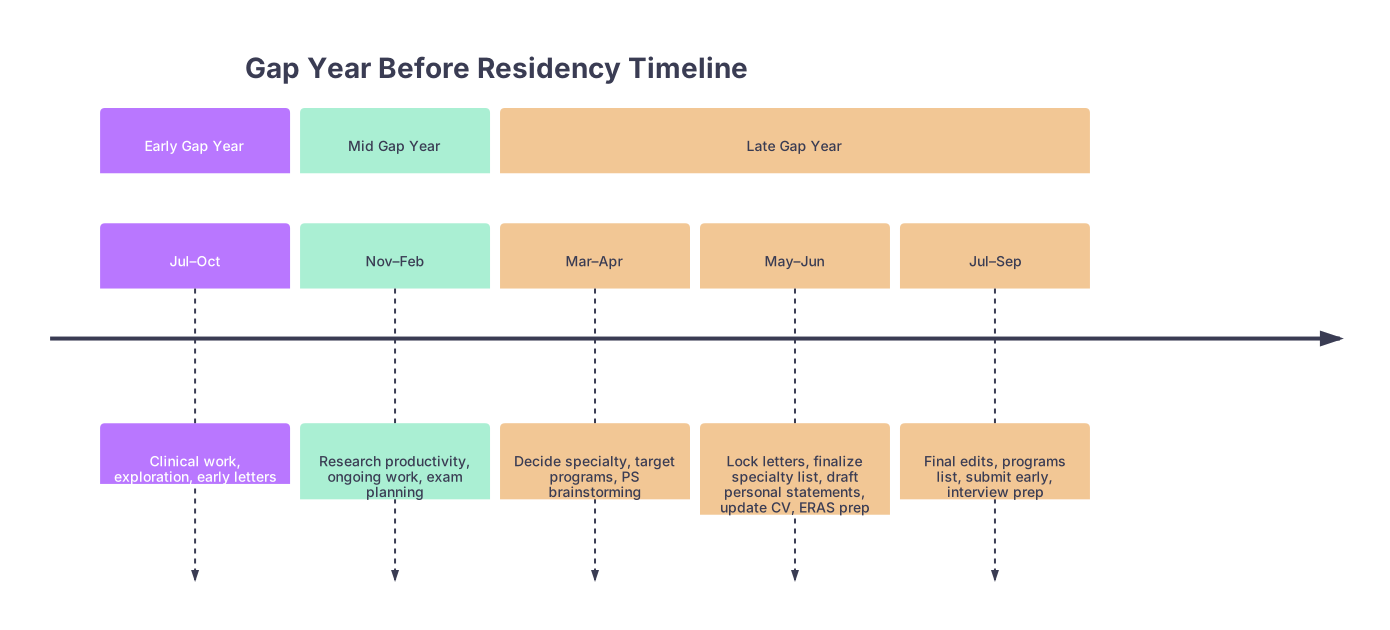
| Period | Event |
|---|---|
| Early Gap Year - Jul–Oct | Clinical work, exploration, early letters |
| Mid Gap Year - Nov–Feb | Research productivity, ongoing work, exam planning |
| Late Gap Year - Mar–Apr | Decide specialty, target programs, PS brainstorming |
| Late Gap Year - May–Jun | Lock letters, finalize specialty list, draft personal statements, update CV, ERAS prep |
| Late Gap Year - Jul–Sep | Final edits, programs list, submit early, interview prep |
By May–June, you should be transitioning from “building experiences” to “packaging and documenting them.”
By May 1: Your Non‑Negotiable Foundations
By the start of May, certain things should already be done or nearly done. If they are not, you make them your top priority. Everything else waits.
1. Specialty Decision Locked (or 95% Locked)
At this point you should:
- Know your primary specialty.
- Know if you are dual‑applying, and to what.
- Be able to defend your choice in 2–3 sentences without sounding confused.
If you are still “between IM, EM, and anesthesia,” that is a problem. I have seen applicants try to keep three specialties alive in May and end up with three weak applications in September.
By May 1:
- You must:
- Choose 1–2 specialties.
- Identify 2–3 “prototype” programs in each (your dream and realistic examples).
- You should have:
- Talked to at least 2 attendings or mentors in each potential specialty.
- Shadowed or worked enough to know the daily workflow is tolerable for you.
If you are truly stuck:
- Book a 30–45 minute meeting with:
- Your med school dean / career advisor.
- A trusted attending in each field.
- Go in with:
- Your objective profile: Step scores, clerkship grades, research, red flags.
- Your preferences: procedures vs clinic, lifestyle, academic vs community.
You walk out of those meetings with a decision. Waffling past mid‑May bleeds into everything else.
2. Core Letter Writers Identified and Confirmed
Letters of recommendation are currency. Weak, generic ones kill strong applications.
By May 1 you should:
- Know exactly who your 3–4 core letter writers are for each specialty.
- Have verbally confirmed with them that they:
- Will write you a strong letter.
- Can complete it by mid–July at the absolute latest.
Typical pattern:
- For Internal Medicine: 2 IM faculty (ideally from medicine sub‑I + inpatient rotation), 1 additional clinical letter.
- For Surgery: 2 surgical faculty (one from sub‑I), 1 additional surgical or ICU letter.
- For competitive fields (derm, ortho, ENT, etc.): often 3 specialty‑specific letters + maybe one medicine / general.
By this point you should have:
- Emailed or spoken with each writer.
- Provided:
- Updated CV.
- Brief personal statement draft or at least a written paragraph on “Why X specialty.”
- Bullet list of what you did with them (cases, projects, notable feedback).
If none of your attendings know you well enough to write a strong letter by May, that tells me your clinical engagement during med school or early gap year was too passive. You fix it now by:
- Reaching out to someone you impressed earlier.
- Asking to re‑engage in a small project / clinic session so they remember you.
- Following through hard for 4–6 weeks so they see your work ethic.
3. Step 2 CK / COMLEX Level 2 Status Under Control
By May 1, one of these should be true:
- You already have a Step 2 CK / Level 2 score that matches or improves your Step 1 profile.
- You have a scheduled test date no later than July and a realistic study plan.
If your Step 1 is weak or pass only and your Step 2 plan is “sometime late summer,” you are gambling with your application.
May 1–31: What Must Be Completed This Month
May is for building the spine of your application. Not polishing. Not prettying it up. Getting the major structures in place.
4. CV and ERAS Experience List Drafted (Not Perfect. Drafted.)
You will not remember small details in August. By end of May, your ERAS‑style CV should exist in a complete draft.
At this point you should:
- Have a master CV document that includes:
- All education entries.
- All jobs (scribe, MA, research assistant, hospitalist extender, etc.).
- All research roles and citations for abstracts/posters/papers.
- All leadership, teaching, and volunteer experiences.
- Dates, locations, approximate hours per week.
Then translate that into ERAS‑style entries:
- 10 meaningful experiences you might highlight.
- Concise descriptions with:
- What you did.
- What changed because you were there.
- Any outcomes (posters, protocols, new workflows).
Do not leave this to August. You will forget the concrete examples that make your entries credible:
- The new handoff template you designed.
- The QI project you pushed the intern to actually complete.
- The patient education sheet you created.
Write it now.
5. Personal Statement: First Real Draft Finished
Not an outline. Not bullet points. A full draft. By May 31 you should:
- Have a ~1 page specialty‑specific personal statement that:
- Answers: Why this specialty?
- Answers: Why you, and why now?
- Shows growth from med school to gap year.
If you are dual‑applying:
- You should have:
- A separate draft for each specialty.
- Not some generic “I love patient care and teamwork” copy/paste disaster.
At this point your draft can be rough. But it must exist. That allows:
- Attendings to glance at it when tailoring letters.
- You to refine, not to invent from scratch in August.
6. Gap Year Work and Research: Storyline Clarified
Your gap year is either a strength or a liability, depending on how coherently you present it.
By late May you should be able to answer cleanly:
- What did you do this year?
- How does it connect to your specialty choice?
- What did you learn that makes you a better intern on July 1 next year?
If you did:
- Research assistant work → You need:
- At least one abstract / manuscript submitted or clearly in progress.
- Your role clearly stated: data analysis, chart review, IRB, etc.
- Full‑time clinical job → You need:
- Clear documentation of your responsibilities and hours.
- 1–2 memorable patient or team stories you might use in PS or interviews.
You do not need 5 publications. You do need a coherent narrative: “I stepped away from med school to do X, which taught me Y, which is why I am ready for residency in Z.”
June 1–30: Convert Preparation into Application‑Ready Materials
By June, ERAS is opening. The scattered pieces you created in May now have to turn into a structured, polished, upload‑ready application.
7. ERAS Account, Tokens, and Housekeeping Done Week 1–2
By mid‑June:
- Your ERAS account should be created and fully functional.
- Your AAMC ID, NRMP ID, and any specialty match IDs (like SF Match) should be:
- Written down.
- Stored in your password manager.
- Matched correctly across all systems.
This is stupidly simple but I have watched people lose entire evenings chasing passwords, mis‑typed emails, or missing tokens.
Also by mid‑June:
- Upload an acceptable professional headshot (no blurry phones, no white coat crossed‑arms clichés in a hallway with terrible lighting).
- Update your contact info:
- Gap year physical address.
- Best phone number.
- Email that you will actually monitor daily from July–March.
8. Letters of Recommendation: Requests Fully Executed
In May you confirmed writers. In June you formalize.
By June 15, at this point you should:
- Have submitted ERAS letter requests to every writer.
- Sent each writer:
- Your CV.
- Personal statement draft.
- ERAS letter request with correct specialty designation.
- Deadline: “Ideal by July 1, absolute latest by July 15.”
You also:
- Decide which letters will be assigned to which specialty.
- For dual applicants:
- Avoid sending a “Dermatology is my life purpose” letter to an Internal Medicine program. Yes, I have seen this. It is as bad as you think.
| Item | Status by June 15 |
|---|---|
| Core writers identified | 3–4 per specialty |
| Verbal agreement obtained | Yes |
| ERAS requests sent | All core writers |
| Supporting documents sent | CV + PS + role summary |
| Deadlines communicated | Ideal July 1, latest July 15 |
If someone is slow to respond in June, you gently nudge once by email, once in person if possible. If they are non‑responsive by late June, you quietly recruit a backup.
9. Finalize Program Targeting Framework (Not Exact List Yet)
You do not need your exact program list in June. But you do need a framework: how many and what tier.
By late June you should:
- Have a realistic range of programs based on your competitiveness:
- Example for IM: 40–60 programs if average, 25–40 if strong, 60–80 if weaker.
- Know:
- Which geographic regions you are targeting (for family, partner, visa, etc.).
- 5–10 “must‑apply” programs per specialty.
- 5–10 “safety‑leaning” programs.
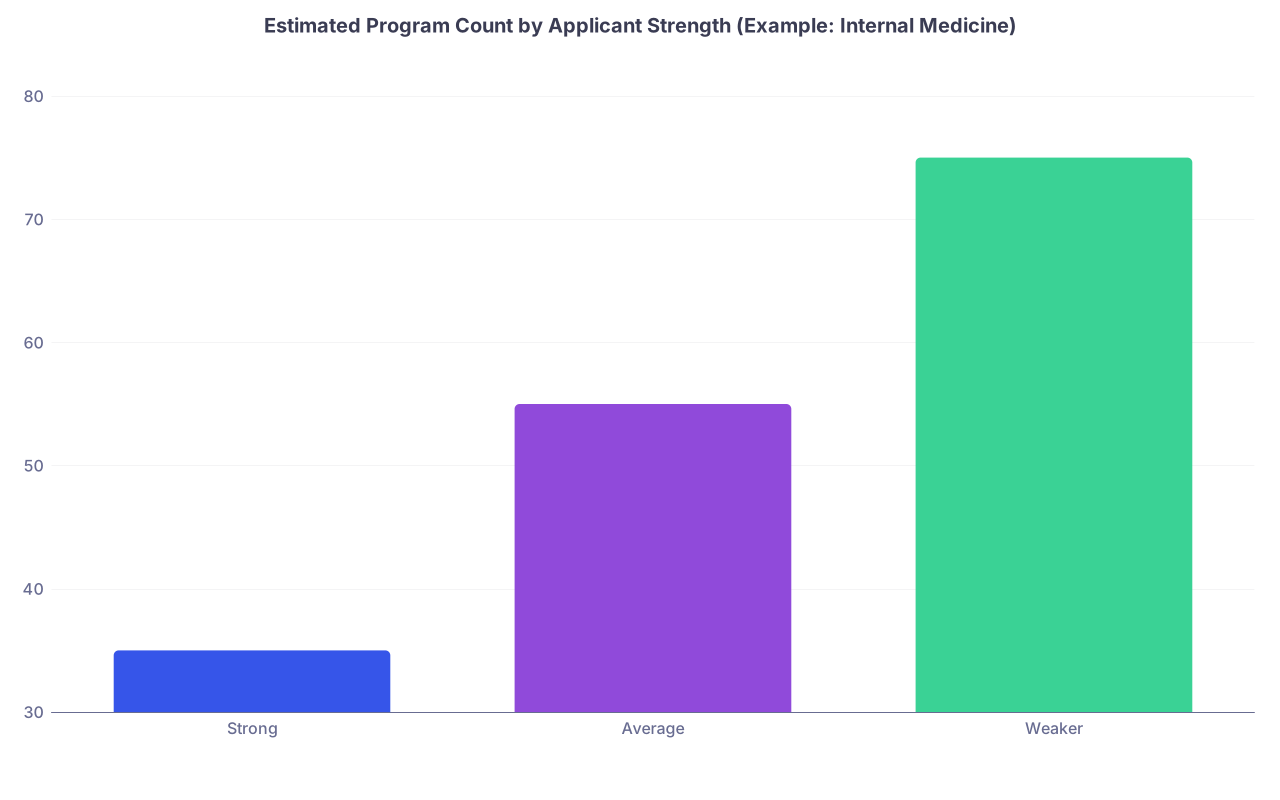
| Category | Value |
|---|---|
| Strong | 35 |
| Average | 55 |
| Weaker | 75 |
At this point you should:
- Have talked to a mentor or advisor who can say, bluntly:
- “You are competitive for university programs.”
- Or: “You need to anchor heavily in community‑based places.”
- Avoid magical thinking. If your Step 2 is 215 and you have no research, applying to 30 academic IM programs and 3 community hospitals is not bold, it is delusional.
June is also when:
- International grads should be confirming:
- Visa options (J‑1 vs H‑1B reality check).
- Which programs actually sponsor.
Week‑by‑Week Focus: Late May through June
Let me tighten this up into a practical schedule.
Last Two Weeks of May
Week 3 of May:
- Lock your specialty decision.
- Draft or update your CV with everything from this gap year.
- Brainstorm 10–15 ERAS experiences and rough bullet descriptions.
Week 4 of May:
- Write full first draft of personal statement for main specialty.
- If dual‑applying, at least outline the second specialty PS.
- Meet (in person or Zoom) with 1–2 mentors to:
- Review specialty decision.
- Confirm your competitiveness bracket.
First Two Weeks of June
Week 1 of June:
- Create ERAS account; check login, IDs, and basic settings.
- Upload a professional photo.
- Send formal LOR request emails (even if you asked verbally before).
- Start transferring experiences into ERAS format from your master CV.
Week 2 of June:
- Clean up PS draft #1 into PS draft #2 (something you are not embarrassed to show).
- Fill in all education and exam sections in ERAS.
- Block 30–60 minutes to check for typos, inconsistencies in dates, and mislabeling.
Last Two Weeks of June
Week 3 of June:
- Confirm that every letter writer:
- Received ERAS request.
- Has your supporting materials.
- Build your program targeting framework:
- Decide approximate total count.
- Identify regions.
- Make an early spreadsheet tab for each specialty.
Week 4 of June:
- Send first polite reminders to any slow LOR writers (if needed).
- Get at least one trusted reader to review:
- Your ERAS experiences for clarity.
- Your PS draft for coherence (not style perfection).
- Fix any lingering administrative issues:
- Name discrepancies across ERAS, NRMP, USMLE.
- Old email addresses still used in official accounts.
By June 30, your application should feel like a mostly assembled machine that needs tuning, not a pile of parts.
What You Should Stop Doing by May–June
This is just as important.
At this point you should seriously de‑prioritize:
- Starting brand new research projects that cannot produce anything concrete by August.
- Chasing random shadowing in a totally different specialty “just to make sure.”
- Picking up entirely new, unrelated commitments that will distract you from application building (extra job, heavy travel, etc.).
You are not trying to reinvent yourself now. You are trying to present yourself coherently.
How Your Application Should Look by June 30
If you want a simple snapshot, here is what a well‑positioned gap year applicant looks like by the end of June:
| Component | Status by June 30 |
|---|---|
| Specialty choice | 1–2 specialties, fully decided |
| Letters | All requested, writers equipped |
| Personal statement | Solid draft for each specialty |
| CV / ERAS experiences | Fully drafted, mostly entered |
| Exams | Step 2 score available or test booked by July |
| Program strategy | Target numbers & regions defined |
| ERAS admin | Account active, photo uploaded |
If you are missing more than one of these pieces, July and August will be a scramble. And programs can smell scramble.
Final Takeaways
By May–June of your gap year, you are no longer “preparing to apply.” You are building the actual application.
The three things that must be locked or nearly locked by the end of June:
- Your direction: specialty choice, exam plan, and a coherent gap year story.
- Your core materials: CV/ERAS experiences, personal statement drafts, and LOR commitments.
- Your infrastructure: ERAS account functional, photo uploaded, basic program strategy set.
If you handle those on time, July and August become about refinement and interview prep, not emergency construction. And that difference shows up directly in where you match.


