

You’re not required to bleed all over your application just because you took a year off.
Let me be blunt: programs care far less about the details of your personal crisis than they do about two things—are you stable now, and can you do the job? If you handle this the right way, a “personal reasons” gap year doesn’t have to hurt you at all. If you overshare, ramble, or get defensive, it will.
Here’s how to explain a personal gap year before residency—clearly, briefly, and professionally—without turning it into a therapy session.
The Core Rule: Brief, Bounded, and Forward-Looking
Your explanation needs to hit three beats:
- What happened (in one or two calm sentences, no gory detail)
- What you did constructively with that time
- Why you’re ready and reliable now
If you remember nothing else, remember this framework:
“I had a personal/family health situation that required my full attention from [time period]. During that time, I [productive thing: worked in X, did research, volunteered, completed coursework, etc.]. The situation is now stable/resolved, and I’m fully able to commit to residency.”
That’s it. You’re not on trial. You’re giving context.
What Programs Actually Worry About (And What They Don’t)
Most applicants wildly misjudge this.
Program directors are mainly asking:
- Is this a red flag for reliability?
- Is there an ongoing issue that will cause missed shifts or extended leave?
- Is this tied to professionalism or conduct?
- Has the applicant done anything remotely clinical/academic in the gap, or did they completely disengage?
They are not obsessing over:
- Why exactly your parent was sick
- The details of your breakup/divorce
- The specific diagnosis you had
- The intimate family drama that led to you moving home
I’ve sat in meetings where PDs skim the explanation, nod, say “ok, resolved,” and move on. The only time they dig in is when:
- The explanation is vague and there’s no clear evidence of stability now
- The applicant looks evasive or defensive
- The gap overlaps with failing exams, professionalism issues, or a sudden drop in performance
So your job is to make your explanation: clear enough, boring enough, and reassuring enough that they don’t feel the need to keep poking.
How to Phrase It on ERAS (Without Oversharing)
On ERAS, you might address the gap in:
- The Education/Experience timeline (with dates that show a gap)
- The “Additional Information” / “Experiences” / “Explain Gaps” area (depending on the year’s format)
- Your personal statement (briefly, and only if it’s central to your story)
Use neutral, professional language. A simple template:
“From August 2023 to June 2024, I took a leave from formal training due to a personal/family health matter that required my full-time attention. During this period, I remained engaged in medicine through [remote research, part-time clinical work, online coursework, QA projects, etc.]. The situation has since stabilized, and I am fully prepared to commit to the demands of residency.”
If the gap year was almost entirely caretaking or recovery and you didn’t have much bandwidth for clinical work, that’s still workable. You just need to be honest and then pivot:
“From July 2022 to June 2023, I stepped away from training due to a significant personal/family health situation. My primary focus during this period was managing that situation and supporting my family. As the circumstances improved, I gradually returned to academic engagement by [audit courses, exam prep, small research project, part-time work]. The situation is now stable, and I’m ready to return to full-time clinical responsibilities.”
You do not need to write:
- The diagnosis
- The family member’s identity if not necessary
- Therapy details
- Traumatic backstory
You’re stating category + impact + resolution. Not your life story.
What to Say in Interviews: Scripts That Work
This is where people either nail it or blow it.
Use something like this structure:
- One-line summary of what kind of issue
- A very brief description of how it affected your training
- One or two constructive things you did
- Clear assurance of current stability
Example 1 – Family health:
“During my fourth year, a close family member developed a serious health issue, and I became the primary support person. I took a year away from formal training to manage their care and our family logistics. During that time, I stayed engaged in medicine by working on a remote QI project with my home institution and continuing independent study. Their condition is now stable, other support systems are in place, and I’m fully able to commit to residency.”
Example 2 – Personal health:
“I developed a health issue that required treatment and a defined recovery period, which overlapped with my planned application cycle. My school and I agreed that pausing and rescheduling graduation was the safest choice. I used that time to recover fully and, as I improved, I added back structured activities like Step 2 preparation and a telehealth research project. My physicians have cleared me for full, unrestricted work, and I’ve been back to full-time clinical duties without limitations.”
Example 3 – Non-specific “personal reasons” (still OK):
“I had a significant personal situation that required my full attention for several months. Out of respect to others involved, I prefer to keep the specifics private, but I’m happy to talk about how I used that time and what I learned. I stayed engaged in medicine through [X, Y, Z], and the situation has been resolved in a way that allows me to fully commit to a residency program.”
If they push for more and it’s inappropriate? You can set a boundary:
“I’d prefer not to go into detailed personal/medical specifics out of respect for privacy, but what I can say is that it’s fully resolved/stable, and I have no anticipated limitations on my training or availability.”
That’s a fair, professional line. Good interviewers will back off.
How Much Detail Is Enough?
You’re aiming for “just enough to calm a reasonable PD.”
Too vague:
“I had some stuff going on and needed time off.”
Too detailed:
“My mother was diagnosed with Stage IV ovarian cancer in March 2023, she went through three lines of chemo, developed a PE, and I was the one taking her to every appointment…”
Right level:
“A close family member developed a serious health condition, and I became their main support. I stepped away from training for that period. Their condition is now stable, and I’ve transitioned those responsibilities to other family members.”
The test: Could a PD understand why there’s a gap, and feel reassured you’re functional now, in under 30 seconds? If yes, you’re at the right level.
What If the Gap Year Involved Mental Health?
This is where people get nervous. And frankly, for good reason. Bias still exists.
You don’t have to say “depression,” “anxiety,” “burnout,” or anything else explicit if you don’t want to. You can frame it more generally while staying honest:
“I experienced a health issue that required treatment and a period of reduced workload. With my advisors, I decided the most responsible choice was to pause training and focus on recovery. I engaged in structured care, and as I improved, I added back academic work and clinical experiences. I’m now fully recovered, cleared for full-time clinical work, and have systems in place to maintain my wellbeing.”
If you want to name it, keep it short and show it’s managed:
“In my final year, I struggled with depression and burnout. I worked with a psychiatrist and therapist, and my school and I agreed that stepping back temporarily was the safest option. Treatment was effective; I’ve been stable for over a year, maintained full-time clinical responsibilities, and I continue to follow with my providers to stay well.”
Key points:
- Emphasize recovery and stability, not suffering
- Mention support/monitoring systems very briefly
- Be ready to say you have no restrictions on duty hours, call, nights, etc., if that’s true
Make the Year Look Less Empty (Without Lying)
Gap year due to personal reasons doesn’t mean you did absolutely nothing else. Often, you did more than you think—you just haven’t named it.
Things that “count” as constructive on a gap year:
- Remote or part-time research
- QI/QA projects
- Telehealth scribing or MA work
- Online courses (public health, data science, language, etc.)
- Board exam preparation and retake
- Teaching/tutoring (MCAT, Step, anatomy, etc.)
- Volunteering in a consistent, ongoing capacity
- Administrative or coordination work related to health care
Don’t dress up pure caregiving as academic work—that backfires if probed—but do list legitimate activities:
“Primary caregiver for ill family member (unpaid)” is a valid Experience entry if that’s the reality.
Then add 1–3 small academic/clinical items, even if part-time. It signals you didn’t completely disconnect from medicine.

How Programs Compare Different Kinds of Gaps
They do compare. They just don’t always say it out loud.
Here’s roughly how various gaps are perceived, assuming everything is honestly disclosed and now stable:
| Gap Type | Initial Program Reaction |
|---|---|
| Structured research year | Neutral to positive |
| Personal/family health gap, clear and resolved | Neutral if stable |
| Mental health gap, well-framed | Neutral with mild caution |
| Unexplained gap with no activities | Negative, potential red flag |
| Gap + professionalism issues | Strong red flag |
Your goal is to move from “mysterious” to “understood and resolved.”
What Not To Do (Common Mistakes I Keep Seeing)
These are the patterns that quietly tank applications:
Oversharing trauma.
If your interviewer feels like they’ve accidentally walked into your therapy session, they’re not going to rank you higher for vulnerability. They’re going to worry about boundaries and emotional stability. Share themes, not graphic detail.Getting defensive or angry.
“Well, I had to do it, my school didn’t support me, it was unfair…” Even if all true, it makes you look volatile. Calm, factual, and forward-focused plays better.Blaming everyone else.
If the story is “everyone around me was terrible,” the quiet question is: what happens when you think our program is terrible?Sounding unsure you’re ready.
If you say things like, “I think I’m ready now… I hope,” that’s a problem. If you’re not sure, they’ll be less sure.Trying to hide the gap.
Missing dates, mismatched timelines, hoping no one notices—this is amateur hour. They notice. Always.
Quick Decision Guide: How Much Do I Say, and Where?
Here’s a simple way to decide:

| Step | Description |
|---|---|
| Step 1 | Gap year before residency |
| Step 2 | Explain as research/work year |
| Step 3 | Discuss with advisor and consider addressing in detail |
| Step 4 | Use brief, resolved explanation |
| Step 5 | One paragraph in ERAS |
| Step 6 | 2-4 sentences in interviews |
| Step 7 | Personal reason? |
| Step 8 | Ongoing impact on training? |
Rule of thumb:
- ERAS: One concise paragraph
- Personal statement: Only if it shaped your path or explains a major career pivot
- Interviews: 2–4 sentences, then pivot to what you learned and what you bring
How to Pivot Back to Your Strengths
You don’t want to sit in the gap-year topic for 10 minutes. Answer, then steer back to what you offer.
Example pivot:
“So that’s the background on the gap. I’m grateful things are stable now. During that period, I also developed stronger skills in [X—organization, communication with families, managing uncertainty], which I’ve found really helpful on the wards. For example…”
Or:
“That year reinforced for me that I want to train in a program with strong teamwork and communication. That’s actually one of the reasons I’m excited about your program—especially your emphasis on [teaching/QI/patient-centered care].”
You’ve acknowledged the past. Now you’re clearly facing forward.
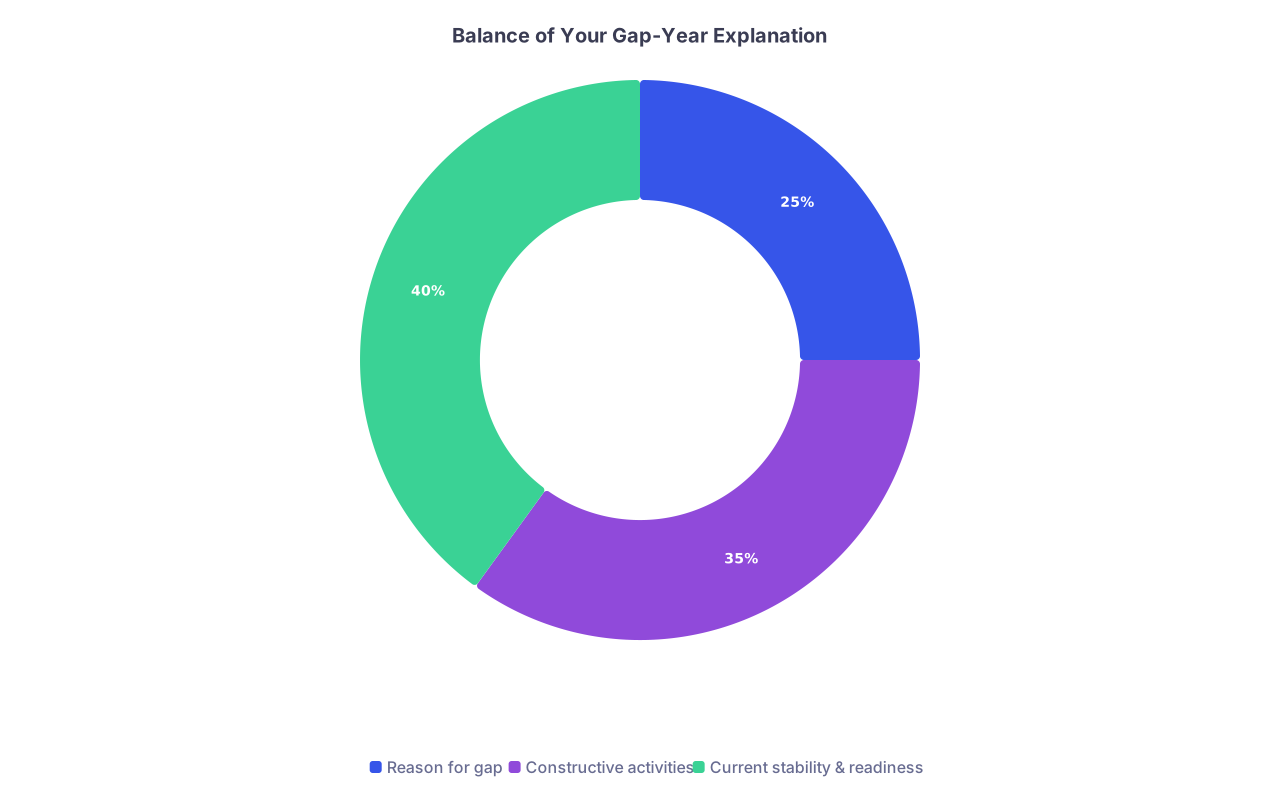
| Category | Value |
|---|---|
| Reason for gap | 25 |
| Constructive activities | 35 |
| Current stability & readiness | 40 |
Use roughly that balance: 20–30% on what happened, the rest on what you did and where you are now.
FAQ: Personal-Reason Gap Year Before Residency
1. Do I have to disclose mental health as the reason for my gap?
No. You can accurately describe it as a “health issue that required treatment and recovery time” without naming the diagnosis. What matters is that you convey you received appropriate care, you’re stable now, and you have no restrictions on clinical duties.
2. Will a personal/family gap year automatically hurt my chances?
Not automatically. A clearly explained, resolved gap year with some ongoing clinical/academic engagement is usually a neutral factor. It becomes negative when it’s unexplained, sounds ongoing/unstable, or is paired with other red flags like failed exams or professionalism issues.
3. Should I put caregiving as an official “Experience” on ERAS?
If caregiving was genuinely your primary role and time commitment, yes, you can list it. Be honest in describing it: “Primary caregiver for a family member with a serious illness” with bullet points like coordinating appointments, managing medications, advocating with medical teams. Then, if possible, also list at least one small clinical or academic activity from that period.
4. What if programs push for details I don’t want to share?
You’re allowed to set boundaries while still reassuring them. Say something like: “Out of respect for privacy, I’d rather not go into more specifics, but the situation is fully stable, and I don’t anticipate any limitations on my training or availability.” If they keep pushing inappropriately, that’s a red flag about them, not you.
5. Should I write about the gap in my personal statement?
Only if it genuinely shaped your path or perspective in a way that matters to your specialty choice or who you are as a clinician. If it’s mostly logistical (you had to step away, now you’re back), keep it to the ERAS gap explanation and interviews. Your personal statement is better used to show your motivation, growth, and fit, not to rehash the full story of the gap.
Bottom line:
You don’t owe your trauma to get a spot. Give a concise, honest category of reason, show you used the time as constructively as you reasonably could, and make it crystal clear you’re stable and ready now. That’s the explanation programs are actually looking for.


