

The instinct to list every gap year job on ERAS is wrong. You should be selective—and strategic.
If you used a gap year (or several) before residency, you’re not obligated to dump your entire employment history into ERAS like a generic CV. Program directors are skimming for signal, not counting how many W‑2s you had.
Let me be direct:
- No, you do not need to mention every gap year job on ERAS.
- You should include experiences that add to your story, explain a timeline, or show professionalism.
- You can safely omit random, short, or irrelevant jobs—if you’re not hiding major red flags.
Here’s how to think about it like a grown-up applicant, not a scared MS4 clicking every box.
The Core Rule: ERAS Is Not a Legal Deposition
ERAS is an application, not a background check. Programs don’t get a report of every job you’ve ever had and compare it to what you entered.
They care about three things:
- Who are you professionally?
- Can you handle the workload and responsibilities?
- Are there unexplained gaps or red flags?
So you build your experiences section to answer those three questions, not to archive your life.
You should almost always include:
- Substantial clinical work (scribe, MA, EMT, nurse, clinic assistant, clinical research coordinator).
- Research positions, especially anything with publications, posters, or serious responsibility.
- Teaching, leadership, or long-standing volunteer roles.
- Jobs that explain a large time block (e.g., “full-time job for 1 year”).
You can choose whether to include:
- Short-term, part-time, non-clinical work (barista, retail, rideshare, random temp work).
- Side gigs that didn’t shape your narrative or skills much.
You should think twice before omitting:
- A major full-time job that appears on your MSPE/Dean’s letter or comes up via a letter writer.
- Anything that directly fills a long period where you otherwise look “unemployed.”
When You Should Be Selective (And How)
Here’s the real strategy: you filter every job through two questions.
- Does this help programs understand why I’m ready for residency?
- Does this meaningfully explain what I was doing with my time?
If the answer to both is “not really,” it’s probably fine to leave it off or compress it.
Good candidates to include
These are often worth putting on ERAS, even from a gap year:
- Full-time clinical jobs: scribe, medical assistant, LPN/RN, ED tech, patient care tech, phlebotomist, medical interpreter.
- Full-time research roles: clinical research coordinator, research assistant with clear responsibilities, funded projects.
- Organized service roles: AmeriCorps, global health fellowships, structured post-bac programs, teaching fellowships.
- Jobs that demonstrate maturity and reliability: long-term consistent work that clearly reflects responsibility (e.g., managing a family business, full-time teaching, military service).
These are the backbone of your story—do not skip them.
Jobs you can usually skip or compress
- Very short gigs (a few weeks) that weren’t meaningful or relevant.
- Purely financial stopgaps: food delivery apps, random warehouse shifts for two months, seasonal retail.
- Unstructured, casual side work that doesn’t involve responsibility or growth.
You’re not lying by omission. You’re curating. Like everyone else.
The “Gap Year Timeline” Problem: What About Empty Months?
This is the anxiety point: you took 2 years off, worked several jobs, and now you worry programs will think you were just sitting on your couch if you don’t list every single one.
Here’s the reality: programs are scanning for gaps longer than about 3 months that look like “nothing happened.”
If your timeline looks like this:
- 06/2022 – 06/2023: Full-time research assistant
- 07/2023 – 03/2024: Scribe in ED
- 04/2024 – 09/2024: Various part-time jobs while applying
You do not need to list every part-time job in that last stretch. You can:
- Add one consolidated entry, e.g. “Various part-time employment while preparing for residency application,” OR
- Just leave that period unlisted if it overlaps with “Studying for Step 2,” family responsibilities, or other documented activities.
If instead you really did nothing formal for, say, 9 months, you should explain it—briefly. Not necessarily as a job, but as an activity:
- Dedicated Step 2 prep
- Family caregiving
- Health issue recovery (brief, no gory details)
- Independent research project or self-study
The point isn’t to impress. It’s to avoid blank space that raises questions.
How Programs Actually Look at This Stuff
Let me burst another myth. Program directors are not:
- Counting number of jobs as a “work ethic” metric.
- Cross-checking your ERAS with your tax returns.
- Mad that you didn’t list that you drove Uber for 4 months.
They are:
- Glancing at your experiences in maybe 60–90 seconds.
- Looking for clear signs you’ve functioned in healthcare settings.
- Checking for professionalism: did you stick with things, did you rise in responsibility, do your letters match your roles?
They’re also very used to gap years. Plenty of applicants have:
- 1–2 years as a clinical research coordinator then apply
- 1 year as a scribe while studying and doing part-time volunteering
- 2–3 years doing research + an MPH or other graduate work
No one cares that you also did Instacart at night to pay rent. Honestly, that’s normal.
Concrete Examples: What to List and What to Cut
Let’s make this very specific.
Example 1: Heavy clinical year with side gig
You did:
- Full-time ED scribe (12 months)
- Part-time DoorDash (evenings)
- Weekend barista job for 3 months at the beginning
On ERAS:
- List: ED scribe with solid description of responsibilities and any promotions/lead roles.
- Skip: DoorDash, barista.
- Result: Your year is clearly full-time and relevant. No one asks where the rest of your time went.
Example 2: Patchwork year after failing Step
You did:
- 4 months off to study and retake Step 2
- 5 months part-time retail
- 3 months part-time MA in a clinic
On ERAS:
- List:
- “Dedicated Board Exam Preparation” (4 months) – keep description minimal but honest.
- “Medical Assistant – Outpatient Clinic” (3 months, highlight skills, patient interaction).
- Optional: Retail job; can be left off if it was truly just income filler and not long or central.
If there’s a long block where the only thing is retail and it covers nearly a year, then you might briefly include it to avoid a huge unexplained gap and frame it as maintaining employment while preparing for residency.
Example 3: Two-year research + multiple small gigs
You did:
- 18 months as full-time clinical research coordinator
- 6-month break between contracts, where you:
- Tutored MCAT
- Helped in a family business
- Did intermittent rideshare
On ERAS:
- List: clinical research coordinator (this should be detailed).
- Consider: MCAT tutor as a separate Teaching experience if you did it consistently and it was structured.
- Skip: “helped in family business” and rideshare unless the time period is otherwise blank and huge.
You’re not trying to look constantly “busy.” You’re trying to look purposeful.
How to Write Less-Relevant Jobs If You Do Include Them
Sometimes you’ll decide to list a less glamorous job because it fills obvious time or shows important personal context (e.g., supporting family, first-generation, financial hardship).
In that case:
- Keep it short.
- Emphasize professionalism, reliability, and transferrable skills.
- Do not oversell. PDs can smell fluff.
Example:
“Retail Associate – BigBox Store (06/2021–11/2021)
Maintained reliable full-time employment while preparing for medical licensing exams. Developed customer service, time management, and team communication skills in a fast-paced environment.”
That’s enough. You don’t need five bullet points about how folding shirts made you a better future intern.
ERAS Sections You Should Prioritize Over Every Random Job
The actual high-yield parts of ERAS are:
- Education and exam scores
- Core clinical experiences
- Research, if relevant to your specialty or strong
- Leadership and meaningful volunteer work
- Letters of recommendation
- Your Personal Statement
That’s where you invest your effort.
If you’re spending more energy figuring out whether to list your 3-month pizza delivery job than polishing your personal statement or asking for strong letters, your priorities are off.
Tradeoffs and Red Flags: When Leaving Things Off Backfires
There are a few times where “being selective” crosses the line into “looks suspicious.” Avoid that.
Do not omit:
- Full-time “professional” positions that anyone might reasonably expect to appear (especially if letter writers, CVs, or MSPE mention them).
- A major hospital-based position if you’re claiming certain skills you could only have learned there.
- Experiences that explain academic gaps (e.g., leave of absence paired with work).
If your Dean’s letter says:
“The student took a leave of absence in 2020–2021 and worked full-time as a medical assistant in a primary care clinic,”
and you do NOT list that MA job anywhere, programs will notice. It feels like you’re hiding something.
In contrast, if your MSPE says nothing about your Uber driving, no one knows or cares that it’s missing.
Simple Decision Framework
If you want a quick filter, use this:

| Step | Description |
|---|---|
| Step 1 | Gap Year Job |
| Step 2 | Include with detail |
| Step 3 | Include briefly or skip |
| Step 4 | Consider brief entry |
| Step 5 | Usually skip |
| Step 6 | Full-time >=6 months? |
| Step 7 | Clinical/Research/Teaching? |
| Step 8 | Fills major gap >6 months? |
If you’re still stuck, default to:
- Include: long, full-time, clinical/research/teaching.
- Briefly include: long, non-clinical jobs that fill obvious time.
- Skip: short, random, clearly peripheral jobs.
Comparison: “List Everything” vs “Be Selective”
| Approach | Pros | Cons |
|---|---|---|
| List Everything | No fear of missing something | Cluttered, harder to see real story |
| Be Very Selective | Cleaner narrative, focused | Risk of unexplained long gaps |
| Balanced (Ideal) | Clear story + no big gaps | Requires a bit of judgment |
Quick Reality Check: What PDs Actually Value in Gap Years
For most specialties, what matters about your gap year is:
- Did you keep building clinically or academically?
- Did you show commitment to medicine (or to something serious)?
- Can someone vouch for you (letters from those jobs)?
- Does your timeline make sense without obvious, unexplained holes?
That’s it. They’re not grading you on how “Instagram-resume” your jobs look.
If your gap year was messy but honest—some research, some retail, some family obligations—you still present it cleanly:
- Highlight the medical/research/teaching core.
- Briefly explain long gaps with simple, honest descriptors.
- Skip the rest unless it truly adds value.
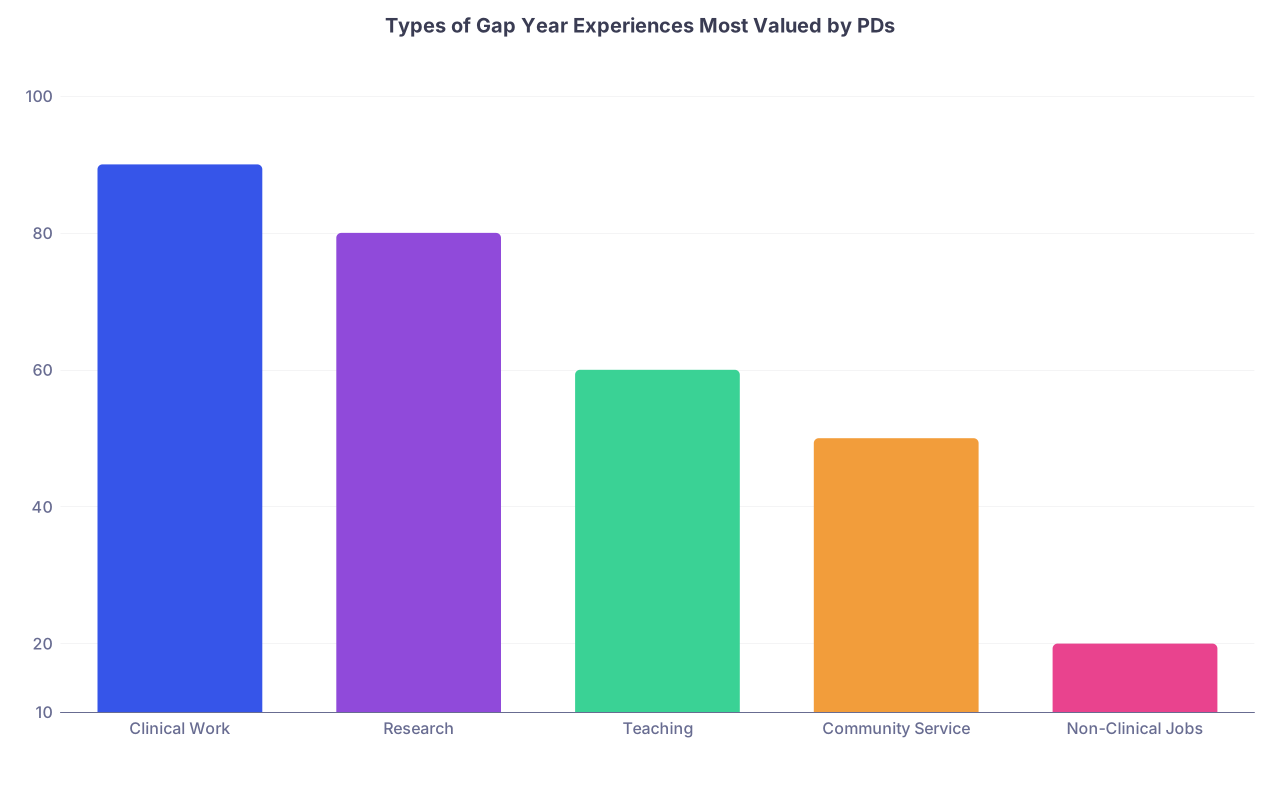
| Category | Value |
|---|---|
| Clinical Work | 90 |
| Research | 80 |
| Teaching | 60 |
| Community Service | 50 |
| Non-Clinical Jobs | 20 |
(Values here are conceptual, but the hierarchy is real: clinical > research > teaching > service > everything else.)
FAQ: Gap Year Jobs on ERAS
1. Do I have to list every job I held during my gap year on ERAS?
No. You should not feel obligated to list every single job. Focus on substantial, relevant, or time-explaining roles—especially clinical, research, teaching, or major full-time work. Small, short-term, or purely financial gigs can be omitted unless they’re the only thing covering a long stretch of time.
2. Will programs see it as dishonest if I don’t include certain jobs (like retail or rideshare)?
No. ERAS is not a legal declaration of every income source. It’s a curated account of professional and educational experiences. Programs are not expecting to see every retail, food service, or gig job you’ve held. They care about red flags, unexplained gaps, and whether your story makes sense—no one is cross-checking against your tax records.
3. How do I handle a long period where my only job was non-clinical?
If that non-clinical job covered many months (e.g., 9–12 months) and would otherwise look like an empty gap, list it—briefly. Emphasize reliability and what you were doing in parallel (e.g., supporting family while studying, preparing to re-enter the match). Do not try to dress it up as something it wasn’t; just show you were a functional adult with responsibilities.
4. Should I list “Studying for Step” or “Preparing for the Match” as an activity?
For a short period (2–3 months), usually not needed. For longer gaps (4+ months) where that’s genuinely what you were doing, it can be appropriate to add a simple, honest entry (e.g., “Dedicated Board Exam Preparation”). Keep descriptions very short, and don’t try to make it sound like a fellowship. The goal is to explain time, not impress anyone.
5. I worked multiple tiny jobs in the same period. Do I list them individually?
Usually no. You can either (a) list the main, most substantive one and let the rest go, or (b) add a single consolidated entry like “Various part-time employment while preparing for residency application” if you really feel the need to show you were working. Program directors prefer a clean, understandable application over a cluttered list of every 2‑month job.
Key takeaways: You do not need to mention every gap year job on ERAS. Prioritize meaningful, relevant, or time-explaining roles, and keep your narrative clean. Avoid obvious, unexplained long gaps, but stop worrying about listing every side gig you took to pay rent.


