

The idea that there’s one “right” choice between a paid clinical job and unpaid research for your gap year is wrong. The right choice depends on your specialty target, your current application gaps, and your bank account.
Let’s cut through the noise and make the decision like an adult, not like a Reddit thread.
The Short Answer: It Depends on 3 Things
Here’s the actual hierarchy that programs care about when they look at your gap year:
- Does what you’re doing fit your target specialty’s culture?
- Does it fix your biggest application weakness?
- Can you sustain it without wrecking your life or finances?
So:
If you’re going for a research-heavy, academic, or competitive specialty (derm, rad onc, ortho, neurosurg, plastics, ENT, some IM subspecialty tracks):
Unpaid or low-paid research often beats a random clinical job.If you’re going for a more clinically focused specialty (FM, psych, IM community programs, peds, EM in many places, OB/GYN at non-elite places):
A paid clinical job often beats aimless, low-quality research.If you have serious financial pressure or debt and no safety net:
A paid job > unpaid research, unless you’re truly all-in on a hyper-competitive academic path and can survive the year.
Let’s break it down properly.
Step 1: What Are You Actually Aiming For?
Before you pick a gap-year plan, you need to be honest about your lane.
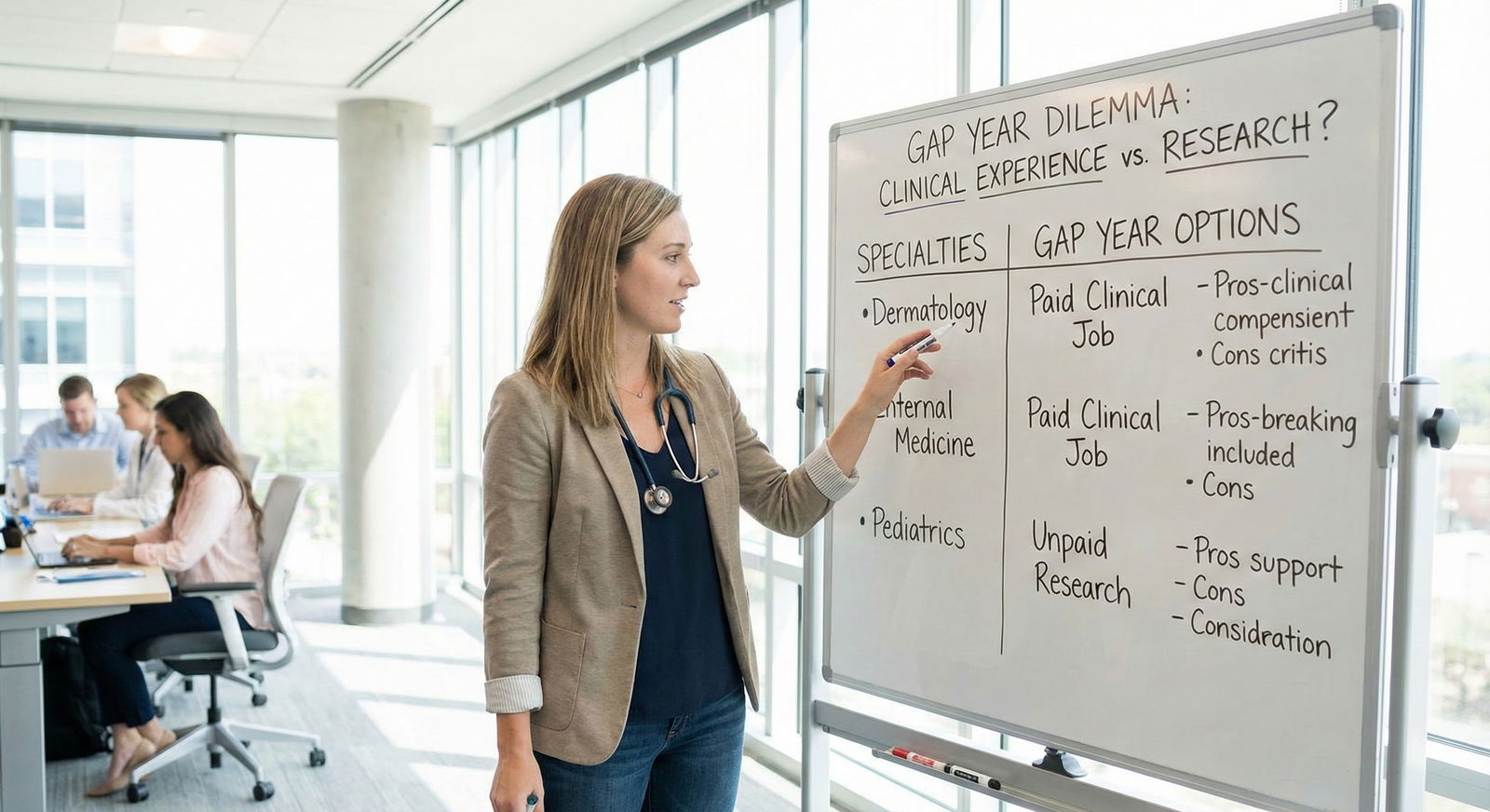
Research-Heavy / Competitive Fields
Think:
- Dermatology
- Plastic surgery
- Neurosurgery
- ENT
- Orthopedic surgery
- Radiation oncology
- Interventional and advanced subspecialty IM tracks at academic centers
For these:
- Serious research is basically currency. Multiple projects, strong mentors, ideally something that leads to posters or papers.
- A gap year where you’re a full-time research assistant in a productive lab, attached to big names, is often more valuable than working as an MA or scribe in a random clinic.
- These PDs care a lot about:
“Can this person eventually publish, get grants, and help our department’s academic profile?”
If this is your lane, and your finances allow it, an unpaid or low-paid full-time research position can absolutely be the better move.
Clinically Oriented or Less Research-Obsessed Fields
Think:
- Family medicine
- Internal medicine (community-heavy focus)
- Psychiatry
- Pediatrics
- Many OB/GYN and EM programs (outside top academic centers)
For these:
- Being a strong, reliable clinician who can function on the wards matters more than having 12 PubMed citations.
- A paid clinical job can be gold:
- Scribe in the ED or outpatient clinic
- MA or nurse assistant
- Clinical coordinator
- Hospitalist service research/QA hybrid roles
Program directors in these fields like seeing real-world patient care, professionalism, and strong letters from people who watch you day after day. A solid clinical job gives you that.
Step 2: What’s Your Biggest Application Weakness?
You don’t pick gap-year work in a vacuum. You pick it like a targeted intervention.
, Late Decision Specialty](https://cdn.residencyadvisor.com/images/articles_svg/chart-common-application-weaknesses-for-residency-applic-8477.svg "Common Application Weaknesses for Residency Applicants")
| Category | Value |
|---|---|
| Low Scores | 35 |
| Few Publications | 25 |
| Weak Clinical Exposure | 20 |
| [No Home Program](https://residencyadvisor.com/resources/gap-year-residency/should-i-stay-at-my-home-institution-or-go-elsewhere-for-a-gap-year) | 10 |
| Late Decision Specialty | 10 |
Ask yourself bluntly: if a program director rejected me right now, why?
Common answers and what actually helps:
Weak or No Research, Aiming for Academic/Competitive Programs
If your weakness is research and you’re going for derm/ortho/neuro/etc:
- Go for research, not clinical work.
- Best case: full-time at a major academic center, with an attending who publishes a lot and is known in your specialty.
- You want:
- Multiple ongoing projects
- A clear role (data collection, chart review, maybe basic bench work)
- A mentor who will write you a strong letter and introduce you around
A random MA job in urgent care isn’t fixing this weakness.
Weak Clinical Evaluations / Need Stronger Clinical Letters
If your evals were “fine” but not glowing, or you had little face time with attendings:
- Paid clinical work can be more useful:
- Scribe for someone respected in your target specialty
- Clinical coordinator on a hospitalist team
- MA in a specialty clinic where an attending will actually notice and mentor you
You want one or two people who can say:
“I worked with this person for 9–12 months. Shows up, owns tasks, learns fast, great with patients.”
That kind of letter hits hard for many programs.
Step/COMLEX Scores on the Lower Side
USMLE Step 1 is pass/fail, but Step 2 still matters. COMLEX too.
- Research doesn’t magically erase mediocre scores.
- What does help:
- A strong Step 2 (if you haven’t taken it yet)
- Evidence that you’re clinically solid: consistent work, solid letters, maybe leadership or teaching in a clinical setting.
In this scenario, a paid clinical role plus dedicated Step 2 prep is usually better than unpaid research where you’re exhausted and broke.
Step 3: Money: Don’t Romanticize Being Broke
People wildly underestimate the impact of financial stress on performance and mental health.
| Path | Money | Career Signal | Best For |
|---|---|---|---|
| Unpaid full-time research | $0–$5K | Strong in academic fields | Competitive/academic specialties |
| Low-paid research assistant | $25–$40K | Moderate–strong | Balanced academic + survive financially |
| Full-time clinical job | $35–$55K | Strong in clinical fields | Clinically oriented specialties, debt load |
| Random non-clinical job | $30–$50K | Weak unless explained | Emergency financial needs only |
If you:
- Have rent, loans, family obligations
- Don’t have savings
- Are relying on a credit card to eat
Then choosing unpaid research purely for “prestige” is a bad call unless you’re honestly locked onto derm/ortho/neuro with a strong base application already.
You will:
- Be more stressed
- Have less time and energy for Step 2, personal statements, and applications
- Risk burning out or needing to abandon the position mid-year
Program directors absolutely understand choosing a paid clinical job to stay afloat. What they don’t like is chaos: starting and quitting things, not following through, looking scattered.
Pros and Cons: Paid Clinical Job vs Unpaid Research
Let’s be concrete.
Paid Clinical Job – When It’s Better
Pros:
- You get actual money. That matters.
- Continuous exposure to patient care and systems.
- You can get strong longitudinal letters (“I’ve seen them with 500+ patients”).
- Looks good for clinical, service-oriented specialties and community programs.
- Often flexible enough to study for Step 2 or do small side projects.
Cons:
- If it’s totally unrelated to your target specialty or at a low-acuity urgent care mill, it may not impress top academic places.
- You won’t produce papers just by existing in a clinic.
- Some competitive specialties will see “no research” as a red flag.
Best if:
- You’re aiming for IM/FM/psych/peds/OB/EM, especially community programs.
- You need money.
- Your main weaknesses are clinical experience or letters.
Unpaid (or Low-Paid) Research – When It’s Better
Pros:
- Shows academic commitment, especially if you’re full-time with a busy lab or PI.
- Can generate posters, abstracts, and possibly publications.
- Excellent for building relationships in your target department.
- Very powerful in research-heavy specialties and top academic programs.
Cons:
- Money. Or lack of it.
- Quality varies wildly – a “research volunteer” who mostly enters data once a week doesn’t impress anyone.
- You can get trapped in endless low-yield work if your PI doesn’t prioritize your output.
- Clinical skills may stagnate if you do nothing patient-facing.
Best if:
- You’re targeting competitive, academic specialties.
- You already have decent clinical evals and scores.
- The lab/mentor is legit and productive, not just “some guy with a project.”
How to Decide: A Simple Flow
Here’s the decision tree I’d actually use.

| Step | Description |
|---|---|
| Step 1 | Graduating / Taking Gap Year |
| Step 2 | Prioritize full-time research |
| Step 3 | Choose paid clinical role |
| Step 4 | Balanced: research with some clinical |
| Step 5 | Consider part-time research + part-time work |
| Step 6 | Targeting competitive academic specialty? |
| Step 7 | Have strong research already? |
| Step 8 | Major financial pressure? |
| Step 9 | Need stronger clinical letters? |
| Step 10 | Main weakness = clinical exposure? |
Notice the pattern:
- Competitive + weak research → research wins
- Non-competitive + financial need or weak clinical → paid job wins
- If you’re in between, hybrid options can work (part-time research, part-time clinical, or paying RA positions).
What Programs Actually Want to See
PDs are not impressed by the label of the position alone. They care about what you did, what you learned, and who will vouch for you.
In a paid clinical job, they want to hear:
- You showed up reliably for a year.
- Nurses, MAs, and attendings liked working with you.
- You handled real responsibility: procedures (if allowed), patient education, documentation help, coordination.
- You’re not a nightmare to work with at 3 a.m.
In research, they want to see:
- Concrete output: at least posters/abstracts, ideally a paper or two.
- That you weren’t just a warm body: you understood methods, contributed ideas, presented something.
- A PI who actually knows you and can say, “They’re smart, disciplined, and will succeed in an academic environment.”
If your gap year ends with:
- One strong letter
- One clear story (“I spent a year doing X, here’s what I learned, and it confirmed my interest in Y”)
- Some tangible accomplishments (poster, paper, performance review, leadership)
You’ve used your year well.
Don’t Do This (Common Mistakes)
I’ve watched people sabotage their applications with well-intentioned but bad gap-year decisions. Top offenders:
Low-yield “research” that’s basically data entry once a week
On paper: looks like fluff. No productivity, no strong letter, no clear role.
Fix: if you’re doing research, go all in or don’t bother.Totally random non-clinical jobs with no story
Working at Starbucks can be fine if you needed the money and can explain it.
It’s a problem when you pretend it’s unrelated and never tie it back to resilience, communication, or professionalism.Switching positions every 2–3 months
Looks flaky. PDs love continuity. One solid-year commitment usually beats four short random gigs.Ignoring Step 2/COMLEX while doing a “fancy” research role
A glam research job doesn’t fix a tanked Step 2. If your test performance is a concern, you must protect time and energy for that exam.
How to Explain Your Choice in Interviews
Whatever you choose, you need a clean, confident narrative.
For a paid clinical job:
- “I took a gap year working full-time as a [scribe/MA/clinical coordinator] in [setting]. I wanted to deepen my clinical experience, see patient care from a different angle, and strengthen my communication and documentation skills. I worked closely with [specialty], which reinforced my interest in [X specialty], and my attending there wrote one of my letters.”
For unpaid research:
- “I spent a dedicated year as a full-time research assistant in [department] under Dr. [Name]. I was involved in [2–3 specific projects], presented at [meeting], and we have a manuscript under review. I took the year because I’m interested in an academic career in [specialty], and I wanted to build a real foundation in research methods and scholarship.”
Say it like that. Direct. Adult. No apologizing for needing money, no bragging about research without results.
FAQ (Exactly 5 Questions)
1. Will programs judge me for choosing a paid job over unpaid research?
Most won’t. Especially in clinically oriented specialties. If your work is relevant, sustained (6–12+ months), and you get a strong letter, they’ll see it as a mature, responsible choice. Just be honest about your financial reality and what you gained from the job. Where you may lose a bit is at very research-heavy academic programs in competitive fields—but even there, a clinically rich year is not a dealbreaker if the rest of your app is solid.
2. Is one year of research actually enough to matter for competitive specialties?
Yes, if it’s the right kind of year. Full-time, high-yield, with a productive mentor. I’ve seen applicants pull 2–4 abstracts and a paper out of a single intense year and match derm, ortho, or neurosurg. On the flip side, three years of half-committed, low-output “research experience” won’t move the needle. It’s not about calendar time, it’s about output and mentorship.
3. What if I want both clinical experience and research?
You can absolutely hybrid it, but don’t spread yourself so thin that nothing looks deep. Best setups: a paid RA position in a clinical research group (hospitalist, cards, EM) where you’re both patient-facing and doing projects; or full-time clinical work with a small, clearly defined research project on evenings/weekends with a motivated mentor. The key is still: clear role, continuity, and at least one tangible deliverable.
4. I already have several publications. Should I still prioritize research?
Probably not, unless you’re aiming for a very academic career (think physician-scientist track, PSTP, or hardcore academic neurology/IM/oncology) or your mentor has huge name recognition that will directly help you match. If you’ve checked the “research” box well—multiple pubs, meaningful contribution—then a year of strong clinical work, teaching, or leadership can actually round you out better than more of the same.
5. Does the prestige of the institution matter for my gap-year role?
It matters, but less than people think. A high-output research year at a mid-tier place with a productive PI who knows you well and gets you on abstracts/papers is better than a prestigious-name institution where you’re anonymous and do nothing significant. Same with clinical work: a glowing letter from a community hospital attending who actually watched you work beats a generic “they were fine” from a big-name academic center. Prestige helps if all else is equal—but it’s not the main thing.
Key takeaways:
- Choose paid clinical work if you need money, want stronger clinical letters, or are aiming for clinically focused specialties.
- Choose serious, full-time research if you’re targeting competitive academic fields and research is your clear weakness.
- Whatever you do, make it sustained, substantive, and letter-worthy—one strong, coherent story beats a resume full of fluff every time.


