

The blunt truth: Yes, you can combine Step studying and full‑time work in a single gap year — but most people either do it badly or underestimate the cost.
Let me be more specific:
You can do it. You probably should not do it blindly.
I’ve watched residents, prelims, and re-applicants try every combination: 1.0 FTE hospital job plus Step 2/3, 0.6–0.8 FTE plus intense dedicated, full unemployment plus hardcore studying, and the “I’ll just squeeze questions in after clinic” fantasy. Some versions work. Some destroy applications.
Let’s lay out how to decide where you fall.
The Core Question: What Is Your Risk Tolerance?
Before any schedule, hours, or resources, answer this:
If your Step score next year is only “okay” instead of “strong,” are you willing to accept the hit to your match chances?
If:
- You’re changing specialties
- You’re IMGs/FMGS trying for the US
- You’ve failed or barely passed a previous Step
- You’re applying to a competitive field (Derm, Ortho, ENT, Rad Onc, etc.)
…then no, you probably should not rely on a full-time job + casual studying. Your margin for error is thin.
If:
- You already passed Step 1 and 2 with solid scores or strong “Pass” profiles
- You’re taking Step 3 mainly as a checkbox
- You’re targeting less competitive specialties or have strong other metrics
…then yes, full-time work + structured, disciplined studying can absolutely work.
So the real question isn’t “Can I combine them?” It’s “Can I afford a non-optimal Step performance?”
What Full-Time + Step Actually Looks Like (Not the Instagram Version)
Here’s the unfiltered version of what I’ve seen from people who successfully combined a full-time job with Step prep:
- 40–45 hrs/week work. Not 65. Not nights + rotating + weekends.
- Consistent schedule. Same or similar hours each week.
- 2–3 hours of focused study on most weekdays.
- 6–8 hours per day on one weekend day, light or off on the other.
- 4–6 months of this, minimum, for Step 2 CK if you aren’t already very strong.
That’s the realistic, sustainable version.
The fantasy version usually sounds like this:
“I’ll just do 100 questions after work every day and grind on weekends.”
Those people are typically burned out by week 3 and averaging 40% correct.
If your job is intense (surgery tech, inpatient nurse with constant overtime, high-output scribe in a busy ED, rotating shifts), treat that as a second cognitive tax. You’ll have less brainpower left at 8 PM than a 9–5 clinic coordinator.
Decide First: Step 1? Step 2? Step 3? And Why?
“Gap year” before residency usually means one of three situations:
- You already graduated med school, taking a year before applying/re‑applying.
- You’re an IMG/FMG trying to complete Step exams and strengthen your CV.
- You matched prelim/TY and are retooling for a categorical spot.
Each exam has a different risk/benefit with full-time work.
| Exam | Typical Priority | Full-Time Work Compatible? | Risk if Underperform |
|---|---|---|---|
| Step 1 | Foundation | Sometimes | High |
| Step 2 | Most critical | Often, if structured | Very High |
| Step 3 | Checkbox for many | Yes, in most cases | Moderate |
If your gap year is before first Match and Step 2 is pending, that exam is effectively your entire academic argument. A “meh” Step 2 in that setting hurts.
For Step 3, I’ve seen plenty of residents and prelims knock it out while working 60–70 hours. It’s harder, but the bar is different; programs care that you pass, not that you crush it (unless you’re aiming for a very competitive fellowship and a weak clinical record).
Three Models That Actually Work (And Who They’re For)
Let me walk through three setups I’ve seen succeed, and who should consider each.
Model 1: True Full-Time (40 hrs) + Step – The High Discipline Route
Best for:
- People with strong Step 1/2 foundations already
- Those working predictable, daytime jobs (research assistant, MA in outpatient clinic, office-based roles)
- Those aiming for non-ultra-competitive specialties
Basic structure:
- Weekdays: 2–3 hours of deep study after work or early morning
Example: 6–8 AM or 7–10 PM - Saturday: 6–8 hours focused (mixed blocks + review + weak topics)
- Sunday: 3–5 hours or full rest day every other week
Average:
- 18–24 effective study hours per week
What makes it work:
- Ruthless scheduling: exact hours blocked in calendar
- Qbank-first mindset (not endless passive reading)
- Non-negotiable sleep (you are not outsmarting physiology)
Who should avoid this:
- Anyone who needs a 20+ point score jump over their baseline
- Anyone with previous Step failure
- Anyone with chronic health issues or mental health struggles currently unstable
Model 2: 0.5–0.8 FTE + Aggressive Study – The Smart Compromise
This is the sweet spot for most gap year candidates if they can afford it.
Best for:
- Re-applicants trying to seriously improve Step performance
- People switching into more competitive specialties and needing a standout score
- IMGs/FMGS needing stronger Step evidence
Setup:
- Work 2–4 days/week, fixed schedule
- On workdays: 1–2 hours of light work (anki/passive review, short q-sets)
- On off days: 6–8 hour high-yield study blocks
Average:
- 25–40 solid study hours/week
Financially:
- Enough income to live modestly, but you’re not stacking savings.
- You’re trading some money for higher match odds. That’s usually a wise trade.
This model also protects your mental health. You still have structure, coworkers, patient contact, but enough bandwidth for real cognitive effort.
Model 3: Front-Loaded or Back-Loaded Dedicated Time – The Hybrid
If you must work full-time, this is the most realistic “I want a strong score” plan.
Two main versions:
- Work full-time first 6–8 months → then 2–3 months full dedicated
- 1–2 months of early dedicated study → then full-time work while polishing / maintaining
Example for Step 2 CK:
- Months 1–6: 40 hrs work + 15–20 hrs/wk lighter study (foundations, first pass of Qbank)
- Months 7–9: reduce hours (or quit) → 40–50 hrs/wk hardcore dedicated
This spreads out the grind and gives you true high-yield time near the exam. It’s also easier to explain in interviews: “I worked full-time for X months, then took Y months as dedicated time to focus fully on Step and my application.”
The Non-Negotiables If You Combine Work and Step
You can bend some parts of your schedule. These pieces you really cannot.
1. Protect Sleep Like a Drug
You are not special. You do not function well on 4–5 hours of sleep plus full-time clinical work plus UWorld. It shows up in:
- Sloppy reading of questions
- Missing easy details
- Emotional overreactions to NBME/UWSA drops
- Getting sick more often and losing entire weeks
Build your schedule backwards from 7–8 hours of sleep. If you cannot fit both work and studying around that without going insane, your plan is bad.
2. Commit to a Qbank-Centered Plan
For Step 2/3, your backbone is:
- UWorld (or Amboss as supplement)
- NBMEs / UWSAs or CCS cases (for Step 3)
Your week should revolve around:
- Timed, random blocks
- Careful review of explanations
- Spaced repetition of missed concepts
Reading entire textbooks after work? That’s how you spend effort without moving your score much.
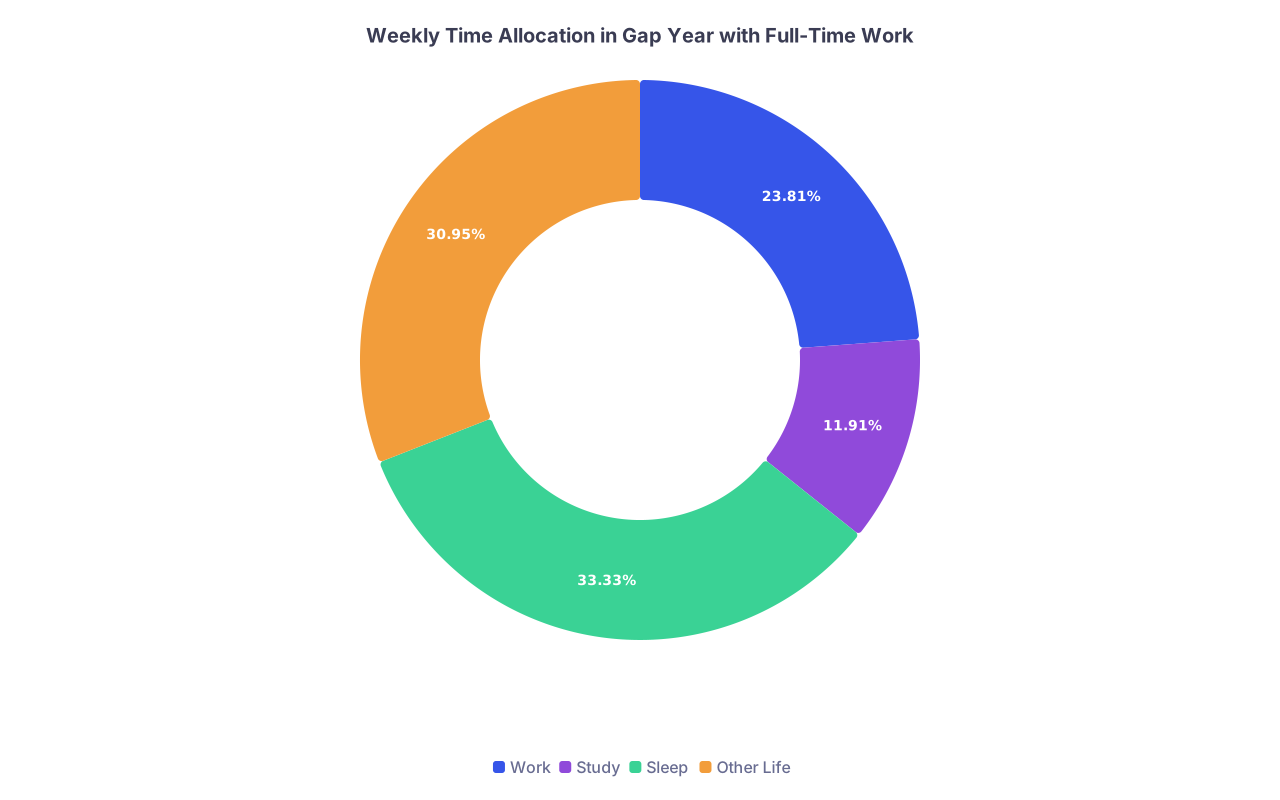
| Category | Value |
|---|---|
| Work | 40 |
| Study | 20 |
| Sleep | 56 |
| Other Life | 52 |
3. Plan Your Exam Date Around the Match, Not Just Your Life
For residency applications:
- Step 2 CK should be done with score reported before programs seriously review apps (usually by early October).
- Step 3 is often best completed before residency or in your first light rotation year 1 if your program approves.
If you’re doing a gap year specifically to fix your academic record, there’s almost no reason to push your Step 2 CK into late fall/winter of application year. Early score = more interview invites.
Red Flags: When Your Plan Is Not Working
Most people wait too long to reassess. Here are early signs your full-time + studying combo is failing:
- After 4–6 weeks, your Qbank percentages are flat or dropping and you aren’t burnt out from the questions but from life.
- You’re regularly skipping planned study blocks more than 2–3x/week.
- You dread both work and studying every day, not just occasionally.
- NBME/UWSA practice scores are stuck well below your target range.
This is when you don’t “try harder.” You change variables:
- Cut work hours or switch to a less draining role.
- Move exam date earlier or later strategically.
- Carve out a true 4–6 week dedicated block, even if it’s unpaid.
What About How This Looks to Programs?
Programs are honestly less obsessed with whether you worked full-time or “just studied” in your gap year and more obsessed with:
- Did your Step 2/3 result help or hurt your file?
- Did you demonstrate continuity in medicine (research, clinical, teaching)?
- Can you explain your choices clearly and maturely?
You can spin any of these credibly:
- “I worked full-time as a clinical research coordinator, studied evenings, and took Step 2 in September. I learned X, Y, Z from balancing both.”
- “I reduced my hours for the second half of the year to focus on Step 2 because I knew a strong score would be central to my re-application.”
- “I used the first half of the year for full-time research and then took three months of dedicated Step studying to maximize my performance.”
What does not sound good:
- “I was kind of working, kind of studying, did not really plan the timing, my score was lower than expected, and I’m not sure what I’d change.”
Have a story that sounds intentional, even if you had to pivot mid-year.
Simple Decision Framework: Should You Work Full-Time and Study in One Gap Year?
Use this blunt checklist.
If you answer “yes” to ALL of these, full-time + Step is reasonable:
- My prior exam performance is at least average or better.
- I can get a job with predictable hours and no chronic overtime.
- I can reliably carve out 15–25 hours/week for studying without collapsing.
- I don’t need a massive score jump to be competitive for my target field/location.
If you answer “no” to ANY of these, strongly consider:
- Cutting to 0.5–0.8 FTE, or
- Planning a 1–3 month fully dedicated block.

| Step | Description |
|---|---|
| Step 1 | Planning Gap Year |
| Step 2 | Reduce to 0.5–0.8 FTE or Dedicated Block |
| Step 3 | Full-Time + Structured Study Plan |
| Step 4 | Need Big Score Boost? |
| Step 5 | Predictable 40 hr Job Available? |
| Step 6 | 15–25 Study Hrs/Wk Realistic? |
How to Structure a Typical Week (Example)
For someone working 40 hrs/week, aiming for Step 2 CK in 6–7 months:
Monday–Thursday
- 7:00–8:00 AM: 10–15 UWorld questions + fast review
- Work day
- 7:30–9:30 PM: 1 timed 20–25 question block + deeper review
Friday
- Light review only (anki, notes, reviewing weak topics) or complete rest
Saturday
- 9:00–12:00: Two timed blocks + review
- 1:00–4:00: Content review/notes based on missed questions
Sunday
- 3–4 hours max; or alternate between full rest and light study weeks.
Adjust based on your baseline and endurance. But notice something:
There is no “I’ll get to it later” in that plan. Every hour has a job.
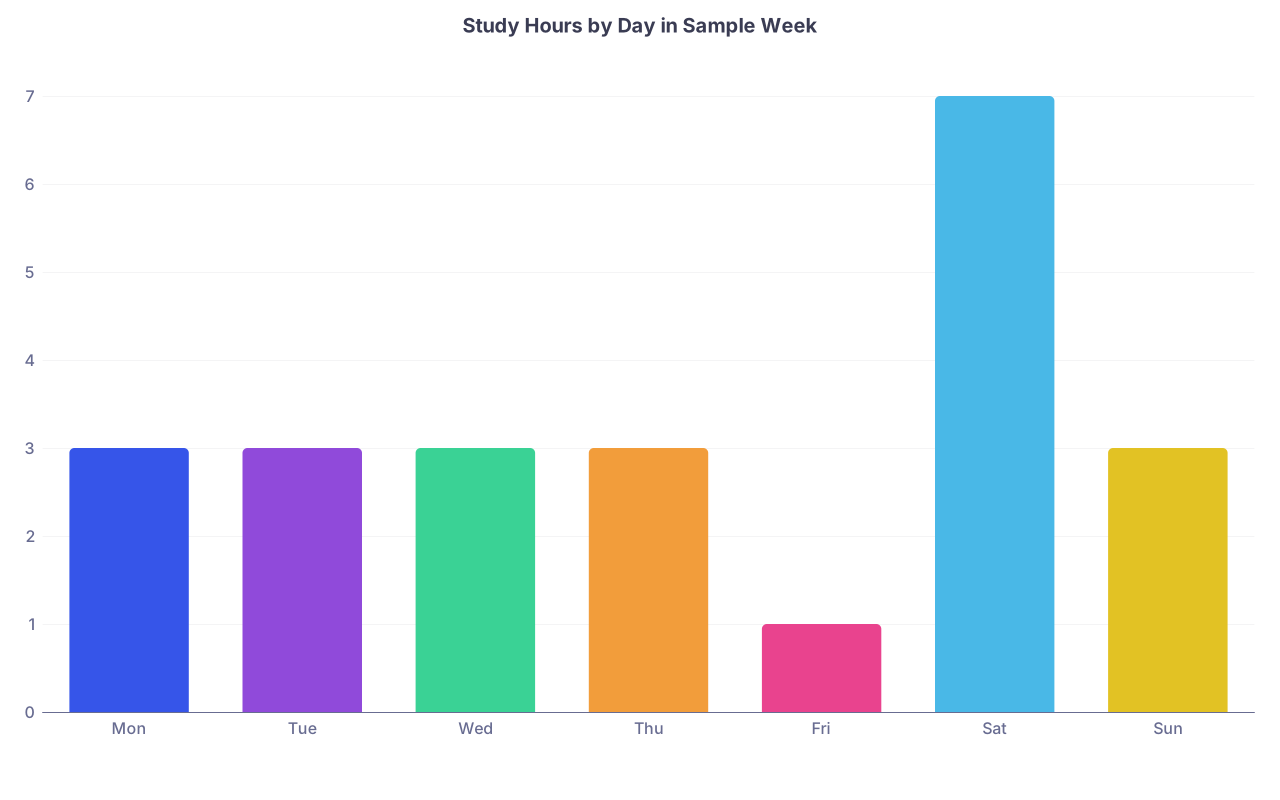
| Category | Value |
|---|---|
| Mon | 3 |
| Tue | 3 |
| Wed | 3 |
| Thu | 3 |
| Fri | 1 |
| Sat | 7 |
| Sun | 3 |
Bottom Line
You can combine Step studying and full-time work in a single gap year. Many people do. The ones who succeed are:
- Honest about their baseline and competitiveness
- Strategic with hours (often not truly 1.0 FTE or at least predictable)
- Aggressive about protecting sleep and energy
- Qbank-centered and time-efficient
- Willing to pivot and reduce work if scores are not moving
The ones who fail are usually trying to prove something to themselves: that they can “handle it all.” Residency will test that enough. Use this gap year to be smart, not macho.
FAQ (Exactly 6 Questions)
1. Will programs judge me harshly if I don’t work full-time and mainly study for Step during my gap year?
No. Not if your outcome justifies it. If your record shows a prior weakness (low Step 1, failures, or inconsistent performance) and you used a gap year to focus on Step 2 and came back with a strong score, most PDs will view that as maturity and course correction. Where it looks bad is if you took a year “just to study,” still performed poorly, and did not engage in any clinical or academic activity at all. At minimum, pair intensive study with some low-volume clinical volunteering, research, or teaching so your story isn’t “I disappeared from medicine for a year.”
2. How many months of dedicated Step study do I need if I work full-time the rest of the year?
For Step 2 CK, 4–6 weeks of true dedicated time (40+ hours/week) after a few months of part-time prep is usually sufficient for most candidates who aren’t starting from zero. For Step 3, 2–4 weeks is often enough if you’re fresh out of clinical work or residency. If your baseline is weak or you need a large score jump, push toward the higher end: 8 weeks of near-full dedication isn’t crazy. Dedication does not have to be fancy—consistent, high-yield hours with UWorld and NBMEs/UWSAs beat drawn-out, half-focused months.
3. Is night shift work compatible with Step studying during a gap year?
Technically yes; practically, it’s brutal. Rotating nights destroy sleep cycles and crush cognitive performance. If you must work nights, build your schedule so you have stable blocks (e.g., 3–4 weeks nights, 3–4 weeks days) and study on your “off” half with extra sleep. Do not expect to work four 12‑hour night shifts and also do high-quality Step blocks on “work days.” It rarely happens beyond week one. If nights are your only option, strongly consider lowering FTE or delaying the exam to protect your performance.
4. How do I know if my full-time job is too demanding to combine with Step studying?
Simple litmus test: After a normal workday, can you honestly give two focused, reasonably calm hours to studying at least four days per week? For four consecutive weeks? If the answer is no—because of emotional exhaustion, constant overtime, or shift unpredictability—your job is not compatible with high-quality Step prep at 1.0 FTE. Patterns like frequent “mandatory overtime,” rotating call, or heavy emotional burden (e.g., constant codes or traumas) are red flags that your willpower will not offset.
5. What if my practice exams are low but I’m already working full-time and my test date is near?
You have three levers: move the date, cut hours, or drastically change how you’re studying. Do not just hope your real score will be magically higher than your NBMEs or UWSAs; it almost never is. If you’re >10–15 points below your target within 4–6 weeks of the test, strongly consider postponing and, if possible, dropping to 0.6–0.8 FTE for a short dedicated block. Also audit your process: Are you doing timed, random blocks? Are you reviewing wrong and right answers in detail? Are you sleeping enough? Surface-level question grinding without analysis is the usual culprit.
6. What’s one concrete Step resource plan if I’m working full-time this gap year?
For Step 2 CK while working 40 hours/week: pick UWorld as your primary Qbank, choose either OnlineMedEd/Boards & Beyond or a short, targeted text (like Step Up/AMBOSS articles) for patching weak content, and add NBMEs/UWSAs every 3–4 weeks once you’re ~40–50% through UWorld. Aim to finish UWorld at least once with full review. Use Anki or your own flashcards solely for high-yield misses, not every trivial fact. If you can afford it, reserve the final 4–6 weeks pre-exam to reduce work hours and shift into near-dedicated. That combination is simple, realistic, and proven.
Open your calendar right now and block off one sample week with actual hours for work, study, sleep, and rest. If it doesn’t fit on paper, it won’t work in real life—fix the plan before you bet your Step score on it.


