

The match screener does not care that you took a gap year. They care whether it looks like you disappeared.
Here’s the answer you’re looking for: a gap year before residency does not need to be glamorous, prestigious, or packed. But it does need clear structure, continuity with your story, and receipts.
If you hit those three, you’re fine. If you don’t, it starts to look aimless.
The Minimum Structure Your Gap Year Needs
Think of “minimum viable structure” for a gap year as three pillars:
- A primary role or anchor activity
- A consistent weekly rhythm
- A narrative you can explain in 30 seconds
If you can define those three, your gap year will not look aimless on ERAS or in interviews.
1. You need one clear “headline” role
Programs want to see a main thing that you were doing. That’s it. Not five half-baked side hustles.
Your headline role should sound like a job title or a serious commitment. Examples:
- Clinical research coordinator in cardiology
- Full-time scribe in ED
- Transitional year intern (off-cycle)
- Full-time caregiver for ill parent + part-time clinic volunteer
- MPH student (1-year program)
- Full-time quality improvement fellow at X hospital
- Chief research assistant in neurology lab
This is the role that appears first in your “Experience” section, the thing you put in your personal statement timeline, and the default answer when someone asks, “What did you do during your gap year?”
If your current plan sounds like this: “A bit of moonlighting, some research if I can find it, and studying for Step 3” — that reads chaotic. Turn it into one anchor:
- “Clinical moonlighting physician assistant (0.8 FTE) at X clinic”
with research and Step 3 clearly labeled as secondary activities.
Do not rely on “studying for boards” as your primary role. That’s not enough for a full year.
2. You need a credible weekly structure
You don’t have to be working 80 hours a week. But if you can’t roughly map your week on paper, programs will assume you had giant blocks of unaccounted time.
A solid guideline:
- 30–40 hours/week of primary activity
- 5–10 hours/week of secondary activities (research, volunteering, teaching, board prep)
- At least one activity with face-to-face accountability (clinic, lab, class, office, recurring meeting)
Here’s what that looks like concretely for different types of gap years:
| Gap Year Type | Primary Hours | Secondary Hours | Looks Structured? |
|---|---|---|---|
| Full-time scribe + 1 clinic volunteer shift | 36 | 6 | Yes |
| Research coordinator + Step 3 prep | 32 | 8 | Yes |
| Only PRN shifts, no set schedule | 8–16 | 0 | No |
| Full-time caregiver + remote QI project | 30–40 | 4 | Yes |
| “Figuring things out” + casual shadowing | ? | 2–3 | No |
If your current plan is light on hours, fine. Then it needs more definition:
- Exact days you’re in clinic/lab/office
- A standing weekly meeting or supervision
- Clear milestones (manuscript, poster, certificate, exam date)
Programs don’t need your calendar. But when they hear you talk, they should feel like you had a professional life, not an extended vacation.
The Three Things Programs Actually Look For in a Gap Year
Let me be blunt: most residency PDs don’t have time to psychoanalyze your gap year. They look for three simple signals:
- You stayed clinically or academically connected
- Someone can vouch for you recently
- Your story makes sense
1. Stay connected to medicine somehow
Here’s the bare minimum: at least one ongoing medical or medically-adjacent activity.
That can be:
- Direct patient care (scribing, MA, RN, PA, moonlighting if licensed, clinic assistant)
- Clinical research with patient interaction
- Hospital quality improvement or operations work
- Public health with a clear clinical relevance to your target specialty
- Formal study (MPH, MS, certificate program) tied to your future field
What doesn’t look good as your only activity for the entire year?
- Purely non-medical retail/office work with no explanation
- “Travel and personal growth” for 12 months, nothing else
- “Helping with family business” without any medical or academic thread
Can you have non-medical work? Yes. But pair it with at least one credible medical/academic thread, ideally >6 months long.
2. Fresh letters from your gap year
A big reason unfocused gap years hurt you: no recent people to vouch for you.
Bare minimum: By the end of the gap year, you should be able to get at least one solid letter from:
- A PI, research mentor, or project supervisor
- A clinic/hospital attending
- A program director or lead from your formal role
If your primary gap-year activity can’t produce a letter, that’s a problem. Fix it now. That might mean:
- Switching to a research role where you’re actually supervised
- Getting on a QI project under a named faculty member
- Taking on more responsibility in clinic so someone really observes you
3. A clean, simple narrative
If your explanation of the gap year takes five minutes and three backstories, it sounds aimless.
Your story should fit into this structure:
- Why you took the gap year
- What you did in a structured way
- How it makes you a better candidate right now
For example:
“I took a gap year after not matching last cycle. I knew I needed stronger U.S. clinical experience and letters in internal medicine. I worked full-time as a clinical research coordinator in a cardiology group, where I also did 1–2 days a week of hands-on clinic work and pre-charting. I’ve now got recent, strong IM letters, more systems experience, and a much clearer sense of where I fit in the field.”
That sounds purposeful, not lost.
How Much Is “Enough” for Different Scenarios?
The bar is different depending on why you’re taking a gap year.
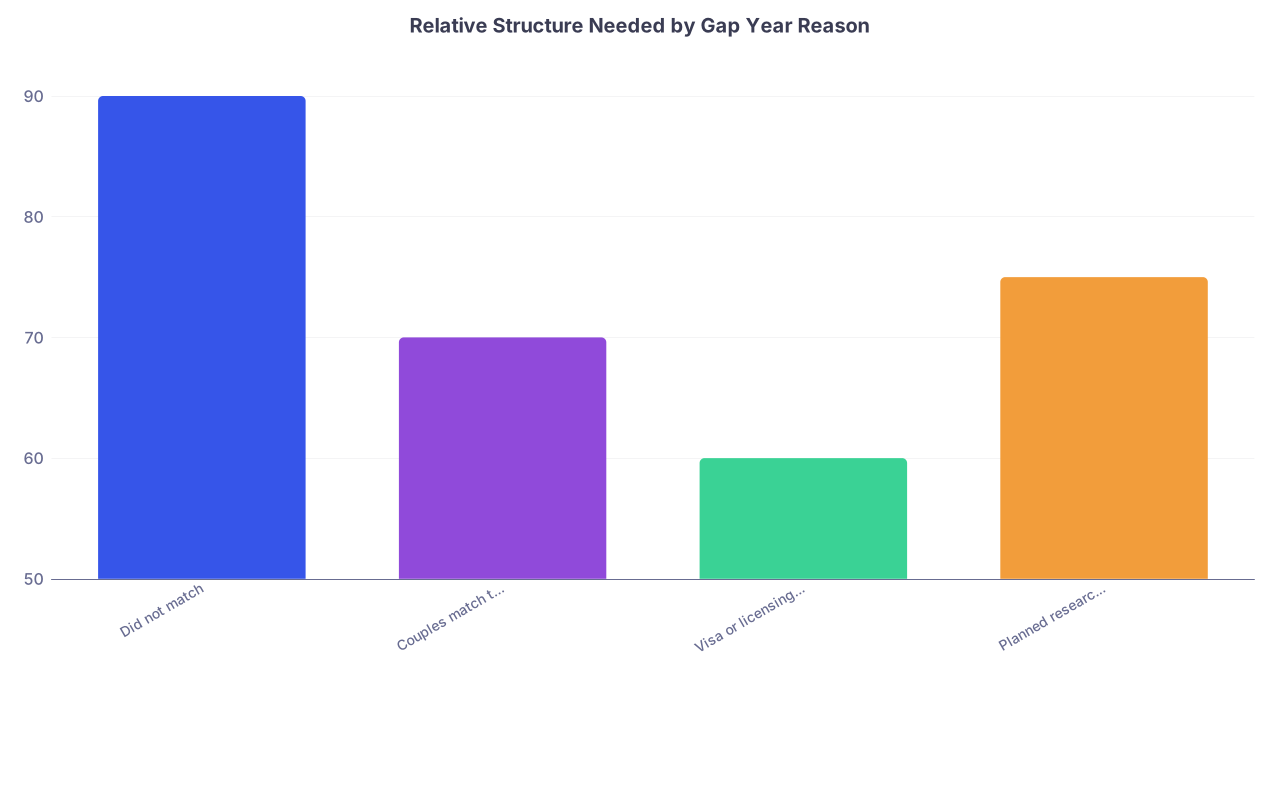
| Category | Value |
|---|---|
| Did not match | 90 |
| Couples match timing | 70 |
| Visa or licensing delay | 60 |
| Planned research year | 75 |
Treat those numbers as “how carefully you need to structure and explain things” on a 100-point scale.
Scenario A: Didn’t match or reapplying
Your gap year is under a microscope. Minimum structure here:
- A full-time primary role (≥32–40 hours/week) with clear clinical or academic value
- At least 1–2 concrete outputs: poster, paper, QI project, better letters, improved exam score
- Evidence you addressed known weaknesses (e.g., more USCE, stronger specialty-specific experience)
Anything less than that and it looks like you didn’t really fix the problem.
Scenario B: You matched, but gap before residency start
Example: delayed start date, program deferral, visa delays.
For you, the bar is a bit lower, but not zero. Minimum structure:
- At least a part-time medical role (research, scribe, telemedicine, clinical assistant)
- Some form of skill maintenance: online CME, Step 3 prep, simulation lab, teaching
You can get away with 20–30 hours/week of structured activity, as long as you can clearly say: “I stayed clinically engaged and will hit the ground running.”
Scenario C: Planned research or degree year
You’re doing a research fellowship or MPH, formal, recognized. Great. Still needs structure.
Absolute minimum:
- Named program, defined supervisor, expected outputs
- At least one publication/poster or clear project milestone by application time
- If no patient contact, pair it with some clinical exposure (clinic ½ day/week, call shifts, shadowing with responsibilities)
Simple Framework: Does Your Gap Year Look Aimless?
Here’s a quick, honest self-test.

| Step | Description |
|---|---|
| Step 1 | Describe gap year in 1 sentence |
| Step 2 | You need a primary anchor job/role |
| Step 3 | Increase hours or add second structured role |
| Step 4 | Add clinical/academic activity weekly |
| Step 5 | Increase responsibility/face time with supervisor |
| Step 6 | Your gap year is structured enough |
| Step 7 | Can you name one main role? |
| Step 8 | Is it 20+ hrs/week for 6+ months? |
| Step 9 | Is there at least 1 clinical/academic thread? |
| Step 10 | Can you get a letter from this year? |
If at any step you land on C, E, G, or I — your gap year still looks under-structured.
Concrete Examples: Bad vs Good Gap Year Plans
Let me make this very concrete.
Example 1: Vague plan
“I’m going to move home, help with the family business, maybe do some shadowing at my old hospital, and study for Step 3.”
How this reads: unfocused, no clear role, no guaranteed letter, weak clinical continuity.
Minimum fix:
“I’ll work 30 hours/week as a medical assistant in the family medicine clinic that’s part of our local hospital system, and 10 hours/week helping with administrative tasks for the family business. I’ll also prep for Step 3 with a target test date in March and am joining a QI project in the clinic on diabetes management, supervised by Dr. X, who has agreed to mentor me.”
Now you have:
- A real medical role with hours
- A supervisor
- A project
- A timeline
Example 2: Research “on the side”
“I’ll pick up some research if I can find it while doing per-diem shifts.”
That’s code for: nothing is actually secured.
Minimum structure:
- Lock in a defined research role with named mentor and expected hours
- Decide whether per-diem shifts are primary or secondary
- Get written confirmation from someone who can later write you a letter
“I’m a 0.6 FTE research assistant on the ICU outcomes team at X hospital, meeting weekly with Dr. Y. I also work 0.2–0.3 FTE doing per-diem night shifts at an urgent care to keep my clinical skills active.”
Now it sounds like a life, not a drift.
Documentation: Proving Your Year Wasn’t Aimless
Intentions don’t show up on ERAS. Outcomes and structure do.
Minimum documentation you should aim to have by the time you apply:
- At least one new letter explicitly referencing your gap-year work
- Updated CV with clear dates, locations, hours (or FTE) for each role
- 1–3 concrete bullets of output from the year:
- Presented at [Conference], poster on [Topic]
- Contributed to [Study], manuscript submitted/accepted
- Led QI project that [measurable change]
- Taught [course/workshop], X sessions

Even if your work is “in progress,” as long as the structure is clear and your supervisor can back it up, you’re fine.
How to Talk About Your Gap Year in Interviews
You’ll be asked some version of: “Tell me about your gap year” or “What did you do between graduating and now?”
Here’s a simple template that keeps you out of trouble:
One-line reason:
“I took a gap year because…” (reapplying, research opportunity, family health, visa, etc.)Two to three structured activities:
“During that year, my main role was… I also…”One or two outcomes:
“From that, I gained… / I completed… / I improved…”Tie-in to residency:
“This will help me in residency by…”
Example:
“I took a gap year after not matching to strengthen my U.S. internal medicine experience and improve my application. I worked full-time as a clinical research coordinator on the heart failure team at University Hospital, where I spent about half my time in clinic with patients and half on data and manuscripts. I also studied for and passed Step 3. That year gave me stronger, more recent letters in internal medicine and a better understanding of how multidisciplinary teams manage complex patients, which I think will make my transition to residency smoother.”
Clear. Structured. Intentional.
Quick Checklist: Does Your Gap Year Clear the Bar?
You’re probably looking for a simple bottom line. Here it is.
Your gap year is structured enough if you can answer “yes” to all of these:
- Do you have ONE primary role you can state in a single phrase?
- Is that role ≥20–30 hours/week for at least 6 months?
- Is at least one activity clearly medical or academic?
- Can you probably get at least one strong letter from this year?
- Can you explain why you took the gap year and what you gained in under 30 seconds?
- Do you have at least 1–3 tangible outcomes (project, exam, publication, QI, teaching)?
If you’re missing more than one of those, you are in the danger zone of “aimless.”
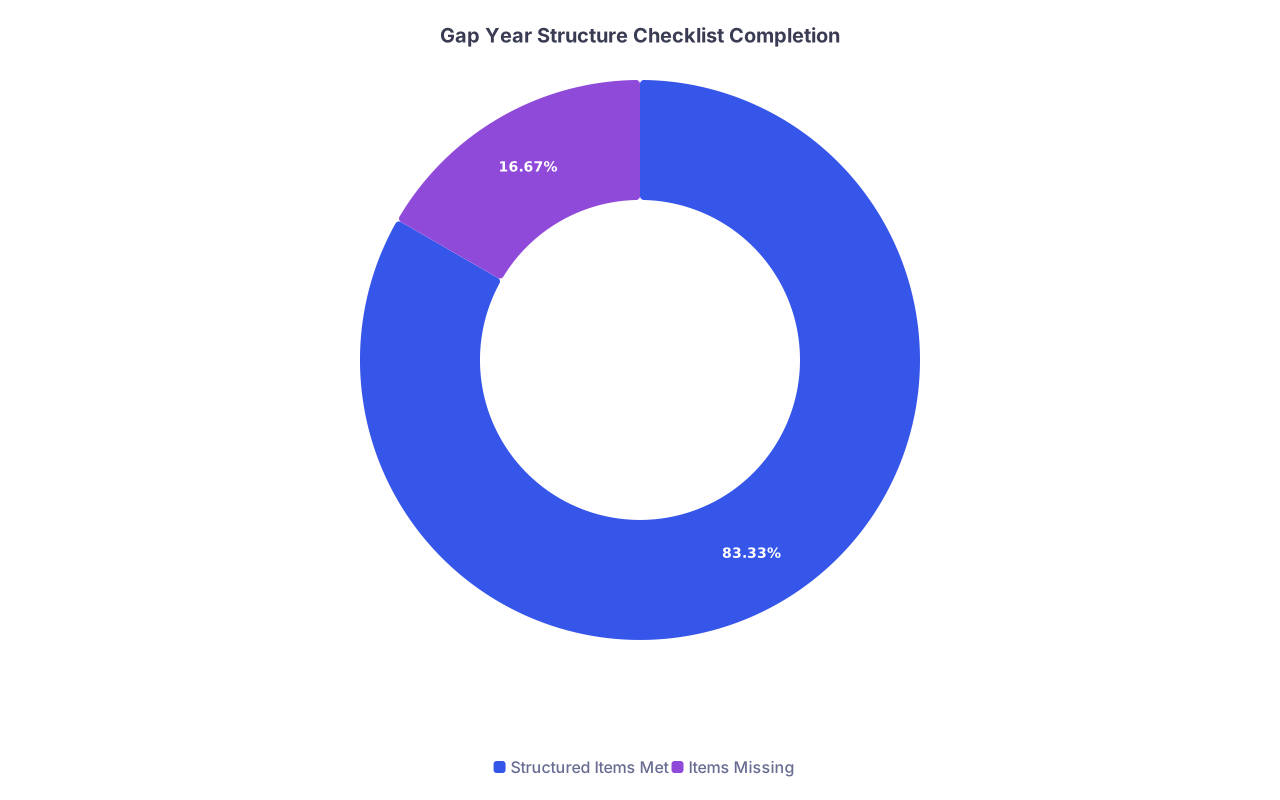
| Category | Value |
|---|---|
| Structured Items Met | 5 |
| Items Missing | 1 |
(You want your real-life ratio closer to 6:0.)

FAQ (Exactly 6 Questions)
1. Is one year off before residency “too long”?
No. A single gap year is extremely common and rarely a problem if it’s structured. The real red flag is multiple unstructured years with no clear clinical or academic anchor. One focused year with a clear role, letter, and outcomes is entirely acceptable.
2. Can my primary gap-year job be non-clinical (e.g., tech, finance, family business)?
It can, but then you must intentionally build in at least one ongoing medical/academic activity so your file does not look like you walked away from medicine. That might be a part-time clinic role, a research position, volunteering in a free clinic with real responsibilities, or a structured teaching/tutoring role related to medicine.
3. Is “full-time research” enough, or do I also need clinical work?
Full-time research is enough if it’s legitimate: named PI, regular meetings, clear responsibilities, and ideally some form of patient or team interaction. If your research is purely behind-the-scenes data work, I’d add at least a half-day per week of clinical exposure to keep your hands in patient care, especially for very clinical fields like EM, IM, FM, or surgery.
4. Does Step 3 studying count as a structured gap-year activity?
Studying for Step 3 is a good secondary activity and looks fine if you actually take and pass the exam in that window. It does not look good as your primary activity for 6–12 months. Programs expect you to be doing something in the real world, not just living inside question banks.
5. How big a deal is it if I don’t get a letter from my gap year?
That’s a problem, especially if you’ve been out of formal training for >12 months. Programs want evidence of your current professionalism, reliability, and clinical skills. If your primary gap-year activity can’t produce a letter, that suggests either it was too casual or you didn’t take on enough responsibility. Fix that now by increasing your involvement or switching into a role with closer supervision.
6. I already started an unstructured gap year. Is it too late to fix it?
No, but stop drifting. Lock in a primary role with clear hours for the remaining months, ideally in a clinical or research setting. Tell your supervisor up front you’d like to work closely enough to earn a letter. Add one concrete project or milestone (poster, QI initiative, defined clinic responsibility). You can frame the early part of the year as “transition and planning,” but you need the later part to be visibly structured.
Key points:
- Your gap year needs one clear primary role, a consistent weekly rhythm, and at least one fresh letter.
- Keep a visible medical or academic thread running the whole time, even if you work outside medicine.
- If you can explain your year in 30 seconds as purposeful, structured, and productive, you’re on solid ground.


