

What do you do when you’ve already gone through SOAP once, failed to land a spot, and now you’re staring at another Match cycle: do you jump back into SOAP or step out and take a gap year?
Let me be direct: if you just went unmatched or partially matched, you do not have a “do everything” option. You have to pick a strategy. Either:
- You commit to SOAP as your primary plan and accept the limitations that come with it, or
- You step back for a structured gap year to repair your application, then come back to the Match with a clearly stronger profile.
The right choice depends on your numbers, your specialty, your flexibility, and how much you’re actually willing to change.
This article will walk you through that decision like an attending walking an intern through a complicated dispo. Step by step, with clear cutoffs, no sugarcoating.
Step 1: Be Honest About Why You Didn’t Match
Before talking SOAP vs gap year, you need a real autopsy of your application. Not vibes. Data.
Here’s what I look at when I review unmatched applicants:
- USMLE/COMLEX scores (or pass/fail plus Step 2 CK)
- Number and type of programs applied to
- Specialty choice(s)
- Red flags (failed exams, leaves, professionalism issues, large time gaps)
- Clinical performance and letters
- Visa status
- Graduate year (fresh grad vs >3 years from graduation)
- Geographic constraints
You need to answer these questions honestly:
- Were you realistically competitive on paper for the specialty you chose?
- Did you apply broadly enough and early enough?
- Did your letters and experiences actually show commitment to that field?
- Do you have any clear red flags: failures, gaps, poor evaluations, professionalism issues?
If your answer to #1 and #3 is “no,” or you have big red flags, SOAP alone probably will not fix this. That’s where a structured gap year starts to make sense.
Step 2: Understand What SOAP Can and Cannot Do
SOAP is not a second, equal Match. It’s more like a high-speed scramble for limited chairs when the music stops. Here’s the reality:
- You cannot assume your desired specialty will have SOAP positions. Many won’t.
- You must be flexible on specialty and geography, or your chances are tiny.
- You have very little time to rewrite or meaningfully reframe your application.
- Programs are under pressure to fill quickly. They’re risk-averse.
Who actually does well in SOAP?
- Candidates with no major red flags who were borderline for their preferred specialty
- Applicants willing to pivot to less competitive or prelim positions
- People who already have strong clinical letters and clear evidence of being a safe, workable intern
Who struggles badly in SOAP?
- Applicants with failed Steps, weak or generic letters, or professionalism issues
- Those insisting on the same competitive specialty that already rejected them
- Older graduates or long time since graduation
- International grads without US clinical experience who are inflexible on location
If your profile fits the “struggles badly” bucket and you already tried SOAP once (or more) with no success, repeating the process without major changes is wishful thinking. That’s where a gap year isn’t a luxury; it’s mandatory.
Step 3: When You Should Seriously Consider a Gap Year Instead of SOAP
Let’s cut through it. You should strongly consider a dedicated gap year (or structured year) if any of these are true:
You’ve already gone through SOAP once and did not receive any offers.
You’re trying to break into a competitive field (derm, ortho, ENT, ophtho, plastics, rad onc, neurosurg) with:
- No home program
- No specialty-specific research
- No strong letters from known faculty in that field
You have objective red flags:
- Step 1 or Step 2 CK failures or repeated attempts
- Very low Step 2 CK (for US grads, <220 is where some doors close hard; for IMGs, often even higher bars)
- Unexplained clinical gaps or extended leaves
You’re >3 years from graduation with minimal or no recent US clinical experience
You’re not willing to pivot to less competitive specialties in SOAP (FM, IM, psych, peds, prelim medicine/surgery, transitional year, etc.)
You’re aiming for visas and only want university programs in big cities
If these describe you and you still try SOAP again without changing anything, you’re basically hoping for luck, not building strategy.
A gap year is not “doing nothing.” A good gap year is an intense rehab program for your application.
Step 4: What a Strong Gap Year Actually Looks Like
If you take a gap year and spend it “thinking” and working a non-clinical random job, you basically just get older and less competitive. So if you take time, do it right.
You want your gap year to answer four questions for programs:
- Are you clinically ready and safe?
- Do you show commitment and consistency to a realistic specialty?
- Did you fix or mitigate prior weaknesses?
- Will you show up and work hard without drama?
Common high-yield gap year activities:
- Full-time research in your target or backup specialty
- Paid clinical work with real responsibility (hospitalist scribe? clinical research coordinator? APP team scribe? MA in clinic if possible)
- US clinical experience for IMGs (observerships, externships, pre-residency fellowships)
- Additional degrees or certificates only if tightly linked to your target field (e.g., MPH with outcomes research for IM/PM&R, not a random degree just to stay busy)
- Dedicated USMLE/COMLEX remediation and high Step 2 CK if Step 1 was weak or failed
Your goal is that, next application season, your new CV and letters give programs a different impression than the one they had this year.
Step 5: SOAP vs Gap Year – Side-by-Side
| Factor | SOAP This Cycle | Structured Gap Year |
|---|---|---|
| Timeline to residency | Earliest start (July) | Delayed by 1+ year |
| Specialty flexibility | Must be very flexible | Can reposition more strategically |
| Ability to fix weaknesses now | Very limited | High, if planned well |
| Risk of another no-match | High if same profile | Lower if you actually improve |
| Financial situation | Start earning sooner if matched | Potential 1 year of lower or no income |
| Control over outcome | Low–moderate | Moderate–high if you do real work |
If you’re financially desperate and willing to take almost anything (including prelim or a very different specialty), SOAP may be reasonable—even if your profile isn’t great.
If you care a lot about specialty fit and long‑term career satisfaction, and you have clear weaknesses, a gap year is usually the smarter play.
Step 6: Specialty-Specific Reality Check
Some specialties are SOAP-graveyards. You’ll rarely see open slots in:
- Dermatology
- Plastic surgery
- Neurosurgery
- ENT
- Ophthalmology
- Radiology (in many years)
- Radiation oncology
Moderately competitive specialties sometimes have scattered SOAP spots but you cannot rely on them:
- EM (this has changed with recent EM dynamics, but still not abundant)
- Anesthesiology
- PM&R
- Neurology (varies)
The specialties that reliably show SOAP positions:
- Family medicine
- Internal medicine (mostly community)
- Pediatrics (varies by year/location)
- Psychiatry (in some years more than others)
- Prelim medicine/surgery
- Transitional year (in smaller numbers)
If your heart is set on a competitive specialty and you’re not willing to do a categorical FM/IM/psych/peds/PM&R as an alternative, then SOAP is largely theater for you. A gap year with serious specialty-related work is the correct route.
Step 7: Assessing Your Numbers and Chances (Coldly)
Here’s where people get offended, but you need the truth. On average:
- Multiple exam failures + no US experience + older graduation year + IMG + competitive specialty = SOAP is almost pointless. Take a gap year and rebuild around a more realistic specialty.
- US grad, pass on all Steps, modest Step 2 CK (say 215–230), applied to a moderately competitive field with few interviews = you might get something in SOAP if you’re very flexible, but you’ll always be at the edge. A gap year focused on Step 2 improvement (if not yet taken), targeted research, and strong letters in a realistic specialty will likely pay off more.
- US grad, strong scores, bad strategy (applied to 30 programs in a competitive field, no backup, late application) = you should probably SOAP this year to try to land something, then decide: do you live with that path or reapply later?
You need to place yourself honestly in one of those buckets.
Step 8: Financial and Personal Considerations (That Actually Matter)
People pretend this is all about “passion” and “calling.” It’s not. Money and life logistics matter.
Questions you must answer:
- Can you afford a year with reduced income?
- Do you have family obligations that make another year of uncertainty unbearable?
- Are you mentally in a place where you can handle a gap year of hustling, not sulking?
- Are you okay doing a different specialty permanently if SOAP gives you that chance?
Sometimes, SOAP into a less-desired specialty is the right choice because you need to start your life, pay loans, support family. That’s valid.
Other times, you’ll deeply regret locking yourself into a field you never wanted because you panicked in SOAP. I’ve watched people miserable in PGY2 because they grabbed the first prelim or categorical spot without thinking long term.
You need to decide which pain you prefer:
- Short-term pain of a gap year with grind and uncertainty,
or - Long-term pain of a potentially misaligned career.
Step 9: Decision Framework – What Should You Do?
Here’s a simple but ruthless flow:

| Step | Description |
|---|---|
| Step 1 | Unmatched or considering re-SOAP |
| Step 2 | Enter SOAP this cycle |
| Step 3 | Strongly consider gap year with repair plan |
| Step 4 | SOAP again + consider backup specialties |
| Step 5 | Gap year with focused remediation |
| Step 6 | SOAP again if very flexible; else gap year |
| Step 7 | Any prior SOAP attempts? |
| Step 8 | Competitive for broad range of fields? |
| Step 9 | Got interviews or offers before? |
| Step 10 | Major red flags or unrealistic specialty? |
Another lens:
Enter SOAP this year if:
- You’re a first-time unmatched applicant
- You have no major red flags
- You’re flexible on specialty and location
- You’d be okay doing FM/IM/psych/peds/prelim if that’s what you get
Strongly favor a gap year instead of SOAP if:
- You’ve already tried SOAP once with no offers
- You insist on a more competitive specialty that rarely SOAPs
- You have clear deficiencies that can actually be improved with a year of work
- You’d regret locking into another specialty just to “be in residency”
Step 10: How to Plan a High-Yield Gap Year (If You Choose It)
If you’re leaning gap year, do not drift. Make a 12‑month plan like this:
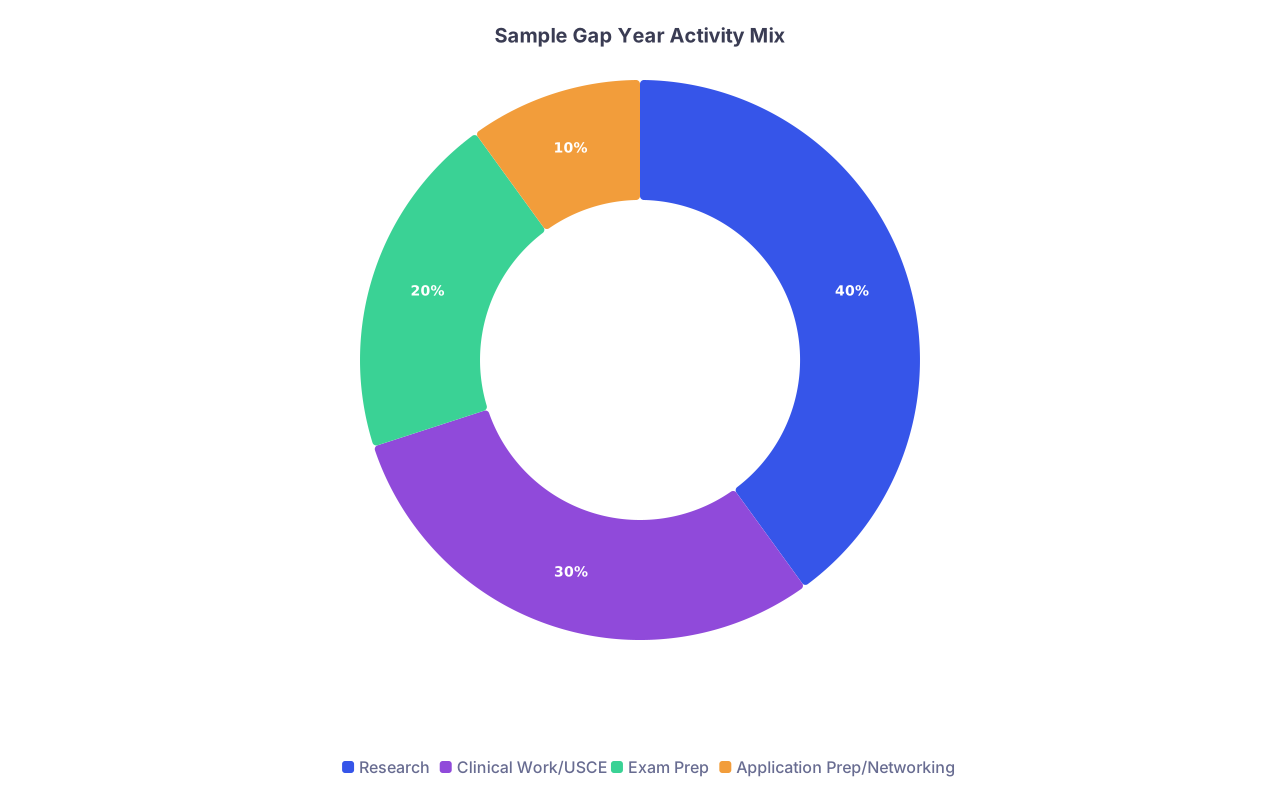
| Category | Value |
|---|---|
| Research | 40 |
| Clinical Work/USCE | 30 |
| Exam Prep | 20 |
| Application Prep/Networking | 10 |
Concrete steps:
- Pick your realistic primary specialty and a backup. Commit.
- Email programs and faculty now for:
- Research positions
- Clinical research coordinator roles
- Observerships/externships
- If needed, schedule your exam retake or Step 2 CK with a 3–6 month dedicated prep block.
- Start building relationships with faculty who can write strong, specific letters by next cycle.
- Keep some structured clinical contact (ward volunteering, clinic assistant, research with patient interaction) so you’re not “out of medicine” for a year.
You want to be able to say in your next personal statement:
“After not matching, I spent the last year working as a clinical research coordinator in [specialty], participating in [X] projects, assisting with patient care in [Y] setting, and preparing for [exam], which I improved from [old] to [new]. This experience confirmed my commitment to [specialty] and strengthened my readiness for residency.”
That’s a story programs can respect.
FAQs: Gap Year vs SOAP After Not Matching (6 Questions)
1. If I already went through SOAP once and failed to match, is it ever smart to try SOAP again instead of taking a gap year?
Yes, but only in narrow situations. If you had interviews or offers last time, no major red flags, and you’re now willing to be more flexible (e.g., adding FM/IM/psych/peds or prelims you previously ignored), SOAP might still be reasonable. If you did SOAP once and got zero serious interest, repeating without a change in profile is usually wasting time. That’s when a gap year with real remediation makes far more sense.
2. Can a prelim or transitional year be a better choice than a gap year?
Sometimes. A prelim or TY year can function like a very intense, paid “gap year” if you use it to earn strong inpatient letters, show you’re a safe intern, and then reapply in a new specialty or aim for categorical in the same field. But this only works if:
- The program is supportive of you reapplying
- You’re okay with a brutally hard year
- You understand there is no guarantee you’ll match afterward
Random prelims taken out of panic, with no long‑term plan, can leave you exhausted and still unmatched.
3. I’m an IMG with older graduation year and failed Step 1 once. Should I even bother with SOAP, or just focus on a gap year and reapplication?
If you have that combo—IMG, older grad year, Step 1 failure—your chances in SOAP without strong US clinical experience and stellar letters are very low. I’d generally advise: skip SOAP as your main plan, and invest in a year of targeted USCE, research, and exam score improvement (especially Step 2 CK). Use that time to pivot into a realistic specialty like FM or IM and build a narrative programs can buy. SOAP rarely rescues that profile out of nowhere.
4. If I take a gap year, will programs see me as “less desirable” because I didn’t go straight in?
Programs do not automatically dock you for a gap year. They dock you for an unexplained or unproductive gap year. If your year shows maturity, resilience, and measurable improvement—research output, new letters, higher scores, clear clinical commitment—that can actually make you look better than you did as a rushed M4 or fresh grad. The key is to be explicit on your CV and in your personal statement about what you did and what you learned.
5. Is there any point to entering SOAP if I’d only accept one or two specific specialties and only in a couple of locations?
Honestly? No. SOAP rewards flexibility. If you’re only willing to take, say, anesthesia or EM in two metro areas, you’re almost certainly wasting your time and emotional energy. Either you go into SOAP ready to accept FM/IM/psych/peds/prelim across broad geography, or you skip SOAP and spend that time designing a gap year that puts you in a stronger position for a future Match. Half‑committed SOAP is just self-inflicted stress.
6. What’s the single biggest mistake people make after not matching?
They panic and do everything instead of one smart thing. They enter SOAP with zero flexibility, send a few half‑baked applications, then “take a gap year” that’s really just drifting and feeling bad. Pick a lane. Either go all‑in on SOAP, accepting that you may land in a different specialty or setting than you planned, or go all‑in on a structured gap year with a written plan, dates, and concrete goals. Straddling both badly is how you end up in the exact same position next year.
Open a blank page right now and write two headers: “If I SOAP” and “If I Take a Gap Year.” Under each, list exactly what you’d do in the next 3 months. If one column looks vague and hopeful while the other looks concrete and demanding, you’ve just found your answer.


