

One truly excellent gap year letter can change how programs see you—but it will not magically erase a weak application. It can reframe you, not replace you.
Let me be very clear: program directors don’t fall in love with single documents. They fall in love with consistent patterns. A gap year letter can tip the balance if it becomes part of that pattern.
Here’s how to think about it like an adult, not like a desperate applicant clinging to one shiny thing.
1. What a “Strong” Gap Year Letter Actually Does (and Doesn’t) Do
Most applicants wildly overestimate what one glowing letter can do.
A genuinely strong gap year letter does three main things:
- Confirms you’re not the same applicant you were last cycle
- Gives concrete evidence of growth (clinical skills, professionalism, work ethic)
- Reduces anxiety for PDs about “taking a chance” on you
What it does not do:
- It does not make a 205 magically become a “competitive” Step 2 score
- It does not overwrite three awful clinical evaluations from third year
- It does not compensate for a personal statement that looks copy‑pasted and generic
Think of your gap year letter as a multiplier, not a substitute. If your base application is a 6/10, a strong letter might make your perceived value look more like 7.5–8/10. If your base app is a 2/10, you’re not jumping to a 9 just because one attending thinks you walk on water.
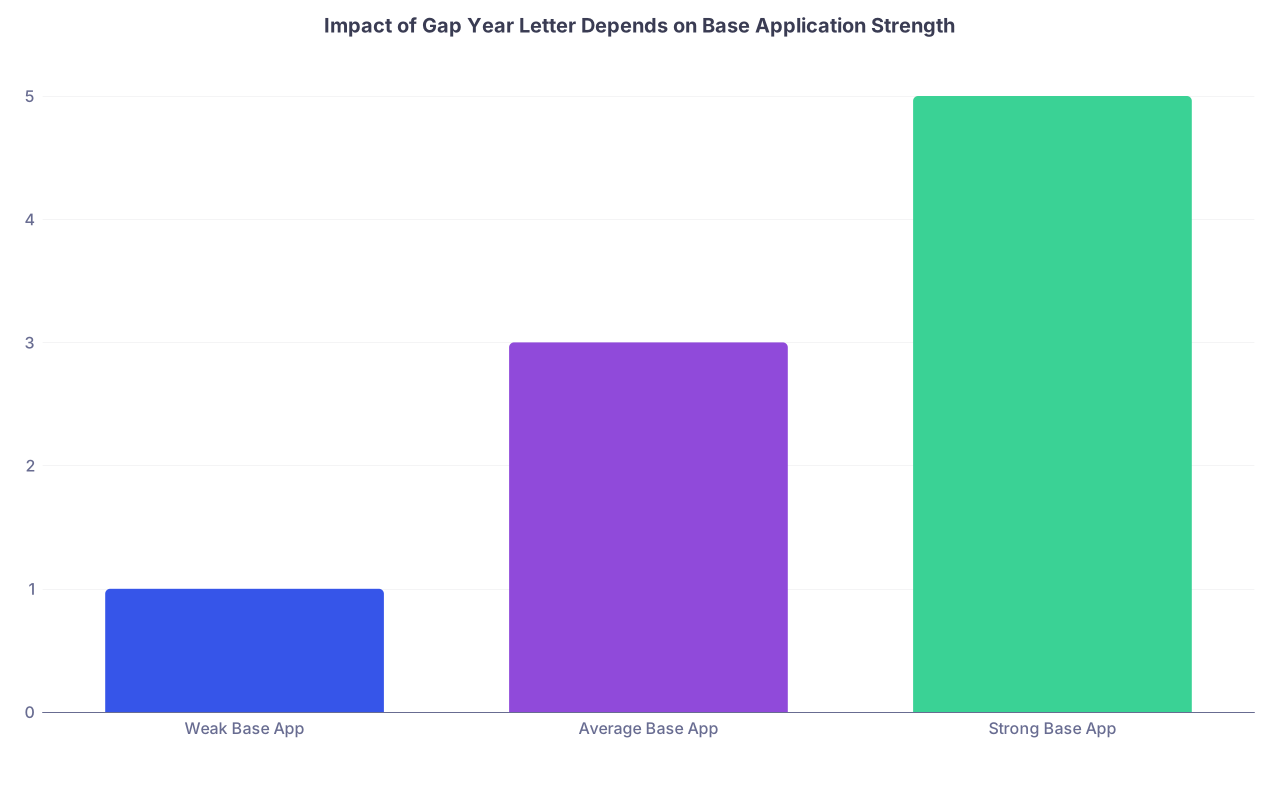
| Category | Value |
|---|---|
| Weak Base App | 1 |
| Average Base App | 3 |
| Strong Base App | 5 |
Legend in plain English: the numbers here roughly show how many “extra points” (figuratively) a great letter feels like, depending on where you’re starting.
2. When One Exceptional Letter Is Enough to Reshape Your File
There are absolutely situations where one gap year LOR becomes the hinge for your entire application. I’ve seen it.
Here’s when that happens:
Scenario A: You had a bland-but-not-disastrous application
- Mid‑range Step 2 (say 220–235)
- Some honors, some passes, no professionalism issues
- Letters from MS4 that were… fine. “Hard‑working, pleasant to work with, will do well in residency.” The usual beige.
Then you do a gap year where:
- You work as a full‑time research fellow or chief prelim
- You effectively function as an intern with real responsibility
- You get a letter from a well‑known, credible attending who writes things like:
- “He functioned at the level of a PGY‑1 by the end of the year.”
- “I would take her into our own residency without hesitation.”
- “This is one of the top 5 students I’ve worked with in the last decade.”
In that situation? Yes. That letter can absolutely reshape how PDs interpret everything else.
Your old “meh” clinical grade in IM suddenly looks like “they were probably just still growing.” Your average Step score becomes less worrying because now they’re reading that score in the context of “but clinically they’re excellent.”
Scenario B: You’re trying to change the narrative
Examples:
- You failed a rotation or had a professionalism concern
- You had a leave during med school and your Dean’s letter looks awkward
- You switched specialties and your prior letters don’t match your current story
A gap year where you:
- Show consistency (no late arrivals, no professionalism flags)
- Take feedback well
- Are trusted with increasing autonomy
…and your letter explicitly speaks to:
- Reliability
- Maturity
- Insight into past mistakes and how you changed
Now the letter isn’t just “good.” It’s rehabilitative. It tells PDs: “Yes, there were issues. I saw this person now, and I’d trust them with my patients.”
That can absolutely reshape how your red flags land.
3. When One Letter Is Not Going to Save You
Here’s where people get burned: they have one terrific letter and assume that means they’re suddenly competitive at programs that were never realistic.
You’re in danger of magical thinking if:
- Your Step 2 score is far below the typical range for your specialty
- You have multiple failed exams or repeated coursework without clear improvement
- Your clinical evaluations consistently mention the same concern (slow, disorganized, poor communication)
- You’re applying to ultra‑competitive specialties or top‑tier academic programs with a heavily below‑average profile
In that context, even a truly outstanding letter usually does one of two things:
- Moves you from “auto‑reject” to “hmm, maybe interview if we have room” at mid‑tier programs
- Moves you from “unlikely” to “possible” at community or slightly less competitive programs
It does not convert a 210 Step 2 + no research + no AOA into a dermatology match just because the derm chair liked you as a gap year fellow.
Let me be blunt: if your numbers and history are way out of line for the programs you’re chasing, the letter is a nice garnish on a dish they weren’t ordering.
4. What Makes a Gap Year Letter Truly Powerful (Not Just “Nice”)
A strong letter for residency is not about flowery adjectives. PDs are numb to “hard worker,” “team player,” and “pleasure to work with.”
The letters that move the needle usually have:
Specific comparisons
“In my 15 years as faculty, she is in the top 10% of students I’ve supervised.”
“He performed at or above the level of our current interns by the second half of the year.”Concrete behaviors
Not “great clinical reasoning,” but:
“On night float, he independently managed 10–15 cross‑cover calls, presented succinct plans, and correctly escalated care when appropriate.”Clear endorsement
PDs look for this exact phrasing:- “I recommend her without reservation.”
- “I would be thrilled to have him in our own program.”
- “I will advocate for her as a top candidate for any residency.”
Longitudinal observation
A gap year is gold because someone’s seen you for 6–12 months, not 2 weeks. The letter should emphasize that:
“Over a full academic year, I saw consistent reliability and growth…”
If your “strong” letter doesn’t have those elements, it’s probably just “good.” Helpful, but not application‑redefining.
5. How This Letter Fits With the Rest of Your Application
One letter, even an amazing one, has to line up with the rest of the story you’re telling. Otherwise PDs get suspicious.
You want alignment across:
- Personal statement
- ERAS experiences
- Other letters
- Dean’s letter/MSPE
- Interview answers

| Step | Description |
|---|---|
| Step 1 | Gap Year Experience |
| Step 2 | Gap Year Letter |
| Step 3 | ERAS Experience Descriptions |
| Step 4 | Personal Statement Content |
| Step 5 | Program Director Perception |
| Step 6 | Interview Invitation & Ranking |
If your gap year letter says you functioned like an intern, but:
- Your ERAS barely mentions clinical responsibility
- Your personal statement talks only about research and nothing about growth
- You seem timid or unconfident on interview when discussing clinical cases
…it feels off. Like you’re not the same person the attending is describing.
Your job is to make that letter feel inevitable when they read the rest of your file. “Of course they got this kind of letter—everything else already hinted they were headed this way.”
6. Strategic Moves: How to Use One Strong Letter to Maximum Effect
Assuming you do have (or will have) one genuinely strong gap year letter, here’s how to leverage it.
1. Get it from the right person
Hierarchy matters, but credibility matters more.
Best case:
- Someone who’s well known in your field
- Or someone who clearly works closely with residents and can compare you directly to them
- Or your gap year PD/section chief who can say, “We treated her as part of the team”
“Nice” but less powerful:
- Postdoc mentor who never saw you with patients
- Faculty who worked with you only on Zoom for a few weeks
- Someone outside your chosen specialty with limited clinical overlap

2. Make sure the content hits your weaknesses
If your biggest problem is:
- Perceived clinical weakness → letter must emphasize clinical reasoning, autonomy, handling acute situations
- Professionalism history → letter must address reliability, communication, trustworthiness
- Step score anxiety → letter must highlight that your day-to-day performance outstrips what the score might suggest
You don’t script the letter. But you can talk with your writer:
“Would you feel comfortable commenting on how I performed compared to your interns or your typical sub‑I students?”
“Is it okay if I share that I’m trying to show programs I’ve really grown in [X area], since that was a concern previously?”
That’s reasonable. And smart.
3. Match your application list to what the letter can actually do
Here’s where people either match or crash.
Rough structure:
| Program Tier | Effect of One Excellent Gap Year Letter |
|---|---|
| Top 10 Academic | Small bump; might get you a look if you're already close |
| Mid-Tier Academic | Moderate bump; can move you from borderline to interview |
| Strong Community | Significant bump; can turn you into a desirable candidate |
| Smaller Community | Big bump; may overshadow older, weaker parts of file |
If your application was previously getting zero or almost no interviews, and now you have this standout letter plus improved Step 2 and stronger narrative, you should:
- Apply more heavily to strong community and mid-tier academic programs
- Be realistic about top‑tier academic programs—add a few, not 40
- Include programs where your letter writer is known or has connections, if possible
7. How Programs Actually Read That Letter
Most programs do not meticulously read every word of every letter on the first pass. They skim. They look for signals.
Common flow:
- Initial screen: scores, fails, geography, visa needs
- Quick look at MSPE / transcript
- If borderline → they’ll actually read your strongest letter(s)
- If letter is exceptional → likely interview
- Final rank list → letters get re‑read for nuance and tie‑breaking
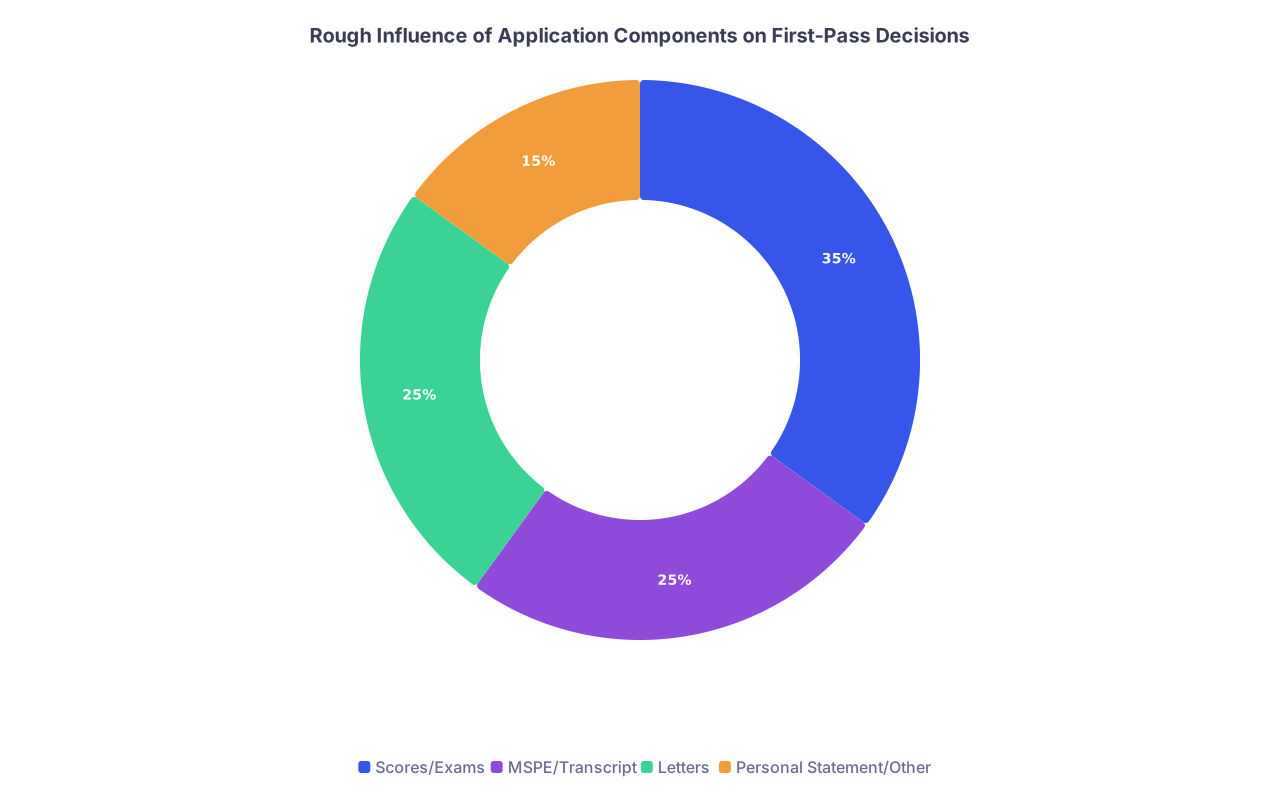
| Category | Value |
|---|---|
| Scores/Exams | 35 |
| MSPE/Transcript | 25 |
| Letters | 25 |
| Personal Statement/Other | 15 |
So where does your gap year letter matter most?
- Not as much in the auto‑screen phase
- A lot in the “borderline, decision could go either way” cases
- A ton during ranking when they’re sorting people they’ve already interviewed
That last part is underrated. Among interviewees, everyone has passed the basic bar. Letters and narratives decide who rises.
If, on interview, you come across exactly like the letter describes—mature, hungry to learn, clinically solid—that one gap year letter can easily be the reason you get ranked higher than someone with better scores but weaker real‑world performance.
8. How to Tell If Your Letter Is Actually “Strong” vs Just “Nice”
Most students think all “positive” letters are strong. They’re not.
Signals that your letter is likely powerful:
- The writer is enthusiastic about writing it (“I’d be happy to write you a very strong letter”)
- They’ve seen you in tough situations and independent work, not just shadowing
- They give you the feeling they know you—they reference specific cases, nights on call, growth over time
- They’ve written residency letters before and know what PDs care about
Red flags:
- “Sure, I can write you a letter,” said in a neutral tone, after only knowing you for 2 weeks
- They ask you to draft your own letter entirely with no input or interest (this usually produces generic garbage)
- They barely remember your name, your rotation dates, or what you did

If you’re not sure, you can ask directly (politely):
“I’m applying again this cycle and really hoping to show programs how I’ve grown. Do you feel you know my work well enough to write a strong, detailed letter comparing me to other residents or students you’ve supervised?”
If they hesitate, find someone else.
9. Bottom Line: Is One Strong Gap Year Letter Enough?
Here’s the straight answer you’re looking for:
- If your application was borderline and you’ve improved other pieces (scores, narrative, maturity), then yes—one truly strong gap year letter can absolutely reshape your application in a meaningful way.
- If your application is severely below the bar for your chosen specialty, one letter won’t fix that. It can help, but it’s not a magic eraser.
- The letter’s power scales with three things:
- Your baseline competitiveness
- The writer’s credibility
- How well the story in that letter matches the rest of your file

If you’re banking your entire reapplication on “this one letter will save me,” you’re in trouble. If you’re using that letter as the anchor of a stronger, more coherent second attempt—then you’re thinking like someone who’s actually going to match.
FAQ (Exactly 7 Questions)
1. Should I delay submitting ERAS until my gap year letter is uploaded?
No. Submit ERAS early with the letters you already have, then add the gap year letter as soon as it’s ready. Programs will see updates. Being late with your entire application just to wait for one letter usually hurts you more than it helps.
2. If I have one amazing gap year letter, can I drop older weaker letters?
Yes, and you probably should. You don’t get extra points for volume. Pick the 3–4 letters that best show who you are now, not who you were at your worst. If an older letter is lukewarm or generic and you have stronger options, replace it.
3. Does it matter if my gap year letter is from a different specialty than I’m applying to?
It matters, but it’s not fatal. A strong letter from a non‑target specialty that can speak to your clinical performance and professionalism still carries weight. Ideally you want at least one letter from your target specialty, but a powerful off‑specialty gap year letter is still very valuable.
4. Can a gap year research-only letter help as much as a clinical letter?
Not usually. A research letter can be great for academic programs or research‑heavy specialties, but it rarely replaces a strong clinical letter that directly compares you to residents and addresses your actual doctoring skills. If possible, get a letter that reflects both research and clinical performance.
5. How many gap year letters is too many?
If you have two high‑quality gap year letters from different people (say, a research PI and a clinical supervisor) that each cover distinct aspects of your performance, that’s fine. More than two starts to look like overcompensation unless your prior letters are truly terrible. Aim for a balanced mix: med school + gap year, not gap year only.
6. Should I send my letter writer my old personal statement or ERAS to “guide” them?
Yes. Send your updated ERAS CV, your personal statement draft, and a short bullet list of what you’re hoping programs will understand about you this cycle (e.g., “reliability after prior issues,” “clinical growth,” “commitment to this specialty”). Don’t script their letter, but give them context and themes.
7. If I don’t match again even with a strong gap year letter, what does that mean?
It usually means the problem wasn’t just letters. Either your specialty choice is too competitive for your profile, your application list wasn’t realistic or broad enough, or there are deeper issues (Step scores, repeated failures, interview performance, professionalism history). At that point, you need a hard, honest review with someone experienced—preferably a PD or advisor willing to be brutally direct.
Key takeaways:
One excellent gap year letter can tip the scale—but only if your underlying application is at least in the competitive ballpark and the letter aligns with a coherent story of growth. Use it as a cornerstone of a stronger reapplication, not as a single heroic fix.


