

The default advice to “just stay where people know you” for a research gap year is lazy and often wrong.
You’re not choosing between “home vs away.” You’re choosing between a strong, targeted, politically smart gap year and a weak, generic one. Sometimes that means staying. Sometimes it absolutely means leaving.
Here’s how to make that call like an adult, not like a scared MS4.
Step 1: Be Honest About Your Situation
Before you even touch the home vs away question, you need to answer three things clearly:
- What is your target specialty?
- How competitive are you on paper (scores, grades, research)?
- What is your actual goal for this gap year?
Most people will fall into one (or more) of these buckets:
- You’re going for a competitive specialty (derm, ortho, plastics, ENT, neurosurgery, rad onc, urology, ophtho).
- You’re trying to rescue or rebrand an application (low scores, failed Step, limited home support).
- You’re trying to upgrade from “probably match somewhere” to “real shot at high-tier or specific geography.”
Your goal might be:
- Get high-yield letters from well-known faculty in your specialty
- Produce serious research output (pubs, first-author, big conferences)
- Get a foot in the door at a particular institution or region
- Prove you can recover from an academic stumble and function at a strong program
Answer those honestly, in writing. Then the home vs away choice becomes much clearer.
Step 2: What Your Home Institution Can Actually Offer
Forget loyalty. Ask: if you stay, what do you really get?
Here’s what “staying home” looks like when it’s actually a good idea:
- You have strong mentors who know you well and already like you.
- There is a well-established research pipeline in your specialty (not just “projects,” but real infrastructure: coordinators, regular meetings, a track record of publications).
- Your department matches well in your specialty, especially to places you’d be happy to end up.
- You can easily get on multiple projects and be productive within a few months.
- Your current letter writers are willing to “go to bat” for you and connect you to others.
If your home institution checks most of those boxes, leaving “just to leave” is stupid. You’re burning social capital and time.
Here’s where staying at home is often a mistake:
- Your home institution barely matches into your chosen specialty.
- There’s no real research machine—just random case reports and student-led chaos.
- Faculty are passive, “nice,” but not proactive or well-connected.
- You’ve had rocky relationships or mediocre evaluations in that department already.
- You need to change your narrative (failed Step, weak rotations, professionalism flags) and your home place sees you as “that student with issues.”
In those scenarios, a gap year at home usually just means: one more year of being stuck in the same ecosystem that already didn’t work for you.
Step 3: What Going Elsewhere Actually Buys You
Going elsewhere is not automatically “better”; it’s higher variance. You can level up dramatically… or get lost.
Going away is usually a smart move when:
- You’re aiming for a super competitive specialty and your home institution is weak or nonexistent in that field.
- You want to target a geographic region (e.g., West Coast, Northeast, big academic centers) and your home school doesn’t place there often.
- You need a fresh start—new mentors, new reputation, new letters.
- You have a chance to work under a big name with heavy research output and strong connections.
What you’re really buying by going away:
- Brand name on your CV (e.g., gap year research at MGH, UCSF, Penn, Mayo)
- Letters from nationally known faculty
- Access to big multi-center studies, RCTs, high-impact journals
- Visibility at a place you might apply for residency (if you perform well, they remember you)
But there are risks:
- You might be treated as cheap labor: endless data entry, zero mentorship.
- No one knows you → if you’re passive, you’ll vanish.
- You may lose the “easy” support you had at your home program.
So if you go, go strategically. Not just because everyone else is “doing a research year at [insert big-name hospital].”
Step 4: The Decision Framework (Use This, Not Vibes)
Here’s the stripped-down framework I’d use if you were sitting across from me.
Question 1: Does my home institution have a strong track record in my specialty?
If yes:
- Look at their recent match list in that specialty.
- If they consistently send people to programs you’d be thrilled with, staying becomes attractive.
If no:
- Strong push toward going elsewhere, especially for competitive fields.
Question 2: Do I already have at least one strong advocate at home?
By “strong advocate,” I mean:
- Knows you well
- Likes you
- Is willing to say, “I will call programs for you”
If you don’t have that at home, you’re not losing much by leaving. If you do, you must weigh that heavily.
Question 3: Which option gives me better research efficiency?
Do not romanticize “big-name” places. Ask where you can:
- Get on multiple projects quickly
- Realistically get at least 1–2 solid publications in 12 months
- Present at a reputable specialty conference
If your home program can line this up next month, but an away program would start you in 6 months with uncertain output? Staying might be smarter.
Question 4: Do I need to change my narrative?
If your story includes:
- Step failure or low scores
- Significant remediation
- Personality conflicts / weak clinical evals in your home specialty department
Then staying puts you under the same lens. Going elsewhere lets you:
- Prove you can function at a high level in a new setting
- Collect fresh letters that don’t reference old baggage
For rebranding, going away often wins.
Step 5: Common Scenarios (And What I’d Do)
Let’s run through a few realistic types.
Scenario A: Competitive specialty, weak home program
You’re at a mid-tier med school with:
- No derm / ENT / plastics / neurosurgery residency
- One or two faculty who “dabble” in the field
- Minimal match history in your target specialty
You want derm. You have okay Step scores, some scattered research, nothing major.
In this scenario, I’d push you strongly to:
- Find a structured research fellowship or research year at a place with:
- A strong residency in your field
- A history of taking their research fellows into their residency or helping them match elsewhere
Staying home here is loyalty to the wrong thing.
Scenario B: Strong home department, you’re average-strong
You’re at a solid academic center with:
- A strong IM or surgery department
- Consistent matches into mid- to high-tier programs
- Faculty who already know and like you
- Existing small projects you’re already working on
You want hospitalist or general surgery. You’re not chasing MGH or Hopkins at all costs.
I’d usually say: stay home, unless you have a very specific away opportunity that is clearly better in terms of mentorship or research.
Scenario C: You need to repair damage
You failed Step 1 once but passed on second try. Your home department knows. Some faculty are cold, or at best neutral.
You’re interested in a moderately competitive specialty (say, anesthesia or radiology).
Here, I’d lean toward an away research year, preferably at a place that has:
- A structured research role
- Faculty used to working with “non-perfect” CVs
- Clear projects and deliverables
You want letters that say, “This person showed up, worked hard, and delivered.”
Step 6: How Programs Actually View Home vs Away Gap Years
Programs do not care where you physically sat in front of a computer. They care about:
- Who is writing your letters
- How strong and specific those letters are
- What you actually produced (papers, posters, tangible outcomes)
- Whether your story is coherent
A gap year at your home place that leads to:
- 0–1 low-impact abstracts
- Generic letter from a non-influential faculty member
- No strong narrative about what you learned or contributed
…is far weaker than an away year that gives you:
- 2–3 decent papers or serious projects
- A strong letter from a PD, chair, or well-known faculty
- Clear story: “I took a year to deepen my interest in X and contributed to Y and Z.”
Programs are not stupid. They can tell when a gap year was:
- A serious, focused move
- Or just a way to avoid moving forward
Step 7: Practical Comparison – Home vs Away
Here’s a simple comparison that might help you see it clearly:
| Factor | Home Institution | Away Institution |
|---|---|---|
| Mentorship | Known, predictable | Unknown, can be amazing or absent |
| Letters | Easier to secure | Higher ceiling if well-known names |
| Research ramp-up | Usually faster | May be slower initially |
| Reputation / branding | Depends on your school | Can upgrade if at top program |
| Narrative change | Harder | Easier to reset |
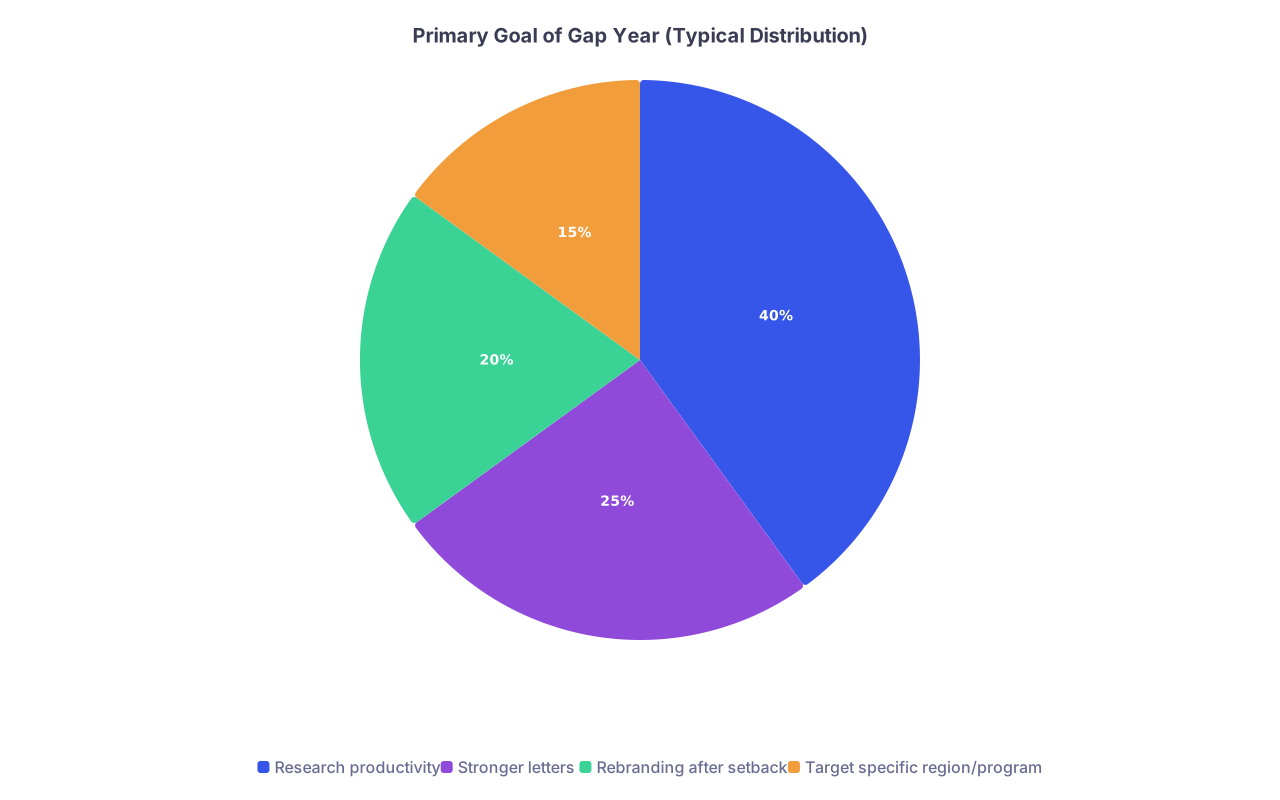
| Category | Value |
|---|---|
| Research productivity | 40 |
| Stronger letters | 25 |
| Rebranding after setback | 20 |
| Target specific region/program | 15 |
Step 8: Questions You Must Ask Before Committing (Anywhere)
Whether you stay or go, have real conversations. Email is fine, but get them on a call or in person.
Ask:
- How many students/trainees do you usually have in this research group per year?
- What kind of output did your last 3 research-year people have? (Papers, talks, match outcomes)
- How often do you meet 1:1 with your research mentees?
- Who typically writes their letters of recommendation?
- Do your research fellows/students ever match into your residency? Where else do they tend to match?
If they can’t answer clearly, that’s a red flag.
Step 9: Don’t Forget Logistics and Sanity
Quick but non-trivial factors:
- Money: Some away positions are paid, most are not. Your home institution might let you moonlight or TA. Do the math.
- Location: Moving across the country for a year is not trivial. If you’re already burned out, adding housing stress may backfire.
- Support system: If you have strong personal support at home, that can matter more than an extra abstract.
But—and this is key—do not let “moving is annoying” be the sole reason you stay in a weak environment for the most important bridge year of your career.

| Step | Description |
|---|---|
| Step 1 | Identify Specialty & Goals |
| Step 2 | Prioritize Away Programs |
| Step 3 | Leaning Home |
| Step 4 | Explore Away + Home Options |
| Step 5 | Evaluate Research Output & Letters |
| Step 6 | Choose Option with Better Mentorship + Output |
| Step 7 | Strong Home Department? |
| Step 8 | Strong Mentor & Projects? |
FAQ: Should I Stay at My Home Institution or Go Elsewhere for a Gap Year?
Will programs think it’s weird if I stay at my home institution for a gap year?
No. It only looks bad if your year is unproductive. If you stay, produce real work and get strong letters. “Stayed at home and crushed it” reads just fine.Is a big-name institution always better for a gap year?
No. A big name with no mentorship and no output is useless. A mid-tier place with a hungry, productive mentor who gives you first-author work is far more valuable. Brand name is a bonus, not the main event.If my home institution has my desired specialty, should I automatically stay?
Absolutely not. You stay if: they have a strong track record, you have engaged mentors, and there’s a clear plan for real output. If the department exists only on paper, look elsewhere.Can a gap year away help me match at that same institution for residency?
Yes, but it’s not guaranteed. Programs often favor known quantities, and if you work hard, get involved clinically, and people like you, your chances there improve. But think of it as creating an opportunity, not a contract.What’s the minimum I should aim to accomplish during a research gap year?
At least: 1–2 meaningful publications or major abstracts, 1–2 strong letters from well-known or respected faculty in your specialty, and a coherent story about what you worked on and what you learned. More competitive specialties will expect more.What if both my home and away options seem mediocre?
Then keep looking. Cold-email other programs, ask your dean’s office for connections, talk to residents in your specialty about where people have done productive research years. Settling for a “warm body” position where no one cares about you is the worst version of a gap year.
Bottom line: Choose the option—home or away—where you will get (1) the best mentorship, (2) the strongest letters, and (3) the most meaningful output. Ignore ego, inertia, and fear. Focus on where you can actually become the version of yourself that programs will want to rank.


