

The obsession with “how many gap year activities” is the wrong question—and it quietly ruins a lot of applications.
You do not need more activities. You need the right mix, at the right depth, that clearly supports your residency story.
Let me give you real numbers and concrete targets so you can stop guessing.
The Real Answer: How Many Gap Year Activities Is “Enough”?
Here’s the blunt truth: programs do not care how many lines you can stuff into ERAS from your gap year.
What they actually look for is:
- Continuity (you didn’t disappear from medicine)
- Progress (you used the year to move forward, not stall)
- Coherence (your activities match the specialty you’re claiming)
- Evidence of reliability (you show up, do the work, and finish what you start)
In most strong applications, a gap year looks like:
- 1–2 primary long-term activities (core focus, 6–12 months)
- 1–3 secondary part-time or intermittent activities
- Maybe 1 short “one-off” (away elective, bootcamp, short course, or mission trip)
So a typical strong gap year has about 2–5 real activities.
Not 10. Not 1, unless that one is extremely robust and full-time.
If you want a rule of thumb:
- Fewer than 2 meaningful activities → often looks thin
- 2–3 solid, sustained activities → ideal for most people
- 4–5 activities → fine if they’re not all shallow or chaotic
- More than 6 → starts looking like you’re collecting lines, not building skills
Now let’s talk types, not just counts.
The 4 Core Buckets Your Gap Year Should Cover
Instead of asking “how many,” think in buckets:
- Clinical exposure / patient care
- Scholarship (research/QI/academic work)
- Professional development / teaching / leadership
- Life + logistics (exams, visas, family, personal constraints)
Most strong residency applicants have at least two of these buckets solidly filled from their gap year.
For competitive fields (derm, ortho, plastics, ENT, urology, radiation onc), you usually want three buckets: clearly clinical, clearly research, and something that shows initiative or leadership.
Here’s how this breaks down in real life.
What Strong Gap Year Setups Actually Look Like
| Profile Type | Primary Activity | Secondary Activity | Extra |
|---|---|---|---|
| Competitive Surg (Ortho/Plastics) | Full-time research | 1 day/week clinical | Teaching / tutoring |
| Medicine/Peds | Full-time clinical job | Small QI or research project | Volunteer or teaching |
| EM/Anesthesia | 0.8 FTE clinical job | Research or EMS work | Exam prep/teaching |
| IMG Strengthening Profile | Research or observerships | Language or exam prep | Local volunteering |
| Transitional/Prelim Focus | Mix of clinical + research | Teaching | Short course or cert |
That table is what “enough” usually looks like. One big anchor activity, plus 1–2 supporting ones.
How Many Activities By Type? Concrete Targets
Let’s break it down by category.
1. Clinical Activities
You need at least one clinically relevant activity unless you’re doing a hardcore, branded research year with ongoing clinical exposure baked in (like an NIH or major university research fellowship that still involves patient contact).
Good targets:
- 1 primary clinical role:
- Scribe, clinical assistant, research coordinator with patient-facing tasks, junior doctor/service post (for countries where that’s a thing), observer with regular schedule
- 20–40 hours/week, 6–12 months
Optional, but helpful:
- 1 extra small/PRN clinical thing:
- Weekend shifts, telehealth assistant work, or volunteering 2–4 hours/week
Too little:
- One 2-week observership and then nothing → programs notice that gap.
- A couple of random shadowing experiences → this screams “I didn’t really work.”
2. Research and Academic Work
For some specialties, research is optional-but-helpful. For others, it’s practically mandatory.
Rough expectations:
Competitive specialties (derm, ortho, ENT, neurosurg, plastics, rad onc):
- 1 primary research role (full-time or near-full-time)
- Ideally linked to a known PI or strong department
- Aim: at least 1–2 abstracts/posters or in-progress manuscripts by application time
Internal medicine, pediatrics, neurology, EM, anesthesia:
- 1 research or QI project is often enough
- Does not have to be full-time, but needs visible output
FM, psych, PM&R, pathology (varies by program and region):
- Research is a nice bonus, not usually a must-have
Weak move: listing five “ongoing” research projects that are all “manuscript in preparation,” with no real output. Programs see right through that.
Strong move: one main project you can actually discuss deeply, plus maybe 1–2 side projects you helped with.
3. Teaching, Leadership, and Extra Roles
This is where people overdo it.
You do not need 10 minor leadership roles from your gap year.
You need 1–3 things that show you stepped up, owned something, and stuck with it.
Examples that count:
- Teaching assistant for MS1 anatomy or small groups
- Regular Step/USMLE tutor with documented hours
- Organizer/leader for a free clinic, quality initiative, or small team
- Chief resident for an intern year (for international grads)
These should support—rather than replace—your clinical and academic core.
1–2 is plenty. 3 if they’re light. More than that and you look scattered.
How Programs Actually Read Your Gap Year
Let me show you how faculty think when they see your activities.
They’re asking:
- Did you disappear for a year?
- Does your story make sense? “I want to be a ______, so I spent my year doing ______, ______, and ______ to prepare.”
- Did you show follow-through or just dabble in everything?
- Are there any red flags? Big time gaps, job hopping every 2 months, weak excuses.
They are not tallying your total count.
To make that clearer:
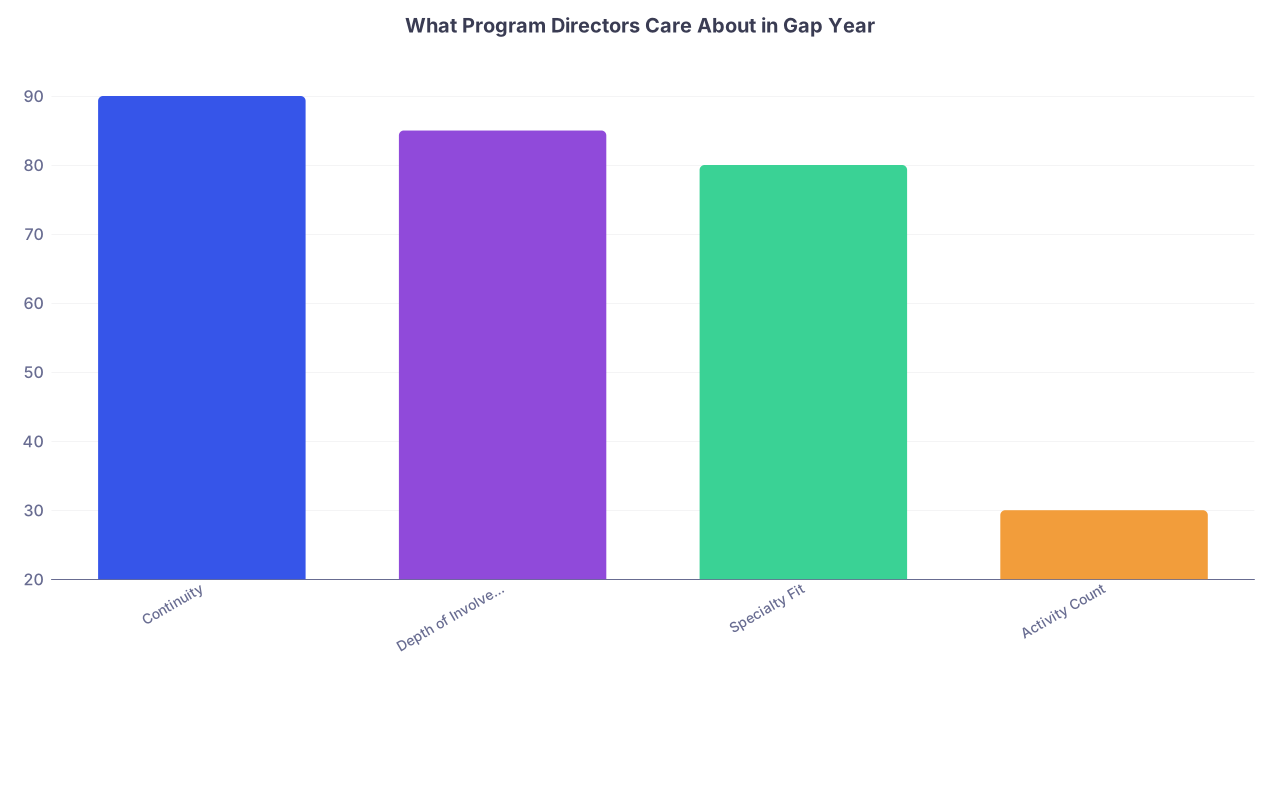
| Category | Value |
|---|---|
| Continuity | 90 |
| Depth of Involvement | 85 |
| Specialty Fit | 80 |
| Activity Count | 30 |
That last bar—“Activity Count”—is the thing everyone fixates on. It’s the least important.
How Many Is Too Many?
There is such a thing as activity inflation. I see this a lot in ERAS.
You’ve gone too far if:
- You’re listing every 3-hour volunteer shift as a separate entry
- You have 15 entries from 1 gap year
- Nothing lasted more than 3 months
- You can’t succinctly explain what each role actually taught you
Programs don’t want “busy.” They want “purposeful.”
A good internal filter:
- If you wouldn’t be proud to get grilled on it for 5 minutes in an interview, don’t list it as a main activity.
- If it was less than 20–30 hours total, group it or cut it.
Tailored Guidance by Situation
If You’re Aiming for a Competitive Specialty
You want:
- 1 major research position (6–12 months, ideally full-time)
- 1 consistent clinical role or longitudinal clinical exposure
- 1–2 extras (teaching, leadership, niche project) that show you’re proactive and engaged with the specialty
So total: about 3–4 real activities.
Example:
- Full-time ortho lab research fellow, 40 hours/week
- One half-day orthopedic clinic every week
- Tutor MS2/MS3s in MSK exam skills
That’s enough. Trying to juggle 6–7 roles just dilutes your impact.
If You’re Strengthening a Weak Application (Low Scores, Red Flags)
Your gap year needs to scream: “I am responsible, I maturely addressed my issues, and I improved.”
You want:
- 1 structured, sustained clinical or research activity (stability)
- 1 clear story about what changed (study habits, mental health treatment, remediation done properly)
- Maybe 1 extra in teaching/volunteering to show generosity and engagement
More unfocused activities don’t fix a red flag. A coherent year does.
If You’re an IMG Using a Gap Year Before Applying
For IMGs, especially with older graduation years, the bar is higher for “enough.”
Strong profile usually includes:
- 1 core research role at a US or Canadian institution (or equivalent strong academic center elsewhere)
- 1 or more US clinical experiences (observership, externship, junior doctor/post, 3–6 months each ideally)
- Possibly 1 part-time job or volunteer role showing integration and reliability
You’re aiming for 3–5 substantial things over 1–2 years, not 10 scattered observerships of 1–2 weeks each.
How to Audit Your Own Plan in 5 Minutes
Ask yourself:
- Do I have at least one clear primary anchor activity?
- Do I have at least one of the following:
- Real research with probable output
- Strong, regular clinical exposure
- A leadership/teaching role with real responsibility
- Can I explain, in one sentence, how each activity supports my target specialty?
If you can’t do #3, you have filler.
Here’s a quick way to structure your year.

| Step | Description |
|---|---|
| Step 1 | Start Planning |
| Step 2 | Pick Primary Activity: Clinical or Research |
| Step 3 | Shadow 2-3 Fields, Decide in 1-2 Months |
| Step 4 | Add 1-2 Secondary Activities |
| Step 5 | Add Focused Study/Improvement Plan |
| Step 6 | Add Optional Teaching/Leadership |
| Step 7 | Commit 6-12 Months |
| Step 8 | Reassess at 6 Months, Adjust |
| Step 9 | Target Specialty Clear? |
| Step 10 | Red Flags/Scores? |
If your current plan doesn’t fit somewhere in that flowchart, tweak it.
Common Bad Assumptions (That Will Hurt You)
Let’s kill a few myths.
“More short observerships are better than one long one.”
Wrong. Depth beats variety almost every time.“If I list 10 things, they’ll think I’m super productive.”
No. They’ll think you’re unfocused or padding your app.“If it’s not research, it doesn’t count.”
Also wrong. For many programs and fields, consistent clinical work + good narratives beat weak research.“I took time for personal reasons, so my year is ruined.”
Not inherently. But you do need at least 1–2 solid, explainable activities and a clear, honest explanation of your time.
Quick Visual: Reasonable vs Overstuffed Gap Year
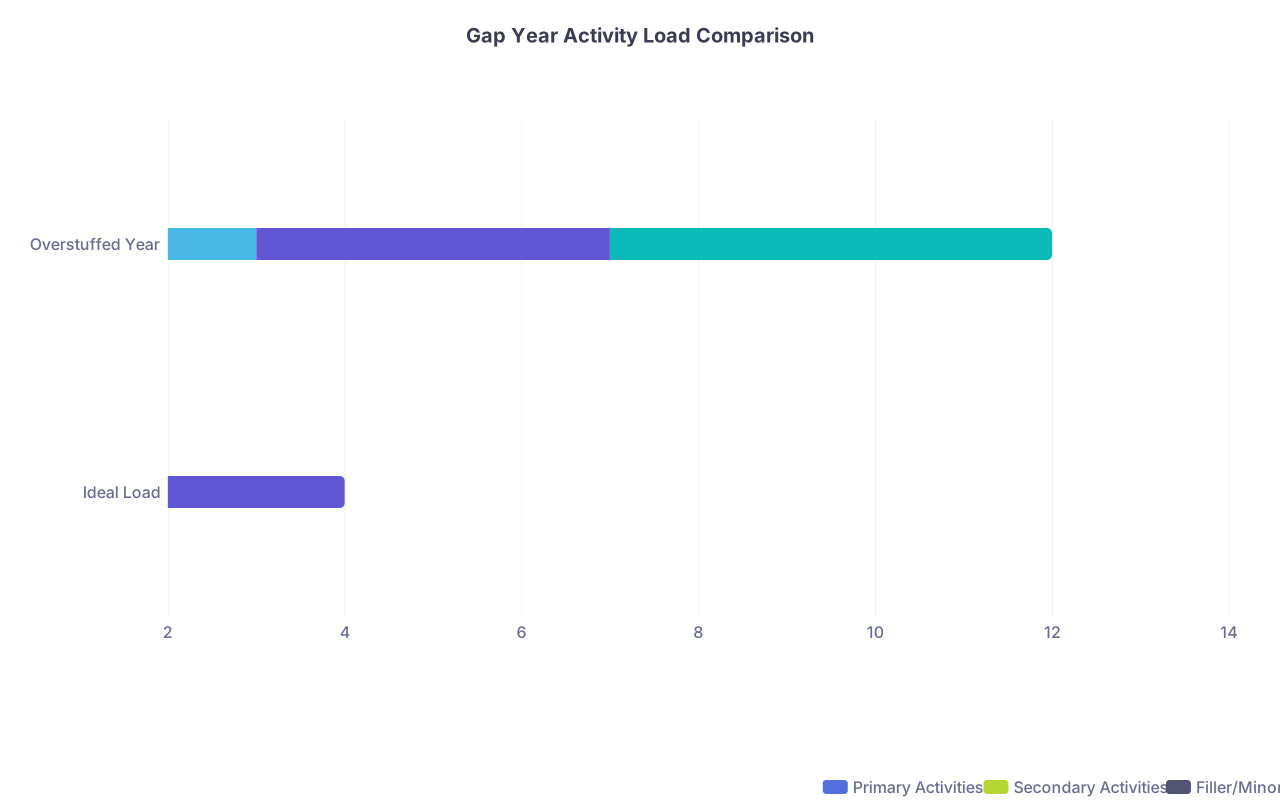
| Category | Primary Activities | Secondary Activities | Filler/Minor |
|---|---|---|---|
| Ideal Load | 2 | 2 | 0 |
| Overstuffed Year | 3 | 4 | 5 |
You want to live on the left side of that chart.
Bottom Line: The Numbers You Should Walk Away With
For a strong residency application from a gap year, your realistic target is:
- Total substantial activities: 2–5
- Primary (anchor) activities: 1–2
- Secondary (supporting) activities: 1–3
- Ultra-short/filler: only if they clearly add to your story or fill a gap
If you’re spending your energy asking, “Do I have enough?” you’re focused on the wrong metric.
Ask instead: “Does each thing I’m doing clearly make me a better candidate for this specialty, in a way I can explain in 2–3 sentences?”
That’s the filter programs are actually applying.
FAQ: Gap Year Activities for Residency (5 Questions)
1. Is it okay if I only have one main gap year activity (like a full-time research fellow job)?
Yes—with conditions. If it’s truly full-time, 9–12 months, and you can show real outcomes (abstracts, manuscripts, strong letters, specialty alignment), one major activity can be enough. It’s stronger if you can add one small, consistent side activity (clinic half-day, teaching role), but it’s not mandatory if your primary role is excellent and clearly relevant.
2. Will programs judge me for working a non-medical job during my gap year?
They will judge you harshly only if that is all you did and you have no recent clinical/academic engagement. If you had to work for financial reasons, pair that job with at least one part-time clinical or academic role, even 4–8 hours a week. Then you can frame it as: “I supported myself while still staying active in medicine and preparing for residency.”
3. How long should each activity last to “count” as substantial?
A good rule: at least 3 months for a longitudinal role, or 100+ hours total, unless it’s an intense short-term program (4-week sub-I, away elective, bootcamp). Anything less than a few dozen hours starts to look like a “tourist” experience unless it’s a very high-yield one-time thing (national conference presentation, focused mission with a clear deliverable).
4. I’m doing a research year but don’t have any publications yet. Is that a problem?
Not automatically. Programs know the research pipeline is slow. What they want to see: concrete progress (submitted abstracts, ongoing manuscripts, data collection finished, posters presented). If, after 9–12 months, you have nothing tangible—no submission, no poster, no clear role—it looks weak. Focus your last months on pushing at least 1–2 projects to a visible endpoint.
5. How do I explain a gap year that includes personal/health/family time and fewer activities?
Be direct and professional. In your personal statement or interview, briefly acknowledge the situation (no oversharing), explain how you addressed it, and then emphasize what you did after stabilizing—at least 1–2 concrete, sustained activities that show you’re ready now. Programs do not need perfection. They do need evidence that any major issue was faced, managed, and followed by solid, reliable performance.
Open your activity list right now and cross out anything you wouldn’t proudly defend for 5 minutes in an interview. Then make sure you have 1–2 anchor roles and 1–3 solid supporting ones that clearly match your target specialty. That’s your “enough.”


