

Your gap year is not the problem. The story you tell about it is.
If you had academic trouble and ended up with a forced gap year before residency, you are not “done” and you are not doomed. But if you handle this year passively, you probably are.
I am going to treat you like a colleague who needs a plan, not a pep talk. You hit a wall: failed a course, repeated a year, Step failure, LOA after probation, or some ugly combination of those. Now you are sitting with:
- A gap year you did not want
- A transcript you do not love
- Anxiety about how programs will judge you
Here is the blunt truth: programs do not reject you because you had trouble. They reject you because:
- The trouble appears unexplained or ongoing
- Your later performance does not clearly show repair
- Your story sounds defensive, vague, or evasive
You fix that with structure, proof, and a controlled narrative. Not with “I learned a lot” paragraphs.
This article lays out a repair strategy for a forced gap year after academic trouble, specifically geared to residency applications and the Match.
Step 1: Diagnose the Actual Damage (Not the Drama in Your Head)
Before you “reframe” anything, you need to know what you are reframing.
1.1 Categorize the academic problem
Be specific. Programs will be.
Common scenarios:
- Step/COMLEX failure
- Multiple shelf exam fails
- Course/clerkship failure or remediation
- Repeated year due to academic probation
- Leave of absence (LOA) related to academic or personal issues
- Combination of the above (more common than people admit)
Write this out for yourself in plain language:
“I failed Step 1 on my first attempt. I passed on the second with a 215.”
“I failed Medicine and Surgery clerkships on the first attempt and remediated both.”
“I was placed on academic probation and repeated my third year.”
Own the specifics first. If you cannot say it cleanly to yourself, you will absolutely mangle it in an interview.
1.2 Quantify where you stand now
You need objective data, not vague impressions. Grab:
- Final transcript
- MSPE / Dean’s letter (or draft, if available)
- Score reports (USMLE/COMLEX)
- Class rank or quartile if your school reports it
Then quickly mark:
- All “red flags”: F, remediation, LOA, withdrawals, Step/COMLEX failures
- All improvements after those events: higher clerkship grades, passing scores, honors, strong sub-I, etc.
You are looking for the before/after line. Example:
- Before: 2 shelf failures, low passes, Step 1 fail
- After: All shelves pass, strong Medicine sub-I, Step 2 240+
That “after” is what we are going to build your story and your gap year around.
1.3 Identify how programs will perceive the risk
Programs are not moral judges. They are risk managers. They ask:
- Will this resident pass boards?
- Will they show up?
- Will they collapse under stress?
- Will they require extra monitoring time we do not have?
Your academic issues trigger one or more of these fears. You must know which:
- Step failure → “Board risk”
- Multiple course fails → “Cognitive/knowledge or discipline risk”
- LOA for burnout/depression → “Durability / reliability risk”
- Professionalism notes plus failures → “Behavior risk”
Write down your top two risk messages from a PD’s eyes. Example:
“Board risk + time management risk”
“Durability risk + reliability risk”
Those are what your gap year has to directly attack.
Step 2: Build a Purposeful Gap Year Framework (No Aimless “Research Year” Nonsense)
Most people in forced gap years drift. They grab random research, maybe some tutoring, “work on application stuff,” and hope the year just passes.
That looks terrible to PDs. Unfocused time while under a cloud of academic trouble reads as avoidance.
You are going to do the opposite: intentional, structured, and clearly aligned with addressing the risk.
2.1 Choose your primary repair objective
Your gap year should have one main headline, not eight.
Typical primary objectives:
- “Demonstrate academic and board readiness”
- “Show consistent reliability and full-time workload tolerance”
- “Move from ‘marginal’ to ‘strong’ in my target specialty via research/clinical immersion”
Pick one based on your main perceived risk.
Then pick one secondary objective, at most. Example:
- Primary: Board readiness
- Secondary: Specialty-specific research output
Now everything you do needs to feed one or both of those. If it does not, it is a hobby, not a repair activity.
2.2 Pick the right types of activities
You want visible, documentable activities that can show up in ERAS and in letters.
Common productive components:
Structured research
- With a clear PI, timeline, expected outputs
- Optimal if related to your desired specialty
- Aim for: 1–2 posters, a manuscript submission, or clear heavy-lift roles
Clinical exposure or employment
- Research coordinator, clinical assistant, scribe in ED or outpatient clinic
- Full-time (or close) if possible
- Shows reliability, team function, real work hours
Formal academic strengthening
- Dedicated Step 2 / Step 3 plan with documented results
- Possibly a structured remediation program or certificate course in medical education, biostats, QI, etc.
Teaching / tutoring roles
- Anatomy or physiology TA, USMLE/CBC tutor, med school teaching assistant
- Strong if your issue was marginal academic performance and you then demonstrate mastery by teaching others
Weak gap year choices:
- “Travel and reflect” alone (fine for wellness, bad as the main story)
- Completely unrelated low-intensity jobs with no clinical or academic connection
- Sporadic volunteering only, with big gaps in activity
You are not on a sabbatical. You are on a structured repair year.
Step 3: Month-by-Month Planning – Turn Vague Intentions into a Schedule
Here is where you stop “planning” in your head and write something that looks like a project plan.
3.1 Set your timeline backwards from application cycle
Assuming a typical US cycle:
- ERAS submission: September
- MSPE release: October
- Interviews: October–January
- Match: March
You want the first 6–9 months of the gap year to produce:
- At least one strong letter from the gap-year period
- Evidence of consistent activity and progression
- If applicable, a new Step score that crushes your prior doubt
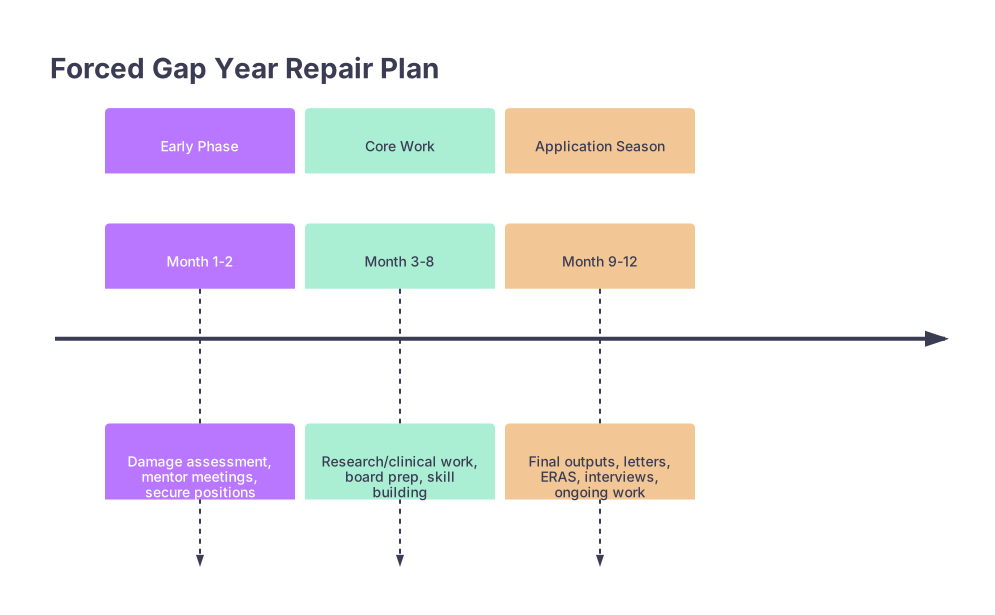
| Period | Event |
|---|---|
| Early Phase - Month 1-2 | Damage assessment, mentor meetings, secure positions |
| Core Work - Month 3-8 | Research/clinical work, board prep, skill building |
| Application Season - Month 9-12 | Final outputs, letters, ERAS, interviews, ongoing work |
3.2 Build a real weekly structure
On paper, for a typical “strong” gap year, I like to see something like:
- 35–45 hours/week: research or clinical employment
- 8–10 hours/week: board prep or structured academic work
- 2–4 hours/week: teaching/volunteering/QI projects
Not perfect. But this signals: “I can handle a resident-like workload and still improve academically.”
If you are recovering from serious health or mental health issues, you may need to ramp more slowly. Fine. Just make the ramp intentional and clearly improving, not flat.
Step 4: Directly Attack the “Board Risk” if That Is Your Weak Spot
If your red flag involves Steps or COMLEX, this is non-negotiable. A forced gap year is your chance to erase uncertainty.
4.1 Design a serious, not cosmetic, prep plan
You know the difference. A cosmetic plan is “I will do UWorld again.” A serious plan looks like:
- 2–3 NBME/COMSAE baseline assessments spaced over months
- Targeted content review schedule by system
- Daily question blocks with tracking of weak areas
- Documented adjustment after each assessment
You want data. You want to be able to say:
“My baseline NBME was equivalent to 205. Over three months of structured study, I brought this to ~230, and my final Step 2 score was 236.”
That is a recovery arc. PDs respect arcs.
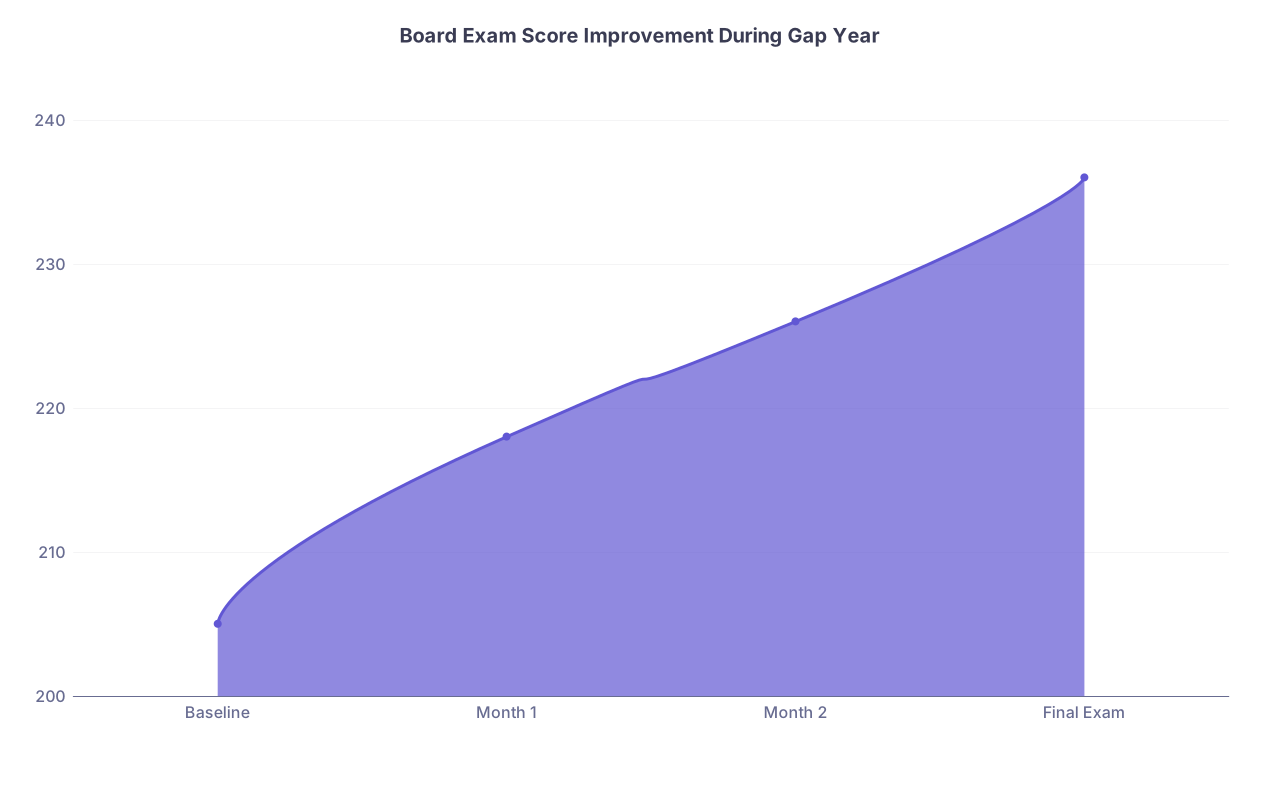
| Category | Value |
|---|---|
| Baseline | 205 |
| Month 1 | 218 |
| Month 2 | 226 |
| Final Exam | 236 |
4.2 Integrate this into your narrative
Your gap year story then sounds like:
“After failing Step 1, I took a formal leave to re-build my approach to studying. During my gap year, I structured a full-time schedule combining research with dedicated Step 2 preparation. I tracked my NBME progress monthly, adjusted based on performance, and ultimately scored a 236 on Step 2, which I believe better reflects my current readiness for residency-level learning.”
Notice what this does:
- Names the failure
- Shows a change in process, not just more time
- Ends with data, not feelings
That is the pattern you want.
Step 5: Fix the “Reliability / Professionalism” Question
If you had probations, missed deadlines, repeated courses, or LOAs that raise doubts about your reliability, you need proof of function.
5.1 Choose work that demands consistency
You will not fix a reliability concern by doing a couple of half-day clinics and random volunteer shifts.
Better choices:
- Full-time clinical research coordinator with scheduled patient visits
- MA/scribe in a busy clinic or ED
- Longitudinal teaching role (weekly small group sessions, OSCE prep, etc.)
Anything that makes:
- Other people depend on you
- Your absence or sloppiness obvious
- Your timeliness trackable
5.2 Get letters that explicitly address this
You want at least one letter that says, in essence:
“I supervise Dr. X in their role as research coordinator in our cardiology clinic. Over the past 10 months, they have been consistently reliable and professional, managing a full-time schedule with patient enrollment, data collection, and IRB documentation. They have not missed deadlines, have handled complex tasks independently, and have been one of our most dependable team members.”
You cannot write that about yourself. Someone else has to.
So early in the gap year, tell your supervisor the real story:
- “I had academic trouble; I am in a gap year.”
- “I am trying to prove that I can sustain full-time, high-reliability work.”
- “If by the end of this, you feel I have done that, I will ask you to mention it explicitly in a letter.”
Yes, it is uncomfortable. Do it anyway. It aligns your goals and theirs.
Step 6: Frame the Story in ERAS, PS, and Interviews
Now we get into the reframing part. You are not just surviving a gap year; you are building a controlled narrative.
There are three main places you tell this story:
- ERAS application (education timeline, experiences, “discrepancy” explanations)
- Personal statement
- Interviews
6.1 The structure of a good “trouble + gap year” story
Use a simple pattern:
- Brief, concrete description of the problem
- What caused it (your responsibility, not excuses)
- What you changed (systems, habits, support, mindset)
- How your gap year activities prove that change
- How this now makes you a safer, stronger resident
Example for an academic probation with repeated year:
- “During my third year, I failed two clerkships and was placed on academic probation, which required me to repeat the year.”
- “This was the result of poor time management, underestimating the clinical workload, and an unwillingness to ask for help early.”
- “I worked with our learning specialist to build a new planning system, scheduled regular check-ins with faculty, and changed my study approach from passive reading to daily practice questions and case discussions.”
- “During my gap year, I maintained a full-time schedule as a research assistant in internal medicine, while studying for and passing Step 2 with a 238, and teaching junior students in their clinical skills course.”
- “The combination of better systems and sustained full-time clinical work has made me much more organized, realistic about my limits, and ready for the consistent demands of residency.”
This is the spine. You will shorten or lengthen pieces depending on the venue.
6.2 Personal Statement: What to say and what to cut
Your personal statement is not an apology letter. If you spend 80% of it relitigating your failures, you will sink yourself.
Rough allocation:
- 15–25%: Acknowledge the issue and show the inflection point
- 50–60%: Focus on what you have done since (including the gap year) and what they show about you
- 20–30%: Why this specialty, what kind of resident you will be, what you bring
Bad version:
“I struggled and failed, but I learned a lot and grew as a person…”
Better version:
“I struggled, failed, and then deliberately rebuilt my systems and habits. My gap year was structured to test whether those changes would hold under a full-time workload. They did. Here is how.”
You do not need to pour your soul onto the page. You need to show that the pattern has changed.
Step 7: Timing and Program Strategy – Where and How You Apply
Even with a great repair year, you must be realistic about the landscape.
7.1 Understand your competitiveness post-trouble
Use your full picture:
- US vs IMG
- Specialty choice (match rates and board score expectations)
- Step/COMLEX history
- Academic record strength after the trouble
- Gap year achievements
| Profile | Risk Level | Notes |
|---|---|---|
| US MD, 1 Step fail, strong Step 2 | Moderate | Many IM/FM/psych programs open |
| US DO, repeated year, low passes | High | Focus on community / smaller sites |
| IMG, Step fail, average Step 2 | Very High | Needs heavy networking, wide net |
| US MD, LOA for health, strong after | Moderate | Clear stability + letters required |
Harsh, but accurate. You can still match from any of these, but your strategy will differ drastically.
7.2 Adjust specialty expectations if needed
Some specialties simply will not tolerate certain flags, no matter how good your story is. A single Step failure can effectively close doors in:
- Derm
- Plastics
- Ortho
- ENT
- Rad onc
- Some radiology and anesthesia programs
Internal medicine, family medicine, psychiatry, pediatrics, and many community-based programs are much more willing to look at the whole story.
If your heart is set on a historically competitive specialty and you have major academic trouble, you need a hard, honest talk with someone who knows the numbers at your school. Not rumor. Actual outcomes.
Step 8: Common Mistakes That Sabotage a Repair Year
I have seen people waste their best chance at a comeback. The patterns repeat.
Here is what wrecks you:
Vagueness
- “I had some personal issues” with no specifics
- “I struggled with time management” with no evidence of change
Over-disclosure or drama
- Dumping every detail of family conflict, relationship issues, or mental health without a clear “now stable and treated” arc
- Making the story about how unfair the system was
Passive gap year
- Low hours, scattered activities, months of nothing
- No single supervisor who can really vouch for you
Defensiveness in interviews
- Blaming school, exam format, attendings, “toxic culture”
- Arguing with feedback rather than owning obvious mistakes
Ignoring the board signal
- Step 1 fail + Step 2 barely passing = unaddressed risk
- You must show upward trend or at least solid passing performance
Avoid these and you already separate yourself from a lot of troubled candidates.
Step 9: Practical Action Plan – What You Should Do This Week
Let’s get concrete. Over the next 7–14 days, your job is to stop hand-wringing and set up the year.
9.1 This week
Write your one-paragraph “problem summary”
- One short paragraph, plain language, naming the issue and your perceived risks.
- No excuses. Just facts and ownership.
Identify 2–3 potential mentors / supervisors
- Faculty from your desired specialty
- Program directors or associate PDs who like you
- Research PIs you have worked with
Email them for a 20–30 minute meeting
- Subject: “Seeking advice on structured gap year plan”
- Attach your CV + transcript + score reports
Draft a skeleton gap year plan
- Primary objective (board vs reliability vs specialty fit)
- Possible roles (research, clinical, teaching)
- Rough weekly time blocks
Bring this plan to your meetings and ask two explicit questions:
- “Does this plan adequately address the risks in my application?”
- “What would you change to make a PD more comfortable ranking me?”
Take notes. Adjust accordingly.
9.2 Over the next month
- Lock in at least one primary full-time role
- Start board prep with a baseline assessment if applicable
- Set up a shared calendar to track your weekly schedule
- Ask your supervisor what they need from you to eventually write a strong letter
Then stick to it. Boring consistency is your friend here.
FAQ (Exactly 3 Questions)
1. Should I explicitly mention my forced gap year in my personal statement, or let programs ask about it?
Address it briefly and directly. Do not wait for them to pull it out of you. One concise paragraph acknowledging the issue, outlining what changed, and tying it to your gap year activities is enough. Then move on to why you are prepared and excited for residency. Silence breeds suspicion; controlled disclosure builds trust.
2. What if my gap year is already half over and I have not done much yet? Is it too late to repair things?
You cannot change the past six months, but you can salvage the next six. Compress your structure: prioritize a full-time, higher-responsibility role starting now, begin board prep immediately if needed, and aggressively seek one or two supervisors who can observe you consistently for at least 4–6 months. In your narrative, frame the early part of the year as “transition and regrouping,” then emphasize the structured second half.
3. How honest should I be about mental health or personal crises that contributed to my academic trouble?
Be honest, but not graphic. You are not in therapy; you are talking to an employer. If mental health or family crises played a role, you can say something like: “I had a period of significant personal and mental health challenges, which affected my performance. I received appropriate treatment, completed therapy, and have been stable for X time while handling Y workload.” The key is to convey that:
- The issue was real
- It has been treated and stabilized
- You have already “tested” your stability under a demanding schedule (ideally during this gap year)
Open a blank document right now and write your one-paragraph “problem summary” and one-page gap year plan. If you cannot put your situation and your strategy into clear, concrete language today, programs will not be able to understand it tomorrow.


