Understanding the Landscape: Cardiothoracic Surgery as a US Citizen IMG
Cardiothoracic surgery is one of the most competitive and resource‑intensive training pathways in medicine. For an American studying abroad (US citizen IMG), building an effective program selection strategy is just as crucial as having strong scores, research, and letters.
Before deciding how many programs to apply to or how to choose residency programs, you need to understand what you’re targeting.
Training pathways in cardiothoracic surgery
In the US, there are three main routes toward cardiothoracic surgery:
Integrated 6-year (I‑6) Cardiothoracic Surgery Residency
- Match directly from medical school into a 6-year cardiothoracic training program.
- Extremely competitive; small number of positions nationally.
- Heavy emphasis on academic excellence, research, and strong letters.
Traditional 5+2 Pathway (General Surgery → CT Fellowship)
- Match into a 5-year general surgery residency.
- After completion (or toward the end), match into a 2- or 3-year cardiothoracic surgery fellowship.
- Still competitive, but the initial gateway is general surgery, which has more positions.
4+3 or 3+3 Hybrid Pathways
- Jointly structured tracks that combine general surgery and thoracic training.
- Fewer positions; institutional nuances vary.
As a US citizen IMG, you can match into any of these paths, but your competitiveness and strategic positioning may differ for each. Many US citizen IMGs ultimately enter cardiothoracic surgery via general surgery first, then fellowship.
Why program selection matters even more for US citizen IMGs
Program selection is not just about prestige or city preference; it must reflect a realistic assessment of your profile and the specific barriers IMGs face:
- Some institutions or programs do not consider IMGs at all.
- Others are IMG-friendly but may have specific visa or policy constraints (less problematic for US citizens, but historical patterns matter).
- Integrated CT programs often favor US MD applicants from highly academic schools with robust research backgrounds.
Your goal is to design an application list that:
- Maximizes your interview chances.
- Balances reach, realistic, and safety programs.
- Aligns with your long-term goal: integrated CT vs general surgery → CT fellowship.
Understanding this context will shape every subsequent decision about how many programs to apply and which programs to prioritize.
Step 1: Clarify Your Path – Integrated CT vs General Surgery First
Before you build a program list, decide your primary pathway:
- Are you aiming directly for an integrated cardiothoracic surgery residency?
- Or will you pursue general surgery residency with a plan for cardiothoracic fellowship?
You can apply to both in the Match, but your strategy and messaging must remain coherent.
Candid self-assessment as an American studying abroad
As a US citizen IMG, evaluate your profile in three key domains:
Academic metrics
- USMLE/COMLEX scores (if applicable).
- Number of exam attempts.
- Clerkship performance, especially in surgery and medicine.
- Any honors/distinctions.
Cardiothoracic-relevant experience
- Research in cardiothoracic surgery, cardiovascular medicine, or related fields.
- Publications, presentations (national/international conferences).
- Hands-on exposure: electives, observerships, sub‑internships in CT or general surgery.
- Letters of recommendation from US cardiothoracic or general surgeons, especially with academic titles.
IMG‑specific strength
- US clinical experience (USCE) in core rotations.
- Evidence of adaptation to the US health system.
- Strong communication skills (evaluations, narrative comments).
Realistic targeting for integrated cardiothoracic surgery
Integrated cardiothoracic surgery residency programs typically expect:
- Top-tier exam scores.
- Significant CT-related research and scholarly work.
- Strong letters from known cardiothoracic surgeons.
- Often prior exposure at their institution (sub‑I, away rotation, or research year).
For a US citizen IMG, directly matching I‑6 is possible but uncommon without:
- Exceptional metrics (e.g., high USMLEs, robust research).
- Strong US clinical exposure at academic centers.
- Networking and advocacy from CT surgeons.
If you do not meet most of these criteria, consider:
- Applying to a limited number of integrated CT “reach” programs, while
- Primarily focusing on general surgery residency programs with proven CT fellowship pathways.
Step 2: Defining Your Program Selection Strategy
A good program selection strategy blends data, self-awareness, and logistics. For US citizen IMGs interested in cardiothoracic surgery, that means combining strict filters with targeted flexibility.
Start with the right filters
For each program category (integrated CT and/or general surgery), filter by:
IMG-friendliness
- Check program websites and historical match lists.
- Use NRMP Charting Outcomes data, FREIDA, and alumni networks.
- Look for:
- IMGs among current residents.
- Statements like “We accept IMGs” or “We have no minimum score cutoffs.”
US citizen vs visa issues
- You do not need visa sponsorship, which helps.
- Still, programs that historically accept IMGs (including those needing visas) are typically more open to non-US school graduates—beneficial for an American studying abroad.
Cardiothoracic orientation
- For integrated programs: clear CT focus is obvious.
- For general surgery:
- Presence of an in‑house cardiothoracic surgery fellowship.
- Strong cardiac or thoracic surgery volume.
- Elective rotations in CT surgery.
- Faculty with CT research interests.
- These factors shape your future heart surgery training opportunities.
Geographic and personal constraints
- Willingness to relocate anywhere vs specific regions.
- Family responsibilities, support systems, or major deal‑breakers.
- Remember: cardiothoracic is niche and competitive—overly narrow geographic preferences can be harmful early on.
Categorize programs: Reach, Realistic, and Safer
For each target list (integrated and/or general surgery), stratify programs:
Reach programs
- Historically match top-tier applicants.
- Few or no IMGs, or predominantly university-based with high research output.
- You may have a specific hook (away rotation, research there, mentor recommendation).
Realistic programs
- Match applicants with profiles similar to yours.
- Some IMGs in current or recent classes.
- Reasonable exam score expectations and stepped application policies.
Safer programs
- Community or hybrid programs.
- Higher proportion of IMGs.
- Less research-heavy but solid operative experience.
This tiered approach prevents an overly top‑heavy list and ensures you have enough programs where interviews are realistically attainable.
Balancing cardiothoracic ambitions with match safety
Your program selection strategy should explicitly acknowledge your risk tolerance:
High‑risk, high‑reward approach
- More integrated CT applications and academically strong general surgery programs.
- Appropriate if your application is very powerful (e.g., high scores, substantial CT research).
Balanced approach
- A mix: some integrated CT, strong academic general surgery programs, and several IMG-friendly community programs that still offer cardiothoracic exposure.
- Ideal for most US citizen IMGs.
Safety‑focused approach
- Primarily general surgery programs that are IMG-friendly and geographically broad.
- Selected CT or cardiothoracic‑oriented programs within that group.
In all cases, maintain a clear narrative in your personal statement(s) and interviews about why cardiothoracic surgery and how each pattern of applications supports that goal.
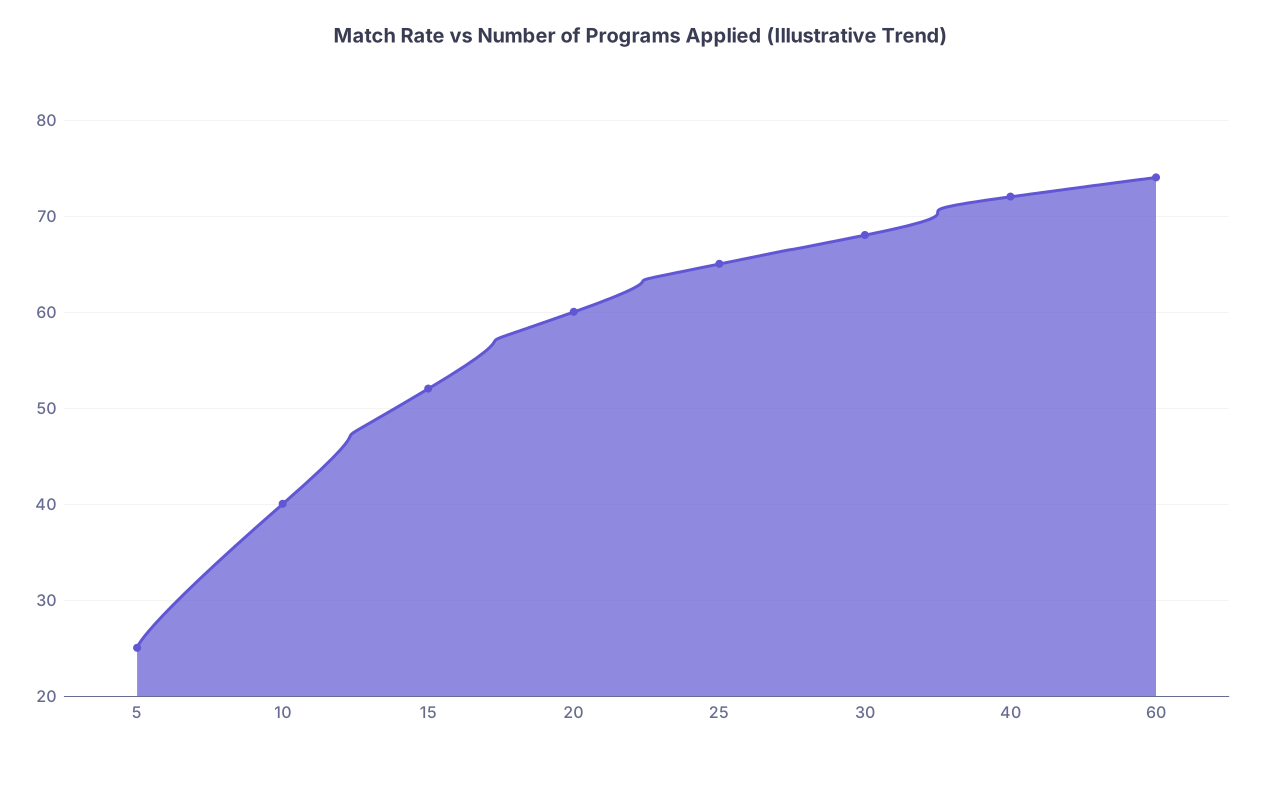
Step 3: How Many Programs to Apply To as a US Citizen IMG
The question “how many programs to apply” does not have a single number, but we can outline realistic ranges and decision points based on your profile and chosen pathway.
Integrated cardiothoracic surgery residency applications
Integrated CT programs are few in number, and each often receives hundreds of applications for a handful of positions.
For US citizen IMGs:
If strongly competitive (high scores, robust CT research, strong US letters, CT electives in the US):
- Consider applying to most or all integrated CT programs that:
- Accept or have not excluded IMGs.
- Align with your geographic preferences.
- This may be in the range of 15–25 I‑6 programs, depending on how many exist and their stated policies.
- Consider applying to most or all integrated CT programs that:
If moderately competitive:
- Apply more selectively to I‑6 programs where you have:
- Institutional connections (rotations, research, mentors).
- Evidence of IMG acceptance.
- Typical range: 8–15 I‑6 programs as “reach” options, while focusing heavily on general surgery.
- Apply more selectively to I‑6 programs where you have:
General surgery applications for CT-bound applicants
General surgery is the main gateway to heart surgery training for many IMGs.
For a US citizen IMG with a CT focus:
Highly competitive general surgery applicant
- Strong USMLE scores, significant US clinical experience, some CT or surgical research.
- Typical strategy:
- 30–45 general surgery programs, a mix of university, university‑affiliated, and community programs.
- Aim for enough breadth to secure interviews but not so many that your application becomes diluted.
Moderately competitive applicant
- Solid scores, but perhaps not stellar; some gaps in US research or fewer US letters.
- Typical strategy:
- 50–70 general surgery programs, including:
- Several academic centers with CT exposure.
- Many IMG‑friendly community or hybrid programs.
- Consider broad geographic coverage.
- 50–70 general surgery programs, including:
More challenged applicant (exam attempts, lower scores, or limited US experience)
- Still aiming cardiothoracic long‑term but with significant application risk.
- Typical strategy:
- 70–100+ general surgery programs, primarily:
- IMG‑friendly community programs.
- Places known for giving IMGs a chance.
- You can still highlight your CT interest but must prioritize matching into any solid surgical training environment.
- 70–100+ general surgery programs, primarily:
Total application volume and practical limits
ERAS fees increase progressively, and the interview season has time and financial constraints. For most US citizen IMGs:
- A combined total of 60–100 applications (I‑6 + general surgery) is common.
- Applying to substantially more may offer diminishing returns unless your profile necessitates maximal breadth.
Balance:
- Cost and burnout vs
- Risk of not matching.
If uncertain, lean slightly toward more applications rather than fewer, especially if any red flags exist (exam attempts, gaps, late graduation, etc.).

Step 4: How to Choose Residency Programs Wisely
Once you know your approximate volume target, refine how to choose residency programs one by one. This step transforms a random list into a cohesive program selection strategy.
Key factors for integrated CT programs
If you're applying to integrated cardiothoracic surgery programs, prioritize:
Evidence of IMG openness
- Does the program currently or recently have IMGs?
- Has a US citizen IMG or non‑US IMG matched there in the last 5–10 years?
Research and academic expectations
- Many I‑6 programs expect residents to be future academic leaders.
- Review:
- Research productivity of residents and faculty.
- Dedicated research years (if available or required).
- Your fit with their research interests (cardiac, thoracic, aortic, transplantation, etc.).
Clinical exposure and breadth of cases
- Adult cardiac, congenital, thoracic oncology, transplantation, mechanical circulatory support.
- Case volumes and graduated responsibility.
Culture and support
- Mentorship for IMGs and early trainees.
- Wellness culture and approach to resident development.
Key factors for general surgery with CT aspirations
For general surgery programs, think beyond “will I match” to “will this set me up for heart surgery training later?” Look for:
In‑house cardiothoracic fellowship
- Strong plus: you will have earlier exposure to CT faculty and cases.
- Access to CT conferences, research projects, and rotations.
Track record of placing residents into CT fellowships
- How many residents have gone into CT in the past 5–10 years?
- Where did they match (academic vs community, high‑volume centers, etc.)?
Operative experience
- Strong general surgery foundation is essential for future CT surgeons.
- Look at operative logs, autonomy, and complexity of cases.
Research infrastructure
- Is there active surgical or cardiothoracic research?
- Are residents expected or encouraged to publish or present?
IMG-friendliness and support
- Clear evidence of prior IMGs among residents.
- A reputation for fair treatment and inclusion.
- Faculty familiar with supporting IMGs through future fellowship matches.
Practical “red flags” to consider
When choosing where to apply, be cautious about:
- Programs explicitly stating they do not consider IMGs or require US medical school graduation.
- CT‑oriented programs with no history of accepting any IMGs despite large applicant pools.
- Surgery programs with chronically unfilled positions, high attrition, or poor supervision—these can derail your long‑term CT goals.
Step 5: Tactical Application Tips for US Citizen IMGs Aiming for CT
Having a strong list is step one. Presenting yourself well to those programs is step two.
Tailor your documents to your pathway
Personal statements
- For integrated CT:
- Emphasize your commitment to cardiothoracic surgery, early experiences, and long-term vision in heart and thoracic surgery.
- Highlight research, leadership, and maturity for an early subspecialty commitment.
- For general surgery:
- Clearly state your primary goal is to become an excellent general surgeon with a plan to pursue cardiothoracic surgery fellowship.
- Show openness to the breadth of general surgery, not just CT.
- For integrated CT:
Letters of recommendation
- Aim for at least one or two letters from cardiothoracic surgeons or cardiologists if possible, especially for integrated applications.
- For general surgery, letters from general surgeons at US institutions carry high value.
- Ensure letter writers explicitly speak to:
- Your technical skills.
- Work ethic and reliability.
- Capacity to handle a demanding surgical career.
Program-specific signals
- Use any signaling mechanisms (if available in your application cycle) strategically:
- Prioritize your strongest and most desired CT or CT-friendly surgery programs.
- If you have rotated or done research at a program, explicitly mention that and your connection in your application.
- Use any signaling mechanisms (if available in your application cycle) strategically:
Managing interviews and ranking
Once invitations arrive:
- Accept broadly at first, especially early in the season, then narrow if overbooked.
- Prioritize:
- Programs with established CT exposure and mentorship.
- IMG-friendly environments.
When ranking programs:
- Rank according to true preference, not where you think you’re more likely to match—the algorithm already accounts for that.
- For those with both integrated CT and general surgery interviews:
- Clarify your personal hierarchy:
- Would you prefer a moderate‑prestige I‑6 program over a top general surgery program?
- Or vice versa, given your long‑term academic ambitions?
- Clarify your personal hierarchy:
A clear ranking strategy prevents last‑minute stress and regret.
Putting It All Together: Example Program Selection Scenarios
To make these concepts concrete, here are three illustrative profiles of US citizen IMGs and how their program selection strategy might differ.
Scenario 1: Strong US citizen IMG with CT research
- High USMLE scores, no attempts.
- 2–3 CT-related publications, including one first-author paper.
- Sub‑I in CT surgery at a US academic center; strong letter from a CT attending.
- Fluent English, strong USCE.
Strategy:
- Integrated CT: Apply to 20 I‑6 programs, focusing on those:
- With prior IMGs or open language.
- Where your research mentors have connections.
- General surgery: Apply to 30–40 programs with:
- In‑house CT fellowships.
- Strong CT case volume.
Scenario 2: Solid US citizen IMG with some USCE, limited research
- Above-average USMLEs, but no significant CT research.
- Completed US core rotations and an elective in general surgery.
- Good letters from US surgeons, but none specifically in CT.
Strategy:
- Integrated CT: Apply to 8–12 I‑6 programs as reach options, especially where:
- You have any institutional contact or connection.
- General surgery: Apply to 50–65 programs, with:
- Mix of academic and community programs.
- Emphasis on IMG-friendliness and CT exposure.
- Focus personal statement on general surgery with a clear future CT interest.
Scenario 3: Challenged applicant with exam attempt
- One exam attempt, but passed Step 2 with a reasonable score.
- Limited USCE, no CT research, but determined interest in cardiothoracic surgery.
- Strong clinical evaluations from home school.
Strategy:
- Integrated CT: Possibly 0–5 programs only if there is a compelling connection; treat them as long‑shot reach options.
- General surgery: Apply to 80–100+ programs, emphasizing:
- IMG-friendly community hospitals.
- Any programs that have historically given chances to applicants with non‑traditional paths.
- During residency, build CT credentials through electives, research, and mentorship.
FAQs: Program Selection Strategy for US Citizen IMG in Cardiothoracic Surgery
1. As a US citizen IMG, is an integrated cardiothoracic surgery residency realistically achievable?
It is possible but highly competitive. Most I‑6 programs favor applicants with exceptional academic metrics and robust CT research from well-known institutions. As a US citizen IMG, your best chances increase if you have:
- High USMLE scores with no attempts.
- Multiple CT-related research projects or publications.
- Strong letters from US cardiothoracic surgeons.
- Prior clinical or research time at the program or similar academic centers.
If you lack several of these elements, you can still apply to a limited number of I‑6 programs as reach options, but your main strategy should likely be general surgery → CT fellowship.
2. How many programs should I apply to if I’m set on a career in heart surgery but not sure about my competitiveness?
For most US citizen IMGs:
- If moderately competitive:
- 8–15 integrated CT programs (if you have some relevant experience)
- 50–70 general surgery programs
- If unsure or with significant application weaknesses (exam attempt, older graduation):
- Possibly 0–8 I‑6 programs and
- 70–100+ general surgery programs
Adjust numbers based on honest appraisal with mentors and financial/mental bandwidth. Err on the side of slightly more programs rather than fewer.
3. Should I only apply to general surgery programs that have in‑house CT fellowships?
Not necessarily. Having an in‑house CT fellowship is helpful but not mandatory. Many residents at programs without in‑house fellowships still match into strong CT fellowships elsewhere. Key is to look for:
- Strong operative experience and broad case exposure.
- Supportive faculty interested in your CT goals.
- A track record of sending residents into CT or other competitive fellowships.
However, if you can prioritize programs with in‑house CT, it may provide earlier exposure, networking, and research opportunities in cardiothoracic surgery.
4. How can I quickly assess whether a program is IMG-friendly for an American studying abroad?
Use a multi-step approach:
Check the program website for:
- Current resident bios: look for IMGs or non-US schools.
- Any explicit mention of IMGs or international graduates.
Look at external databases (e.g., FREIDA) and discussion forums for:
- Reports of IMGs currently or previously in the program.
Ask your school’s alumni and mentors:
- Has anyone from your school or similar schools matched there?
- Any insight on how the program views IMGs?
If unclear, you may email the program coordinator with a brief, professional inquiry about whether they consider IMGs; but do this selectively to avoid overburdening programs.
By approaching residency applications with a structured program selection strategy, informed by your profile and the realities of the specialty, you can dramatically improve your chances of matching into a pathway that leads to a successful career in cardiothoracic surgery as a US citizen IMG.