Understanding the Landscape: Addiction Medicine Pathways for Caribbean IMGs
For Caribbean international medical graduates (IMGs), building a career in addiction medicine in the United States is absolutely achievable—but it requires a deliberate, informed program selection strategy. Before deciding how many programs to apply to or developing your program selection strategy, you need to understand the training pathways and how your Caribbean background fits into each step.
The Two-Step Pathway: Core Residency → Addiction Medicine Fellowship
Addiction medicine in the U.S. is primarily pursued through:
- Core Residency (ACGME-accredited) in a primary specialty, most commonly:
- Internal Medicine
- Family Medicine
- Psychiatry
- Emergency Medicine
- Pediatrics (less common but possible)
- Addiction Medicine Fellowship (ACGME-accredited), following completion of an eligible residency.
Historically, many physicians entered addiction medicine through Psychiatry → Addiction Psychiatry fellowship, but now there is a robust Addiction Medicine fellowship pathway that accepts candidates from multiple core specialties.
Why Strategy Matters More for Caribbean IMGs
As a Caribbean IMG—whether from SGU (St. George’s University), Ross, AUC, or another Caribbean medical school—you may face:
- More scrutiny of your academic record
- Greater emphasis on USMLE scores and clinical performance
- Program hesitancy about visa sponsorship
- Bias toward U.S. MD/DO graduates in competitive regions
Success stories exist—especially with strong SGU residency match outcomes—but those physicians typically:
- Understood their position in the applicant pool
- Applied broadly and strategically
- Selected programs aligned with their realistic competitiveness
- Built an early focus on substance abuse training and clinical exposure
Your goal: craft a program selection strategy that maximizes your chance to match into a solid core residency now and positions you well for an addiction medicine fellowship later.
Clarifying Your Goals: Core Residency vs Addiction Medicine Fellowship
Because addiction medicine is fellowship-level training, your program selection decisions occur in two phases:
- During core residency applications (your current focus if you haven’t matched yet)
- Later, when applying to addiction medicine fellowships
For now, your immediate strategic question is: Which residency programs should I target, and how many programs should I apply to, given my goal in addiction medicine?
Decide on Your Preferred Core Specialty
For a Caribbean IMG wanting to build a career in addiction medicine, the most common—and practical—residency choices are:
- Psychiatry
- Directest alignment with addiction care
- Strong foundation in mental health, co-occurring disorders
- Highly attractive for addiction medicine and addiction psychiatry fellowships
- Internal Medicine
- Broad medical foundation (liver disease, infectious disease, chronic disease management)
- Excellent for hospital-based or integrated addiction medicine positions
- Family Medicine
- Strong match for outpatient addiction care, primary care MAT clinics, community programs
- Ideal if you’re drawn to longitudinal patient relationships
- Emergency Medicine (more competitive for IMGs)
- Less common but relevant—frequent acute substance use presentations
- Useful if you prefer acute care settings
To decide:
- If you are drawn to mental health, psychotherapy, and psychopharmacology → Psychiatry is usually best.
- If you like complex medical management and inpatient medicine → Internal Medicine may be better.
- If you prioritize continuity of care, community health, rural settings → Family Medicine is highly suitable.
Your chosen core specialty determines:
- Which programs you target now
- Where you can pursue future addiction medicine fellowship training
- The clinical lens you bring to substance abuse training
Building a Program Selection Strategy as a Caribbean IMG
Once you’ve clarified your core specialty, the next question is how to choose residency programs and design a realistic program selection strategy. This is especially important as a Caribbean IMG from schools like SGU or other Caribbean medical schools where residency match often depends on program list quality and breadth.

Step 1: Assess Your Competitiveness Honestly
Before deciding how many programs to apply to, analyze your profile:
1. Academic metrics
- USMLE Step 1 (pass/fail) – still relevant via school performance and transcript detail
- USMLE Step 2 CK score (crucial for Caribbean IMGs)
- Any exam failures or repeats
2. Clinical performance
- U.S. clinical experience (USCE), especially:
- Sub-internships or audition electives
- Addiction, psychiatry, internal medicine, or family medicine rotations
- Evaluations and letters of recommendation (LORs)
3. Other strengths
- Research, especially in addiction, psychiatry, or public health
- Quality of personal statement with clear focus on addiction medicine
- Leadership, volunteering, work in substance abuse programs, harm-reduction orgs, AA/NA support services, or rehab centers
4. Potential red flags
- Multiple exam attempts
- Gaps in training
- Unexplained leaves or disciplinary actions
Be rigorous, not pessimistic. Use:
- NRMP Charting Outcomes (for IMGs, latest edition)
- Specialty-specific IMG match data
- Career advising from your Caribbean medical school (e.g., SGU, Ross, AUC often have detailed match guidance)
Step 2: Define Your Non-Negotiables and Preferences
For each core specialty (e.g., Psychiatry, IM, FM), write down:
Non-negotiables:
- Must accept IMGs
- Must consider your visa type (J-1 vs H-1B or none)
- Must not require US grad status only
Strong preferences:
- Programs with:
- Existing addiction medicine fellowship or strong substance abuse training
- Affiliation with addiction treatment centers, methadone clinics, or MAT programs
- Significant psychiatric or behavioral health integration if you’re not in psychiatry
- Geographic considerations:
- Willingness to live in less competitive regions (Midwest, South, smaller cities, rural areas)
- Cost of living, family ties, and support systems
Nice-to-haves:
- Strong alumni track record matching into addiction medicine or addiction psychiatry fellowships
- Faculty with published research in addiction or substance use disorders
- Protected scholarly or QI time where an addiction-related project is feasible
Step 3: Use an “IMG-Friendly + Addiction-Oriented” Filter
When compiling your list, every program should go through two filters:
IMG-FRIENDLY FILTER
- Do they list “U.S. citizen or permanent resident only”? If yes, exclude.
- Do they clearly state acceptance of IMGs / require ECFMG? If yes, keep.
- Do they require all training in the U.S.? If yes, usually a problem for IMGs unless specifically clarified.
ADDICTION-ORIENTED FILTER Scan program websites for:
- Dedicated addiction rotations, clinics, or consult services
- Affiliated addiction medicine or addiction psychiatry fellowships
- Faculty bios mentioning:
- Addiction medicine
- Substance use disorders
- MAT (medication-assisted treatment)
- Harm reduction, opioid use disorder, or public health addiction work
Programs that are both IMG-friendly and addiction-oriented go to your “highest priority” list.
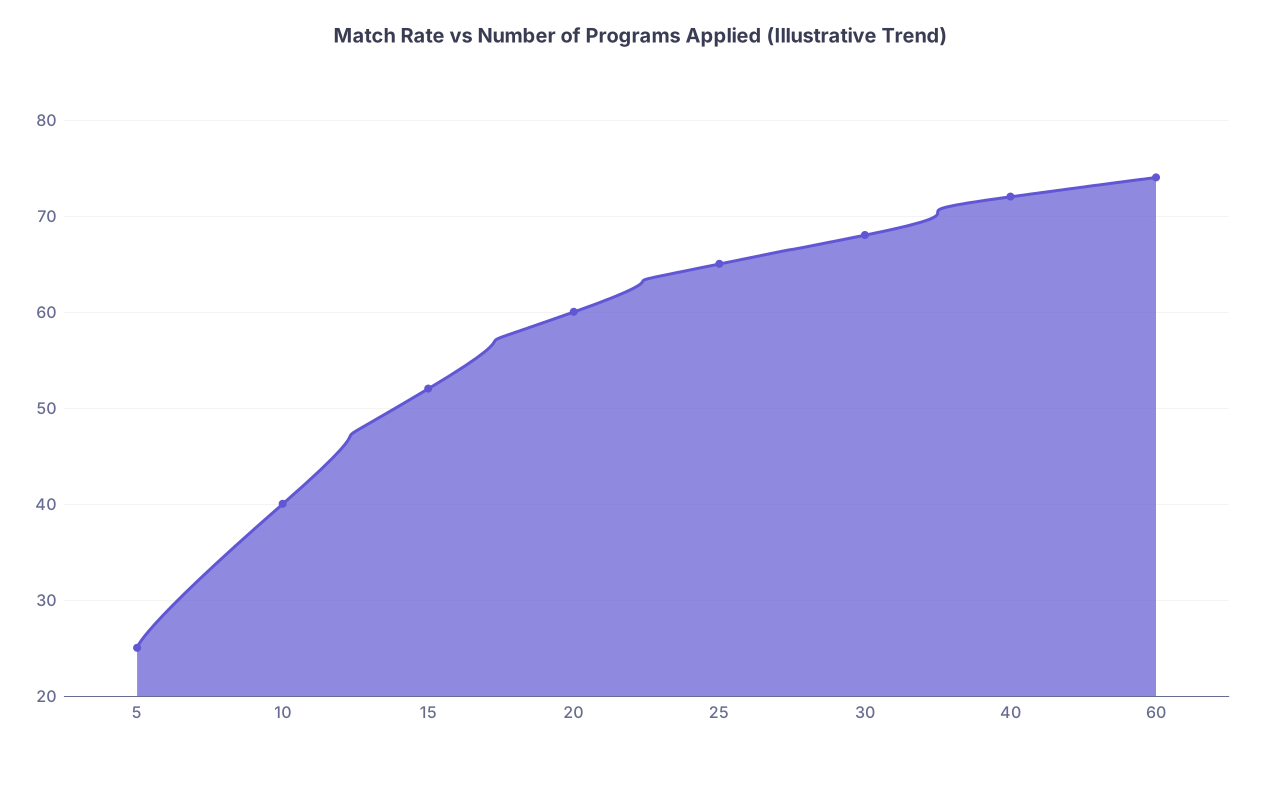
How Many Programs Should You Apply To as a Caribbean IMG?
This is one of the most important practical decisions. Your program selection strategy must balance financial cost, time, and match probability.
General Ranges for Caribbean IMGs (Core Residency)
These ranges are not absolute, but are realistic for most Caribbean IMGs targeting:
Psychiatry:
- Average Caribbean IMG: 60–80 programs
- Strong candidate (higher Step 2 CK, strong USCE, no red flags): 40–60 programs
- Weaker profile (repeats, gaps, lower scores, late graduation): 80–120 programs
Internal Medicine:
- Average: 60–80 programs
- Strong candidate: 40–60 programs
- Weaker profile: 80–120 programs
Family Medicine:
- Average: 40–70 programs
- Strong candidate: 30–50 programs
- Weaker profile: 70–100 programs
Emergency Medicine (more competitive, fewer IMG-friendly spots):
- Only if you’re genuinely strong: often 50–80 programs, but EM is riskier for Caribbean IMGs with addiction goals; many instead choose IM, FM, or Psychiatry.
These numbers assume:
- You are willing to apply across multiple states and regions
- You are open to community programs and not only big-name academics
- You prioritize matching into a solid program over “prestige”
Adjusting Based on Your Profile
Ask yourself:
Are my USMLE scores clearly above average for IMGs in this specialty?
- If yes, you can be on the lower end of the range.
- If no, you should be on the higher end.
Do I have strong, U.S.-based specialty LORs and relevant addiction exposure?
- Strong LORs + addiction experience → you can slightly reduce the number.
- Non-U.S. LORs + limited exposure → increase the number and broaden the list.
Do I have any red flags?
- Multiple attempts, exam failures, or large gaps → plan to apply broadly, near or above the top of the suggested ranges.
Am I highly geographically restricted?
- Only one or two regions → apply to more programs.
- Nationwide or nearly nationwide → standard ranges may suffice.
Cost-Benefit Consideration
ERAS fees increase as you apply to more programs, but for Caribbean IMGs, the cost of not matching is much higher (time lost, extended graduation, ECFMG issues, visa complications, burnout).
When in doubt as a Caribbean IMG—especially if not coming from a school with the strongest SGU residency match-type track record—lean toward applying to more programs, not fewer, while still being targeted and strategic.
Building a Tiered Program List Focused on Addiction Medicine
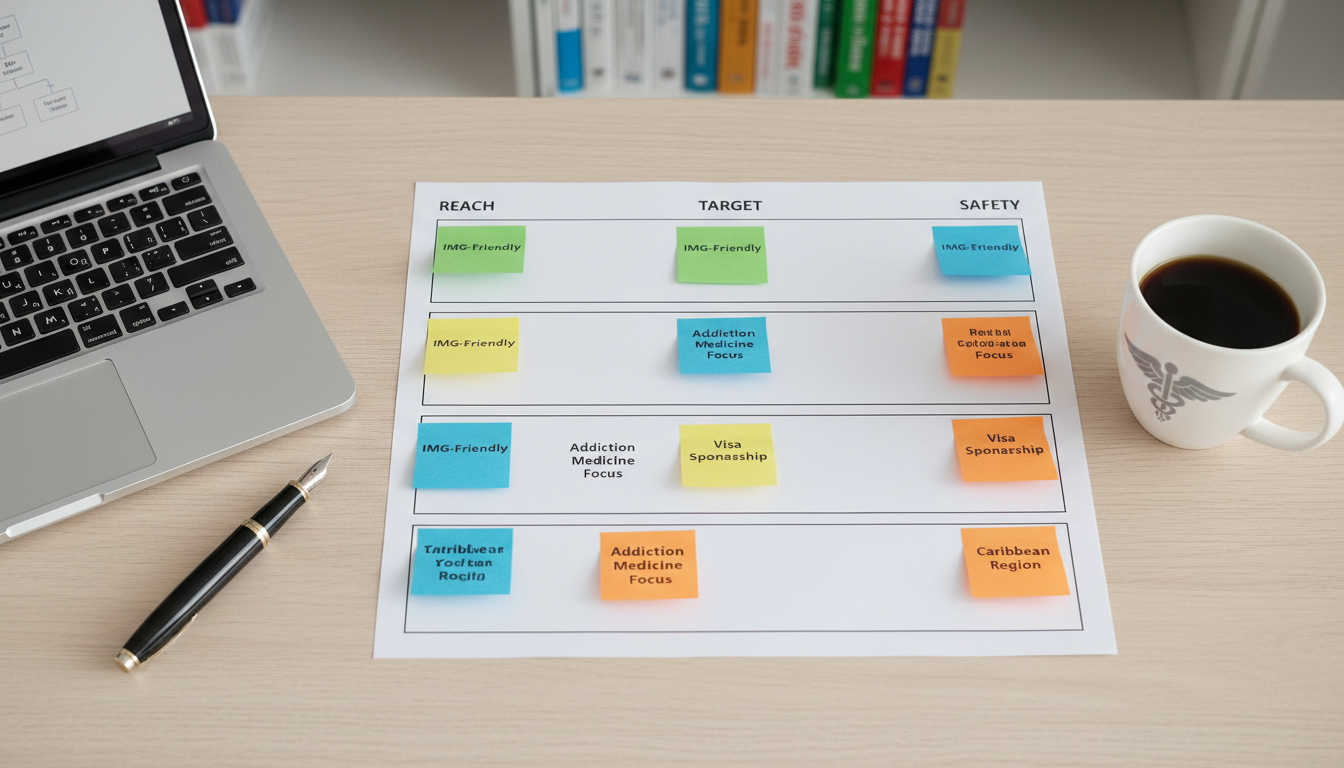
You shouldn’t treat all programs equally. A well-designed program selection strategy involves tiering your list while still applying broadly enough to be safe.
Step 1: Create Three Tiers
Based on IMG-friendliness and your profile:
Tier 1: Aspirational / Reach Programs (15–25%)
- More well-known academic centers
- Strong addiction medicine infrastructure (fellowships, research, consult services)
- Higher average board scores
- Still accept IMGs but may favor U.S. grads
Tier 2: Solid / Target Programs (40–60%)
- Community or university-affiliated community programs
- Clearly IMG-friendly with consistent prior IMG matches
- Some addiction exposure (rotations, clinics, or associated fellowship)
- Reasonable board score expectations
Tier 3: Safer / Backup Programs (25–40%)
- Strong track record of IMGs, especially Caribbean graduates
- More flexible board score thresholds
- May have less formal addiction infrastructure, but:
- Serve populations with high substance use prevalence, or
- Are open to resident-driven projects, QI, or scholarly work in addiction
You want a balance:
- Enough Tier 3 so that you maximize match odds
- Sufficient Tier 2 where you’re well-aligned
- Select Tier 1 programs that align with your addiction goals and where an IMG match is genuinely plausible
Step 2: Identify Addiction-Relevant Signals in Each Tier
For each program, note:
- Addiction Medicine or Addiction Psychiatry Fellowship On-Site or Nearby
- Big plus; increases future networking and elective opportunities
- Addiction-Focused Rotations
- Detox units, rehab centers, MAT clinics, high-volume ED with addiction consults
- Faculty Interests
- Look at program or department websites:
- “Substance use disorders”
- “Opioid use disorder”
- “Addiction psychiatry”
- “Medication-assisted treatment”
- Look at program or department websites:
- Patient Population
- County hospitals, safety-net hospitals, VA centers, and urban centers often have high prevalence of substance use disorders—even without formal addiction labels
A program with no formal addiction fellowship can still be excellent for addiction-focused IMGs if:
- The population served includes a high burden of SUD
- Faculty are supportive of your scholarly interests
- Electives can be configured to include addiction clinics, methadone programs, or community agencies
Step 3: Avoid Common Mistakes Caribbean IMGs Make
Common pitfalls in program selection strategy:
- Overfocusing on prestige
- Applying heavily to top-tier academic centers with minimal IMG matches
- Underapplying
- Applying to only 20–30 programs due to cost, drastically lowering match chances
- Ignoring visa policies
- Programs that clearly do not sponsor your visa type
- Not verifying IMG acceptance
- Some programs list IMGs historically, but now only consider U.S. grads—check the most recent resident bios
- No addiction lens
- Choosing programs solely on location or reputation, without any pathway to addiction exposure
Positioning Yourself for an Addiction Medicine Fellowship
Your program selection strategy for residency should be driven by one central question: Will this program give me the tools, exposure, and mentorship needed to be a strong applicant for an addiction medicine fellowship?
What Strong Addiction Medicine Fellowship Programs Look For
Addiction medicine fellowships (both academic and community-based) typically value:
- Solid clinical performance in your core specialty
- Evidence of genuine interest in addiction:
- Longitudinal work with SUD patients
- QI or research projects related to substance use
- Advocacy, public health, or systems-based work in addiction
- Strong letters from faculty who can speak to:
- Your clinical skills
- Your commitment to addiction medicine
- Your professionalism and teachability
Choosing Residency Programs that Facilitate Fellowship Success
Within your IMG-friendly list, prioritize programs that offer:
- Elective time early enough (PGY-2/PGY-3) to do addiction-focused rotations
- Research support:
- QI mentorship
- Basic research infrastructure
- Opportunities to collaborate on addiction-related posters or publications
- Conference Support:
- Funding or time off to attend ASAM, APA (for psychiatry), or other addiction conferences
When evaluating how to choose residency programs, ask during interviews or by email:
- “Do your residents have the opportunity to rotate through addiction treatment programs or substance use clinics?”
- “Do you have any alumni who went on to addiction medicine or addiction psychiatry fellowships?”
- “Are there faculty with a special interest in substance use disorders whom residents can work with?”
Programs receptive to these questions are more likely to support your long-term goals.
FAQ: Program Selection Strategy for Caribbean IMG in Addiction Medicine
1. Should I choose psychiatry over internal medicine or family medicine if I know I want addiction medicine?
Not necessarily. All three (Psychiatry, Internal Medicine, Family Medicine) are well-accepted backgrounds for addiction medicine fellowship. Choose based on:
- Your genuine clinical interests
- What kind of patient problems you enjoy solving
- Your competitiveness in each specialty as a Caribbean IMG
Psychiatry may be strongest if you are deeply interested in co-occurring mental illness and psychotherapy. Internal Medicine or Family Medicine may be better if you prefer medical complexity, chronic disease, and primary care models that integrate substance abuse training.
2. How many programs should I apply to if I’m a Caribbean IMG with some red flags?
If you have exam failures, multiple attempts, or significant gaps:
- Psychiatry or Internal Medicine: often 80–120 programs
- Family Medicine: often 70–100 programs
You should:
- Focus heavily on IMG-friendly community and university-affiliated community programs
- Broaden geographic scope (rural areas, smaller cities)
- Ensure your personal statement directly—but professionally—addresses red flags and demonstrates growth
3. Do I need to match into a residency with its own addiction medicine fellowship to get into addiction medicine later?
No. It’s helpful but not essential. Many fellowship directors accept strong candidates from programs without on-site fellowships, especially if you:
- Sought out addiction-related rotations
- Completed addiction-focused QI or research
- Obtained strong LORs emphasizing your commitment to SUD care
However, if two programs are otherwise similar, choosing the one with an addiction medicine fellowship or robust substance abuse training is strategically advantageous.
4. As a Caribbean IMG, is it realistic to aim for a top academic addiction medicine fellowship?
Yes—if you plan ahead. Many successful Caribbean IMGs (including from schools with good SGU residency match outcomes and others) have reached top fellowships by:
- Matching into a strong, academically oriented core residency
- Building a clear addiction portfolio (clinical, QI, research, leadership)
- Networking early with addiction faculty at national conferences
- Demonstrating excellence in patient care, professionalism, and scholarship
The key is not only where you train, but how you use your residency to build a focused profile in addiction medicine.
By approaching your residency applications with a deliberate program selection strategy—grounded in honest self-assessment, IMG-friendly filters, addiction-oriented criteria, and realistic expectations about how many programs to apply to—you can significantly increase your chances of matching and ultimately building a successful career in addiction medicine as a Caribbean IMG.