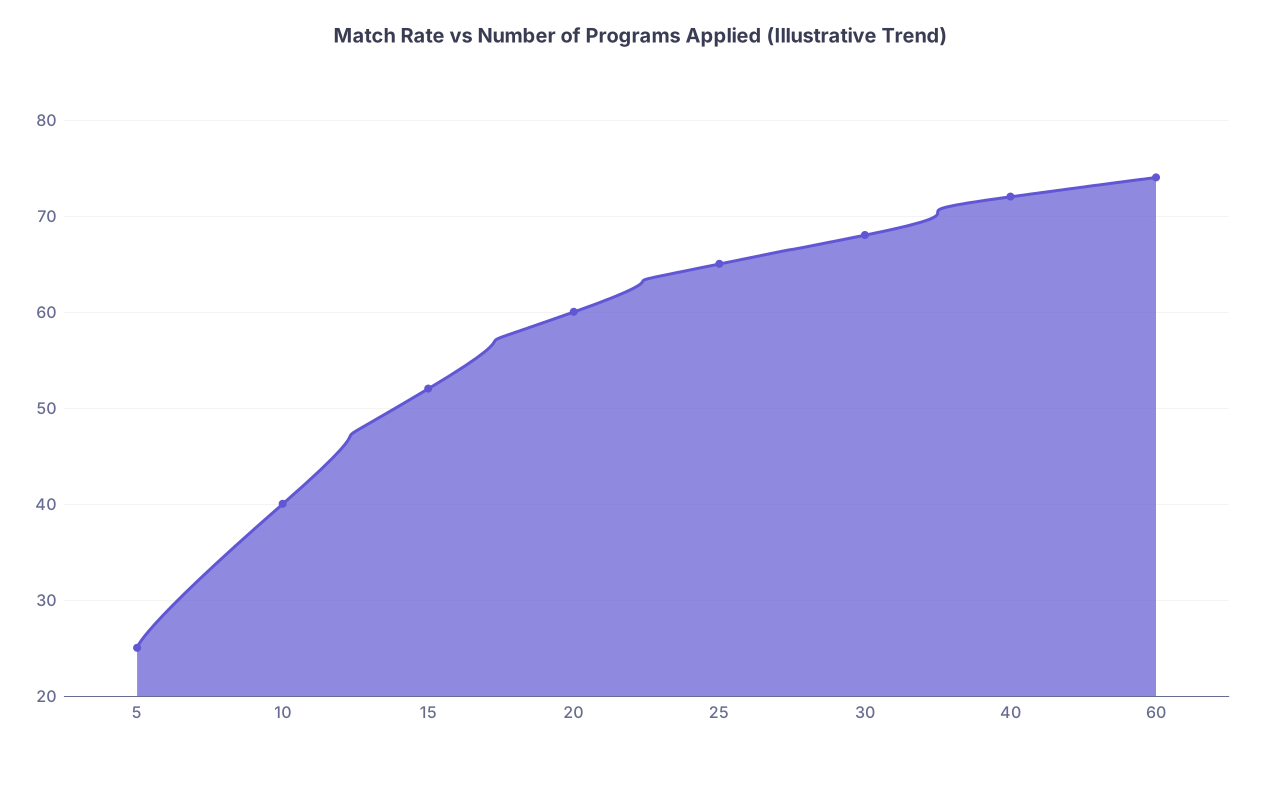
Understanding the Landscape: Otolaryngology Match as a Caribbean IMG
Otolaryngology (ENT) is one of the most competitive specialties in the U.S., and entering the otolaryngology match as a Caribbean IMG requires a very deliberate program selection strategy. You are not just asking how many programs to apply; you are asking which programs and why, while balancing cost, competitiveness, and realistic outcomes.
Key realities you should work from:
- ENT is highly competitive for everyone, but especially for IMGs (including Caribbean graduates).
- Many ENT programs either do not consider IMGs or interview them extremely rarely.
- Your Caribbean medical school residency prospects depend heavily on:
- USMLE scores (especially Step 2 CK)
- ENT-specific research and publications
- U.S. clinical experience and strong letters (ideally ENT)
- Strategic, data-driven program selection
- A strong SGU residency match track record (or from other established Caribbean schools) helps, but ENT remains an uphill climb even from the “top” Caribbean medical schools.
This article focuses on how to choose residency programs and build a data-backed program selection strategy specifically as a Caribbean IMG targeting otolaryngology, including:
- How to decide how many programs to apply
- How to segment programs into realistic tiers
- What filters to use (and which to ignore)
- How to prioritize ENT vs backup specialties
- Practical tools, examples, and step-by-step planning
Step 1: Clarify Your ENT Profile and Risk Tolerance
Before you search any programs, you need brutal clarity about your starting point. Your program list should match your objective profile, not just your dream.
1. Key Profile Components
As a Caribbean IMG pursuing an otolaryngology match, consider:
Medical school
- Is your Caribbean school relatively well-known (e.g., SGU, Ross, AUC, Saba) with an established SGU residency match or equivalent track record into competitive specialties?
- Does your school publish match lists with ENT or other surgical subspecialties represented?
USMLE scores
- Step 1: Often pass/fail now, but prior numeric scores (if applicable) still matter to PDs.
- Step 2 CK: Critical.
255: Extremely strong for an IMG; opens more doors.
- 245–255: Solid but still below some top-tier U.S. MD applicants.
- 235–245: Possible, but you’ll need exceptional research/ENT exposure and realistic expectations.
- <235: ENT becomes extremely difficult; you should strongly emphasize backup planning.
ENT-specific research
- Publications, posters, or abstracts in otolaryngology or closely related fields
- Dedicated research year(s) in ENT or head & neck surgery
- Strong letters from research mentors in ENT
Clinical experience
- U.S. ENT electives or sub-internships
- U.S. letters of recommendation from ENT faculty
- Strong evaluations and narrative comments indicating operative performance, clinical reasoning, and work ethic
Visa status
- U.S. citizen or permanent resident → fewer restrictions.
- Needing J‑1 or H‑1B visa → significantly narrows the program pool.
2. Define Your Risk Category
A simple, practical framework:
High-viability ENT IMG candidate
- Caribbean school with decent match record
- Step 2 CK ≥ 250
- ENT research (ideally ≥ 1–2 publications / multiple abstracts)
- 1–2 U.S. ENT electives with strong letters
- U.S. citizen/permanent resident or J‑1 compatible
- Realistic goal: Apply ENT broadly + strong backup specialty.
Borderline ENT IMG candidate
- Step 2 CK 238–249
- Some ENT exposure or research, but not extensive
- 1 strong ENT LOR, plus strong non-ENT academic letters
- May require broad backup strategy and possibly a research year
- Realistic goal: Very selective ENT applications + robust backup plan.
Aspiring but low-probability ENT IMG candidate
- Step 2 CK < 238 or failed attempt
- Minimal ENT research/clinical exposure
- Visa-dependent and/or low Caribbean school name recognition
- Realistic goal: ENT mainly as a long-term aspiration (e.g., through research or alternate path), with primary focus on a more attainable specialty.
Your program selection strategy and how many programs to apply in ENT and in backup specialties should match which category you fall into.

Step 2: Mapping the ENT Residency Landscape for IMGs
You can’t choose programs intelligently without understanding the otolaryngology match structure and where IMGs historically fit in.
1. Otolaryngology Program Types and Sizes
ENT programs vary by:
- Program size: Small (1–2 residents/year) vs larger (3–5/year)
- Institution type:
- Big academic centers / university hospitals
- University-affiliated community programs
- Community-focused programs with academic ties
In general:
- Large academic programs often have more research expectations but may also have more total spots.
- Smaller programs can be tight-knit but occasionally more conservative with IMGs.
2. IMG-Friendliness in Otolaryngology
While “IMG-friendly program lists” for ENT are limited and sometimes outdated, you can still infer IMG-friendliness using:
- NRMP Program Director Survey (for ENT)
- Look at attitudes toward IMGs, Step scores, research.
- Program websites and resident bios
- Scan for Caribbean or other IMG graduates over the last 5–10 years.
- FREIDA and program data
- Some list whether they sponsor visas.
- Note: Visa sponsorship ≠ IMG-friendly, but no visa sponsorship is a hard stop if you need one.
3. Realistic Expectations as a Caribbean IMG
Purely for strategy (not to discourage):
- Many ENT programs do not rank any IMGs in a given year.
- Some programs may have never matched a Caribbean IMG.
- Even with excellent metrics, you’ll be competing with:
- U.S. MDs from top schools with dedicated ENT research years
- U.S. DOs with strong research and faculty connections
- That said, IMGs (including Caribbean) do match ENT every year, typically those with:
- High Step 2 CK scores
- Significant ENT research
- Strong networking and mentorship
- Very intelligent, data-informed program selection
Your goal is not to apply everywhere blindly—it’s to identify the subset of programs where your Caribbean medical school residency application has a plausible chance.
Step 3: Building Your ENT Program List – Filters and Tiers
Now we move from concepts to a concrete program selection strategy. This is where you decide how to choose residency programs in ENT and how to structure your list.
1. Start with the Full ENT Program Universe
- Use sources like:
- FREIDA
- ACGME program directory
- Otolaryngology residency society websites
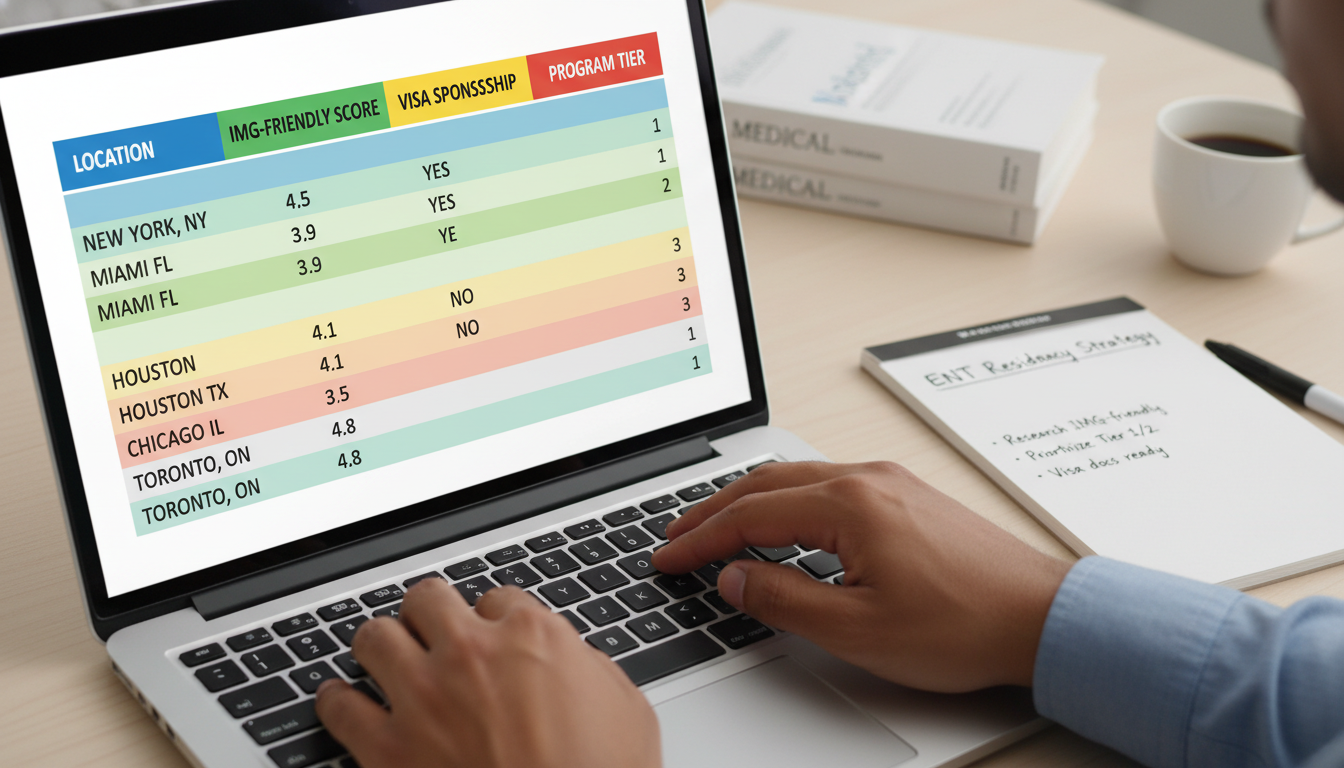
- Export or create a spreadsheet with columns for:
- Program name & location
- Program type (university, community, hybrid)
- Number of positions per year
- IMG status of past residents
- Visa sponsorship (J‑1/H‑1B)
- USMLE score unofficial thresholds (if known)
- Research emphasis (e.g., required research block, T32 grant)
- Notes (e.g., Caribbean alum, PD comments from webinars, etc.)
2. Apply Hard Filters First
Hard filters remove programs you should not spend money applying to:
Visa sponsorship
- If you require a J‑1 visa, remove all “no visa sponsorship” programs.
- If you require H‑1B, recognize that very few ENT programs sponsor H‑1B. You may need to focus heavily on J‑1 willing positions or reconsider your plan.
Stated policy on IMGs
- Some programs clearly state: “We only consider U.S. MD/DO graduates.”
- Take them at their word and exclude them.
USMLE failures
- If you have a Step failure and a program explicitly states “no failures accepted,” exclude it.
This may reduce your list by 20–40%, which is good—you’re tightening your focus.
3. Research and Identify IMG-Friendly Signals
For the remaining programs, examine:
Past residents on program websites:
- Look for any Caribbean names/schools (SGU, Ross, AUC, Saba, etc.).
- Look for non-U.S. schools—if they have matched other IMGs, it’s a positive.
Faculty or alumni connections:
- Does your ENT research mentor know anyone at that program?
- Does your Caribbean school have alumni who matched there (in any specialty)?
Program social media / webinars:
- Some PDs or programs explicitly encourage diverse applicants, including IMGs.
- Note programs that participated in IMG-oriented sessions.
Give each program an informal “IMG-openness” rating (e.g., 1–5 scale).
4. Tiering Your ENT Programs
Now group your list into tiers based on your profile and the program’s competitiveness/IMG-friendliness:
Tier 1 – Reach ENT programs
- Historically very competitive (e.g., top academic brand names, high research output).
- Little or no IMG representation, but not explicitly closed to IMGs.
- You apply here only if:
- You have very high Step 2 CK (≥255) and
- Strong ENT research and letters.
Tier 2 – Reasonable ENT targets
- University or hybrid programs with some IMG history.
- Moderate research expectations.
- No anti-IMG policy; may have one IMG every few years.
- These should be the core of your ENT list if you are a strong Caribbean IMG.
Tier 3 – IMG-friendlier ENT programs
- Programs with more than one IMG in the last decade, possibly including Caribbean grads.
- Sometimes smaller or less famous centers, but solid training.
- They may not scream “prestige” but can be your best actual chance for an otolaryngology match.
Try to distribute them roughly as:
- 20–30% Reach (Tier 1)
- 40–60% Core Targets (Tier 2)
- 20–30% IMG-Friendlier (Tier 3)
This balance may shift depending on your profile. For a borderline applicant, emphasize Tiers 2 and 3 much more heavily.
Step 4: How Many ENT Programs to Apply To (and How to Balance Backups)
The question “how many programs to apply” cannot be answered in isolation for ENT—it must be considered alongside your backup specialty plan and your financial reality.
1. General ENT Numbers for Caribbean IMG Applicants
Because ENT is highly competitive and relatively small:
- Strong Caribbean IMG ENT applicants often apply to:
- 35–60 ENT programs (depending on eligibility after filters)
- Borderline candidates may apply to:
- 20–40 ENT programs, focusing on IMG-friendlier and realistic options.
If your filtered list of ENT programs that:
- Consider IMGs
- Sponsor your visa (if applicable)
- Do not have hard score cutoffs you can’t meet
…is less than ~20, then ENT is essentially a very narrow shot, and you should put heavy emphasis on backup specialties.
2. The ENT + Backup Model
Most Caribbean IMGs targeting ENT will adopt one of these strategies:
Strategy A: ENT Primary + Surgical Backup
(For relatively strong candidates)
- ENT applications: 35–60 programs
- Backup specialty (e.g., general surgery, prelim surgery, internal medicine as a last resort): 30–60 programs, depending on competitiveness and your scores.
- Rationale:
- Keeps you in a surgical field.
- Preserves the possibility of later subspecializing (though not usually directly to ENT).
Strategy B: ENT Exploratory + Strong Primary Backup
(For borderline candidates)
- ENT applications: 15–30 carefully selected programs
- Primary backup specialty (e.g., internal medicine, family medicine, pediatrics, or another more attainable area for Caribbean IMGs): 40–80 programs, depending on scores.
- Rationale:
- Acknowledges the low probability of an ENT match.
- Ensures high likelihood of matching into a solid, realistic specialty.
Strategy C: ENT as Long-Term Goal (Heavy Backup Now)
(For low-probability candidates)
- ENT applications: 0–10 “dream” programs (optional)
- Main focus: IMG-friendly core specialties with large program numbers and IMG tracks.
- Long-term plan:
- Enter another specialty or research track.
- Explore potential (though rare) paths to ENT or related fields later.
3. Cost Considerations
ERAS is expensive. As a Caribbean IMG, you may already be carrying significant financial burden. Before finalizing your numbers:
- Estimate cost:
- ENT programs (a relatively small field) may not be as numerous as IM, but high total number of applications still add up.
- Backup specialties can easily push total applications beyond 80–100.
- Discuss with family/mentors what is realistically affordable.
- Remember: Doubling applications does not double your odds if your list is not well selected. Quality of targeting > raw number.
4. Strategic Example Scenarios
Example 1: High-viability Caribbean IMG candidate
- Step 2 CK: 256
- SGU graduate with 2 ENT publications and 1 ENT Sub-I in the U.S.
- U.S. citizen
Program strategy:
- ENT: 45 programs
- 10 Reach, 25 Core, 10 IMG-friendlier
- Backup: 35 general surgery programs with a few prelim surgery slots
- Total ~80 applications
- Heavy networking with ENT research mentors and alumni.
Example 2: Borderline Caribbean IMG candidate
- Step 2 CK: 242
- Caribbean school with moderate reputation
- 1 ENT elective, no publications yet
- Needs J‑1 visa
Program strategy:
- ENT: 25 programs
- 5 Reach, 12 Core, 8 IMG-friendlier (all J‑1 friendly)
- Backup: 60 internal medicine programs (IMG-friendly, J‑1 friendly)
- Total ~85 applications
- Focused effort on strong IM letters and a compelling personal statement that doesn’t conflict (e.g., ENT interest framed as part of broader academic curiosity).
Step 5: Fine-Tuning Your Program Selection Strategy
Once you’ve decided your approximate numbers, refine your program selection strategy to maximize interview yield.
1. Consider Geography Thoughtfully
As a Caribbean IMG:
- Being geographically flexible helps. Don’t restrict yourself to only a few states or large coastal cities.
- Include:
- A mix of urban, suburban, and some smaller city programs.
- Regions known for higher IMG representation in general (e.g., certain parts of the Midwest or South).
- Only limit geography if:
- You have strong family or visa-related reasons, or
- There are specific states with licensing issues for your school (rare for established Caribbean schools, but check).
2. Analyze “Fit” Without Self-Elimination
Avoid extreme self-elimination based on:
- Perceived prestige alone:
- Some “lower prestige” programs may be your best chance of entering ENT.
- Overreacting to research emphasis:
- Yes, ENT is research-heavy, but some programs value solid clinical work and strong letters over massive research CVs.
- Overvaluing anecdotal advice from a single person:
- One PD’s opinion is not the entire field.
Do, however, consider:
- Programs where your mentors have connections.
- Programs with clear curricula that match your interests (e.g., strong head & neck oncology, otology, pediatrics ENT).
- Programs that showcase a culture of mentorship and resident support on their websites/social media.
3. Using Personal and School Networks
As a Caribbean IMG, networking is not optional:
- Use your school’s alumni database:
- Look for ENT or surgical subspecialties, or any alumni at your target institutions.
- Ask research mentors:
- To advise which programs might be more open to your profile.
- Whether they can send an email to colleagues at a few programs to introduce your application (never demand; politely request).
- Attend ENT conferences or virtual events:
- Short, professional emails to residents or faculty can clarify whether a program has historically considered IMGs.
4. Iterative Refinement
Your list doesn’t have to be perfect in one pass:
- Start with a broad list of ENT programs that meet hard criteria.
- Narrow based on IMG-friendliness and personal priorities.
- Adjust numbers as your finances, letters, or test scores solidify.
Save a master spreadsheet you can adjust over multiple seasons if needed.
Step 6: Integrating ENT Strategy with Overall Career Planning
Your program selection strategy is not just a one-cycle decision; it may shape your early career.
1. Planning for a Research Year or Reapplication
If you apply once and don’t match to an otolaryngology residency:
- A dedicated ENT research year at a major academic center can:
- Strengthen your CV dramatically.
- Build direct PD and faculty relationships.
- Often lead to strong letters and sometimes even in-house preference.
- During a research year, you might:
- Reapply to ENT with a stronger dossier.
- Or pivot to another specialty with greater academic strength (e.g., neurology, radiology, IM subspecialties).
2. Backup Specialty as a Legitimate Career, Not Failure
For a Caribbean IMG in a highly competitive specialty like ENT, a backup is not:
- “Giving up”
- “Failing”
It’s a rational acknowledgment of the numbers.
If you enter another specialty:
- You can still:
- Incorporate ENT-related interests (e.g., allergy/immunology, pulmonology, head & neck oncology from a medical perspective).
- Build an academic career, teach, do research, or work in procedural-heavy fields.
- Your primary goal remains patient care and a fulfilling career, even if the path differs from your initial otolaryngology match plan.
3. Mindset: Strategic Optimism, Not Blind Hope
Your best posture as a Caribbean IMG targeting ENT:
- Optimistic enough to pursue ENT where there is a plausible opening.
- Strategic enough to protect your future with a strong backup plan.
- Honest enough to adjust your strategy if your scores, feedback, or finances indicate a need to pivot.
FAQs: Program Selection Strategy for Caribbean IMG in Otolaryngology (ENT)
1. As a Caribbean IMG, is ENT realistically possible, or should I not even try?
It is possible but rare. If you have:
- Strong Step 2 CK (ideally ≥250),
- Meaningful ENT research,
- U.S. ENT clinical experience and letters,
…then a targeted attempt at the otolaryngology match can be reasonable, especially if you balance it with a robust backup specialty. If your metrics are weaker and you lack ENT exposure, ENT is technically not impossible, but your chances are very low, and your focus should be on a more attainable specialty.
2. How many ENT programs should I apply to if I’m a mid-to-strong Caribbean IMG?
Assuming you are a reasonably competitive Caribbean IMG (good scores, some ENT research, at least one ENT rotation in the U.S.):
- ENT: 35–60 programs, depending on how many remain after applying your filters (IMG acceptance, visa policy, etc.).
- Backup: 30–60 programs in a more attainable specialty.
If your filtered ENT list is less than ~25 programs, treat ENT as a high-risk side attempt and put most of your resources into your backup field.
3. How do I find which ENT programs have matched Caribbean IMGs before?
Use a combination of:
- Program websites and resident bios (look for Caribbean school names).
- Your school’s match lists (SGU, Ross, AUC, etc.) and alumni networks.
- Networking with ENT faculty and residents through conferences or virtual events.
- Online forums can give hints but should be cross-verified.
Keep a simple log in your spreadsheet: “Caribbean/IMG in last 10 years: Yes/No/Unknown.”
4. Should I apply to ENT without a backup if I’m very committed to the specialty?
As a Caribbean IMG, this is extremely risky. Even the strongest applicants can go unmatched in ENT. Without a backup specialty:
- You risk being fully unmatched and losing a year.
- You may need to scramble (SOAP) into a less desirable or unrelated field in a rushed fashion.
A safer approach is to:
- Apply to ENT with a realistic range of programs, and
- Apply to a backup specialty you would be comfortable training in, with enough programs to secure interviews and a match.
A thoughtful, data-driven program selection strategy—balancing ENT aspirations, Caribbean IMG realities, and strategic backup planning—gives you the best chance of emerging from the match with both a position and a viable long-term career trajectory.