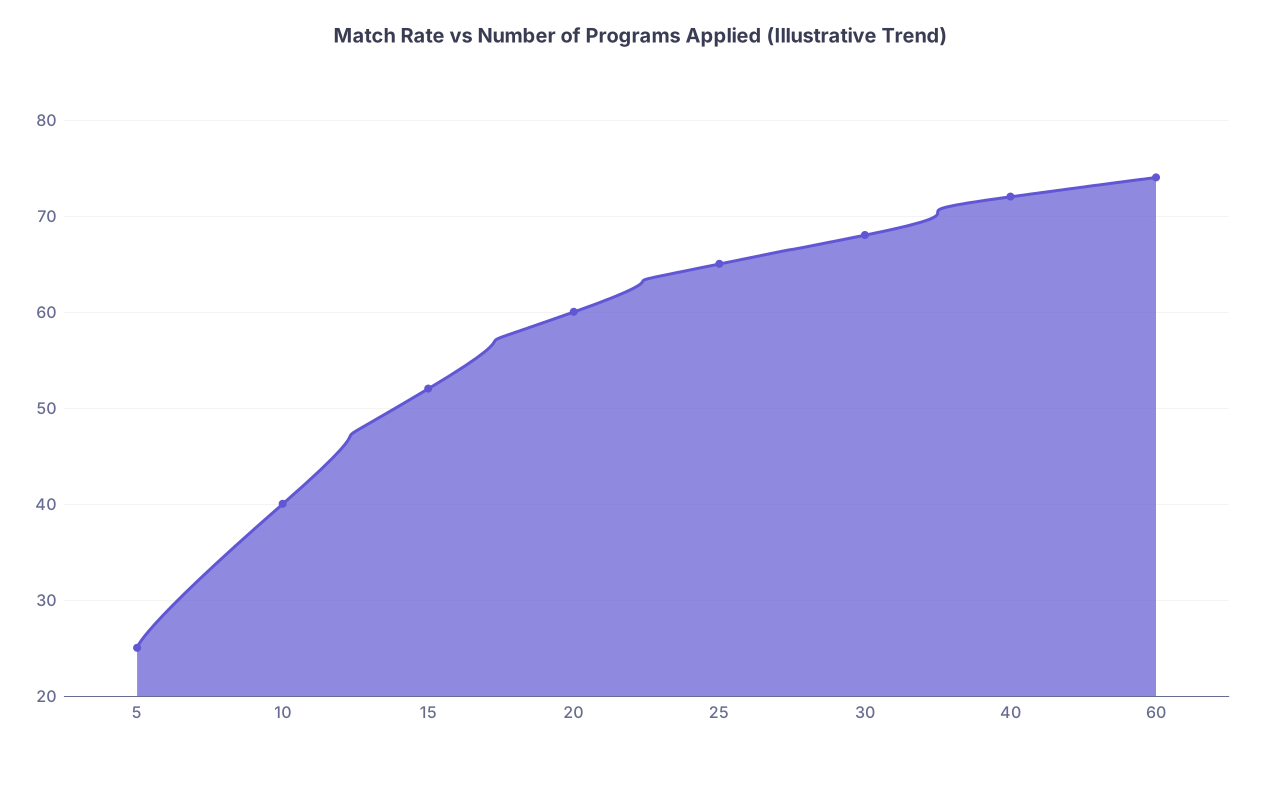
Choosing where to apply for residency is one of the highest-stakes decisions you’ll make as a Caribbean IMG. For family medicine in particular, a smart program selection strategy can make the difference between a strong FM match or an avoidable mismatch—or even going unmatched. This guide is written specifically for Caribbean graduates (including SGU, AUC, Ross, Saba, and others) planning to apply in family medicine.
You’ll learn how to build a realistic and strategic list, how many programs to apply to, how to use SGU residency match and other data, and how to assess your competitiveness honestly so you don’t under- or over-apply.
Understanding Your Starting Point as a Caribbean IMG
Before you ask how to choose residency programs, you must understand the context you’re applying in as a Caribbean IMG.
The Caribbean IMG Reality
While many Caribbean graduates successfully match into family medicine every year, you are still evaluated differently than U.S. MD and, to a lesser degree, U.S. DO graduates. Program directors often:
- View USMLE scores and clinical performance with extra scrutiny
- Prefer applicants with strong U.S. clinical experience and solid letters
- Use your medical school’s prior match outcomes as a quality signal
That doesn’t mean you can’t match well. It means your program selection strategy must be data-driven, realistic, and aligned with your specific profile.
Key Factors That Define Your Competitiveness
As you think about FM match chances, look at your application through a program director’s eyes. Core elements:
USMLE performance
- Step 2 CK is now critical (especially with Step 1 pass/fail).
- For family medicine:
- Highly competitive: 235+
- Solid/average: 220–234
- At risk: <220 or multiple attempts
Attempts and gaps
- Any exam failures or long gaps (>6–12 months) need context and explanation.
- More red flags → you should apply more broadly and to more programs.
Clinical experience
- Recent U.S. clinical rotations in family medicine or primary care are extremely valuable.
- Hands-on clerkships > observerships or shadowing, especially in FM or IM.
- Strong letters from U.S. family physicians or community preceptors are a major asset.
Citizenship/visa status
- US citizen/green card holder: More options, more IMG-friendly programs available.
- Visa requiring (J-1/H-1B): Fewer programs sponsor visas; your list must explicitly target visa-accepting FM programs.
School reputation & match history
- Some Caribbean schools (e.g., SGU) have robust match support and established relationships with FM programs.
- Use your school’s outcomes as a guide: look at where SGU residency match graduates (or peers from your school) have matched in family medicine in recent years.
Non-academic strengths
- Prior degree (MPH, nursing, pharmacy, etc.)
- Meaningful primary care, community, or volunteer experience
- Strong communication skills and U.S. cultural competence
All of these will determine how many programs to apply to and which programs should be on your list.
How Many Family Medicine Programs Should a Caribbean IMG Apply To?
This is one of the most common and anxiety-provoking questions: how many programs to apply for a Caribbean medical school residency in family medicine.
There isn’t a single perfect number, but there are solid ranges based on competitiveness and visa status.
General Ranges for Caribbean IMGs in Family Medicine
Assuming you apply only to family medicine and submit a complete application early:
Highly competitive Caribbean IMG
- Step 2 CK: 235+ (first attempt)
- No significant gaps/red flags
- Strong U.S. FM clinical experience and letters
- US citizen or green card, or straightforward J-1
- Recommended range: 35–60 FM programs
Moderately competitive Caribbean IMG
- Step 2 CK: 220–234 (first attempt)
- Minor issues or older grad, but with explanation
- Good U.S. rotations, decent letters
- Any visa status
- Recommended range: 60–90 FM programs
At-risk Caribbean IMG
- Step 2 CK: <220, or any exam failures
- Gaps in training, older graduation year, limited U.S. experience
- Visa requiring, especially H-1B only
- Recommended range: 90–120 FM programs
These numbers are intentionally broad. The FM match is more IMG-friendly than many specialties, but Caribbean graduates still face significant competition.
When to Increase or Decrease Your Application Volume
You might consider applying to more programs if:
- You require an H-1B visa
- You have exam failures or multiple attempts
- You have limited or no U.S. clinical experience
- You are >3–4 years from graduation
- You’re geographically restricted to saturated regions (e.g., Northeast only)
You might consider slightly fewer programs if:
- You have an excellent application with clear strengths in FM
- You are very flexible geographically
- You have strong connections or home/affiliated programs that reliably take graduates from your Caribbean school
- You are comfortable with a broader set of program types (community, rural, smaller hospitals)
Budget reality: ERAS fees add up quickly. For Caribbean IMGs, it is almost always better to apply slightly “too broadly” than to regret under-applying, but do try to be systematic. If your budget is tight, prioritize quality “fit” programs over raw volume.
Building a Smart Program List: Tiers, Filters, and Fit
Once you know roughly how many programs to apply, the next question is how to choose residency programs from the enormous list of family medicine sites.
Your program selection strategy should be organized and deliberate, not random.
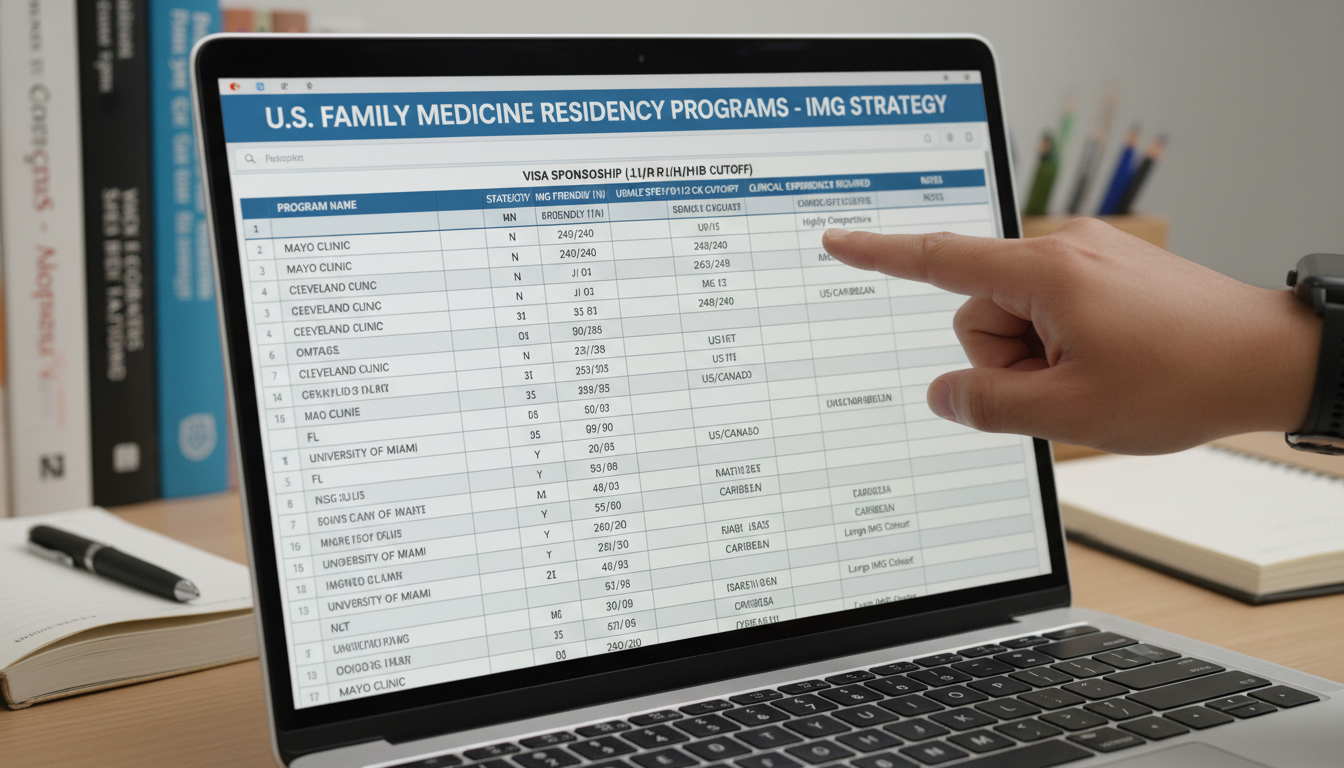
Step 1: Start with Key Eligibility Filters
Use the FREIDA database, program websites, and your school’s match office resources to create an initial pool by filtering:
Visa policy
- Do they accept IMGs?
- Do they sponsor J-1, H-1B, or both?
- Is there a recent Caribbean IMG in their resident list?
Minimum requirements
- Any explicit Step 2 CK cutoffs?
- Do they state “no more than 5 years from graduation”?
- Do they require U.S. clinical experience?
IMG-friendliness
- Percentage of current or recent residents who are IMGs
- Specifically note Caribbean IMGs, not just “foreign grads”
- Some programs list graduates from SGU, Ross, and AUC; that’s a strong signal.
Geographic tolerance
- Decide which regions are absolutely off-limits (e.g., no Midwest winters, no rural areas).
- The more flexible you are, the more options you’ll have.
This filtering step avoids wasting applications on programs that will screen you out automatically.
Step 2: Organize Programs into Tiers
After applying the basic filters, classify programs into three working tiers. This is not exact science, but a tool to balance risk.
Reach (Ambitious) Programs
- University-based or highly reputed community programs
- Lower proportion of IMGs or more competitive cutoff scores
- May favor U.S. MD/DO but sometimes take strong Caribbean grads
- Example: A large academic FM program that has 1–2 IMGs in a cohort of 10–12 residents
Target (Realistic) Programs
- Community or university-affiliated programs with a consistent record of taking Caribbean IMGs
- Requirements roughly match your exam scores and profile
- Balanced environment, decent teaching and exposure
Safety (IMG-heavy) Programs
- Programs where the majority of residents are IMGs
- Clear history of recruiting Caribbean medical school residency graduates
- Often community-based, underserved, or rural locations
- Might be less competitive, but still need adequate performance and professionalism
A common structure for a moderately competitive Caribbean IMG applying to 70 FM programs might look like:
- ~10–15 Reach
- ~35–40 Target
- ~15–20 Safety
Adjust these ratios based on your personal risk tolerance and profile strength.
Step 3: Evaluate “Fit” Beyond Numbers
Scores get you past filters; fit often gets you interviews. For each program, look at:
Mission and population
- Does the program emphasize underserved care, immigrant health, or rural medicine?
- Do these align with your background, values, or experiences?
Curriculum structure
- Strong outpatient continuity clinic?
- Inpatient vs. outpatient balance
- Opportunities in OB, pediatrics, geriatrics, addiction, procedures, etc.
Support for IMGs
- Any specific mention of mentorship or support for international graduates?
- Do current residents’ bios show fellow Caribbean IMGs thriving?
Location and lifestyle considerations
- Cost of living and realistic ability to afford life as a resident
- Climate preference (especially if you’ve spent most of your life in the Caribbean)
- Availability of family/community support
Future career goals
- If you want fellowship (e.g., sports medicine, geriatrics), see if the program has:
- Strong faculty with fellowship connections
- Graduates who went on to fellowships
- If you want outpatient primary care only, a strong clinic-based training is key.
- If you want fellowship (e.g., sports medicine, geriatrics), see if the program has:
Create a simple spreadsheet with columns like:
- State/City
- Program Type (University/Community/Rural)
- IMG % / Caribbean alumni?
- Visa Type
- Step 2 cutoff / Year of graduation policy
- Notes on fit (mission, curriculum, location)
This becomes the foundation of your program selection strategy.
Caribbean-Specific Insights: Using Match Data and SGU Residency Match Examples
As a Caribbean IMG, you have an advantage if you leverage existing Caribbean match data—especially from schools like SGU that publish detailed outcomes. Even if you’re not from SGU, this data still helps you see patterns.
How to Use SGU Residency Match and Similar Data
Many Caribbean schools publish:
- Lists of hospitals/programs where graduates matched into family medicine
- Year-by-year numbers for each specialty
- Sometimes profiles of individual graduates and their stories
Use this data to:
Identify historically friendly programs
- Programs that repeatedly appear as sites for SGU residency match in family medicine are very likely open to interviewing Caribbean grads.
- Pay attention to how many SGU or Caribbean grads they take per year.
Spot regional trends
- You might see concentration in certain states:
- New York, New Jersey, Pennsylvania
- Michigan, Ohio, Illinois
- Texas, Florida, and some Southern or Midwestern states
- These often correlate with higher IMG and Caribbean presence.
- You might see concentration in certain states:
Calibrate your expectations
- If a program regularly takes multiple SGU/Caribbean grads, it is more realistic than a well-known academic center that hasn’t taken a Caribbean IMG in years.
Practical Example
Imagine you’re a Caribbean IMG with:
- Step 2 CK: 226
- No failures, recent graduate
- 3 months of U.S. FM and IM rotations with solid letters
- Requires J-1 visa
You review SGU’s family medicine match lists and notice:
- Program A (Midwest community FM) takes 3–4 SGU/Caribbean grads almost every year.
- Program B (East Coast academic-affiliated FM) takes 1–2 Caribbean grads every couple of years.
- Program C (big-name university FM) has no Caribbean grads in the last 5 years.
Your strategy:
- Program A = Safety/Realistic – definitely include.
- Program B = Target/Light Reach – include, but don’t overload with too many such programs.
- Program C = High Reach – you might include 1–2 of these, but not base your list on them.
Even if you’re not from SGU, this pattern holds: past behavior of a program is one of the best predictors of future openness to similar applicants.

Tactical Tips to Strengthen Your Application While Selecting Programs
Program selection is only one side of the FM match equation. You can improve your odds significantly by simultaneously upgrading your application.
1. Tailor Your Personal Statement to Family Medicine
For Caribbean IMGs, a generic or vague personal statement is a missed opportunity. Aim to:
- Clearly explain why family medicine specifically (not just “I like everything”).
- Highlight experience with continuity of care, primary care, underserved populations, or community work.
- If relevant, connect your Caribbean background with care for immigrant, minority, or underserved communities in the U.S.
- Address any red flags briefly but honestly (gaps, exam failures), focusing on what you learned and how you improved.
2. Leverage U.S. Clinical Experience Strategically
Your family medicine rotations in the U.S. can be a major asset:
- Ask preceptors if they know or have connections at specific programs on your list.
- Request LORs from U.S. family physicians whenever possible.
- Emphasize any:
- Longitudinal outpatient experience
- Work with diverse or underserved patient populations
- Teamwork and interdisciplinary collaboration
When you’re thinking about how to choose residency programs, lean slightly toward sites that resemble environments where you’ve already performed well.
3. Apply Early and Completely
For Caribbean IMGs, timing can be a quiet deal-breaker:
- Submit your ERAS application as early as the system opens for submissions.
- Have:
- Personal statement
- Letters of recommendation
- MSPE and transcript
- USMLE scores uploaded
Programs frequently start reviewing applications as soon as the ERAS transmission date hits; late or incomplete files are easily overlooked.
4. Use Geographic Networks and Flexibility
Family medicine programs often have stronger ties to local schools and hospitals—but they also value committed applicants willing to serve their region.
- If you did core rotations in a certain state, weigh programs there a bit more heavily.
- Don’t underestimate smaller cities or rural areas. They often:
- Are more IMG-friendly
- Offer strong hands-on training
- Provide more interviews relative to the number of applicants
Geographic flexibility is one of the most powerful tools you have as a Caribbean IMG.
5. Reassess and Adjust Each Cycle (If Needed)
If you don’t match on the first attempt:
- Request feedback from programs where you interviewed.
- Analyze:
- Number of interviews (generally, for FM, ~10–12 interviews often correlates with high match probability).
- Where your interviews came from (safety vs. reach).
- In your next cycle, adapt:
- Increase number of applications, particularly to IMG-heavy and visa-friendly programs.
- Strengthen weaknesses (e.g., new U.S. clinical experience, additional letters, improved Step 3 if applicable).
Putting It All Together: A Sample Program Selection Strategy
Here’s a concrete example from start to finish.
Applicant Profile
- Caribbean IMG, SGU graduate (same logic applies to other schools)
- Step 1: Pass (first attempt)
- Step 2 CK: 229 (first attempt)
- Step 3: Not taken yet
- 1 year since graduation
- US citizen
- 3 months U.S. FM rotations, 2 months IM, 1 month pediatrics
- Solid letters, one from a U.S. FM program director
Strategic Goals
- Specialty: Family medicine only
- Location preference: Open to most of the U.S., except very remote rural communities
- Objective: Maximize chances of matching in first cycle while maintaining quality training
Plan
Decide application volume
- Profile = moderately competitive → target 70–80 FM programs.
Create initial list using filters
- Exclude programs that:
- Do not accept IMGs
- Explicitly require U.S. MD/DO only
- Prioritize:
- Programs with clear history of Caribbean IMGs (SGU residency match lists, program websites)
- J-1 sponsor programs (even though visa isn’t needed, this is a sign of IMG-friendliness)
- Exclude programs that:
Tier the list
- 15 Reach:
- University-affiliated programs with limited but present IMG history
- 40 Target:
- Community or university-affiliated FM programs with consistent Caribbean alumni
- 15–25 Safety:
- Community/rural programs with high IMG percentages; multiple Caribbean grads per year
- 15 Reach:
Refine for fit
- Remove programs where mission doesn’t resonate (e.g., heavy sports med focus if uninterested).
- Prioritize those with strong primary care, underserved care, or community health emphasis.
Prepare tailored materials
- One main family medicine personal statement
- Optional small modifications for certain programs (e.g., emphasize rural interest for rural-focused program)
Submit early and follow-up
- Apply on day 1 of ERAS submissions.
- Track interview offers in a spreadsheet.
- If a certain type of program (region or tier) never responds, note this pattern for future planning.
This structured approach supports a strong FM match outcome while respecting your time and finances.
FAQs: Program Selection Strategy for Caribbean IMGs in Family Medicine
1. Is family medicine a realistic option for Caribbean IMGs?
Yes. Family medicine is among the most IMG-friendly specialties, and many Caribbean graduates match into FM every year. However, “IMG-friendly” does not mean “easy.” You still need:
- Competitive Step 2 CK (or a solid explanation if lower)
- Strong U.S. clinical experience, ideally in FM
- Thoughtful, broad, and realistic program selection
- Early, complete ERAS submission
Your chances improve significantly when you apply to an adequate number of programs and focus on IMG-friendly sites.
2. How many family medicine programs should I apply to if I’m a Caribbean IMG with lower scores?
If your Step 2 CK is <220 or you have exam failures, gaps, or older graduation:
- Aim for 90–120 FM programs, with a heavy emphasis on IMG-friendly and Caribbean-friendly community or rural programs.
- Maximize U.S. clinical experience and strong letters.
- Be very flexible geographically and in the type of program you consider.
This larger number compensates somewhat for the increased likelihood of early screening at certain programs.
3. Should I take Step 3 before applying as a Caribbean IMG to family medicine?
It depends on your situation:
- If you have red flags (low scores, failed attempts, long gap), a pass on Step 3 can reassure programs about your test-taking ability.
- If your Step 2 CK is strong and you’re a recent grad, Step 3 is helpful but not mandatory for FM.
- If you require an H-1B visa, some programs prefer or require Step 3 at the time of ranking or contract signing.
Don’t delay your ERAS application to wait for a Step 3 score unless your advisors strongly recommend it based on your profile.
4. How can I identify which family medicine programs are truly IMG-friendly?
Use a combination of methods:
- Program websites: Look at current residents; count IMGs and specifically note Caribbean grads.
- School match lists (e.g., SGU residency match): Identify programs that repeatedly take Caribbean graduates in FM.
- FREIDA and third-party databases: Search filters for IMGs, visa, and program characteristics.
- Networking: Ask seniors and alumni from your school where they interviewed and matched.
Programs that consistently have multiple Caribbean IMGs in their cohorts are your best starting point when building a target and safety list.
A thoughtful, data-driven program selection strategy—grounded in honest self-assessment, informed by Caribbean match patterns, and supported by flexible geography—gives you the best chance to secure a strong family medicine residency position as a Caribbean IMG.