Understanding the Landscape: General Surgery Residency as a Caribbean IMG
For a Caribbean international medical graduate (IMG) aiming for a general surgery residency in the United States, program selection strategy is not optional—it’s the core of a successful application. The same USMLE scores and experiences can lead to very different outcomes depending on where and how you apply.
General surgery is among the more competitive specialties, and Caribbean medical school residency outcomes vary widely. While schools like SGU (St. George’s University), AUC, and Ross do place graduates into surgery, the SGU residency match data and similar reports from other schools show a pattern: candidates who match into surgery tend to have strong metrics, focused preparation, and a deliberate program selection strategy.
Before selecting programs, you need to understand:
General surgery competitiveness:
- Lower overall IMG match rate than primary care specialties
- Strong preference for US clinical experience and clear commitment to surgery
- Many programs with de facto or explicit Step 1/Step 2 CK score thresholds
Caribbean IMG perception:
- Heavier scrutiny of board scores and clinical performance
- More weight on letters from US surgeons and strong sub-internships
- Bias still exists; strategic targeting of IMG-friendly programs is crucial
Given this reality, “how many programs to apply” and how to choose residency programs aren’t abstract questions—they’re risk management decisions. Your goal is to identify enough realistic programs where your application can be seriously considered, while still including a smaller group of high-reach options that match your career goals.
In this article, we’ll walk step-by-step through a program selection strategy tailored specifically to Caribbean IMGs targeting general surgery.
Step 1: Know Your Applicant Profile Honestly
Before you can build a strategy, you need an accurate assessment of your own competitiveness. This is where many applicants overestimate or underestimate their chances.
Core Dimensions of Competitiveness
For a Caribbean IMG in general surgery, programs typically weigh these elements heavily:
USMLE Performance (Step 1 and Step 2 CK)
- While Step 1 is now Pass/Fail, programs still care about:
- Whether you passed on the first attempt
- The strength of your Step 2 CK score
- Step 2 CK often becomes the primary objective filter.
Rough guide for general surgery (for Caribbean IMGs, not set in stone):
- Highly competitive: Step 2 CK ≥ 250, strong overall profile
- Competitive: Step 2 CK 240–249, no red flags
- Borderline/moderate: Step 2 CK 230–239
- At-risk: Step 2 CK < 230, or exam failures
- While Step 1 is now Pass/Fail, programs still care about:
Academic Performance & School Reputation
- Honors in surgery clerkship and strong MS3 performance
- Being from a Caribbean school with known US presence (e.g., SGU, AUC, Ross) may help a bit relative to lesser-known schools, but doesn’t override weaker metrics.
- Class rank, Dean’s letter language, and narrative comments matter.
Clinical Experience & Sub-Internships (Sub-Is)
- US clinical rotations in surgery are critical.
- Sub-Is or acting internships (AIs) in general surgery at US hospitals are particularly valuable, especially if:
- They are at institutions with residency programs
- You performed well and obtained strong letters of recommendation
Letters of Recommendation (LORs)
- At least 2–3 letters from US general surgeons are ideal.
- Program directors (PDs) or chairs carry extra weight.
- LORs should be detailed, personal, and strongly supportive, not generic.
Research & Scholarly Activity
- Not mandatory for every community program, but increasingly important, especially for university or academic programs.
- Quality > quantity: a few strong posters, publications, or QI projects in surgery are better than a long list of unrelated items.
Red Flags
- USMLE failures or multiple attempts
- Gaps in training, professionalism issues, poor clerkship comments
- Late graduation (>3–5 years) without sustained clinical activity
Categorize Yourself Into a Competitiveness Tier
Create a simple grid for yourself:
Tier 1 (High-Reach Candidate)
- Step 2 CK ≥ 250
- Strong honors, no failures, robust US surgery exposure, strong LORs, some research
- Actively connected to mentors in surgery
Tier 2 (Solid but Not Elite)
- Step 2 CK 240–249
- Good clerkship performance, no major red flags, at least one excellent surgery Sub-I, solid LORs
- Some or minimal research
Tier 3 (Viable but Needs Heavy Strategy)
- Step 2 CK 230–239, or minor academic concerns (no major red flags)
- Adequate US rotations, at least a few solid LORs, but less standout features
Tier 4 (High-Risk Profile)
- Step 2 CK < 230, exam failure, gaps, or multiple red flags
- Limited US exposure in surgery, weaker LORs
This self-categorization will drive the answers to how many programs to apply and what kind of general surgery programs to prioritize.

Step 2: Decide How Many Programs to Apply To (By Tier)
There’s no magic number, but there are evidence-informed ranges and practical considerations for Caribbean IMGs targeting general surgery.
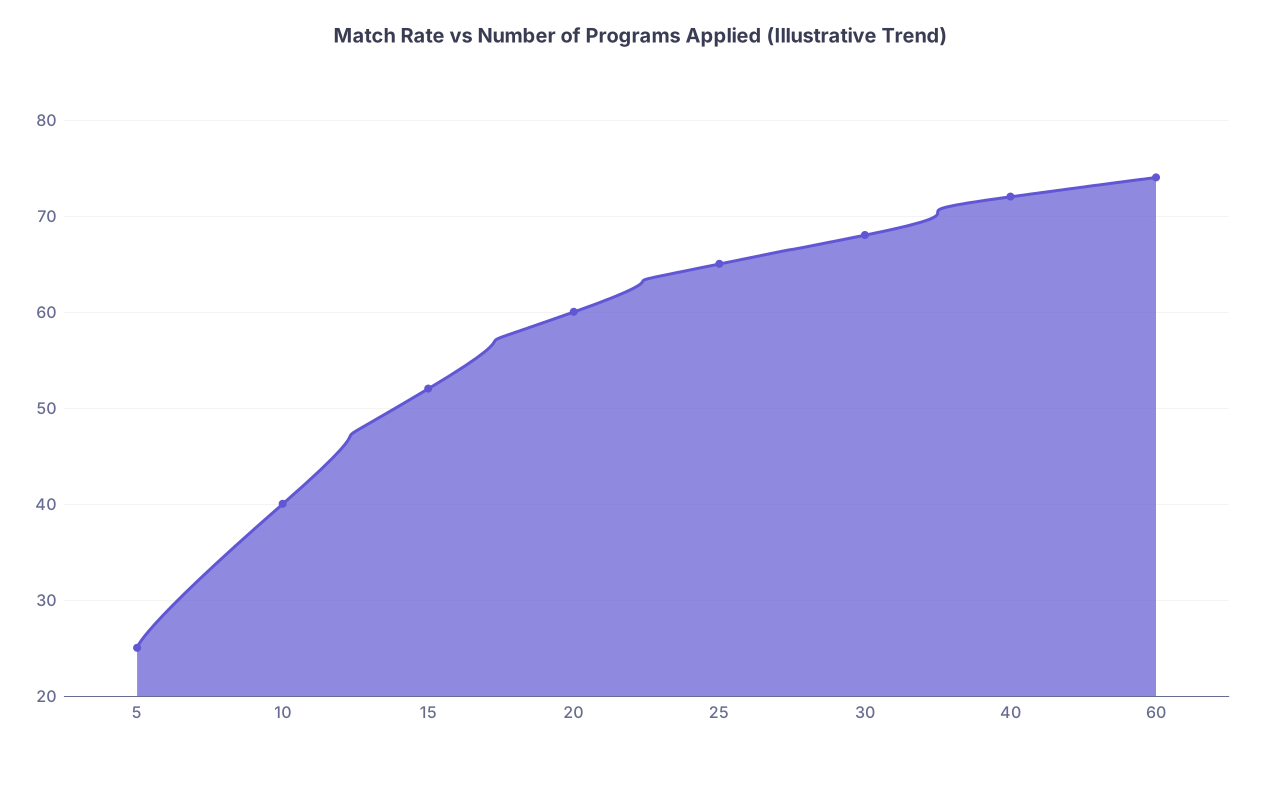
General Surgery + Caribbean IMG: Why Volume Matters
- General surgery is competitive with limited IMG spots in many programs.
- Many Caribbean applicants underestimate how many programs will screen them out automatically based on Step thresholds, IMG status, or graduation year.
- You’re competing in an environment where US MD/DO candidates are often prioritized.
For these reasons, most Caribbean IMGs applying in general surgery need to apply to more programs than a comparable US MD candidate.
Recommended Application Ranges by Tier
These ranges assume:
- You are applying only to categorical general surgery (not prelim-only), and
- You are reasonably geographically flexible.
Use this as a starting point and refine based on your situation.
Tier 1 (High-Reach Candidate)
- Typical range: 60–80 general surgery programs
- Why not fewer?
- Despite strong stats, being a Caribbean IMG still limits options at some academic-heavy institutions.
- Strategy:
- 10–15 very competitive academic programs (big-name university centers, top-tier research-heavy places)
- 25–40 mid-range university-affiliated and strong community programs that are IMG-friendly
- 20–30 solid community programs with consistent IMG intake
Tier 2 (Solid but Not Elite)
- Typical range: 80–110 programs
- Reasoning:
- You’re a credible candidate, but competition is fierce; some academic programs may filter you out.
- Strategy:
- 5–10 high-reach academic programs (mostly for upside, don’t over-invest here)
- 30–50 university-affiliated/community hybrid programs that are moderately competitive but IMG-tolerant
- 40–60 community-heavy programs known to interview or match IMGs
Tier 3 (Viable but Needs Heavy Strategy)
- Typical range: 100–140 programs
- Reasoning:
- Many programs may screen out based on score cutoffs or school type.
- You need to expand breadth while being very intentional about IMG-friendly and lower-score-threshold programs.
- Strategy:
- 0–5 high-reach programs (only if there’s a strong connection like a home rotation or LOR)
- 30–50 mid-tier but explicitly IMG-welcoming programs
- 70–90 community, smaller or more geographically distant programs that historically take IMGs/categorical surgery residents
Tier 4 (High-Risk Profile)
- Typical range: 120–160+ programs
- Reasoning:
- Higher risk of automatic screening; match probability is lower.
- Volume plus precise targeting of receptive programs becomes critical.
- Strategy:
- Focus heavily on:
- Community and hybrid programs with known Step flexibility
- Places that have taken Caribbean grads specifically
- Consider including some prelim general surgery programs to gain US experience and potentially transition later.
- Focus heavily on:
Balancing Cost vs. Benefit
ERAS applications get expensive, especially after the first 30–40 programs. For a Caribbean IMG in general surgery, however, under-applying is often more expensive in the long run if it leads to not matching.
When deciding between 80 vs. 110 programs, ask:
- Do I have red flags that many programs will filter out?
- Do I have geographic limitations that shrink my pool?
- Am I applying late, with Step 2 CK results delayed?
If yes to any of these, lean toward the higher end of suggested ranges.
Step 3: Build a Target List: How to Choose Residency Programs Strategically
Once you know roughly how many programs to apply to, the next step is program selection strategy: which specific programs make sense for your application.
1. Start With Objective Filters
Use databases like FREIDA, individual program websites, and resources from your Caribbean school’s match office (e.g., SGU residency match lists) to filter:
IMG Status
- Does the program accept IMGs?
- Do they require US citizenship or green card (affects J-1/H-1B sponsorship)?
- Check historical residents: are there IMGs in the current or recent classes?
Minimum USMLE Requirements
- Some programs list Step 1/Step 2 cutoffs.
- Others may say “no minimum” but historically only interview high scorers; check resident profiles and match lists from SGU or similar schools for clues.
Visa Policy
- For non–US citizens:
- Prefer J-1 sponsoring programs at minimum.
- H-1B availability is a bonus but more restrictive.
- For non–US citizens:
Graduation Year Limit
- Many programs have a max YOG (e.g., 3–5 years since graduation) unless substantial continuous clinical experience is shown.
Apply these hard filters to create your initial pool of programs.
2. Examine Historical IMG Friendliness
Dig deeper than “we accept IMGs”:
Look at current residents on program websites:
- Do you see Caribbean graduates (SGU, AUC, Ross, Saba, etc.)?
- Do you see non-US medical schools at all?
Cross-reference with your school’s match data:
- For example, look at SGU residency match lists in general surgery; if certain programs have repeatedly taken SGU grads, they may be more open to Caribbean IMGs overall.
- Ask your school’s career services which programs have taken your school’s graduates in general surgery over the past 3–5 years.
Create a tiered list:
- High-IMG-friendly programs: Regular Caribbean or IMG residents
- Moderately IMG-friendly programs: Occasional IMG residents
- Low-IMG-friendly programs: Rare or no IMG residents (use mostly for reach applications)
3. Classify Programs by Type and Strength
General surgery programs differ in structure and expectations:
Academic University Programs
- Large tertiary centers, heavy research, strong subspecialty exposure
- Tend to be more competitive, may favor US MD/DO
- Better suited to Tier 1 and some Tier 2 candidates
University-Affiliated/Hybrid Programs
- Community programs with a university connection
- Balance of academic exposure and hands-on experience
- Frequently more open to IMGs than pure academic powerhouses
Community Programs
- Smaller or mid-sized hospitals
- Often have more operative autonomy earlier, less emphasis on research
- Many are IMG-friendly and are main targets for Tier 2–4 applicants
Your goal is not to apply to only one type, but to align the mix with your competitiveness level and career goals.
4. Consider Geographic Strategy
General surgery programs in certain regions are more competitive simply due to desirability (e.g., major coastal cities, California, NYC). As a Caribbean IMG, you should:
- Be realistic:
- Highly sought-after regions and cities may be more IMG-resistant.
- Be opportunistic:
- Expand into Midwest, South, and less densely populated states where many high-quality but less oversubscribed programs exist.
- Tie in personal/geographic connections:
- If you did rotations or grew up in a region, highlight this in your application or supplemental ERAS responses.

Step 4: Prioritization Framework: Ranking and Balancing Your List
After building a preliminary pool, you should not treat all programs as equal. A structured prioritization system helps you aim your efforts where they matter most.
Develop a Scoring System
Use a simple spreadsheet and assign scores (e.g., 1–5) for:
IMG Friendliness
- 5 = Regular Caribbean/IMG residents
- 3 = Occasional IMGs
- 1 = No visible IMG presence
Competitiveness Fit
- Does your Step 2 CK and profile roughly match resident averages?
- Consider ACGME case volume, reputation, and fellowships as proxies.
Geographic Fit
- 5 = Strong personal ties/rotations
- 3 = Neutral
- 1 = Strong preference against living there (still may apply, but weigh lower)
Training Environment & Career Goals
- Academic vs community, trauma volume, subspecialty exposure
- Your interest in trauma, surgical oncology, vascular, etc.
Visa/Policy Compatibility (if relevant)
- 5 = J-1/H-1B friendly
- 3 = J-1 only
- 1 = No visa sponsorship
Calculate a rough composite score. This helps you:
- Identify core programs (high total score) you care most about.
- See which programs are “padding” your list (low scores but still IMG-friendly).
Balancing Reach, Target, and Safety
Within your total number of applications (e.g., 100 programs), create a balance:
Reach Programs (10–20%)
- More competitive, less IMG-friendly, or academically heavy
- Justified because you have some strong elements (scores, research, connections)
Target Programs (50–60%)
- Reasonably IMG-friendly, align with your stats and background
- These are your core realistic options
Safety-Leaning Programs (20–30%)
- Community-heavy, historically IMG-welcoming, sometimes less geographically desirable
- Do not underestimate these; they often form the backbone of successful matches for Caribbean IMGs
This balance prevents a common mistake: applying to too many glamorous programs and too few where you’d actually be strongly considered.
Step 5: Tactics Specific to Caribbean IMGs in General Surgery
Program selection is not just about numbers; it’s about how you position yourself to the programs on your list.
1. Leverage Your Caribbean School’s Network
Most major Caribbean schools have:
- Alumni networks in general surgery across the US
- Match offices and advisors who track historical residency match data by program
- Pre-existing relationships with certain institutions where they regularly send students for surgery rotations
Use this to your advantage:
- Identify alumni in general surgery and request brief informational calls or emails.
- Ask which programs have been historically welcoming and what they value.
- Use internal match data (e.g., SGU residency match outcomes) to find patterns:
- Programs with multiple SGU or Caribbean grads over several years are high-yield targets.
2. Optimize Your Sub-Internships Strategically
If you still have time before applying:
- Choose sub-Is at institutions with general surgery residencies, preferably ones that:
- Are known to interview or match Caribbean IMGs
- Accept visiting students from your school routinely
- During sub-Is:
- Be highly reliable, proactive, and professional
- Seek a strong, personalized LOR from a surgeon (ideally PD/Associate PD)
Programs where you’ve rotated and performed well rise to the top of your target list—they have seen you in action and may be more likely to interview you.
3. Tailor Your Application Materials to Your Target Programs
Your program selection strategy should inform how you present yourself:
- Emphasize experiences that match the strengths of your target programs:
- Community-oriented service? Trauma-heavy experiences? Academic research?
- For programs in regions where you have ties, clearly indicate your geographic connection in your personal statement, supplemental ERAS, or emails.
- Highlight any Caribbean-specific strengths:
- Adaptability in diverse clinical settings
- Exposure to resource-limited environments
- Resilience in navigating a non-traditional training path
4. Consider Including Prelim Positions (Selectively)
If your profile is Tier 3–4 or you have red flags, consider:
- Applying to a modest number of preliminary general surgery positions at programs where:
- Categorical residents occasionally come from their prelim pool
- You can gain robust operative/logging experience
- This does not replace categorical applications but can be a parallel back-up pathway, especially for at-risk candidates.
Step 6: Common Pitfalls to Avoid in Program Selection
Pitfall 1: Over-focusing on Reputation Only
Prestige is appealing, but as a Caribbean IMG:
- A well-run community program where you operate a lot, get strong mentorship, and match into solid fellowships can be far more valuable than an ultra-prestigious program that will never seriously consider your application.
- Many mid-tier community and hybrid programs provide excellent training and career outcomes.
Pitfall 2: Underestimating the Need for Volume
Applying to 30–40 general surgery programs as a Caribbean IMG is almost always insufficient, unless you are an exceptionally strong, nearly unique candidate. Under-applying is a frequent cause of going unmatched, even for good applicants.
Pitfall 3: Ignoring Program Signals and Data
If a program has no IMGs in the last 5 years, minimum Step 2 CK cutoffs higher than your score, and no prior Caribbean grads, it likely belongs in the “reach” or “do not apply” category, not your core target list.
Pitfall 4: Being Too Narrow Geographically
Staying only in a few high-demand cities or states can dramatically shrink your realistic chances. For general surgery in particular, casting a wide geographic net is often necessary for Caribbean applicants.
FAQ: Program Selection Strategy for Caribbean IMG in General Surgery
1. As a Caribbean IMG, how many general surgery residency programs should I apply to?
It depends on your profile, but most Caribbean IMGs should target:
- Tier 1 candidates: ~60–80 programs
- Tier 2 candidates: ~80–110 programs
- Tier 3 candidates: ~100–140 programs
- Tier 4 candidates: ~120–160+ programs
These ranges assume you are flexible geographically and applying primarily to categorical general surgery. If you have red flags, are applying late, or limit your locations significantly, lean toward the higher end of these ranges.
2. How can I identify IMG-friendly general surgery programs?
Use a combination of:
- Program websites and resident lists (look for Caribbean or other IMGs).
- FREIDA and other databases for visa and IMG policies.
- Your school’s match data (e.g., SGU residency match lists) to see where Caribbean grads have matched in previous years.
- Alumni contacts and advisors who know which programs repeatedly take IMGs.
Programs that consistently have IMGs in their resident roster, especially multiple Caribbean graduates over several cycles, are your strongest targets.
3. Should I include preliminary general surgery programs in my application?
If you are a Tier 3–4 applicant, have significant red flags, or are strongly committed to surgery but worry that categorical spots may be out of reach, applying to a smaller number of well-chosen prelim programs can be wise. Look for:
- Programs that explicitly note prelim-to-categorical transitions (even if not guaranteed).
- Strong operative experience and structured teaching.
Use prelim programs as backup or stepping-stone options, not as your only pathway.
4. Is it realistic for a Caribbean IMG to match into general surgery?
Yes—many Caribbean graduates match into general surgery each year, particularly from schools with strong US networks. However, success requires:
- Competitive Step 2 CK score and no major red flags when possible
- Strong US surgical rotations and letters
- A deliberate program selection strategy with sufficient volume
- Geographic and program-type flexibility
When you align your application strength, program targets, and number of applications, your chances of a successful surgery residency match improve significantly—even as a Caribbean IMG.
By evaluating your profile honestly, understanding the general surgery landscape, and crafting a structured program selection strategy, you can transform a daunting process into a series of deliberate, informed decisions. For a Caribbean IMG, that strategic discipline is often what separates those who match into general surgery from those who fall short despite similar credentials.