Choosing where to apply for residency is one of the most strategic—and stressful—decisions you’ll make as a Caribbean IMG interested in global health. Your program list will determine your interview opportunities, your match probability, and ultimately the kind of international medicine career you can build.
This guide walks you through a step-by-step program selection strategy specifically tailored for Caribbean medical school graduates pursuing global health–related paths.
Understanding Your Profile as a Caribbean IMG in Global Health
Before you decide how many programs to apply to or how to choose residency programs, you must realistically understand how programs are likely to view your application.
Key Factors That Shape Your Competitiveness
For Caribbean IMGs, residency selection is influenced by:
USMLE/COMLEX Performance
- Step 1 (now Pass/Fail): Programs still care about the number of attempts and how quickly you passed.
- Step 2 CK: Often the most critical score for IMGs.
- Multiple attempts or large gaps may require applying more broadly to ensure enough interview invitations.
Clinical Experience in the U.S.
- Core rotations in the U.S. (especially at teaching hospitals) are a major strength for SGU, AUC, Ross, and other Caribbean graduates.
- Sub-internships / Acting Internships (AIs) in internal medicine, family medicine, pediatrics, or emergency medicine can strongly support a global health focus if done in diverse, urban, or underserved settings.
Global Health Experience Programs interested in global health residency track applicants look for:
- Electives or projects in low- and middle-income countries (LMICs).
- Work with refugee or immigrant populations.
- Public health, epidemiology, or NGO experience.
- Quality Improvement (QI) or research with an international medicine angle.
Letters of Recommendation (LoRs)
- At least two strong letters from U.S. academic physicians in your target specialty.
- If possible, one letter from a faculty member involved in global health (e.g., director of a global health track, public health program, or international elective).
Gaps, Remediation, and Attempts
- Any study gap, leave of absence, or failed exam doesn’t disqualify you—but it changes your program selection strategy.
- The more “red flags” you have, the wider and more diverse your program list should be (including community programs and less competitive geographic areas).
Self-Assessment: Where Do You Stand?
Roughly categorize your profile:
Strong Caribbean IMG for Global Health
- Step 2 CK ≥ ~240 (or strong COMLEX).
- Passed all exams on the first attempt.
- Multiple U.S. clinical rotations with strong letters.
- Demonstrated global health involvement (research, electives, projects).
- No major red flags.
Moderate Caribbean IMG
- Step 2 CK ~220–239.
- One older attempt or minor gap, otherwise consistent.
- Some global health experience, but not extensive.
- Good clinical evaluations and at least one strong letter.
At-Risk / Underdog Caribbean IMG
- Step 2 CK < 220 or multiple attempts.
- Noticeable academic gaps or leaves.
- Limited global health experience.
- Letters adequate but not exceptional.
- You may still match—but only with a large and strategic list.
Your category will heavily influence how many programs to apply to and how much you need to adjust your expectations about “dream” vs “safe” programs.
How Many Programs to Apply To as a Caribbean IMG in Global Health
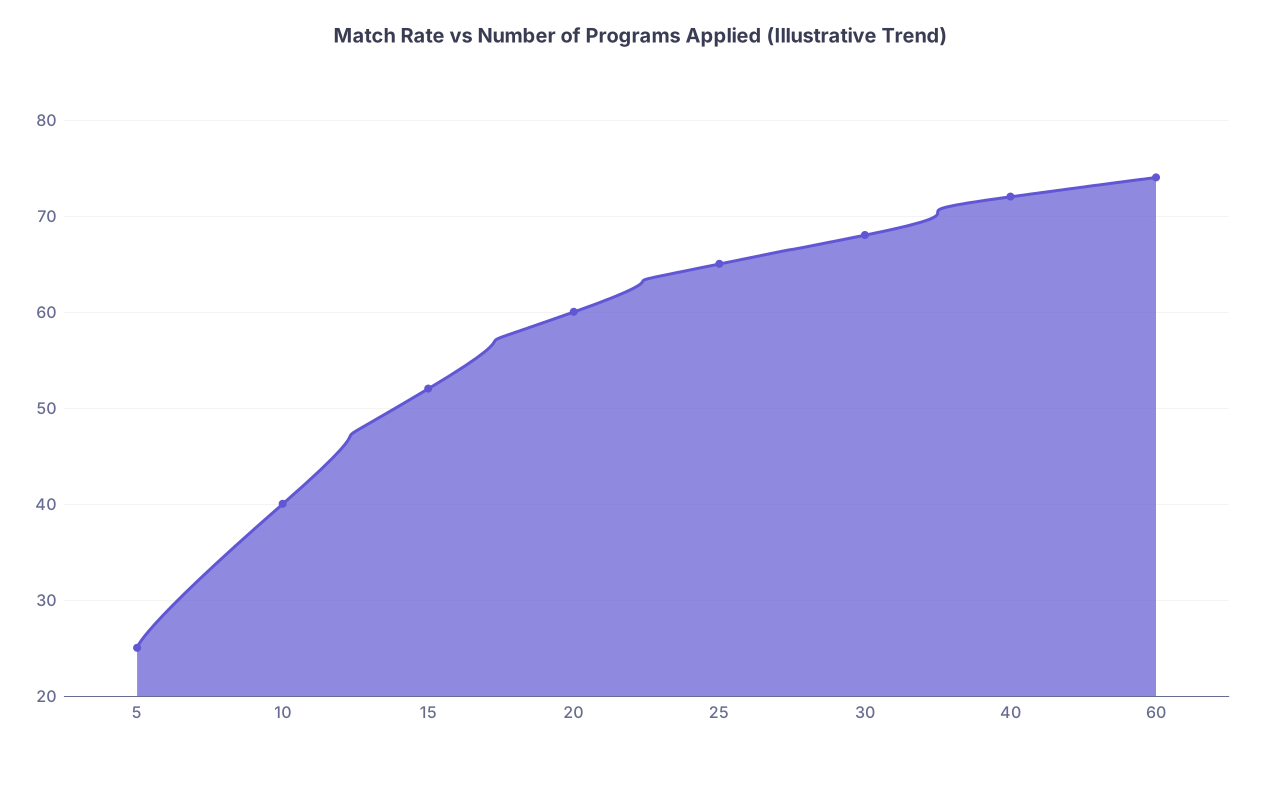
The number of applications you submit is both a financial and strategic decision. Applying to too few can risk not matching; applying to too many in an unfocused way can waste time and money without significantly improving your outcomes.
General Benchmarks for IMGs
These are ballpark ranges for total applications in primary care fields (Internal Medicine, Family Medicine, Pediatrics) for Caribbean IMGs:
Highly competitive Caribbean IMG
- Target: 40–70 programs
- Focus more on quality fit and alignment with global health interests.
Moderately competitive Caribbean IMG
- Target: 70–120 programs
- Mix of academic and community programs, broader geographic spread.
At-risk / underdog Caribbean IMG
- Target: 120–180+ programs
- Must be more flexible regarding location, program reputation, and specific global health branding.
These numbers should be further adjusted by:
- Your specialty choice
- Geographic preferences
- Presence or absence of visa needs
- How specifically you need a global health residency track, versus being open to building global health skills in more general programs.
Specialty-Driven Differences
For Caribbean IMGs pursuing global health careers, the most common residency choices are:
- Internal Medicine (IM) – for global health, infectious diseases, HIV care, health systems work.
- Family Medicine (FM) – broad global medicine, rural/underserved, primary care in LMICs.
- Pediatrics (Peds) – child/global maternal-child health.
- Emergency Medicine (EM) – humanitarian response, disaster medicine (more competitive).
- OB/GYN – maternal health in resource-limited settings (very competitive for IMGs).
Rough application ranges by specialty for Caribbean IMGs:
Internal Medicine / Family Medicine / Pediatrics
- Strong: 40–70
- Moderate: 70–120
- At-risk: 120–180+
Emergency Medicine, OB/GYN, or combined/prestigious global health programs
- Strong: 60–100
- Moderate: 100–160
- At-risk: Often requires parallel planning (e.g., also applying to IM or FM).
If you are an SGU residency match hopeful with a strong record, you can afford to target fewer, better-fit programs. If you’re less competitive or at a smaller Caribbean medical school, increase the total number and range of programs.

Finding Programs That Support Global Health Careers
You do not need to match into a formal global health residency track to build a successful global career—but it helps to train somewhere that supports international and underserved work.
Types of Programs to Consider
Programs with a Named Global Health Track
- Internal Medicine, Family Medicine, or Pediatrics with a:
- “Global Health Track”
- “International Health Track”
- “Health Equity and Global Medicine Pathway”
- Look for program websites mentioning:
- International rotations (e.g., Haiti, Kenya, Guatemala, India).
- Strong connections with NGOs or global health institutes.
- Dedicated global health faculty or fellowship.
- Internal Medicine, Family Medicine, or Pediatrics with a:
Programs with Strong Underserved/Community Focus
- Even without “global health” in the title, programs that:
- Serve high proportions of immigrant, refugee, or limited-English-proficiency populations.
- Emphasize health disparities, public health, or population health.
- Urban county hospitals and some rural programs often mirror global health challenges: resource limitations, social determinants, multidisciplinary care.
- Even without “global health” in the title, programs that:
Academic vs Community Programs
- Academic programs:
- More likely to have formal global health tracks, research, and fellowships.
- Often more competitive for Caribbean IMGs, but not impossible—especially if you have a strong global health CV.
- Community programs:
- May allow maximum flexibility in electives.
- Can still support international medicine if they encourage away rotations, global electives, or mission work on vacation time.
- Academic programs:
Researching Programs Efficiently
Use a structured method to research and shortlist programs:
Start with Official Databases
- AAMC’s Residency Explorer (if available to you).
- FREIDA Online (AMA) to filter by:
- Visa sponsorship (if needed).
- Program size.
- Academic vs community.
Program Websites & Global Health Clues On each program’s site, specifically look for:
- “Global Health” or “International Health” track descriptions.
- Mentions of:
- Rotations in other countries.
- Telehealth or cross-border care.
- Refugee/immigrant clinic affiliations.
- Photos and bios of faculty doing:
- International research
- Public health
- Humanitarian work
Talk to People
- Current residents (especially IMGs) via:
- Program open houses.
- Social media (Twitter/X, LinkedIn).
- Alumni from your Caribbean medical school who matched there:
- Ask: “How supportive is the program of global health interests?”
- Current residents (especially IMGs) via:
Signal vs Reality Some programs heavily market “global health” but offer:
- Only 1–2 elective slots abroad per year. Others may not brand themselves as global health programs but:
- Have attendings doing global research.
- Serve immigrant-heavy communities.
- Provide robust public health or community medicine training.
Build a simple spreadsheet capturing:
- Program name
- Location
- Size
- IMG friendliness (Yes/Some/No)
- Visa support (J-1/H-1B/No)
- Explicit global health track (Yes/No)
- Underserved / safety-net setting (Yes/No)
- Personal notes
This will guide your program selection strategy and help you prioritize where to send personalized messages or tailor your personal statement.
Building a Balanced Program List: Reach, Target, and Safety
Your final list should not be made up solely of dream global health residency track programs at big-name academic centers. As a Caribbean IMG, you must be intentional and realistic.
Three Tiers of Programs
A practical distribution:
Reach Programs (15–25%)
- Highly academic, prestigious, or very selective.
- Leading academic medical centers with robust global health infrastructure.
- May have limited IMG slots—but not zero.
- Examples (not exhaustive; for structure only):
- University-based programs with global health institutes.
- Combined internal medicine–pediatrics with global focus.
Target Programs (40–60%)
- Good academic or hybrid academic-community programs.
- Historically accept some IMGs, including Caribbean graduates.
- Offer:
- International electives, or
- Strong underserved care exposure.
- Reasonable alignment with your Step 2 CK and profile.
Safety Programs (25–35%)
- Programs with a strong history of accepting Caribbean IMGs.
- Often community-based or less geographically competitive regions.
- May not explicitly brand a global health track but allow:
- Flexible electives.
- Support for international rotations using vacation or elective time.
Adjusting Tiers by Competitiveness
Strong Caribbean IMG
- Reach: ~25–30%
- Target: ~50%
- Safety: ~20–25%
Moderate Caribbean IMG
- Reach: ~15–20%
- Target: ~50–60%
- Safety: ~25–35%
At-risk Caribbean IMG
- Reach: ~10–15% (to keep some aspirational options)
- Target: ~40–50%
- Safety: ~35–50% (many programs in areas with lower applicant demand)
Geography: Where You’re Willing to Train
The more rigid you are about location, the more programs you’ll need to apply to in that region—and the more you risk not matching.
For Caribbean IMGs interested in global health:
High-demand cities (NYC, Boston, California, DC, Seattle, etc.)
- Very popular among both AMGs and IMGs.
- Academic global health programs here are often reach-level.
- Apply if you have strong ties or exceptional global health experience, but do not over-concentrate here.
Midwest, South, and some parts of the Northeast
- Often more IMG-friendly.
- Many programs serving refugee, immigrant, or underserved communities.
- Excellent places to get strong clinical training, then pursue global health fellowships or positions later.
A strong program selection strategy for Caribbean IMGs usually includes:
- A mix of urban safety-net hospitals, mid-sized cities, and less competitive states.
- Fewer applications in ultra-competitive coastal metropolitan areas unless you are a very strong applicant or have strong personal ties.

Integrating Global Health Goals into Your Application Strategy
Your program list should align with your global health ambitions, but your application materials must communicate this clearly and credibly.
Using Global Health to Strengthen, Not Narrow, Your Chances
If you insist on only programs with formal global health residency tracks, your list may become dangerously small and competitive. Instead:
- Make global health a central narrative of your application:
- Personal statement.
- CV.
- Interview responses.
- But apply broadly to:
- Programs with strong underserved care.
- Programs with diverse patient populations.
- Programs with elective flexibility that lets you go abroad.
You can often build a global health career from:
- Internal Medicine + Infectious Disease.
- Family Medicine + additional global health fellowship.
- Pediatrics + global health track/fellowship. even if your core residency isn’t explicitly branded as “global health.”
Tailoring Your Materials by Program Type
For Explicit Global Health Programs
- Use a personal statement version that:
- Highlights your concrete experience (not just travel).
- Connects your work in Caribbean settings, electives, or NGOs to future goals.
- Emphasize:
- Long-term commitment (not “medical tourism”).
- Sustainable partnership mindset.
- Interest in health systems, policy, or community engagement.
- Use a personal statement version that:
For Community / Underserved-Heavy Programs
- Emphasize:
- Work with vulnerable populations (homeless clinics, FQHCs, community outreach).
- Language skills (e.g., Spanish, French, Haitian Creole) as assets.
- Adaptability and comfort caring for diverse patient groups.
- Emphasize:
For Programs Without Clear Global Branding
- Focus on:
- Interest in excellent core clinical training.
- Desire to work with diverse or underserved patients.
- Your plan to incorporate global health through:
- Electives.
- Research collaborations.
- Post-residency fellowships.
- Focus on:
Strategic Use of Signals (If Applicable)
If your specialty uses preference signals (e.g., in some pilot programs):
- Use signals on:
- Programs that are true top choices.
- Programs with global health residency tracks where you would absolutely attend if matched.
- Avoid using signals on:
- Ultra-reach programs where you are statistically unlikely to be ranked highly.
- Programs you wouldn’t be happy training at despite global branding.
Practical Steps to Build Your Program List
To make the process manageable, approach it in stages.
Step 1: Define Your Non-Negotiables
List your absolute requirements, such as:
- Specialty (IM vs FM vs Peds vs EM).
- Visa support (if needed: J-1 vs H-1B).
- Deal-breaker locations (e.g., cannot live in extremely rural areas due to family).
- Program type: Are you okay with community-based? Or strictly academic?
Step 2: Generate a Broad List
Start with:
- 150–250 programs that:
- Accept IMGs.
- Meet your visa and specialty criteria.
- Are not obviously out-of-range (e.g., top 10 highly selective programs if your scores are average).
Use:
- FREIDA filters.
- Lists from your Caribbean school’s match outcomes (e.g., SGU residency match lists by specialty and state) to find historically IMG-friendly institutions.
Step 3: Score Programs Based on Fit
Create simple scoring (1–5) in columns for:
- IMG Friendliness
- Global Health / Underserved Alignment
- Geographic Acceptability
- Program Reputation/Training Quality
- Personal or family ties
Total score each program; this helps you prioritize.
Step 4: Narrow to a Realistic Application Count
Using your competitiveness category:
- Strong IMG: Narrow to 40–70.
- Moderate IMG: Narrow to 70–120.
- At-risk IMG: Narrow to 120–180+.
Ensure:
- You include enough safety programs.
- You are not overloading your list with super-competitive academic global health residency track programs only.
Step 5: Final Sanity Check
Ask yourself:
- If I only got interviews from my safety programs, would I still be willing to train there?
- Does my list have:
- At least 10–15 realistic safety options (for moderate/at-risk applicants)?
- A geographically diverse spread?
- A mix of academic and community programs?
If not, revise.
FAQs: Program Selection Strategy for Caribbean IMG in Global Health
1. Do I need to match into a formal global health residency track to build a global health career?
No. A global health residency track is helpful but not mandatory. Many leaders in international medicine trained in standard Internal Medicine, Family Medicine, or Pediatrics programs and then:
- Took international electives during residency.
- Completed a global health fellowship after residency.
- Worked with NGOs, WHO, CDC, or academic global health centers later.
Prioritize strong foundational clinical training, exposure to diverse/underserved populations, and opportunities for global or public health electives, even if the program doesn’t have a named track.
2. As a Caribbean IMG, should I still apply to top academic global health programs?
Yes—but strategically and in moderation.
- If you have a strong profile (high Step 2 CK, robust global health CV, strong letters), include a handful of top academic programs as reach options.
- If your profile is average or below average, apply to a small number of these as aspirational programs, but do not build your list around them.
- Make sure the majority of your applications go to programs where Caribbean IMGs have matched before, including a solid number of safety options.
3. How important is location for building a global health career?
Location matters, but often less than:
- The training quality.
- The patient population (diverse, underserved, immigrant, or refugee populations).
- The flexibility for international electives.
- Access to mentors involved in global or public health.
Matching in a midwestern or southern city with a robust underserved population and supportive faculty can be far better for your global health development than being in a big coastal city that offers limited opportunities for IMGs to engage in international work.
4. If I have exam attempts or academic gaps, do I still have a chance to pursue global health?
Yes—but you must:
- Be realistic and strategic about your program list size (likely larger—120+ programs).
- Focus on:
- IMG-friendly, community-based, or hybrid programs.
- Locations that historically accept more IMGs.
- Strengthen your application through:
- Solid U.S. clinical experience.
- Strong, supportive letters.
- Demonstrated commitment to underserved work or global health, even if local (e.g., refugee clinic, community outreach).
Once matched and well-trained, you can still build a global health career through electives, fellowships, NGOs, and public health work.
By combining a realistic self-assessment, thoughtful program research, and a disciplined program selection strategy, you can maximize your chances of matching as a Caribbean IMG in a residency that supports your long-term global health goals—whether or not it has “global health” in its title.