Understanding the Residency Landscape as a Caribbean IMG
For a Caribbean international medical graduate (IMG) targeting internal medicine, smart program selection can be the difference between a strong IM match and an unsuccessful cycle. You cannot afford a random or purely prestige-driven approach. Instead, you need a data-informed, realistic, and strategic plan tailored to:
- Your academic profile and exam scores
- Your clinical experiences and letters
- Your visa and geographic constraints
- The current competitiveness of internal medicine residency
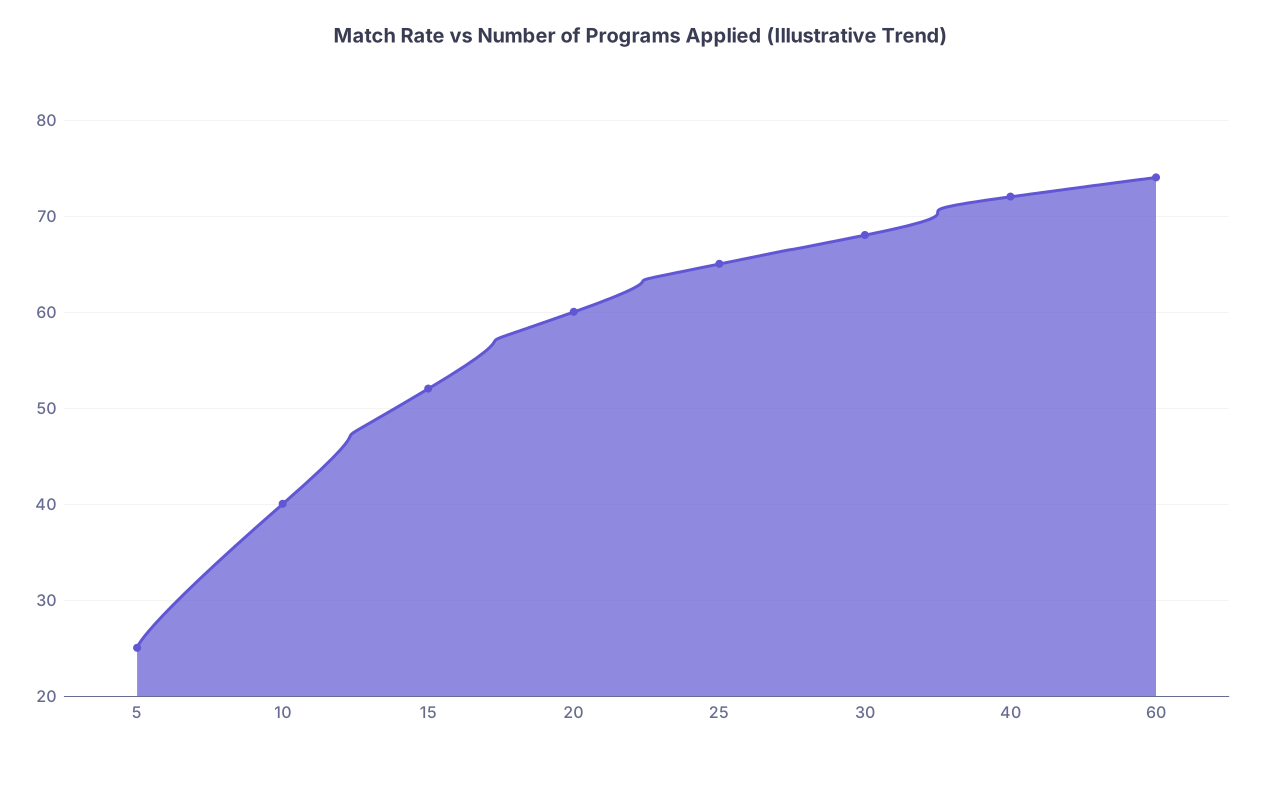
Because the number of applications per applicant has increased dramatically, programs are flooded with ERAS submissions. This is particularly impactful for Caribbean medical school residency candidates, who may not receive the same “automatic” review that strong US MD/DO applicants often get. Your program selection strategy is where you regain control.
This article focuses on internal medicine and is written specifically for Caribbean IMGs (including SGU, AUC, Ross, Saba, and other offshore schools). We’ll cover how to choose residency programs intelligently, how many programs to apply to, and how to build tiers of reach, target, and safety programs to maximize your SGU residency match–style success story, regardless of which Caribbean school you attend.
Step 1: Know Your Applicant Profile (and Where You Truly Fit)
Before building any list, you must understand how program directors will see you on paper. This means taking a cold, honest look at your metrics and application elements.
Core Components of Your Profile
Key factors for internal medicine residency:
- USMLE Step 1: Now Pass/Fail, but a fail attempt is a major red flag. A pass on first attempt is critical.
- USMLE Step 2 CK: This is now the main numeric screening tool.
- Clinical performance: Clerkship grades, especially medicine, and performance in US clinical rotations.
- Letters of Recommendation (LORs): Preferably 2–3 strong IM letters from US academic physicians.
- IMG status and medical school: Caribbean schools are well-known; some have established relationships with IM programs.
- Gaps and red flags: Delays in training, multiple exam attempts, professionalism issues, or leaves of absence.
- Visa requirement: Needing a visa (J-1/H-1B) immediately shrinks the pool of viable programs.
- Research and extras: Research, leadership, teaching, and volunteer work can help you stand out, especially at academic programs.
Rough Benchmarking by Step 2 CK Score
While cutoffs vary by program, here is a general Caribbean IMG–oriented benchmark:
Step 2 CK ≥ 245–250+
- Competitive for a broad range of mid-tier university and strong community programs.
- Some lower-tier university academic IM programs may be realistic.
- Still, top 20–30 IM programs remain long shots due to IMG bias, but a few “reach” applications can be justified.
Step 2 CK 230–244
- Solid for many community and some university-affiliated programs that are IMG-friendly.
- Should focus on programs with a track record of interviewing Caribbean graduates.
- Avoid overloading on highly academic or IMG-averse programs.
Step 2 CK 220–229
- Competitive primarily for strongly IMG-friendly community programs, smaller hospitals, and some community-based university affiliates.
- Need a large application volume and careful targeting of Caribbean medical school residency–friendly programs.
Step 2 CK < 220 or multiple attempts
- This is a high-risk profile. Match is possible but requires:
- Very large number of applications
- Heavy focus on IMG-heavy, community-based internal medicine programs
- Compelling improvements (e.g., strong US LORs, excellent US clinical performance, no further red flags)
- This is a high-risk profile. Match is possible but requires:
These are approximations; each program sets its own thresholds, and some use filters more rigidly than others. But you cannot build a realistic program list without this type of benchmarking.
Step 2: Define Clear Application Constraints and Priorities
Your dream program list has to meet your life circumstances. Clarifying constraints early makes your research efficient and avoids wasted applications.
Key Constraints
Visa Status
- No visa needed (US citizen/green card)
- Wider program pool. Some community programs that avoid visa sponsorship will still be open to you as a Caribbean IMG.
- Needs J-1 visa (most common for IMGs)
- Many programs sponsor J-1; still, you must verify each program’s stance.
- Needs H-1B visa
- Far fewer internal medicine programs sponsor H-1B.
- Typically more academic and selective. If you require H-1B, your list must be highly tailored.
- No visa needed (US citizen/green card)
Geographic Flexibility
- Are you truly able to move anywhere in the US? Or are you limited by family, spouse/partner, finances, or childcare?
- If you restrict yourself to one region (e.g., Northeast only), as a Caribbean IMG you must compensate with:
- A higher number of applications within that region
- Consideration of less competitive, smaller community hospitals in that area
Academic vs. Community Preference
- As a Caribbean IMG, you are more likely to find opportunities in:
- Community hospitals
- Community-based university programs
- Large academic centers (big-name universities, tertiary referral centers) often take very few Caribbean IMGs, except from schools with whom they have longstanding relationships or strong performance histories.
- As a Caribbean IMG, you are more likely to find opportunities in:
Lifestyle and Career Goals
Consider:
- Do you want a program with strong fellowship placements or a focus on hospitalist training?
- Are research and teaching important to you?
- Do you prefer a smaller city or large metropolitan area?
- Are you comfortable working in underserved or rural areas, where many IMG-friendly programs are located?
Write these down. Your final program selection strategy must be compatible with these realities.
Step 3: Researching Programs and Identifying IMG-Friendly Targets
This is the most time-consuming part of your strategy—but also where Caribbean IMGs gain the biggest advantage.

Start with Hard Data Sources
Use a combination of official and third-party resources:
FREIDA (AMA Residency & Fellowship Database)
- Filter by specialty: Internal Medicine (categorical)
- Filter by:
- Visa sponsorship (J-1/H-1B)
- Program type (university-based vs community-based)
- Check: number of IM residents, program size, and any listed requirements.
Program Websites
- Look specifically for:
- Stated visa policy
- Any mention of USMLE score cutoffs
- Whether they accept or have current IMGs
- Photos or biographies of current residents—look for Caribbean schools (SGU, Ross, AUC, Saba, etc.)
- Look specifically for:
NRMP and “Charting Outcomes in the Match” Data
- Use IM-specific data to understand the match rate for IMGs at different score levels.
- Helps you estimate how broad you need your list to be.
Residency Explorer Tool (when available)
- Compare your profile (scores, publications, etc.) with residents at specific programs.
- Some data may be limited for IMGs, but it still offers a general competitiveness gauge.
Identify IMG-Friendly Patterns
For an internal medicine residency, IMG-friendly programs often share certain characteristics:
- Large community programs that need a stable workforce
- Located in less popular geographical areas (Midwest, some Southern states, smaller cities)
- Historically have multiple IMGs per class
- Often affiliated with, but not central to, a university
- Publicly list acceptance of Caribbean IMGs or showcase them in resident profiles
Specific signs of IMG-friendliness:
- Current residents include names or bios clearly indicating Caribbean medical schools.
- The program’s “Alumni/Fellowship” page includes Caribbean IMG graduates.
- Website explicitly states: “We welcome international medical graduates” and details visa sponsorship.
- No strict USMLE score cutoffs at or above 240; instead, they mention holistic review or moderate thresholds.
Build an Initial Long List
At this stage, do not worry about “how many programs to apply” overall; instead, aim for a robust long list that:
- Meets your visa constraints
- Shows at least some documented Caribbean IMG presence
- Fits your broad geographic preferences (or “anywhere” if you are fully flexible)
For many Caribbean IMGs, this initial long list will easily reach 120–180 internal medicine programs or more, before refining.
Step 4: Tiering Programs – Reach, Target, and Safety
Once you have a long list, you need to convert it into a strategic application list using tiers. This is where you refine how to choose residency programs that are both realistic and aspirational.

Defining Tiers for a Caribbean IMG in Internal Medicine
1. Reach Programs
- Programs where your metrics are below their typical range or they are known to be less IMG-friendly.
- Examples:
- Well-known university programs with only a few IMGs on their rosters
- Programs with average Step 2 CK scores substantially above yours
- Aim: 10–20% of your total list.
2. Target Programs
- Programs where your profile is reasonably aligned with (or slightly below) their typical residents.
- They regularly take IMGs and may have current Caribbean residents.
- You meet or are close to any stated USMLE cutoffs.
- Aim: 40–60% of your total list.
3. Safety Programs
- Strongly IMG-friendly internal medicine programs with multiple Caribbean IMGs.
- Typically community-based or community-university hybrids.
- Often located in less competitive or less popular geographic regions.
- Your Step 2 CK is at or above the level they typically accept, based on available data and resident profiles.
- Aim: 30–40% of your total list.
A Sample Tiered Distribution (Caribbean IMG Profiles)
Below are example distributions combining tiering with the question of how many programs to apply:
Example A: Strong Caribbean IMG (Step 2 CK 245+, no major red flags)
- Total IM programs: ~80–100
- 15–20 Reach
- 40–50 Target
- 20–30 Safety
Example B: Moderate Profile (Step 2 CK 230–244)
- Total IM programs: ~110–140
- 10–15 Reach
- 50–70 Target
- 40–50 Safety
Example C: Higher-Risk Profile (Step 2 CK 220–229 or exam attempts)
- Total IM programs: ~140–180
- 5–10 Reach
- 50–70 Target
- 80–100 Safety
These are guidelines, not rules, but they reflect realistic numbers for a Caribbean medical school residency applicant in internal medicine who wants a strong chance at an IM match.
Step 5: How Many Programs Should You Apply To in Internal Medicine?
For Caribbean IMGs, the question “how many programs to apply” is practical and high-stakes. Over-applying can be costly; under-applying is risky.
General Ranges for Caribbean IMGs in IM
For internal medicine only, assuming you are only applying to IM:
- Very Strong Applicant (Step 2 CK ≥ 250, honors, strong US LoRs, no visa)
- 60–80 IM programs may be sufficient if strategically chosen.
- Solid Applicant (Step 2 CK ~235–249, no major red flags)
- 80–120 IM programs is a safer range.
- Moderate/Borderline Applicant (Step 2 CK ~220–234, or minor red flags)
- 120–160 IM programs is often recommended.
- High-Risk Applicant (Step 2 CK < 220, multiple attempts, gaps)
- 160–200+ IM programs may be necessary, heavily focused on safety/IMG-heavy programs.
Many SGU residency match success stories and other Caribbean IMGs who match into internal medicine share a common feature: they applied broadly. While quality of applications matters, quantity provides more chances to pass through program filters and reach real human review.
Balancing Cost and Benefit
Each ERAS application fee adds up quickly. To manage costs while maintaining a strong IM match strategy:
- Prioritize internal medicine categorical positions over preliminary IM spots (unless you have a specific reason for prelim).
- Avoid clearly unrealistic programs, such as top 10 academic powerhouses that historically do not take Caribbean IMGs, unless you have a very unique connection or exceptional profile.
- Invest more in IMG-friendly, mid-tier programs that realistically could rank you.
If your budget is limited, work with a mentor, advisor, or older resident from your school to help refine your list so that each application has a genuine chance.
Step 6: Advanced Filters – Beyond Score Cutoffs
Once you have your approximate number and basic tiers, refine the list using deeper criteria.
1. Historical IMG Acceptance
Manually check:
- Resident rosters (PGY-1 through PGY-3)
- Alumni lists and where they trained
- Any blog posts, photos, or Instagram/LinkedIn accounts linked to residents
If you repeatedly see SGU, Ross, AUC, or similar Caribbean schools, it’s a strong positive sign. Many Caribbean IMGs at those programs signal that you’re working with a genuinely IMG-friendly internal medicine residency.
2. Program Size and Structure
- Larger IM programs (e.g., 10–20+ categorical residents per year) tend to offer more opportunities for IMGs than very small programs.
- Community-university hybrids (community hospital with a university affiliation) can be excellent for Caribbean IMGs:
- More hands-on experience
- Reasonable research options
- Often less competitive than large university hospitals
3. Fellowship and Career Outcomes
If your long-term goal involves cardiology, GI, pulmonary/critical care, or other IM subspecialties:
- Look at fellowship match lists on program websites.
- Ask yourself: Does this program routinely send residents to fellowships (even if not always at top institutions)?
- For Caribbean IMGs, a solid mid-tier program with decent fellowship outcomes can be a fantastic launching pad, even if it’s not in a famous city.
4. Schedule, Education, and Culture
While harder to quantify from outside:
- Read resident testimonials and blogs.
- Join informational sessions or open houses.
- Reach out politely to current or recent residents (especially if they’re Caribbean IMGs) via LinkedIn or alumni networks and ask:
- “Are IMGs here treated fairly?”
- “Is there support for board exams and fellowship applications?”
- “How is the workload and supervision?”
These qualitative factors matter. Matching into an unsupportive environment can make residency unnecessarily painful.
Step 7: Aligning Your Application Theme with Program Types
Your personal statement, experiences, and letters should reflect a coherent story that fits the kinds of programs you’re targeting.
If You’re Targeting Academic or University-Affiliated Programs
Emphasize:
- Research experience (even small projects, QI, or case reports)
- Teaching, tutoring, or leadership roles
- Interest in subspecialty training and academic medicine
- Evidence of scholarly curiosity (presentations, posters, publications)
If You’re Targeting Strong Community and Community-Academic Programs
Highlight:
- Clinical acumen and patient-centered care
- Adaptability, work ethic, and resilience
- Experience with underserved or diverse populations
- Commitment to becoming a well-rounded internist or hospitalist
As a Caribbean IMG, your narrative can powerfully differentiate you, especially at programs where many applicants have similar scores. Make sure your program selection strategy and your application messaging reinforce each other.
Step 8: Practical Example – Building a List for a Hypothetical Caribbean IMG
To bring this together, consider “Dr. M,” a Caribbean IMG graduate:
- School: SGU (St. George’s University)
- Step 1: Pass, first attempt
- Step 2 CK: 238
- No major red flags, 1-year gap for family reasons explained clearly
- Needs J-1 visa
- Prefers East Coast but willing to go anywhere
- Completed 3 US IM rotations, with strong LORs
Program Selection Strategy for Dr. M:
Initial Long List (150+ programs)
- All J-1–sponsoring IM categorical programs
- IMG-friendly, especially with current Caribbean residents
- Slight preference for East Coast and Midwest
Tiering and Trimming to ~120–130 Programs
- 15 Reach: mid-tier university hospitals on East Coast with some IMGs
- 65 Target: community-university hybrids and larger community programs with clear Caribbean representation and average Step 2 CK around 230–240
- 40–50 Safety: heavily IMG-populated community programs in less popular states, where most residents are IMGs and program size is large
Tailored Messaging
- Personal statement: emphasizes resilience, adaptability, patient-centered care, and interest in hospitalist or fellowship later on.
- LORs: highlight strong clinical performance, communication, and independence in inpatient internal medicine.
- Application timing: submits ERAS as early as possible with all materials complete.
This strategy doesn’t guarantee success, but it significantly improves Dr. M’s odds of an IM match compared to a random or prestige-only list.
FAQs: Program Selection Strategy for Caribbean IMGs in Internal Medicine
1. As a Caribbean IMG, should I apply to other specialties in addition to internal medicine?
If internal medicine is your true goal, splitting applications across multiple specialties can weaken your narrative and letters. However, in certain high-risk profiles (multiple exam attempts, very low scores), some applicants consider a parallel plan (e.g., IM + Family Medicine). If you do this:
- Keep your primary focus and strongest letters for IM.
- Understand that applying to multiple fields can be expensive and confusing to program directors.
- Discuss this with a mentor or advisor from your Caribbean school before deciding.
2. Is it worth applying to top-tier academic IM programs as a Caribbean IMG?
For most Caribbean IMGs, top 20–30 internal medicine programs are extreme reach options. You can include a small number (e.g., 3–5) if:
- You have exceptional scores and substantial research.
- You have a direct connection (e.g., strong letter from faculty there, prior research at that institution).
Do not waste a large portion of your applications on places that rarely interview or rank Caribbean graduates. Your main focus should be solid, IMG-friendly programs where you realistically have a chance.
3. How do I know if a program is too competitive for me?
Look for:
- Their residents’ background: If virtually all residents are US MDs from highly ranked schools and there are no IMGs, it’s likely too competitive.
- Any published USMLE cutoffs: If they mention 240+ average Step 2 and you have 225, it’s probably a reach.
- Location and reputation: Highly desirable cities plus strong university name usually mean high competitiveness.
You can still apply to a few such programs as “lottery tickets,” but build your main list around those with documented Caribbean IMG representation and more moderate metrics.
4. What if my Step 2 CK is low—should I still apply to internal medicine?
Yes, many Caribbean IMGs with modest scores still match into internal medicine when they:
- Apply broadly (often 160+ programs for very low scores)
- Focus heavily on strongly IMG-friendly, community-based IM programs
- Have strong US letters, recent clinical experience, and no ongoing professionalism issues
- Present a coherent, honest explanation for any issues or gaps
Low scores limit options but do not completely close the door, especially in IM. Your program selection strategy should adjust to emphasize volume and IMG-heavy programs.
A thoughtful program selection strategy is one of the most powerful tools a Caribbean IMG has in pursuing an internal medicine residency. By knowing your profile, setting realistic expectations, researching IMG-friendly programs, and applying broadly—but intelligently—you give yourself the best chance to secure interviews and ultimately achieve a successful IM match.