Understanding Your Unique Position as a Caribbean IMG in Med-Peds
Caribbean international medical graduates (IMGs) pursuing a Medicine-Pediatrics (Med-Peds) residency occupy a very specific niche. You are:
- An IMG (with all the implications for visa, screening, and competition)
- From a Caribbean medical school (which U.S. programs view differently than USMD/DO and non-Caribbean IMGs)
- Applying to a relatively small specialty (fewer programs and positions than Internal Medicine or Pediatrics alone)
This combination makes your program selection strategy absolutely critical. A strong SGU residency match or Caribbean medical school residency outcome in Med-Peds is very achievable—but only if you build a smart, realistic, and targeted list.
Before deciding how many programs to apply to and which ones to prioritize, you need to understand how you will be viewed by programs and what levers you can control.
Key factors programs will look at:
- USMLE scores (Step 1: pass/fail but still reviewed; Step 2 CK: very important)
- Number of attempts on any exam
- Clinical performance (especially U.S. clinical rotations; sub-internships if available)
- Letters of recommendation in Internal Medicine and Pediatrics
- Graduation year (recency of training)
- Visa status (citizen/green card vs needing sponsorship)
- Evidence of commitment to Med-Peds (personal statement, experiences, mentorship)
For Caribbean IMGs, the residency match in Med-Peds is not impossible, but it is competitive. Med-Peds programs are generally smaller, more academic, and often more selective. You must plan deliberately.
Step 1: Clarify Your Med-Peds Profile and Competitiveness
Before you can build a realistic program list, you must honestly assess your personal competitiveness. This will drive both how many programs to apply to and which tiers to include.
A. Core academic metrics
USMLE Step 2 CK score
- For Med-Peds, Step 2 CK is often weighted heavily (especially as Step 1 is now pass/fail).
- While exact numbers vary by season and program, you can think in rough bands:
- High: ≥ 245–250
- Solid: 235–244
- Marginal/At-risk: 220–234
- Concerning: < 220 or multiple attempts
- A high Step 2 CK significantly improves your odds at more academic programs.
Exam attempts and failures
- Any fail (Step or COMLEX) is a red flag, especially for Med-Peds.
- A single failure can be overcome if:
- You show a clear upward trend
- You strongly address it in your application
- The rest of your application is strong (strong letters, U.S. clinical experience, compelling story)
Year of graduation
- For categorical Med-Peds, most programs prefer candidates within 3–5 years of graduation.
- If >5 years out, you will need:
- Very strong recent clinical experience (ideally U.S.)
- Clear explanation of gaps
- Realistic targeting of programs more open to IMGs and older grads
B. Clinical experience and letters
Caribbean students often have significant U.S. clinical exposure. This is a point in your favor—if leveraged correctly.
U.S. core and elective rotations in IM and Pediatrics
- Aim to have at least:
- 2–3 strong IM letters (preferably including a sub-I if possible)
- 1–2 strong Pediatrics letters
- If you can secure a letter from a Med-Peds trained physician, that’s even better.
- Aim to have at least:
Quality of letters
- Strong letters are detailed, specific, and comparative (“top 10% of students I’ve worked with”).
- Program directors know that generic letters for Caribbean graduates are common. You need letters that clearly stand out.
C. Non-academic strengths
Commitment to Med-Peds
- Longitudinal interest in combined care (e.g., projects, QI, leadership, research spanning both age groups)
- Med-Peds shadowing or mentorship if available
- Thoughtful explanation in your personal statement of:
- Why Med-Peds (not just “I like both adults and kids”)
- How your experiences support your choice
Research and scholarly activity
- Med-Peds is small but often quite academic.
- Any scholarly activity (QIP, case reports, posters, QI projects) in IM, Peds, or combined areas is a plus.
- This matters more at university and university-affiliated programs but can help anywhere.
D. Visa and citizenship
Your program selection strategy must account for visa realities:
U.S. citizen or green card holder
- Fewer barriers; more programs available.
- Still considered IMG, but no visa restrictions.
Needing visa sponsorship (J-1 or H-1B)
- Many Med-Peds programs sponsor J-1; fewer sponsor H-1B.
- Some explicitly do not sponsor any visas.
- You must systematically track this and filter programs accordingly.

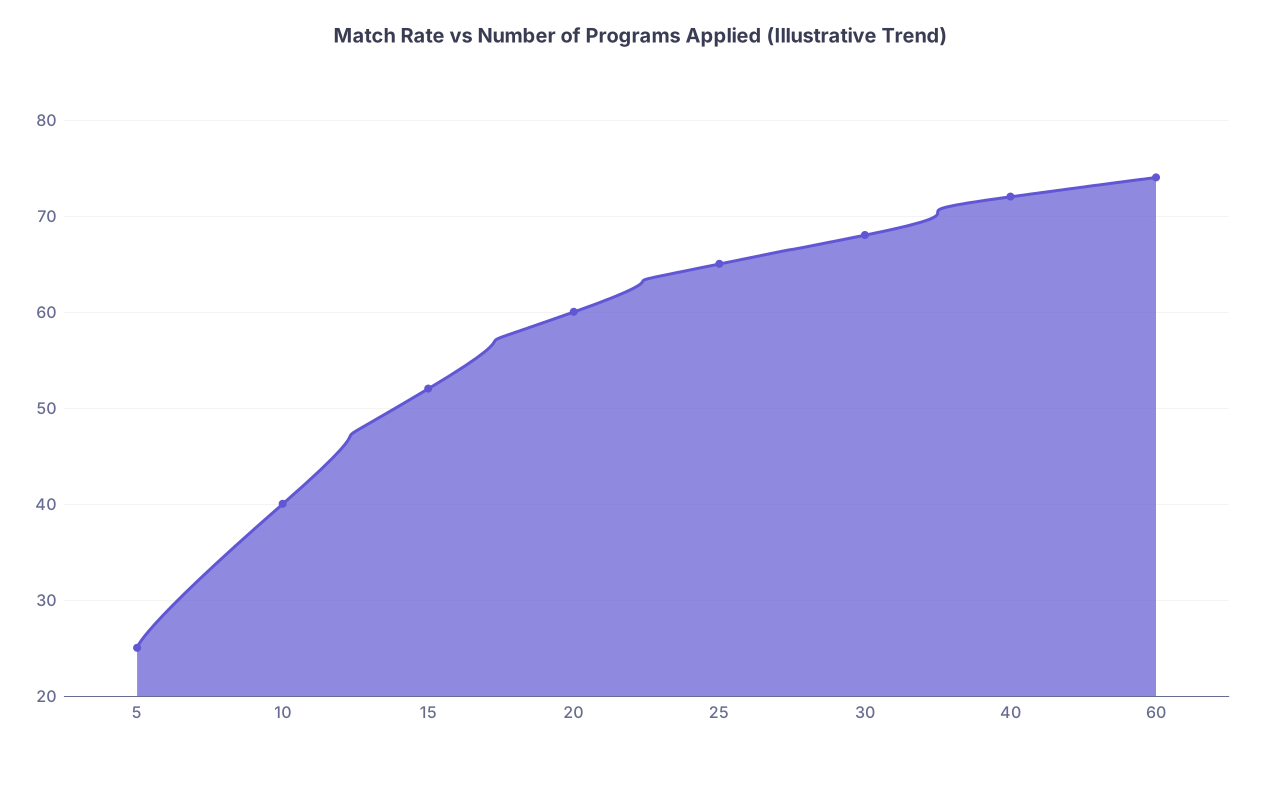
Step 2: Deciding How Many Programs to Apply To (Realistic Ranges for Caribbean IMGs)
Because Med-Peds is relatively small (~80–90 programs nationwide, ~400–450 positions total, varies by year), your approach to how many programs to apply to differs from high-volume specialties like Internal Medicine.
A rough framework for Medicine-Pediatrics match strategy as a Caribbean IMG:
A. Understand the program landscape
- Around 80–90 Med-Peds programs in the U.S.
- Many are:
- University-based or large academic centers
- Located in urban or suburban areas
- Relatively IMG-limited but not IMG-excluding
- Total positions per program often range from 4–12 per year.
Because the absolute number of programs is limited, you cannot apply to 100+ Med-Peds programs like you might in categorical IM; they simply don’t exist. Instead, you need to balance breadth within Med-Peds with backup strategies (discussed later).
B. Application volume by competitiveness level
Below are general guidelines for how many Med-Peds programs to apply to as a Caribbean IMG. These are not strict rules, but realistic starting points.
Stronger Caribbean IMG applicant
- Profile:
- Step 2 CK ≥ 245
- No exam failures
- Recent grad (≤ 3 years)
- Strong U.S. IM and Peds rotations with excellent letters
- Some scholarly activity or leadership
- Suggested Med-Peds applications:
- 30–45 Med-Peds programs, if available (essentially most programs that:
- Are IMG-friendly or at least IMG-neutral
- Accept your visa status, if needed )
- 30–45 Med-Peds programs, if available (essentially most programs that:
- Backup:
- 20–30 categorical IM and 10–20 categorical Peds programs, focusing on IMG-friendlier programs.
- Profile:
Typical/Moderate Caribbean IMG applicant
- Profile:
- Step 2 CK ~230–244
- No more than one exam attempt
- Reasonably recent grad (≤ 5 years)
- Good but not extraordinary letters
- Suggested Med-Peds applications:
- 35–55 Med-Peds programs, leaning toward:
- Community-based university-affiliated
- Historically IMG-accepting programs
- 35–55 Med-Peds programs, leaning toward:
- Backup:
- 40–60 categorical IM + 25–40 categorical Peds (adjust mix based on your strengths and preferences).
- Profile:
At-risk/Challenging Caribbean IMG applicant
- Profile:
- Step 2 CK < 230 or with a failure
- Older graduate (> 5 years)
- Limited U.S. clinical experience or weaker letters
- Suggested Med-Peds applications:
- 25–40 Med-Peds programs, carefully chosen:
- Strongly IMG-friendly
- Less hyper-academic, more community-based or smaller university-affiliated
- 25–40 Med-Peds programs, carefully chosen:
- Backup:
- 70–100 categorical IM + 40–60 categorical Peds (heavier emphasis on IM, which tends to have more positions and more IMG acceptance).
- Profile:
C. Strategic reality check
For Caribbean medical school residency applicants in Med-Peds:
- It is risky to apply only Med-Peds.
- A combined program selection strategy—Med-Peds plus categorical IM and/or Peds—is usually the safest option unless you are an exceptionally strong candidate with strong mentorship and evidence that Med-Peds programs are already very interested in you.
Step 3: Building a Tiered Program List for Medicine-Pediatrics
Once you know your competitiveness and target number of applications, your next step is to create a tiered program list. This is where the core of your program selection strategy comes in.
A. Define your tiers
Think in three broad tiers based on your profile:
Reach programs
- Highly academic, top-tier universities
- Historically low IMG percentage or heavy USMD/DO dominance
- Very strong research expectations or elite reputations
- You should still apply to a few if your profile is solid—but don’t over-allocate here.
Target programs
- University-based or university-affiliated community hospitals
- Accept IMGs, including some from Caribbean schools
- Solid academic environment, but not hyper-competitive
- These should make up the bulk of your Med-Peds applications.
Safety programs (relative safety, not guaranteed)
- Community-based or university-affiliated with:
- Documented history of Caribbean IMGs
- Lower average USMLE ranges
- Open statements about valuing diversity and IMGs
- These are often outside major coastal metros, in mid-sized cities or more rural areas.
- Community-based or university-affiliated with:
A reasonable distribution for a moderate Caribbean IMG might look like:
- 15–20% Reach
- 50–60% Target
- 25–35% Safety
Adapt the percentages based on your competitive level (stronger applicants can allocate a bit more to reach; at-risk applicants should overweight safety and target).
B. Researching programs effectively
Your time is limited, so be systematic in how you research Med-Peds programs:
Tools and sources:
- FREIDA (AMA Residency & Fellowship Database)
- NRMP Program Directory
- Individual program websites
- Program social media (Twitter/X, Instagram)
- Your school’s match list (e.g., SGU residency match data and internal advising records)
- Alumni and upperclassmen who matched in Med-Peds or categorical IM/Peds
Key data points to track:
For each Med-Peds program, create a spreadsheet and include:
- Program name and location
- Type: university, university-affiliated, community
- Size (number of Med-Peds positions/year)
- IMG policy:
- Do they accept IMGs?
- Do they list “IMG” or “international graduates” specifically?
- Visa sponsorship:
- J-1? H-1B? None?
- USMLE requirements:
- Minimum score?
- Step 2 required at time of application?
- Recent residents:
- Any IMGs? Any Caribbean grads?
- Rotation opportunities for students:
- Do they take visiting students? (Helps for future Caribbean students, even if too late for you.)
- Geographic preferences:
- Are you willing to live there realistically for 4 years?
- Special Med-Peds features:
- Combined clinics
- Global health tracks
- Urban underserved vs rural focus
- Research expectations

Step 4: Applying Filters: IMG-Friendliness, Location, and Program Fit
Now translate your research into a concrete program selection strategy tailored to you.
A. IMG-friendliness and Caribbean status
Being an IMG is one thing; being from a Caribbean medical school is another. Some programs:
- Accept IMGs but prefer non-Caribbean IMGs
- Have matched SGU or other Caribbean grads consistently (great sign)
- Rarely or never match Caribbean graduates (higher risk)
Look for:
- Evidence of Caribbean grads in current or recent classes
- Check program websites’ resident bios.
- Ask your school’s advising office if alumni have matched there.
- Explicitly IMG-welcoming language
- “We value international medical graduates.”
- “We consider all applicants holistically,” etc.
When you see multiple SGU residency match outcomes or other Caribbean medical school residency success at a program, that suggests a possible pathway for you.
B. Visa realities
Filter programs by visa:
If you need J-1:
- Most university and larger community programs can sponsor it.
- Still confirm on their website or via FREIDA.
If you need/want H-1B:
- Far fewer Med-Peds programs offer H-1B.
- Prioritize:
- Programs that list H-1B sponsorship explicitly
- Programs in states with historically more H-1B-friendly institutions (e.g., NY, TX, etc.)
If a program clearly states “no visa sponsorship,” move on; do not waste an application there.
C. Location and lifestyle filters
You must be realistic about where you’re willing to live for 4 years. However, keep in mind:
- Many of the most IMG-friendly Med-Peds programs are in:
- Mid-sized cities
- Less “popular” states (e.g., Midwest, South)
- Non-coastal regions
- Overly restricting yourself to NYC, California, or major coastal cities will drastically limit your chances.
Ask yourself:
- “Would I realistically go there if it’s my only match?”
- If the answer is no, don’t apply.
- But be open to regions beyond your initial comfort zone.
D. Program culture and training style
Even as a Caribbean IMG, you are not just looking for “any” Medicine-Pediatrics match—you want a good fit.
Consider:
Balance of Medicine vs Pediatrics
- Does the program lean more adult or pediatric-heavy?
- Are there strong categorical IM and Peds departments?
Fellowship opportunities
- If you might want a fellowship (e.g., cardiology, critical care, med-peds hospitalist, complex care), look at:
- Presence of strong categorical programs
- Fellowship match lists of Med-Peds graduates
- If you might want a fellowship (e.g., cardiology, critical care, med-peds hospitalist, complex care), look at:
Population served
- Urban underserved, refugee, rural, suburban?
- Does that align with your career interests?
Use this not to overly narrow your list, but to prioritize within each tier.
Step 5: Combining Med-Peds with Categorical IM and Pediatrics Safely
Because Med-Peds is small, a key question for every Caribbean IMG is:
“How should I balance Med-Peds with categorical IM and Pediatrics in my program selection strategy?”
A. Parallel application strategy
For most Caribbean IMGs, a parallel plan is safest:
- Apply broadly in Med-Peds and
- Apply broadly in at least one categorical specialty (Internal Medicine or Pediatrics; many do both)
A common structure:
- Med-Peds: Your passion and priority.
- Internal Medicine: Larger number of positions; relatively more IMG-friendly overall.
- Pediatrics: Also IMG-friendly in many regions, though slightly more competitive than IM in some areas.
B. Example application portfolios
Strong Caribbean IMG, Med-Peds-focused
- 35–45 Med-Peds programs
- 25–35 categorical IM
- 10–20 categorical Peds
Moderate Caribbean IMG, balanced focus
- 40–55 Med-Peds
- 40–60 categorical IM
- 20–30 categorical Peds
At-risk Caribbean IMG, Med-Peds hopeful but highly pragmatic
- 25–40 Med-Peds
- 70–100 categorical IM
- 30–50 categorical Peds
Adjust these based on your budget, time, and advisor input.
C. Signaling your priorities
Within ERAS:
- You can tailor personal statements:
- One for Med-Peds programs, clearly articulating your combined-care motivation
- One for IM
- One for Peds
- You can adjust:
- “Why our program?” paragraphs in supplemental questions
- Emphasis on experiences relevant to each specialty
Be transparent in your story, but there’s no need to highlight to a categorical IM program that you prefer Med-Peds above all. Instead, frame your interest as:
- Strong commitment to internal medicine with substantial experience across the age spectrum.
Step 6: Practical Timeline and Action Steps for Caribbean Med-Peds Applicants
To execute this program selection strategy effectively, you need a timeline.
A. 12–18 months before Match
- Clarify your interest in Med-Peds.
- Seek mentorship:
- Ideally from a Med-Peds trained physician.
- If none are available, then from IM and Peds faculty who understand combined training.
- Plan rotations strategically:
- U.S. IM and Peds rotations at institutions with Med-Peds programs if possible.
- Aim for strong letters.
B. 6–9 months before ERAS opens
- Take and do well on Step 2 CK (or be in the final preparation phase).
- Start your program research spreadsheet:
- List all Med-Peds programs.
- Filter by IMG status, visa, location preferences, and competitiveness.
- Begin early drafts of:
- Med-Peds–specific personal statement
- IM and Peds personal statements, if applying parallel.
C. 3–4 months before ERAS submission
- Finalize your competitiveness assessment (based on Step 2 score, letters, and performance).
- Decide on your target number of Med-Peds, IM, and Peds applications.
- Tier your programs (Reach/Target/Safety) and refine based on:
- New info about IMG-friendliness
- Recent resident rosters
- Any alumni input
D. 1–2 months before ERAS submission
- Confirm LOR writers and ensure they know your Med-Peds interest.
- Review and polish your personal statements.
- Double-check each program’s:
- Visa policy
- USMLE cutoffs
- Application deadlines and special requirements (e.g., supplemental essays)
E. After submission and during interview season
- Track interview invitations by program tier and specialty.
- If Med-Peds interviews are fewer than hoped:
- Prioritize categorical IM and Peds interviews carefully.
- Reassess the strength of your Med-Peds narrative and be prepared to explain it clearly.
FAQs: Program Selection Strategy for Caribbean IMGs in Med-Peds
1. As a Caribbean IMG, is Med-Peds realistic for me, or should I only focus on categorical IM or Peds?
It is realistic but more competitive than many categorical IM positions. The key is to:
- Apply broadly in Med-Peds (as many programs as reasonably fit your profile)
- Simultaneously apply to categorical Internal Medicine and/or Pediatrics as a parallel plan
- Target Med-Peds programs that:
- Accept IMGs and sponsor your visa type
- Have a track record (even small) of Caribbean or IMG graduates
- Ensure your application clearly demonstrates a convincing, consistent interest in combined training.
Many Caribbean graduates have successfully matched into Med-Peds, but they almost always had strong scores, solid U.S. experience, and a smart, diversified program selection strategy.
2. How do I know if a Med-Peds program is truly IMG-friendly?
Use a combination of signals:
- Check the current resident list on the program website:
- Are any residents IMGs?
- Are any from Caribbean schools (SGU, Ross, AUC, Saba, etc.)?
- Ask your school’s advising office or alumni network:
- Has anyone from your school matched there?
- Do they have insight into the program’s openness to Caribbean grads?
- Look at FREIDA and the program site:
- Do they explicitly welcome IMGs?
- Do they list visa sponsorship details?
- If in doubt and the website is vague, you can email or call the program coordinator with a short, professional question about IMGs and visas. The tone and content of their response can be informative.
3. How many Med-Peds programs should I rank to have a good chance of matching?
For Med-Peds, because total programs are limited, there’s no exact “safe” number. However, as a Caribbean IMG:
- Aim to interview at and rank every Med-Peds program that interviews you, unless you truly would not attend.
- Historically in NRMP data across specialties, IMGs need more interviews than USMDs to achieve high match probabilities. In Med-Peds, simply maximizing the number of interviews (10, 12, 15 or more if possible) is critical.
- The number of programs you rank isn’t capped; rank all interviewed programs where you’d be willing to train.
- Use your rank list to reflect true preference—but do not leave off programs where you would be content to train, even if they are lower in your hierarchy.
4. Should I do a visiting rotation (away rotation) at a Med-Peds program to improve my chances?
If possible, yes—but strategically:
- A Med-Peds or combined IM/Peds visiting rotation can:
- Demonstrate your commitment to combined training
- Allow you to earn a strong letter from Med-Peds faculty
- Put you on the radar of that specific program
- However:
- Spots are limited and may be competitive.
- Some programs may restrict visiting students to USMD/DO only.
- If you can’t secure a pure Med-Peds rotation:
- An IM or Peds sub-internship at an institution with a Med-Peds program still helps.
- You can meet Med-Peds faculty informally and express interest.
Always weigh the cost and logistics carefully, but for strong or moderate candidates targeting specific institutions, an away rotation can be a powerful part of your Med-Peds program selection strategy.
A careful, data-driven program selection strategy—tailored to your Caribbean IMG context, scores, experiences, and visa needs—can transform a risky Med-Peds application into a well-structured path toward a successful Medicine-Pediatrics match and a rewarding dual-specialty career.