Understanding the Unique Path: Medicine-Psychiatry as a Caribbean IMG
Applying for a Medicine-Psychiatry (Med-Psych) combined residency as a Caribbean medical school graduate is very different from applying to categorical internal medicine or psychiatry. The programs are few, highly individualized, and often unfamiliar with Caribbean medical education. At the same time, many Med-Psych directors actively value non‑traditional paths and holistic thinkers—exactly where many Caribbean IMGs shine.
A strong program selection strategy is not just about how many programs to apply to; it’s about deliberately targeting where you realistically fit and where you can truly thrive. For a Caribbean IMG, especially from schools like SGU, AUC, Ross, Saba and others, your choices must be shaped by:
- The small number of Medicine-Psychiatry combined programs
- Your exam profile and timeline (including any attempts or gaps)
- Your US clinical experience and letters
- Your visa and geographic constraints
- How each program historically views IMGs and Caribbean graduates
This guide breaks down a systematic, practical approach to choosing Medicine-Psychiatry programs as a Caribbean IMG, including how to balance Med-Psych with categorical backup options, and how to decide how many programs to apply to overall.
Step 1: Know the Landscape of Medicine-Psychiatry Programs
Before building a program list, you need a clear understanding of what you’re choosing between.
1.1 What Is a Medicine-Psychiatry Combined Residency?
Medicine-Psychiatry is a 5-year ACGME-accredited combined program leading to board eligibility in both Internal Medicine and Psychiatry. Graduates can:
- Practice both specialties (e.g., split inpatient medicine and C/L psychiatry)
- Pursue fellowship in areas like addiction, consult-liaison, geriatrics, hospital medicine
- Lead integrated care models, collaborative care, and population health initiatives
For a Caribbean IMG, this dual training can be a strong differentiator—demonstrating versatility and broad clinical competence, which can enhance post-residency job security and fellowship options.
1.2 The Numbers: Why Strategy Matters
Compared to categorical internal medicine and psychiatry, Medicine-Psychiatry combined programs are few (typically only a few dozen slots nationwide). That means:
- You cannot rely solely on Med-Psych if your application is modest or borderline.
- You must think early about backup specialties (usually categorical internal medicine and/or psychiatry).
- Every Med-Psych application needs to be highly tailored and evidence-based.
1.3 Caribbean IMG Reality Check
As a Caribbean medical school graduate (whether or not you have a strong SGU residency match track record behind you), you will be considered an International Medical Graduate (IMG). Programs vary widely in how open they are to IMGs, and even more in how comfortable they are recruiting from Caribbean schools.
You need to assume:
- Some Med-Psych programs will rarely or never rank Caribbean IMGs.
- A subset will be IMG-friendly, but may still prioritize higher USMLE scores and strong US clinical experience.
- Your program selection strategy must deliberately target the subset where you have a realistic chance.
This is not about “limiting yourself”; it’s about optimizing your energy, money, and time to maximize interview conversions and your overall match probability.
Step 2: Clarify Your Profile and Constraints
Before asking how to choose residency programs, you must honestly assess your own profile. Your realistic competitiveness dictates your program tiering and how many programs to apply to.

2.1 Academic and Exam Profile
Key elements:
- USMLE Step 1: Pass/fail or three-digit score; any failed attempts?
- USMLE Step 2 CK: Three-digit score and attempts
- Step 3 (if taken): Can be a plus, especially for visa-needing IMGs
For Med-Psych, programs often look for:
- Solid clinical performance (Step 2 CK more important than Step 1 now)
- Reliability: no major red flags (multiple failures, large unexplained gaps)
- Evidence of interest in both medicine and psychiatry (electives, research, personal statement)
As a rough orientation for Caribbean IMGs (not rigid cutoffs, and can vary by year):
- More competitive Caribbean IMG Med-Psych profile:
- Step 2 CK ~ 235+ with no fails
- Timely graduation (≤ 1–2 years from graduation at time of application)
- Strong US letters in both IM and psych
- Moderately competitive:
- Step 2 CK ~ 220–235, maybe one non-critical red flag (minor delay, one retake)
- Challenged profile:
- Step 2 CK < 220 or multiple attempts
- Older graduate (>5 years), limited USCE
Your program selection strategy must align with where you fall.
2.2 Clinical and Personal Profile
Consider:
- US clinical experience (USCE): Rotations, sub-internships, observerships
- Ideally: at least 1 strong IM and 1 psych US rotation with solid letters
- Research or scholarly work in integrated care, C/L, behavioral health in primary care
- Leadership, advocacy, or community work, especially involving both mental and physical health
- Language skills and cultural competence (can be a real asset for safety-net hospitals)
2.3 Logistic Constraints
You should also be clear about:
- Visa status: Need J-1 / H-1B vs green card / US citizen
- Geographic flexibility: Are there family, financial, or immigration reasons to limit certain regions?
- Graduation year: More distant graduation requires more IMG-friendly, flexible programs
These factors strongly impact how many programs to apply to in the Med-Psych category and how broad your backup category list should be.
Step 3: Building a Targeted Med-Psych Program List
Now that you understand your profile, you can design a targeted Medicine-Psychiatry program list.
3.1 Start With Comprehensive Program Identification
Use multiple sources:
- FREIDA and AAMC Residency Explorer
- Official program websites (often more up to date)
- Combined Med-Psych program consortium lists and academic society web pages
- Program social media (X/Twitter, Instagram, LinkedIn) to gauge culture and recent updates
Create a spreadsheet with the following columns:
- Program name and location
- PGY‑1 positions per year
- IMG acceptance history
- Any known Caribbean medical school residency matches (SGU, Ross, AUC, etc.)
- Visa sponsorship (J‑1, H‑1B, or none)
- USMLE requirements and stated cutoffs
- “Feel” of the program: more psych-heavy vs more medicine-heavy; integrated vs parallel rotations
- Your interest level (1–5)
- Your perceived competitiveness for that program (1–5)
3.2 IMG-Friendliness and Caribbean Considerations
For each Med-Psych program, research:
- Recent residents’ medical school origins (check program website “Residents” pages, LinkedIn profiles)
- Whether any residents or graduates are IMGs, and specifically Caribbean IMGs
- Whether the institution overall matches Caribbean graduates in internal medicine or psychiatry (even if the combined Med-Psych track hasn’t yet)
If a university’s categorical internal medicine and psychiatry programs never take Caribbean IMGs, it is unlikely (though not impossible) that their Med-Psych track will.
3.3 Tiering Programs for Strategy
Divide your Med-Psych list into three tiers:
- Reach programs: Top academic centers, few or no IMGs, highly competitive exam expectations
- Target programs: Some IMGs, possibly a Caribbean IMG history, reasonable exam thresholds
- Safety / realistic programs: Regularly accept IMGs, clearly IMG-friendly institutional culture
For many Caribbean IMGs:
- Reach: 20–30% of Med-Psych applications
- Target: 40–60%
- Safety/realistic: 20–40%
Because the total number of Med-Psych programs is small, the actual counts may be modest; the key is relative emphasis, not rigid percentages.
3.4 How Many Med-Psych Programs Should You Apply To?
Given the small number of Medicine-Psychiatry combined programs, many serious applicants apply to nearly all programs where they are even marginally viable.
For a Caribbean IMG, a reasonable rule of thumb:
- Stronger profile (Step 2 ~235+, no fails, recent grad, solid USCE):
- Apply to virtually all Med-Psych programs that:
- Accept IMGs or at least do not exclude them
- Fit your basic geographic and visa needs
- This often means applying to 80–100% of available Med-Psych programs.
- Apply to virtually all Med-Psych programs that:
- Moderate profile (Step 2 220–235 or minor red flag):
- Still apply broadly—70–100% of feasible programs
- Avoid only those with explicit “no IMGs” or high USMLE cutoffs you clearly don’t meet
- Challenged profile:
- Selectively apply where you see clear IMG-friendliness and aligned mission
- Focus most of your total ERAS applications on categorical IM or psych
Because the absolute number of Medicine-Psychiatry programs is small, the cost of applying broadly within this niche is usually justified.
Step 4: Balancing Med-Psych With Categorical Backup Programs
No matter how passionate you are about dual training, as a Caribbean IMG you must have a realistic backup plan. Many successful integrated-care physicians trained in categorical internal medicine or psychiatry and then specialized their careers.

4.1 Choosing Your Backup: IM, Psych, or Both?
For most Caribbean IMGs aiming at Med-Psych, the most natural backups are:
- Categorical Internal Medicine
- Categorical Psychiatry
Your decision depends on:
- Where your strengths lie (clinical exposure, letters, personal narrative)
- Which specialty you would feel more satisfied practicing if Med-Psych doesn’t work out
- Your long-term goals: hospitalist, consult-liaison psychiatry, outpatient integrated care, etc.
Many dual-interested applicants:
- Apply to both internal medicine and psychiatry categorical programs as backup, tailoring their personal statements appropriately.
- Clearly distinguish in their application why they are applying to Med-Psych vs single-specialty tracks at the same institution (to avoid confusing program directors).
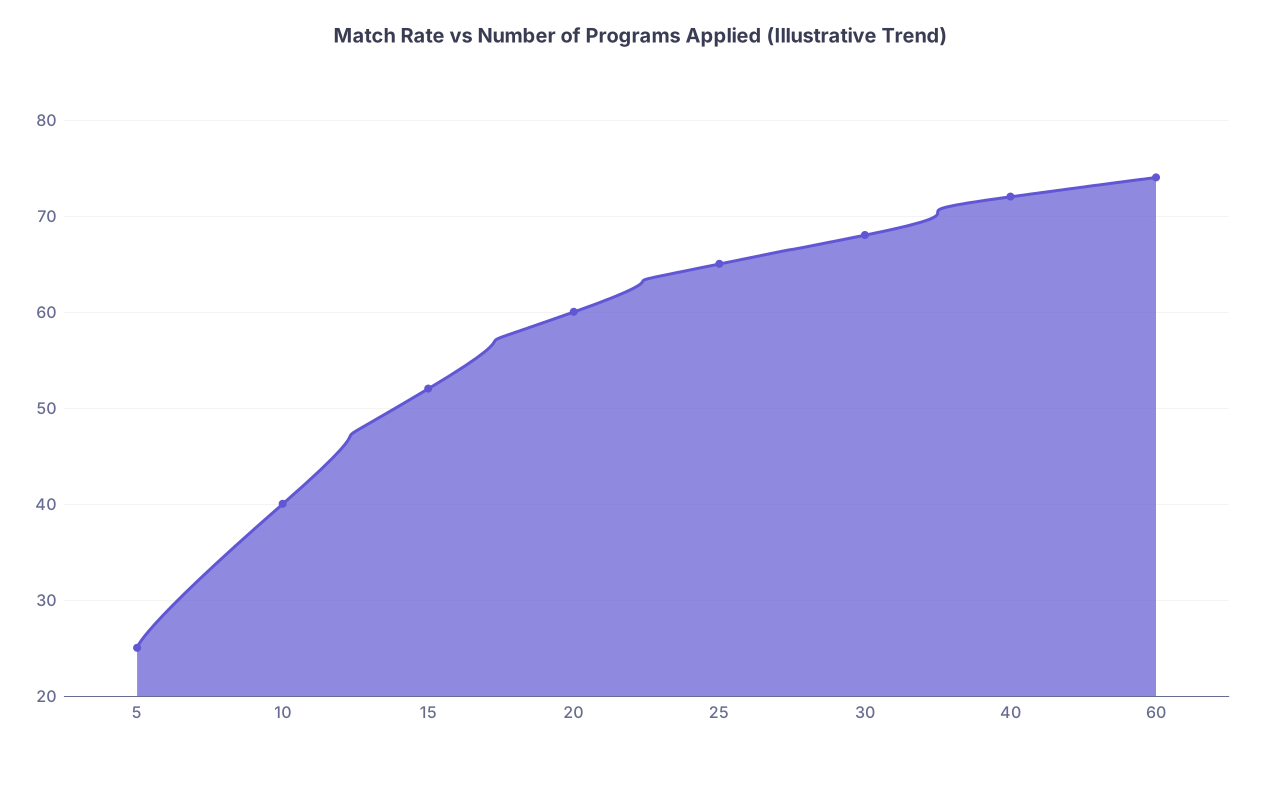
4.2 How Many Programs to Apply to Overall?
This is where your program selection strategy must be highly personalized. For a Caribbean IMG applying Med-Psych plus backup:
- Total applications (Med-Psych + IM + Psych):
- Strong Caribbean IMG: often 40–70 programs total
- Moderate Caribbean IMG: often 60–100 programs total
- Challenged Caribbean IMG: often 80–120+ programs total, mostly categorical
Breakdown example for a moderately competitive Caribbean IMG:
- Med-Psych combined: apply to most or all feasible Med-Psych programs (e.g., 10–15)
- Categorical psychiatry: 25–40 programs, heavily IMG-friendly
- Categorical internal medicine: 20–30 programs, heavily IMG-friendly
Your goal is to secure enough interviews (commonly at least 10–12 solid interviews overall) to feel comfortable about matching, whether in combined or categorical pathways.
4.3 Selecting Categorical Programs Strategically
For each categorical specialty (IM and/or psych):
Use an IMG lens:
- Look for programs with a history of accepting IMGs and Caribbean graduates.
- Check if SGU residency match lists or your own school’s match data show that program.
Match your profile to the program’s profile:
- For internal medicine: community and community-university programs often more receptive to Caribbean IMGs than highly research-focused academic powerhouses.
- For psychiatry: many safety-net and community-based university programs value diverse backgrounds and IMGs.
Consider geography and visa:
- Certain states and health systems are more accustomed to sponsoring visas and training IMGs (e.g., New York, New Jersey, Michigan, Texas, etc.).
Tier and distribute:
- Include a healthy portion of “safety” programs that regularly take IMGs with similar scores and graduation years to yours.
This backup planning significantly reduces the emotional pressure around your Medicine-Psychiatry applications.
Step 5: Evaluating Fit—Beyond Competitiveness
Once you have a broad list, refine it based on qualitative “fit” factors. For Med-Psych, fit is especially important, because the programs are small and often close-knit.
5.1 Program Structure: Integrated vs Parallel
Key questions when choosing Med-Psych programs:
- How are the medicine and psychiatry rotations organized?
- Parallel (alternating blocks) vs longer “immersion” blocks
- Is there a strong consult-liaison psychiatry presence?
- Are there rotations or clinics where integrated care (e.g., collaborative care, primary care psychiatry) is explicitly emphasized?
If your passion is integrated inpatient care, hospital-based C/L, or complex medical-psychiatric populations (e.g., transplant psychiatry, HIV, addiction), prioritize programs with strong C/L and robust medicine training.
If you lean toward community mental health integrated with primary care, look for:
- Federally Qualified Health Center (FQHC) partnerships
- Collaborative care clinics
- Integrated behavioral health in primary care sites
5.2 Institutional Mission and Patient Population
As a Caribbean IMG, you often bring cross-cultural strengths and bilingual or multilingual skills. Programs focusing on:
- Underserved communities
- Immigrant and refugee populations
- Safety-net health systems
may particularly value your background.
Examine each program’s mission statements, clinic locations, and affiliated hospitals. Ask:
- Does the program explicitly highlight diversity, inclusion, and serving marginalized populations?
- Are there faculty whose interests intersect with your own (e.g., global mental health, addiction in primary care, community psychiatry)?
5.3 Size, Support, and Culture
Med-Psych programs are typically small—often 1–3 residents per year. Consider:
- How many current residents are there in the Med-Psych track?
- Do they appear supported, or isolated between two departments?
- Are there established combined program leaders (e.g., program director and associate PD dedicated to Med-Psych)?
- Are there regular Med-Psych didactics, journal clubs, or joint conferences?
For a Caribbean IMG, especially one relocating far from home, a supportive culture and cohesive resident group can be just as important as academic reputation.
Step 6: Practical Program Selection Workflow
To make your decisions concrete, you can follow this structured workflow.
6.1 Week 1–2: Research and Initial List
- Compile all Medicine-Psychiatry programs into a sheet.
- Add basic data: location, positions, visa, IMG history.
- Mark each program:
- Green: clearly IMG-friendly, aligned with your stats and mission.
- Yellow: uncertain, borderline, or limited data.
- Red: explicit no-IMG policies or far above your competitive range.
6.2 Week 3–4: Add Categorical Backups
- For internal medicine and psychiatry:
- Pull lists from FREIDA or your school’s advising resources.
- Mark IMG-friendliness using:
- School match lists (e.g., SGU residency match data, your own school’s annual match reports)
- Program websites and current resident backgrounds
- Tier each program as reach/target/safety.
6.3 Week 5: Finalize “How Many Programs to Apply To”
Decide your application totals based on your competitiveness:
- Strong Caribbean IMG:
- Med-Psych: most or all feasible programs
- Categorical IM/Psych: enough to reach 40–60 total applications
- Moderate Caribbean IMG:
- Med-Psych: most or all feasible
- Categorical IM/Psych: enough to reach 60–80+ total
- Challenged Caribbean IMG:
- Med-Psych: targeted IMG-friendly programs only
- Categorical IM/Psych: bulk of 80–120+ total programs
- Strong Caribbean IMG:
Cross-check for:
- Visa compatibility
- Geographic preferences
- Reasonable balance of program tiers
6.4 Tailor Your Materials Accordingly
Your program selection strategy must be aligned with your written application:
- Med-Psych personal statement should:
- Clearly articulate your motivation for dual training
- Connect your Caribbean background and US experiences to integrated care
- Categorical internal medicine and psychiatry statements should:
- Show genuine interest in that specialty alone
- Avoid giving the impression that it is “just a backup,” especially if applying to Med-Psych at the same institution
Finally, track everything meticulously in your spreadsheet so you can quickly update as programs change policies, respond to questions, or share information on social media.
Frequently Asked Questions (FAQ)
1. As a Caribbean IMG, can I realistically match into a Medicine-Psychiatry combined program?
Yes, it is possible, but it is more competitive than many community categorical programs. Your odds are better if:
- You have a solid Step 2 CK score (often >230, though there are exceptions).
- You have strong US clinical experience in both medicine and psychiatry.
- You apply broadly to almost all Med-Psych programs that are at least somewhat IMG-friendly.
- You also build a robust backup plan in categorical internal medicine and/or psychiatry.
Your Caribbean background can be an asset if you frame it as evidence of resilience, adaptability, and cross-cultural competence, particularly valuable in integrated care settings.
2. How many Med-Psych programs should I apply to versus categorical programs?
For most Caribbean IMGs interested in Med-Psych:
- Apply to nearly all Medicine-Psychiatry programs that:
- Do not exclude IMGs
- Match your basic visa and geographic needs
- Then, add enough categorical internal medicine and/or psychiatry programs to reach:
- Around 40–70 total programs if you are stronger
- Around 60–100+ total programs if you are moderate or more challenged
The exact mix depends on your scores, attempts, graduation year, visa needs, and geographic flexibility, but the core rule is: do not rely solely on Med-Psych to match.
3. Should I prioritize internal medicine or psychiatry as my backup specialty?
It depends on:
- Which field you would be comfortable practicing long-term if you don’t match Med-Psych.
- Where your current strengths lie (letters, clinical exposure, comfort level).
- Your long-term career goals (e.g., hospitalist vs C/L psychiatrist vs outpatient integrated care).
If your passion is the medical complexity side, internal medicine categorical may make more sense. If you are drawn primarily to behavioral health and psychotherapy, psychiatry may be the better backup. Some applicants apply to both, but you must tailor your personal statements carefully to avoid appearing unfocused.
4. How can I tell if a program is truly IMG-friendly, especially for Caribbean graduates?
Look at:
- Current and recent residents’ medical schools on program websites.
- Whether your school (e.g., SGU, Ross, AUC) lists that program on their residency match report.
- Program or institution statements on diversity and international graduates.
- Visa sponsorship policies and history of sponsoring J‑1 or H‑1B for residents.
- Feedback from alumni, online forums, and networking (with caution for bias).
If a program consistently has multiple IMGs in recent classes or is listed repeatedly in SGU residency match or your own school’s match data, it is more likely to be open to Caribbean graduates.
A thoughtful, data-informed program selection strategy—grounded in clear self-awareness and realistic expectations—can significantly improve your chances of matching as a Caribbean IMG pursuing Medicine-Psychiatry. By combining a broad but intelligent Med-Psych application with a strong categorical backup plan, you protect your future while still giving yourself every possible opportunity to pursue the integrated career you envision.