Understanding the Unique Path: Pediatrics-Psychiatry for Caribbean IMGs
Pediatrics-Psychiatry (often called “Peds-Psych”) and Triple Board (Pediatrics–Psychiatry–Child & Adolescent Psychiatry) are small, competitive, and highly specialized training tracks. As a Caribbean international medical graduate (IMG), you face additional hurdles: visa needs, program bias toward US MDs, and questions about clinical exposure. A thoughtful, data-driven program selection strategy is essential.
This guide focuses on how a Caribbean IMG can build a smart list of Pediatrics-Psychiatry and Triple Board programs, alongside related pathways, and decide how many programs to apply to and which ones to target.
We’ll cover:
- The structure of Peds-Psych and Triple Board pathways
- How to honestly assess your competitiveness as an SGU or other Caribbean graduate
- How to identify realistic, stretch, and safety programs
- How many programs to apply to (and in which categories)
- Practical steps to research and prioritize programs as a Caribbean IMG
Throughout, we will also touch on SGU residency match experience patterns and what they imply for other Caribbean graduates.
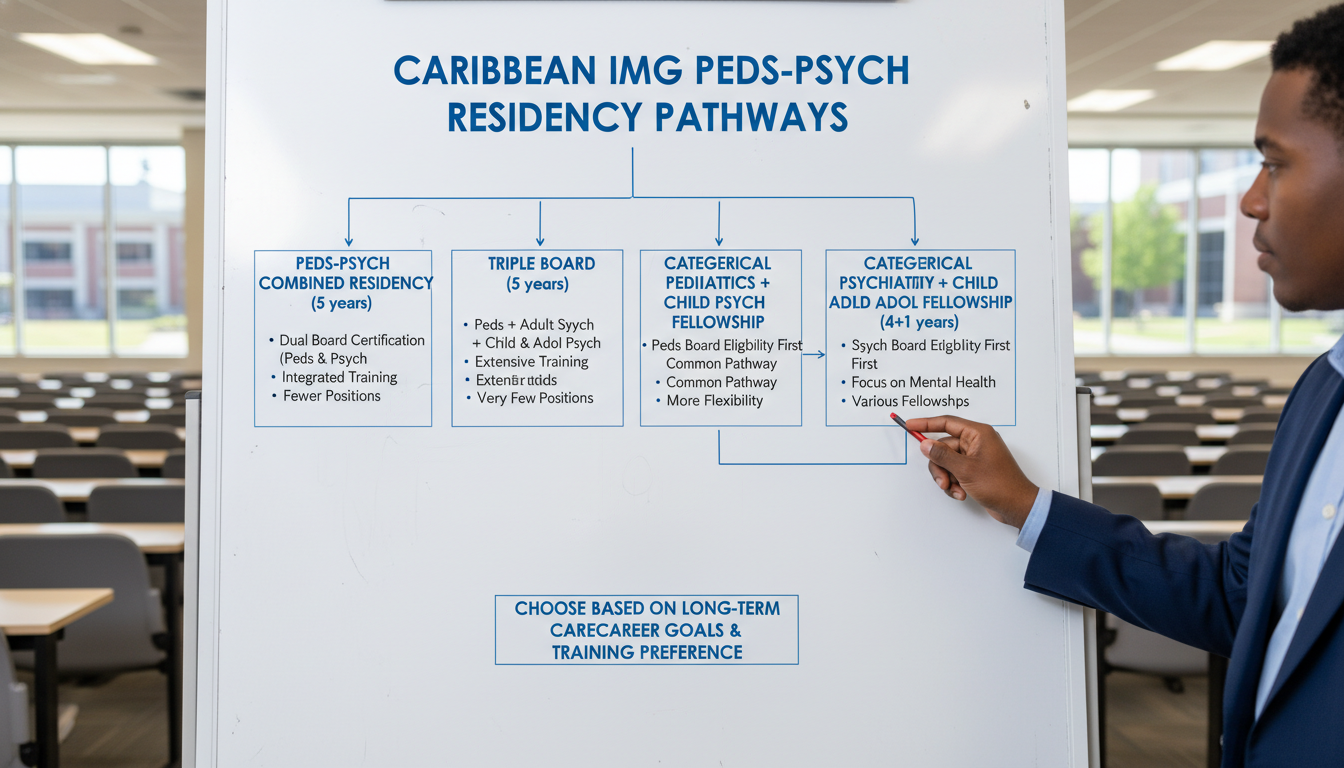
1. Know Your Pathways: Peds-Psych vs Triple Board vs Alternatives
Before you choose programs, you must be clear on what training path you’re actually targeting and what backup routes align with your goals.
1.1 Core Definitions
Pediatrics-Psychiatry Combined Programs (Peds-Psych)
- Length: Usually 5 years
- Training: Integrated Pediatrics + General (Adult) Psychiatry, sometimes with Child & Adolescent Psychiatry exposure
- Outcome: Graduates are typically board-eligible in Pediatrics and Psychiatry (check each program’s specific board eligibility details)
Triple Board Programs
- Length: 5 years
- Training: Integrated Pediatrics + General Psychiatry + Child & Adolescent Psychiatry
- Outcome: Graduates are board-eligible in all three fields (Peds, Psych, Child & Adolescent Psych)
Because these tracks are closely related, many applicants interested in peds psych residency apply to both Peds-Psych and Triple Board programs.
1.2 Why These Pathways Are Tricky for Caribbean IMGs
- Very small number of positions nationwide (some Triple Board programs offer 2–4 positions per year; many Peds-Psych programs offer 1–3).
- High applicant-to-seat ratio; many applicants come from US MD schools with strong academic records.
- Some programs have limited or no history of taking IMGs, especially Caribbean IMGs.
- Visa sponsorship policies can further narrow your options.
For a Caribbean IMG, your program selection strategy must recognize these constraints and address the question:
If I am deeply committed to Peds-Psych, how do I design a plan that maximizes my chance of matching somewhere—even if not directly into a combined or Triple Board program?
1.3 Adjacent Pathways to Consider in Your Strategy
To build a robust plan, include:
- Categorical Pediatrics programs
- Many child-psychiatry-interested applicants choose Pediatrics first, then Child & Adolescent Psychiatry fellowship.
- Categorical Psychiatry programs
- Another common route: Adult Psychiatry residency → Child & Adolescent Psychiatry fellowship.
- Triple Board programs
- These often align closely with Peds-Psych career goals.
- Peds-Psych & Triple Board together
- Treat them as a single “focus track” in your planning.
Your final list may combine all four categories, tailored to your strengths, risk tolerance, and geographic preferences.
2. Honest Self-Assessment: Where Do You Stand as a Caribbean IMG?
Your program selection strategy must start with a realistic self-assessment. Combined and Triple Board programs are small; they will scrutinize every aspect of your application.
2.1 Key Competitiveness Factors
USMLE Scores
- Step 1 (if scored) and Step 2 CK remain important screening metrics.
- For competitive combined tracks, many applicants have Step 2 CK scores typically > 230–235, often higher for more selective institutions.
- As a Caribbean IMG, stronger scores can help offset institutional bias.
Clinical Performance
- High grades and Honors in Pediatrics and Psychiatry rotations are particularly important.
- Strong letters from US-based Pediatricians and Psychiatrists show you can succeed in both domains.
Research and Scholarly Activity
- Work in child psychiatry, developmental pediatrics, integrated care, or related fields strengthens your narrative.
- Publications, posters, QI projects, or case reports can differentiate you, especially for Peds-Psych and Triple Board.
US Clinical Experience (USCE)
- Core clinical rotations in the US (especially if from a recognized Caribbean school like SGU) matter.
- Electives/sub-internships in Pediatrics, Psychiatry, or Child Psychiatry at US institutions are very valuable.
Visa Status
- US citizens/permanent residents are more flexible applicants.
- If you require J-1 or H-1B, check carefully which programs sponsor visas—this is crucial in Peds-Psych and Triple Board because of their small size.
2.2 Using SGU Residency Match and Other Caribbean Data
Even if you are not from St. George’s University (SGU), SGU residency match outcomes provide some guidance:
- SGU regularly publishes match lists, including Pediatrics, Psychiatry, and occasionally combined or Triple Board matches.
- Look for:
- Programs that have previously matched SGU or other Caribbean graduates in Pediatrics or Psychiatry.
- Whether those institutions tend to be IMG-friendly overall.
- If a program has never taken Caribbean IMGs in any track, treat it as a high-risk stretch option.
2.3 Creating Your Personal Competitiveness Tier
Based on scores, clinical performance, research, and visa needs, categorize yourself:
High-Competitiveness Caribbean IMG
- Step 2 CK ≥ 240
- Strong clinical grades, US-based research or notable scholarly work
- Multiple strong US letters from Pediatrics and Psychiatry
- Preferably no visa needed, or J-1 okay
Moderate-Competitiveness Caribbean IMG
- Step 2 CK 225–239
- Solid clinical performance, one or two honors in core rotations
- Some scholarly activity or at least strong clinical evaluations
- Visa needs possible, but flexible
At-Risk / Lower-Competitiveness Caribbean IMG
- Step 2 CK < 225 or multiple failures
- Average clinical evaluations, limited USCE
- Minimal or no scholarly work
- Significant visa limitations (e.g., requiring H-1B only)
Your category will heavily influence how many programs to apply to and the balance of Peds-Psych vs categorical Pediatrics/Psychiatry.
3. Building Your List: How to Choose Residency Programs Strategically
With your self-assessment in hand, you can now design a program selection strategy tailored to Peds-Psych, Triple Board, and backup options.
3.1 The Four-Bucket Approach
Use four buckets:
- Bucket A: Peds-Psych and Triple Board Programs (primary dream path)
- Bucket B: Categorical Pediatrics Programs (IMG-friendly)
- Bucket C: Categorical Psychiatry Programs (IMG-friendly)
- Bucket D: A few “reach” programs in highly competitive institutions (optional, if you have time and budget)
Your aim is to ensure that even if you don’t match into Peds-Psych or Triple Board, you still have a strong chance in Pediatrics or Psychiatry, keeping your child mental health career goal alive through fellowship.
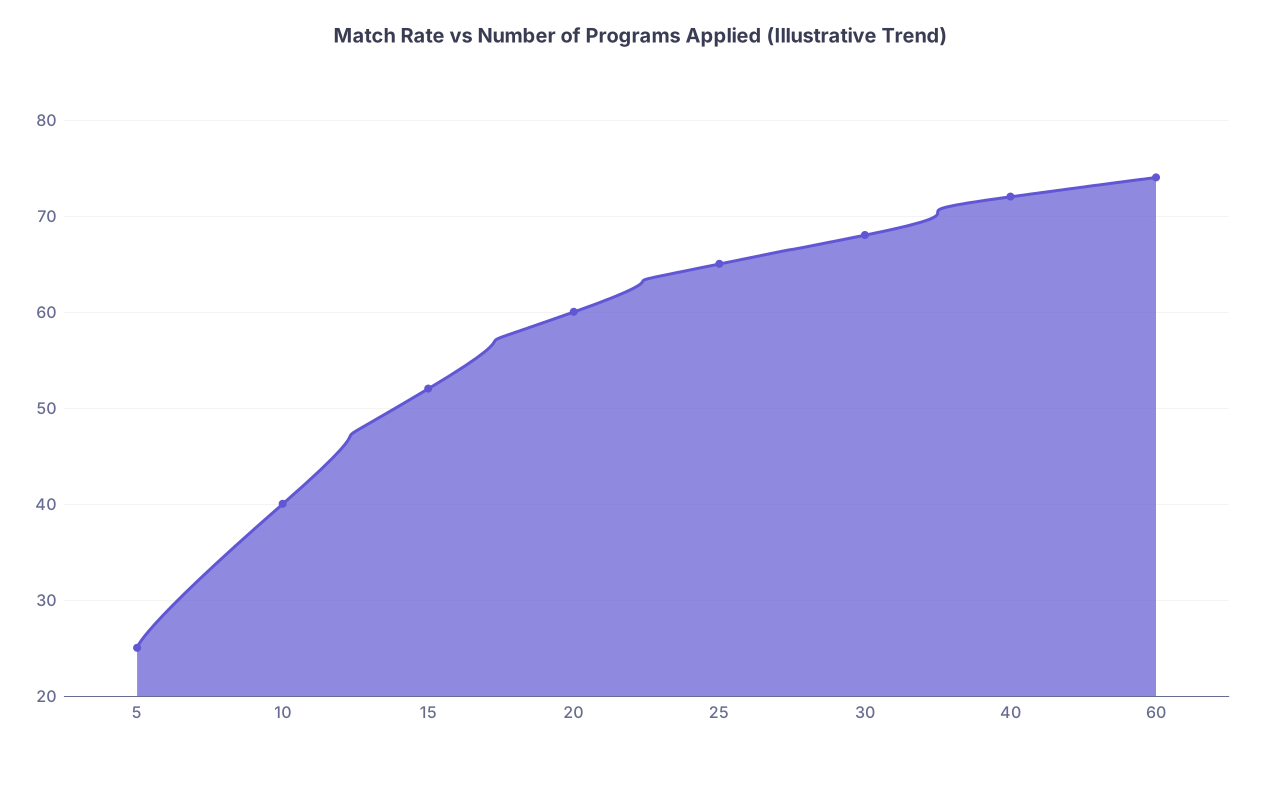
3.2 How Many Programs to Apply (Approximate Targets)
Exact numbers change year-to-year, but approximate ranges for a Caribbean IMG interested in Peds-Psych:
High-Competitiveness Caribbean IMG
- Peds-Psych + Triple Board: 8–15 programs (essentially all that exist and accept ERAS, with reasonable geographic/visa fit)
- Categorical Pediatrics: 25–40 programs
- Categorical Psychiatry: 20–35 programs
- Total: ~55–90 programs
Moderate-Competitiveness Caribbean IMG
- Peds-Psych + Triple Board: 8–15 programs
- Categorical Pediatrics: 40–60 programs
- Categorical Psychiatry: 35–50 programs
- Total: ~85–125 programs
Lower-Competitiveness Caribbean IMG
- Peds-Psych + Triple Board: 5–10 (prioritize those with explicit IMG acceptance or prior Caribbean graduates)
- Categorical Pediatrics: 60–80 programs (maximally IMG-friendly)
- Categorical Psychiatry: 50–70 programs
- Total: ~115–160 programs
These are broad ranges, but they give a realistic sense of how many programs to apply to as a Caribbean IMG targeting a niche combined specialty.
3.3 Using Program Filters and Data
To refine your list:
- FREIDA / AAMC data:
- Filter by specialty: Pediatrics, Psychiatry, combined programs, Triple Board.
- Check for: number of residents, IMG percentage, visa policies.
- Program websites:
- Look for explicit mentions of accepting IMGs.
- Review current and past resident lists for Caribbean graduates.
- NRMP and Specialty Organizations:
- Some Peds-Psych or Triple Board programs may list extra selection criteria or typical applicant profiles.
3.4 Criteria for Selecting Peds-Psych & Triple Board Programs
When you evaluate each combined or Triple Board program, look for:
IMG-Friendliness
- Any IMG or Caribbean alumni listed?
- Do they mention “we welcome IMGs” on their website?
- What is their average USMLE score range?
Visa Policy
- Do they sponsor J-1? H-1B? Neither?
- Some smaller programs avoid the administrative complexity of visas.
Program Structure and Emphasis
- Balance of Pediatrics vs Psychiatry exposure by year
- Strength of Child & Adolescent Psychiatry
- Opportunities for integrated behavioral pediatrics, developmental pediatrics, or community mental health
Geographic and Lifestyle Fit
- Urban vs rural, cost of living, support systems for trainees
- Consider your own support network and stress resilience as an IMG far from home.
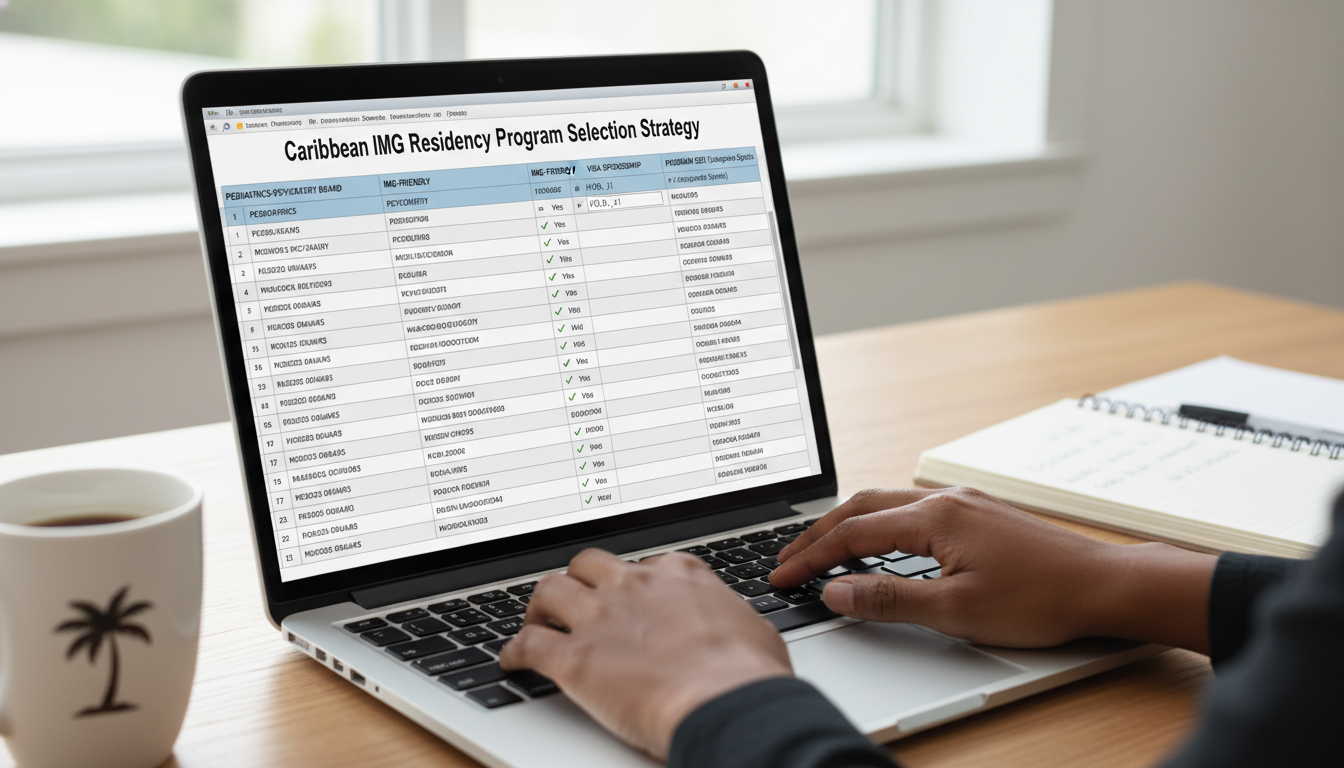
Create a spreadsheet with columns:
Program | Type (Peds-Psych vs Triple Board) | IMG Presence | Visa | Score Threshold | Notes | Category (Realistic / Stretch)
4. Program Selection Strategy by Competitiveness Level
Here is how to translate your self-assessment into a concrete program selection strategy.
4.1 Strategy for High-Competitiveness Caribbean IMG
Profile Example:
- SGU graduate, Step 2 CK 245, Honors in Pediatrics and Psychiatry, a poster in child psychiatry, no visa needed.
Your Strategy:
Apply to every Peds-Psych and Triple Board program that:
- Accepts ERAS applications from IMGs or doesn’t explicitly exclude IMGs.
- Matches your geographic and visa considerations.
For Pediatrics:
- Focus on university-affiliated and large community programs with moderate to high IMG presence.
- Include some academic programs known for child mental health and integrated care.
For Psychiatry:
- Target programs with strong Child & Adolescent Psychiatry fellowships or integrated pediatric rotations.
- Include several mid-tier university programs and robust community programs.
Risk Tolerance:
You can afford some stretch programs, but should still maintain a broad base of IMG-friendly categorical programs to ensure a successful match.
4.2 Strategy for Moderate-Competitiveness Caribbean IMG
Profile Example:
- Caribbean graduate with Step 2 CK 232, mostly Pass/High Pass with one Honors in Pediatrics, good US letters, J-1 visa needed.
Your Strategy:
Peds-Psych & Triple Board:
- Apply widely (essentially all programs that will consider IMGs and sponsor J-1).
- Recognize that most will be stretch or mid-range, but you may still be competitive at a subset.
Categorical Pediatrics:
- Heavily target mid-sized community and university-affiliated programs with clear IMG representation.
- Use FREIDA filters: percentage of IMGs, J-1 sponsorship, and number of positions.
Categorical Psychiatry:
- Similar approach: high proportion of IMGs, J-1 sponsorship, and strong outpatient/community psychiatry.
- Prioritize programs with established Child & Adolescent Psychiatry fellowships.
Risk Tolerance:
You need a broad safety net. Your chances of matching are much higher through categorical tracks than the limited combined spots. Treat Peds-Psych and Triple Board as target/dream, not as your sole lifeline.
4.3 Strategy for Lower-Competitiveness Caribbean IMG
Profile Example:
- Caribbean graduate, Step 2 CK 218 with a previous Step failure, average clinical performance, limited USCE, requires J-1.
Your Strategy:
Peds-Psych & Triple Board:
- Apply only to programs that:
- Clearly accept IMGs.
- Have small but visible IMG representation.
- Sponsor your visa type.
- Treat these as long-shot options; don’t over-invest emotionally.
- Apply only to programs that:
Categorical Pediatrics:
- Apply very broadly to IMG-heavy programs, especially community-based.
- Prioritize programs with a history of taking Caribbean graduates and stronger support for remediation and advising.
Categorical Psychiatry:
- Similarly, target programs with ≥30–40% IMGs, visible Caribbean alumni, and flexible score cutoffs.
Risk Tolerance:
Your primary objective is to match somewhere. Continue to emphasize your interest in child mental health—but accept that you may need a more gradual pathway (e.g., starting with categorical Pediatrics or Psychiatry, then Child & Adolescent fellowship).
5. Practical Steps to Research and Prioritize Programs
Having a conceptual strategy is not enough; you need a step-by-step approach to building and tightening your list.
5.1 Step 1: Map the Universe of Peds-Psych and Triple Board Programs
- Use:
- FREIDA
- ACGME-accredited program lists
- American Academy of Pediatrics (AAP) & American Academy of Child and Adolescent Psychiatry (AACAP) resources
- Create a sheet with all Peds-Psych and Triple Board programs:
- Location, number of positions, IMG mention, visa status
5.2 Step 2: Screen for IMG and Visa Feasibility
- For each program, check:
- “We accept IMGs” or resident profiles showing IMGs/Caribbean grads
- Visa sponsorship details: J-1 vs H-1B vs none
- Remove programs that explicitly do not take IMGs or cannot sponsor your needed visa.
5.3 Step 3: Score Programs for Fit
Design a simple scoring system (1–5) for each factor:
- IMG-friendliness
- Visa compatibility
- Peds-Psych focus alignment (e.g., strong child mental health, integrated care)
- Geographic preference (proximity to family, lifestyle, climate)
- Institutional support for diversity and wellness
Sum the scores to prioritize programs into:
- Tier 1: High Priority
- Tier 2: Medium
- Tier 3: Low / Stretch
Do this for all four buckets (Peds-Psych/Triple Board, Pediatrics, Psychiatry).
5.4 Step 4: Use Your Network
- Reach out to:
- Recent SGU or other Caribbean alumni who matched into Pediatrics, Psychiatry, or Peds-Psych.
- Mentors from your clinical rotations in the US.
- Ask specific questions:
- “Which programs were particularly supportive of IMGs?”
- “Do you know any Caribbean grads in Peds-Psych or Triple Board?”
- “Which programs seem open to non-traditional applicants?”
5.5 Step 5: Adjust for Application Costs and Interview Logistics
As a Caribbean IMG, application fees and travel (even virtual interviews require time off rotations) matter.
- Start with your maximum affordable total number of applications.
- Allocate roughly:
- 10–15 Peds-Psych/Triple Board
- The remainder split between Pediatrics and Psychiatry, weighted according to your competitiveness and interest.
- If budget is tight:
- Prioritize programs with higher IMG presence and stronger personal/mentor connections.
- Reduce low-yield stretch applications.
6. Presenting Your Interest Strategically Across Applications
Your program selection strategy should be matched by a coherent application narrative.
6.1 Unifying Theme: Child Behavioral Health
Whether you apply to Peds-Psych, Triple Board, Pediatrics, or Psychiatry, frame your interest consistently:
- Emphasize:
- Longstanding passion for child and adolescent mental health
- Experiences in schools, community programs, or developmental clinics
- Research or QI focused on behavioral pediatrics, trauma, ADHD, autism, or family systems
6.2 Tailoring for Each Program Type
- Peds-Psych / Triple Board
- Highlight your excitement about integrated training, ability to work across systems, and comfort with medical + behavioral complexity.
- Categorical Pediatrics
- Emphasize your interest in behavioral pediatrics, chronic illness, and family-centered care.
- Mention future plans for Child & Adolescent Psychiatry fellowship or close collaboration with mental health teams.
- Categorical Psychiatry
- Highlight your comfort with medically complex patients, your pediatrics experiences, and desire to specialize in Child & Adolescent.
6.3 Being Honest Without Undermining Yourself
Programs sometimes worry that combined applicants see categorical training as a “backup only.” Address this carefully:
- Show genuine enthusiasm for each track on its own merits.
- For example:
- In a Pediatrics personal statement:
“While I am strongly interested in child and adolescent mental health, I am equally excited about the breadth of Pediatrics training—caring for children with both acute and chronic medical conditions, and collaborating closely with subspecialists.” - In a Psychiatry personal statement:
“My pediatrics experiences strengthened my interest in early identification of psychiatric conditions and reinforced my commitment to a career in child and adolescent psychiatry.”
- In a Pediatrics personal statement:
FAQs: Program Selection Strategy for Caribbean IMG in Pediatrics-Psychiatry
1. As a Caribbean IMG, can I realistically match into a Peds-Psych or Triple Board residency?
Yes, but the odds are tighter than for categorical Pediatrics or Psychiatry because there are very few positions. A strong Caribbean IMG (solid scores, strong US letters, clear commitment to child mental health) can be competitive, especially at IMG-friendly programs. However, you should not rely solely on Peds-Psych or Triple Board; build a robust list of Pediatrics and Psychiatry programs as well.
2. How many programs should I apply to if Peds-Psych is my top choice?
Most Caribbean IMGs should apply widely:
- 8–15 Peds-Psych and Triple Board programs (essentially all reasonable options)
- 25–80 Pediatrics programs and 20–70 Psychiatry programs, depending on your competitiveness.
Total applications often fall between 80–150 programs for moderate to lower-competitiveness Caribbean IMGs. Adjust based on budget, scores, and risk tolerance.
3. Should I rank Peds-Psych/Triple Board programs above categorical Pediatrics or Psychiatry programs?
Yes—if your genuine top goal is integrated Peds-Psych or Triple Board, rank those programs highest. The match algorithm favors your preferences. After your combined programs, rank your strongest fit categorical Pediatrics and Psychiatry programs. Do not artificially lower combined programs out of fear; instead, build a long, realistic rank list.
4. If I match into categorical Pediatrics or Psychiatry, can I still become a child psychiatrist or work in child behavioral health?
Absolutely. Many child psychiatrists and behavioral pediatric leaders trained via categorical routes. Common pathways include:
- Pediatrics residency → Child & Adolescent Psychiatry fellowship
- Psychiatry residency → Child & Adolescent Psychiatry fellowship
You can still build a career closely aligned with Peds-Psych principles through subspecialty training, dual appointments, and integrated care roles.
By combining a realistic self-assessment, broad and targeted program selection, and a coherent child mental health narrative across applications, a Caribbean IMG can significantly improve their chances of securing a spot in a pathway that leads to a fulfilling peds psych residency career—whether directly through Peds-Psych or Triple Board, or through carefully chosen categorical Pediatrics or Psychiatry programs.