Understanding the Big Picture: Caribbean IMG + Preliminary Medicine
For a Caribbean IMG, building a smart program selection strategy for a Preliminary Medicine (prelim IM) year is both different and more complex than applying to categorical internal medicine. You’re not just asking, “Where can I get a prelim year?” You’re really asking:
- How do I use a preliminary medicine year to:
- Strengthen my CV and US clinical experience?
- Transition into a categorical IM spot or another specialty (e.g., anesthesiology, neurology, radiology)?
- Reduce risk as a Caribbean medical school residency applicant, given match statistics?
At the same time, you need to decide how many programs to apply to, which programs are realistic, which are aspirational, and how to prioritize interviews strategically.
This article walks you through a detailed program selection strategy specifically for Caribbean IMGs targeting Preliminary Medicine, with a strong focus on:
- Translating your Caribbean medical school residency profile into realistic program tiers
- Understanding the prelim IM landscape
- Creating a balanced program list and knowing how many programs to apply to
- Using your SGU residency match or other Caribbean school match data to guide decisions
- Practical tactics to improve interview yield and match chances
Throughout, assume you are:
- A Caribbean IMG (e.g., SGU, AUC, Ross, Saba)
- Targeting a Preliminary Internal Medicine year
- Possibly using prelim IM as a bridge to advanced specialties or as a path to eventual categorical IM
Section 1: The Role of a Preliminary Medicine Year for Caribbean IMGs
1.1 What Is a Preliminary Medicine Year?
A Preliminary Medicine year is a one-year internal medicine residency position (PGY-1) without guaranteed continuation to PGY-2 in that same program. It is often used by:
- Applicants who matched into an advanced specialty that starts at PGY-2 (e.g., neurology at some institutions, radiology, anesthesiology) and need a clinical base year.
- Applicants who want U.S. residency experience, stronger letters, and time to reapply to a different specialty or categorical spot.
For Caribbean IMGs, a prelim IM year can serve as:
- A bridge year while building a stronger application (USMLE Step scores, letters, research).
- A safety net if you do not match into your target advanced specialty.
- A way to prove success in a U.S. ACGME-accredited training environment, which can be highly valuable given biases against Caribbean graduates in some programs.
1.2 Why Caribbean IMGs Often Need a Different Strategy
Compared to U.S. MDs, Caribbean IMGs typically face:
- Lower overall match rates
- More scrutiny of USMLE scores and attempts
- Greater emphasis on visa needs (if applicable)
- Less benefit of “home program” connections
Because of this, your program selection strategy needs to:
- Be more data-driven (school match lists, NRMP data, outcomes of prior Caribbean graduates)
- Include a larger number of programs than most U.S. MDs
- Consider geography, visa policies, and IMG-friendliness as major factors, not afterthoughts

Section 2: Understanding the Prelim IM Landscape and Your Profile
Before deciding how many programs to apply to or which ones to target, you must deeply understand where you stand.
2.1 Key Components of a Caribbean IMG Profile
Programs will mainly look at:
USMLE Scores and Attempts
- Step 1 (Pass/Fail now, but your numeric score still matters if reported)
- Step 2 CK (critical for screening)
- Number of attempts (failed attempts are a major filter at some programs)
Medical School Background
- Recognition of your school (e.g., SGU, AUC, Ross often better known)
- Your Caribbean medical school residency match history (how many graduates match prelim or categorical IM, and where)
Clinical Experience
- U.S. clinical rotations (audition electives, sub-internships)
- Strong letters from U.S. academic or reputable community hospitals
Visa Status
- U.S. citizen/green card vs. requiring J-1 or H-1B
- Some programs are explicitly visa-unfriendly and should be filtered out early
Red Flags
- Gaps in training
- Multiple exam failures
- Unexplained timeline issues
The more red flags you have, the more aggressive and wide your program list needs to be.
2.2 Using SGU or Other Caribbean School Match Data
If you’re from a larger Caribbean school (e.g., SGU), your SGU residency match or similar match list from your school is gold for program selection strategy. It shows:
- Which programs have a history of taking Caribbean IMGs
- Which programs have taken your specific school repeatedly
- Whether those programs are more community-based or university-affiliated
Use this data to:
- Build an initial list of “IMG-friendly” prelim IM and categorical IM programs.
- Prioritize programs that have recent prelim Medicine or IM matches from your school in the last 3–5 years.
If your school doesn’t publish detailed match lists, ask:
- Upperclassmen, recent graduates, alumni networks, or student organizations about where they matched prelim IM or categorical IM.
2.3 The Prelim vs. Categorical IM Distinction for Strategy
Even if your primary focus is prelim IM, your program selection strategy should still consider:
- Categorical IM programs where you might apply in parallel
- Programs that offer both: some institutions have prelim and categorical internal medicine tracks; being on their radar could open both options.
For Caribbean IMGs:
- It’s reasonable to apply to a mix of preliminary medicine and categorical IM programs, especially if your long-term goal is to be an internist.
- If your primary goal is an advanced specialty (e.g., radiology), you might emphasize prelim IM and transitional years, but prelim IM is usually more realistic for IMGs than transitional year at competitive institutions.
Section 3: How Many Programs to Apply To for Preliminary Medicine
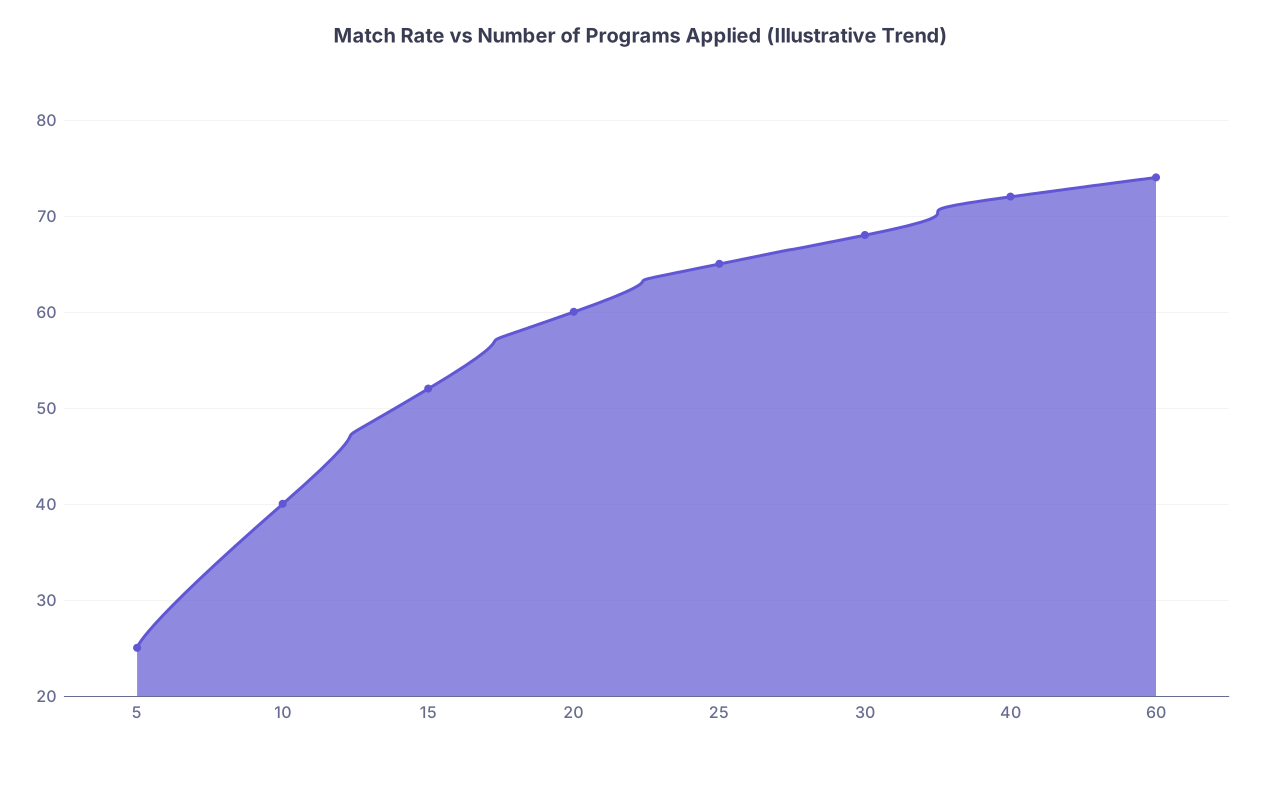
One of the most critical questions is: how many programs to apply? There is no single ideal number for all, but Caribbean IMGs applying to prelim IM generally need to overshoot rather than undershoot.
3.1 General Ranges for Caribbean IMGs Targeting Prelim IM
These ranges assume:
- You are applying only for a preliminary medicine year (and possibly some categorical IM).
- You are a Caribbean IMG with a typical profile.
Stronger Caribbean IMG profiles (e.g., Step 2 CK ≥ 240, no fails, strong U.S. letters):
- Prelim IM only: 30–50 prelim IM programs
- If combined with categorical IM: 40–70 total programs (e.g., 25–40 categorical IM + 15–30 prelim IM)
Average Caribbean IMG profiles (e.g., 225–238 Step 2 CK, one or two minor issues):
- Prelim IM only: 50–80 prelim IM programs
- Prelim + categorical IM: 70–100 total programs
More challenging profiles (e.g., <220 Step 2 CK, failed attempt, or significant gaps):
- Prelim IM only: 80–120 prelim IM programs
- Prelim + categorical IM: 100–150 total programs
These are ballpark estimates, but for a Caribbean IMG, it is far safer to apply broadly.
Important: The number of applications is not the only factor; the quality and relevance of those programs (visa policy, IMG-friendliness, your realistic competitiveness) matter just as much.
3.2 Factors That Should Increase Your Application Count
You should lean toward the higher end of those ranges if you have:
- Step 2 CK < 230
- Any exam failure
- No U.S. clinical experience in internal medicine
- Need for H-1B (far fewer programs sponsor this)
- Longer time since graduation (>3–5 years)
- Very limited research or extracurriculars
Also consider increasing your numbers if:
- You are constrained geographically (e.g., only applying in one or two states due to family reasons).
- Your school has limited historical match success into prelim IM in the U.S.
3.3 Balancing Cost and Opportunity
ERAS fees add up quickly. A rough rule:
- Think of each additional 10–20 programs as “insurance”.
- If you are at a high risk of not matching (per your profile), the cost of not matching is usually much higher than the extra ERAS fees.
Your program selection strategy should weigh:
- Financial limits
- Your risk tolerance
- Objective chances based on prior Caribbean IMG match patterns and your scores
Section 4: Building a Tiered, Data-Driven Program List
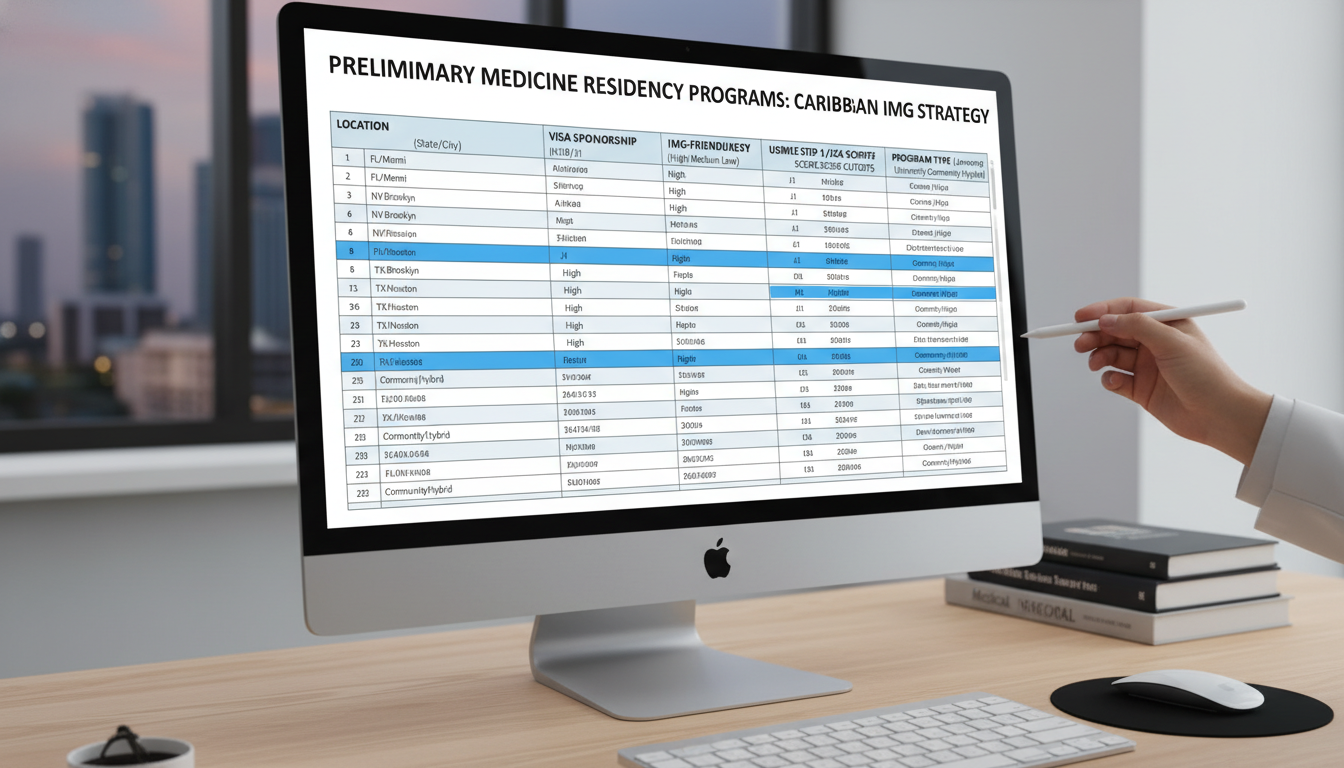
The key to smart program selection strategy is tiering your options and using filters that matter for a Caribbean IMG in prelim IM.
4.1 Step 1: Define Your Non-Negotiable Filters
Before anything else, filter programs by:
Program Type
- Prelim Internal Medicine (required)
- Optional: Categorical Internal Medicine if applying in parallel
Visa Policy
- If you need a visa, remove programs that:
- Explicitly say “No J-1 or H-1B sponsorship”
- Have no IMGs and no history of sponsoring visas
- If you need a visa, remove programs that:
Geographic Constraints
- Decide where you are genuinely willing to train.
- Be honest: once you match, it’s binding.
AAMC/ERAS Filters and FREIDA Data
- Use FREIDA or program websites to confirm:
- Program size
- IMG acceptance history
- Average USMLE scores if available
- Use FREIDA or program websites to confirm:
4.2 Step 2: Identify IMG-Friendly Programs
For Caribbean IMGs, “IMG-friendly” means:
- Programs that routinely accept IMGs (especially Caribbean)
- Clear evidence on:
- Program website (photos, bios of residents)
- FREIDA data
- Your school’s match list (SGU residency match lists, etc.)
Practical steps:
- Go through your school’s Caribbean medical school residency match lists for the last 3–5 years.
- Note every prelim IM and categorical IM program that has taken Caribbean IMGs.
- Cross-reference those with FREIDA to ensure they still exist and offer prelim spots.
4.3 Step 3: Create Tiers Based on Competitiveness
Develop at least three tiers of prelim IM programs:
Reach Programs
- Historically university-affiliated, in desirable cities, or with higher average Step scores.
- Your Step 2 CK may be below or barely at their apparent range.
- You still apply to some (5–15 programs) because occasionally Caribbean IMGs do match here, especially with strong rotations/letters.
Target Programs
- Programs that have multiple Caribbean IMGs in recent years
- Your Step 2 CK and profile are well-aligned with typical residents
- Often medium-sized community or university-affiliated community hospitals
Safety Programs
- Programs that:
- Are in less competitive regions or smaller cities
- Have a heavy IMG presence (including Caribbean)
- May have slightly lower score thresholds
- Programs that:
Your final list should roughly follow:
- 15–25% Reach
- 40–60% Target
- 25–40% Safety
For a typical Caribbean IMG applying to 70 programs total for prelim IM:
- 10–15 Reach
- 30–40 Target
- 20–25 Safety
4.4 Evaluating Programs Beyond Name and City
When deciding how to choose residency programs within these tiers, look for:
Educational structure:
- Is there formal teaching, noon conference, morning report?
- Is the prelim year well-integrated into the categorical IM structure?
Resident support and workload:
- Reasonable duty hours
- Adequate supervision and ancillary staff
Opportunities for Letters and Advancement:
- Are there pathways for prelims to be considered for PGY-2 categorical positions if available?
- Are there strong subspecialty services where you can build relationships (cardiology, GI, etc.)?
For Caribbean IMGs planning to reapply, these factors are critical. A strong letter from your prelim IM PD can be transformative.
Section 5: Strategic Considerations Unique to Caribbean IMGs in Prelim IM
5.1 Prelim IM + Advanced Specialty Strategy
Many applicants use prelim IM as a base year for an advanced specialty. For Caribbean IMGs:
- Some advanced specialties are very competitive (dermatology, radiology, anesthesiology at top institutions).
- If you are targeting those and also applying for prelim IM:
- Be realistic: your prelim IM strategy should stand on its own in case you don’t immediately match advanced.
- Consider applying to more preliminary medicine programs if your advanced specialty chances are uncertain.
5.2 Prelim IM as a Bridge to Categorical IM
If your longer-term goal is categorical IM but your current competitiveness is limited:
- Use prelim IM to:
- Demonstrate clinical excellence in U.S. training
- Obtain strong letters
- Potentially find in-program opportunities (e.g., open PGY-2 categorical spots)
For your program selection strategy:
- Prefer prelim Medicine programs at institutions that:
- Have large or growing categorical IM programs
- Have a history (even unofficial) of converting strong prelim IM interns into PGY-2 categorical when openings arise
- Are in regions with multiple nearby IM programs where you might later transfer or apply
5.3 Managing Interview Season and Prioritizing Programs
If you apply broadly (70–120 programs), you may receive more interview invitations than you can reasonably attend.
Prioritize:
- IMG-friendly programs in locations you’re willing to live in for 1 year.
- Programs with better educational structure or stronger reputations.
- Programs that offer both prelim and categorical IM opportunities or are in hospital systems with multiple training programs.
Avoid overcommitting to very low-yield programs (e.g., highly prestigious academic centers with no history of Caribbean IMGs), especially if interviews are expensive to travel to.
5.4 Common Pitfalls for Caribbean IMGs
Applying to too few programs
- Underestimating the additional hurdles Caribbean IMGs face.
- Even “average” Caribbean applicants often need more applications than U.S. MDs.
Over-focusing on location (only big cities or specific states)
- Some excellent prelim IM opportunities are in mid-sized or smaller cities with strong educational experiences.
- Limiting too much will require you to apply to even more programs in those constrained areas.
Ignoring visa policies until it’s too late
- Always check: Do they sponsor J-1? H-1B? Do they historically take IMGs on visas?
Not researching program culture and support
- A prelim year can be intense. Programs expecting you to function as cheap labor with minimal teaching can leave you exhausted and with weaker letters.
Section 6: Putting It All Together – A Sample Strategy for a Caribbean IMG
Let’s consider a realistic example to show how these pieces fit into a cohesive program selection strategy.
6.1 Example Applicant Profile
- Caribbean IMG (SGU)
- Step 1: Pass (Former score ~225, not heavily emphasized now but still noted)
- Step 2 CK: 233, one attempt
- 3 months U.S. IM rotations (one sub-I at a community hospital)
- Requires J-1 visa
- No major red flags, graduated this year
6.2 Step-by-Step Strategy
Step 1: Decide on total number of applications
- Profile: average Caribbean IMG.
- Plan: Apply to ~80 programs total, focusing on preliminary medicine, plus 20–30 categorical IM programs as backup/parallel.
Step 2: Define filters
- Needs J-1 visa → eliminate programs with no sponsorship.
- Open to multiple regions but prefers East Coast and Midwest.
Step 3: Build initial program pool
- From SGU residency match lists, identify:
- 40–50 prelim IM programs that have taken SGU or other Caribbean grads in past 3–5 years.
- 30–40 categorical IM programs with recent Caribbean IMG presence.
Step 4: Tier the prelim IM programs
Reach (15 programs)
- mid-level university hospitals in larger cities that occasionally take Caribbean IMGs but have higher average scores.
Target (35 programs)
- community and university-affiliated hospitals with recurrent SGU/Caribbean matches and typical Step 2 CK in the 225–235+ range.
Safety (30 programs)
- IMG-heavy community programs, often in less popular locations, clearly J-1 friendly.
Step 5: Apply and manage interviews
- Aim for 10–15 interviews across prelim IM + categorical IM combined.
- If invited to >20 interviews, prioritize:
- Stronger educational programs
- Clear IMG-friendliness
- Locations where long-term staying is possible
Step 6: Rank list strategy
- Rank prelim IM programs where:
- You felt supported by faculty and residents
- There is an opportunity to stand out and secure strong letters
- There might be future categorical openings
If a categorical IM program feels like a supportive fit and realistic long-term home, rank it highly as well.
FAQ: Program Selection Strategy for Caribbean IMG in Preliminary Medicine
1. As a Caribbean IMG, is a preliminary medicine year easier to match into than categorical IM?
Generally, yes, but not always. Many programs have more prelim IM positions than categorical, and some U.S. MDs prefer transitional years or other options, leaving more room for IMGs. However, some highly competitive academic centers still rarely consider Caribbean IMGs, even for prelim spots. You must still apply broadly and target IMG-friendly prelim programs.
2. How many prelim IM programs should I apply to if I am also applying to an advanced specialty (e.g., radiology)?
If you are a Caribbean IMG:
- Strong profile: 30–50 prelim IM programs
- Average profile: 50–80 prelim IM programs
Your advanced specialty may generate few interviews, so prelim IM applications serve both as a required base year and a safety net if advanced does not work out. Don’t rely on just a handful of prelim IM programs; protect yourself with a broad list.
3. Should I apply to both preliminary and categorical internal medicine programs?
For many Caribbean IMGs, yes. If you have any interest in long-term internal medicine, combining prelim IM + categorical IM applications is wise. This gives you two potential pathways:
- A one-year prelim with reapplication/transition
- A direct path into full internal medicine residency
Adjust how many programs to apply to overall based on your finances and competitiveness (e.g., 70–100 total for many Caribbean IMGs).
4. How can I quickly tell if a prelim IM program is IMG-friendly?
Look for:
- Resident lists or photos on the program website showing IMGs and especially Caribbean graduates
- Your Caribbean medical school residency match lists (e.g., SGU residency match data) showing recent placements there
- Clear statements that they sponsor J-1 visas and do not exclude IMGs
- Historical match reports from your school or alumni who have rotated there
If you cannot find any evidence of IMGs, and the program is a prestigious academic center, it is likely not IMG-friendly and might be a “reach” at best.
By combining a broad application strategy, rigorous program filtering, and realistic self-assessment, Caribbean IMGs targeting a Preliminary Medicine year can significantly improve their chance of matching and using the year strategically for their long-term career goals.