As a Caribbean IMG aiming for a preliminary surgery year in the U.S., your program selection strategy can matter as much as your USMLE scores and letters. Unlike categorical positions, prelim surgery residency spots are often limited-term, high-intensity roles with variable support and highly variable chances of “converting” to categorical. That makes smart targeting absolutely critical.
This guide will walk you through how to research, filter, and prioritize programs as a Caribbean graduate, how many programs to apply to, and how to align a prelim surgery year with your long-term goals—whether that’s categorical general surgery, another surgical specialty, or a transition to a different field.
Understanding the Prelim Surgery Landscape as a Caribbean IMG
Before you can build a strong program list, you need a clear view of what “prelim surgery” means—and what it means specifically for a Caribbean IMG.
What is a Preliminary Surgery Year?
A preliminary surgery year is a one-year (sometimes two-year) non-categorical position in general surgery. Common pathways include:
Traditional prelim surgery year
One year of surgical internship, often heavy on general surgery and surgical subspecialty rotations (e.g., trauma, vascular, transplant).Prelim year as a bridge
Used by applicants to:- Reapply to categorical general surgery
- Reapply to another surgical specialty (e.g., ortho, urology, ENT, neurosurgery)
- Improve their U.S. clinical experience, letters, and networking
You are not guaranteed continuation into PGY‑2 surgery. Some residents do convert to categorical positions, but most prelim years end after 12 months.
Caribbean IMG Reality Check
As a Caribbean IMG (e.g., SGU, AUA, Ross, etc.), you face:
- More scrutiny about your clinical training and exam performance
- Potential bias against non–US MD/DO applicants in competitive specialties like surgery
- Limited access to U.S. academic home departments for networking
At the same time, Caribbean schools—especially larger ones—often have:
- Structured match advising
- A proven track record of placing graduates into Caribbean medical school residency positions in the U.S., including preliminary surgery and transitional years
- Alumni networks you must leverage
For example, the SGU residency match data each year typically show a number of SGU graduates matching into both categorical and preliminary surgery. Study those outcomes: which programs have historically taken SGU or other Caribbean graduates? Those are high-yield targets.
Clarify Your Goal Before You Build Your List
Your program selection strategy must align with your primary objective:
Goal A: Convert to categorical general surgery
- You need strong operative exposure, mentorship, and a program that has a history of advancing prelims to categorical roles (either in-house or elsewhere).
Goal B: Reapply to another surgical specialty
- You need robust research opportunities and high-quality letters from subspecialists in your target field.
Goal C: Strengthen your CV to pivot
- You may eventually apply to fields like anesthesia, radiology, IM, EM; you still want solid clinical training, letters, and structured teaching.
Keep this goal in front of you as you evaluate how to choose residency programs and how to rank them.
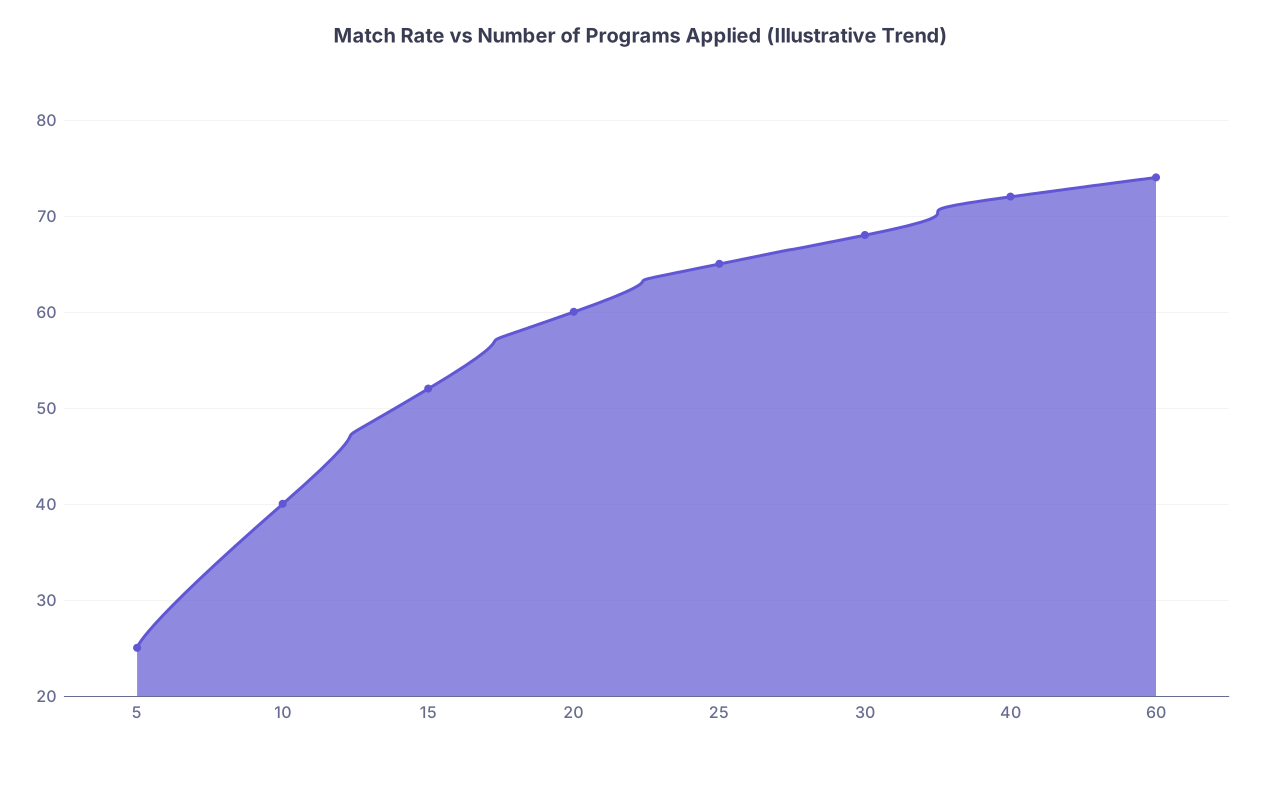
How Many Programs to Apply To for Preliminary Surgery?
For a Caribbean IMG, the question “how many programs to apply?” is not just about numbers—it’s about realistic reach vs. financial limits vs. burnout.
Typical Application Volume Benchmarks
For U.S. MD seniors, prelim surgery applications might be modest (20–40 programs). For Caribbean IMGs, especially if applying in a competitive cycle or with any red flags, you should consider higher numbers.
General ranges for a Caribbean IMG in prelim surgery:
Low-risk profile
- USMLE Step 1: pass on first attempt
- Step 2 CK: ≥ 240–245
- No fails, strong U.S. letters, some U.S. research or surgical exposure
- Reasonable range: 40–70 prelim programs
Moderate-risk profile
- Step 2 CK: 225–239
- Minor red flags (one failed attempt, late graduation, or limited U.S. clinical experience)
- Reasonable range: 60–90 prelim programs
High-risk profile
- Step 2 CK: <225 or multiple attempts
- Significant gaps, limited U.S. letters, or older graduation year
- Reasonable range: 80–120+ prelim programs, plus serious consideration of:
- Transitional year or prelim medicine
- Broader specialty strategies
These are guidelines, not strict rules. If you are from a school with a strong SGU residency match history and robust advising, listen closely to their recommended numbers, because they can factor in current cycle competitiveness.
Balancing Cost and Yield
ERAS fees escalate quickly as you add more programs. When deciding how many programs to apply to, weigh:
- Total budget (ERAS + travel for in-person interviews, if any)
- Your competitiveness (scores, letters, clinical grades, research)
- Program density in your preferred regions (Northeast, Midwest, etc.)
A smart program selection strategy means:
- Not blindly sending 150+ applications
- But also not limiting yourself to 20–30 programs as a Caribbean IMG in surgical prelims
Aim for a core list that feels comprehensive but curated, then add “safety” programs in less desired locations or less well-known institutions to increase your odds.
Step-by-Step Program Selection Strategy for Caribbean IMGs in Prelim Surgery
This is where you translate theory into a concrete program list.
Step 1: Start with Public Data Sources
Use:
- FREIDA (AMA Residency & Fellowship Database)
- Program websites
- NRMP Program Director Survey (for understanding priorities)
- If available: your school’s internal match lists, particularly for recent years
Filter initially for:
- Specialty: General Surgery – Preliminary
- Geography: Start broad; narrow later by region or state
- Program type: University, University-affiliated community, Community
Step 2: Identify IMG-Friendly Programs
As a Caribbean IMG, your first-pass filter is IMG-friendliness:
Clues a program is IMG-friendly:
- Program website or FREIDA shows a history of IMG residents in either categorical or prelim positions
- Your Caribbean school’s match list shows recent alumni at that program
- Alumni or advisors mention that Caribbean medical school residency spots have been filled there for years
Specific actions:
- Ask your dean’s office or career services for:
- A list of surgery prelim programs that have taken Caribbean grads recently
- Contacts of recent graduates who matched to prelim surgery at various institutions
- Search recent class match lists (especially SGU, AUA, Ross) for:
- “Preliminary Surgery”
- “General Surgery (Prelim)”
- And take note of recurring program names

Step 3: Evaluate Training Environment and Support
Not all prelim years are created equal. Some are essentially service-heavy with limited teaching, while others are structured to genuinely help you grow and reapply.
Red flags for Caribbean IMGs:
- No mention of prelim curriculum or support on the website
- High clinical load with minimal emphasis on education or wellness
- Reputation (word-of-mouth) of prelims being “just scut workers”
Positive signs:
- Dedicated orientation for prelims
- Regular didactics you’re required to attend
- Prelim residents included in:
- Morbidity & Mortality conferences
- Simulation training
- Skills labs
- Program description acknowledges:
- Support for prelims who are reapplying
- Structured mentoring
Questions to ask current or former prelims (via alumni connections or email):
- “How were prelims treated compared to categoricals?”
- “Did any prelims secure categorical positions after their year?”
- “What kind of schedule did you have—operative time vs. floor work?”
Step 4: Assess Opportunity for Advancement or Conversion
If your goal is a categorical surgery spot, you must look for:
- Program track record of:
- Converting prelims to categorical in-house
- Helping them match categorical elsewhere
- Number of PGY‑2 categorical spots vs. number of prelim interns
- If there are 6 prelims and no anticipated PGY‑2 vacancies, conversion odds are low
How to gather this info:
- Program websites (sometimes they list success stories for prelims)
- Ask program coordinators (politely) in pre-interview communications:
- “Historically, have your prelims been able to transition into categorical positions at your institution or others?”
- Ask current residents during interviews:
- “In the last 3–5 years, what have prelim interns gone on to do?”
Remember: A prelim year with no pathway or support for advancement can still be useful (letters, experience), but you need to know that upfront and not assume conversion.
Step 5: Match Program Type to Your Risk Profile
General guidance for Caribbean IMGs:
Large academic centers (highly competitive)
- Pros: Strong research, prestige, subspecialty exposure
- Cons: Lower IMG representation, more competitive, sometimes less interest in long-term prelims
- Better for: High-scoring Caribbean IMG with research
University-affiliated community programs
- Pros: Often IMG-friendly, decent reputation, some academic connections
- Cons: Variable research infrastructure
- Good for: Many Caribbean applicants with solid but not stellar scores
Community programs (non-university)
- Pros: Often more open to IMGs, strong hands-on experience
- Cons: May have limited research, less national name recognition
- Important for: Applicants with lower scores or red flags
Your program selection strategy should include:
- A mixture of all three categories
- Heavier emphasis on university-affiliated community and community programs if you are moderate or high risk
Step 6: Geographic Strategy (Reality vs. Preference)
Geography is a powerful filter, but you must avoid over-restricting:
- High-demand regions (e.g., NYC/Boston corridor, West Coast) are more competitive
- Midwest, South, internal parts of the Northeast may be friendlier to IMGs and may have more open prelim positions
If you’re a Caribbean IMG with moderate risk factors:
- Avoid applying exclusively to New York and California
- Intentionally include:
- Midwest academic centers that are IMG-friendly
- Community hospitals in less urbanized areas
Practical Examples of Program Selection Profiles
To illustrate how to choose residency programs in prelim surgery, consider three Caribbean IMG profiles.
Example 1: Strong Applicant Targeting General Surgery Categorical
- Step 1: Pass (first attempt)
- Step 2 CK: 250
- Top 25% of class, strong U.S. core surgery rotation evaluations
- 1–2 surgery publications or abstracts
- Letters: U.S. general surgeons, one from an academic program
Strategy:
- Apply to 40–60 prelim surgery programs
- Distribution:
- ~15–20 large academic centers with known IMG presence
- ~20 university-affiliated community hospitals
- ~10–15 IMG-friendly community programs
- Priority factors:
- High-quality operative experience
- Strong track record of prelim-to-categorical transitions
- Research and networking opportunities
Example 2: Moderate Applicant Planning to Reapply into Another Surgical Specialty
- Step 1: Pass with one retake
- Step 2 CK: 232
- Middle of class, limited U.S. surgical exposure
- Goal: ultimately match into orthopedics
Strategy:
- Apply to 60–90 prelim surgery programs, plus consider some prelim medicine or transitional year programs to broaden options.
- Distribution:
- 10–15 academic centers with strong ortho departments
- 30–40 university-affiliated community surgery programs
- 20–30 community programs in regions known for IMG inclusion
- Priority factors:
- Availability of rotations in target subspecialty (e.g., ortho elective)
- Faculty involved in research who are willing to work with prelims
- Support for reapplications (letter writing, interview prep)

Example 3: Higher-Risk Applicant Seeking Clinical Experience and Possible Pivot
- Step 1: Pass on second attempt
- Step 2 CK: 218
- Older graduation year (4–5 years out)
- Minimal U.S. clinical experience, but strong motivation
Strategy:
- Apply to 80–120+ prelim surgery programs, plus a broad pool of:
- Prelim internal medicine
- Transitional year programs (if any are realistic)
- Heavy emphasis on:
- Community and university-affiliated community hospitals
- Regions traditionally open to IMGs (Midwest, parts of South and Northeast)
- Priority factors:
- Willingness to consider IMGs with attempts
- Strong clinical teaching and letters, even if conversion chances are low
- Realistic expectations about using the year to pivot specialties
Organizing and Refining Your Program List
Once you have a large candidate list, you must organize it so your applications are targeted, not random.
Create a Tiered Spreadsheet
Build a spreadsheet with columns like:
- Program name
- City, state, region
- Program type (academic, university-affiliated, community)
- IMG-friendly? (Yes/No/Unknown)
- Recent Caribbean graduates? (Program and your school)
- Prelim-to-categorical track record (High/Medium/Low/Unknown)
- USMLE cutoffs (if known)
- Research opportunities (High/Medium/Low)
- Your goal fit (GS conversion, subspecialty, pivot)
- Subjective appeal (1–5)
Then assign tiers:
Tier 1 (High Priority)
- Good fit for your goals
- Clearly IMG-friendly
- Reasonable competitiveness for your profile
Tier 2 (Moderate Priority)
- Some positives, some unknowns
- Possibly more competitive, but still feasible
Tier 3 (Low Priority / Reaches or Safeties)
- Either very competitive “reach” programs or safety programs in less desired locations
Aim for a balanced distribution:
- ~30–40% in Tier 1
- ~30–40% in Tier 2
- ~20–30% in Tier 3
Avoid Common Mistakes
As a Caribbean IMG, watch out for these pitfalls:
Over-weighting prestige
Applying mostly to brand-name academic centers but ignoring mid-tier or community programs that actually take IMGs.Underestimating program volume
Applying to only 20–30 programs as a prelim surgery applicant with risk factors.Ignoring data from your own school
If your school’s match history shows certain programs frequently taking Caribbean graduates, do not overlook them.Not adjusting to your scores and red flags
A realistic program selection strategy means acknowledging how PDs screen applications—and compensating with volume and targeted choices.
Making the Most of a Prelim Surgery Year (Beyond Program Selection)
While this article focuses on how to choose and how many programs to apply, your long-term success as a Caribbean IMG depends on what you do after you match.
Once you start your prelim surgery residency:
Be reliable and visible
- Show up early, stay late when needed, respond quickly
- Earn trust from attendings and senior residents
Secure strong letters early
- Identify attendings who can observe your work over several weeks
- Ask for feedback and let them know your future goals
Pursue focused research or academic work
- Even small projects (case reports, QI) with busy surgeons can strengthen your reapplication
Network deliberately
- Meet program leadership, attend conferences, be present at journal clubs
- Let mentors know you are applying for categorical or another specialty so they can advocate for you
Get advising for your next application cycle
- Talk to program leadership and faculty about:
- Where they think you are competitive
- How many programs to apply to in your next cycle
- Whether they can support you staying or moving on
- Talk to program leadership and faculty about:
A well-chosen prelim surgery year will give you the platform to do all of this. Your program selection strategy is the first step in making that possible.
FAQs: Program Selection Strategy for Caribbean IMGs in Preliminary Surgery
1. Should I apply only to prelim surgery, or also to prelim medicine and transitional year programs?
If you are a Caribbean IMG with risk factors (lower scores, attempts, older graduation), it is usually safer to diversify:
- Apply primarily to prelim surgery if your goal is surgical, but also include:
- Prelim internal medicine programs
- Transitional year programs (if realistically within reach) This increases your chance of obtaining some U.S. training position, which you can then leverage for future applications—even if it’s not surgery initially.
2. How important is it that the program has taken Caribbean graduates before?
Very important. Programs that have previously offered Caribbean medical school residency spots (including prelim surgery) are more likely to:
- Understand your educational background
- Be open to IMGs in general
- Have less internal bias against offshore grads
Make this one of your early filters when building your spreadsheet, especially by reviewing your own school’s recent match list (e.g., the SGU residency match or similar).
3. Can a prelim surgery year realistically lead to a categorical surgery spot for a Caribbean IMG?
Yes, but it depends heavily on:
- Your performance during the year (work ethic, evaluations, letters)
- The program’s prelim-to-categorical track record
- The number of PGY‑2 openings expected in your institution and elsewhere
Your program selection strategy should deliberately target institutions known to support prelims in obtaining categorical spots, whether internally or at other programs.
4. If I have a Step attempt, how many programs should I apply to?
With a Step 1 or Step 2 CK attempt as a Caribbean IMG:
- Plan for at least 80 prelim surgery applications in most cases
- Consider 100+ if you also have:
- Lower scores (<225)
- Older graduation
- Limited U.S. clinical experience
At the same time, be strategic, not random: concentrate on IMG-friendly, community, and university-affiliated programs across multiple regions, and avoid applying only to highly competitive coastal urban centers.
By combining realistic self-assessment with a structured program selection strategy, careful evaluation of IMG-friendliness, and a thoughtful answer to how many programs to apply to in prelim surgery, you significantly improve your odds of securing a meaningful position in the U.S. system and moving closer to your ultimate surgical goals as a Caribbean IMG.