Understanding Transitional Year (TY) and Why Strategy Matters for Caribbean IMGs
For Caribbean international medical graduates (IMGs), especially those from schools like SGU, AUC, Ross, and others, the transitional year residency (TY) can be both an opportunity and a risk. It’s often used as:
- A bridge to advanced specialties (e.g., Radiology, Anesthesiology, Ophthalmology, Dermatology)
- A structured clinical year while reapplying for a categorical position
- A way to gain U.S. clinical experience and letters of recommendation
But entering the process with a vague plan—especially regarding how many programs to apply to and how to choose residency programs—can severely weaken your Caribbean medical school residency prospects.
What is a Transitional Year Residency?
A transitional year residency is a one-year, broad-based clinical training program. It typically includes rotations in:
- Internal Medicine
- Surgery
- Emergency Medicine
- Pediatrics
- Electives (which can be tailored toward your target specialty)
Key features:
- Length: 1 year (PGY-1 only)
- Outcome: Completion of an ACGME-accredited intern year
- Future Paths:
- Enter an advanced specialty that starts at PGY-2
- Apply for categorical PGY-2 or PGY-1 positions in other specialties
- Pursue fellowship-eligible specialties that require a clinical year
For Caribbean IMGs, the SGU residency match and similar outcomes from other Caribbean schools show that a structured, data-driven program selection strategy is one of the strongest predictors of success.
Step 1: Clarify Your Goals Before Building a TY Program List
Before you open ERAS or start counting “how many programs to apply” to, you must define why you want a transitional year.
Common Goal Scenarios for Caribbean IMGs
You already have an advanced position secured (Radiology, Anesthesia, etc.)
- TY is simply your PGY-1 requirement.
- Your priority: Good training, location fit, supportive environment.
- Competitiveness level is less critical, but quality still matters.
You plan to apply (or reapply) to an advanced specialty next year
- Your priority:
- Strong letters of recommendation
- Flexibility in electives
- Programs that support your specialty interests
- You’ll need to be strategic about elective rotations (e.g., in radiology, anesthesia).
- Your priority:
You didn’t match this cycle and need an intern year while you re-strategize
- Your priority:
- Any ACGME-accredited clinical year you can realistically match into
- Balanced workload so you can study for Step 3, improve your portfolio, and reapply
- Your priority:
You are uncertain of your long-term specialty
- Your priority:
- Exposure to multiple specialties
- Strong mentorship and advising
- Programs known for career guidance
- Your priority:
Write your main goal down. Your program selection strategy must be tailored to that goal.

Step 2: Understand Competitiveness and Risk as a Caribbean IMG
As a Caribbean IMG applying to transitional year residency, the biggest trap is underestimating risk—particularly in deciding how many programs to apply to and where.
Key Competitiveness Factors
Transitional Year is somewhat unique:
- Many TY programs are attached to competitive advanced specialties.
- Some TY spots are “preliminary” internal medicine or surgery labeled as TY-like, but not true TY.
- A significant proportion of “strong” TY programs prefer:
- U.S. MD graduates
- Applicants already matched into advanced positions
- U.S. citizen IMGs with strong scores and U.S. clinical experience (USCE)
As a Caribbean IMG, programs may evaluate you on:
- USMLE/COMLEX scores: Higher scores significantly improve your chances.
- Red flags: Step failures, gaps in training, professionalism issues.
- Clinical experience: Quality and recency of USCE, especially in core specialties.
- Visa status: Many TY programs are less willing to sponsor visas than categorical IM programs.
Realistic Self-Assessment
Before deciding your program list and application volume:
- Be brutally honest about:
- Your Step 1, Step 2 CK scores
- Any exam failures
- Gaps between graduation and application
- Visa needs (J-1 vs. no visa)
Example self-assessment tiers (for Caribbean IMG TY applicants):
Higher competitiveness (for TY):
- Step 1: Pass on first attempt (if taken)
- Step 2 CK: ≥ 240+
- No gaps > 1 year
- Strong USCE with good letters
- No visa needed or J-1 OK
Moderate competitiveness:
- Step 1: Pass (or not required)
- Step 2 CK: 225–239
- Minor gaps, explained
- Some U.S. rotations, decent letters
- J-1 visa sponsorship needed
Higher risk / lower competitiveness:
- Step 2 CK < 225
- Any exam failure
- Multiple years since graduation
- Limited or no U.S. clinical experience
- Visa required with limited options
Your self-assessment tier directly affects your program selection strategy and how many programs to apply to.
Step 3: How Many Transitional Year Programs Should You Apply To?
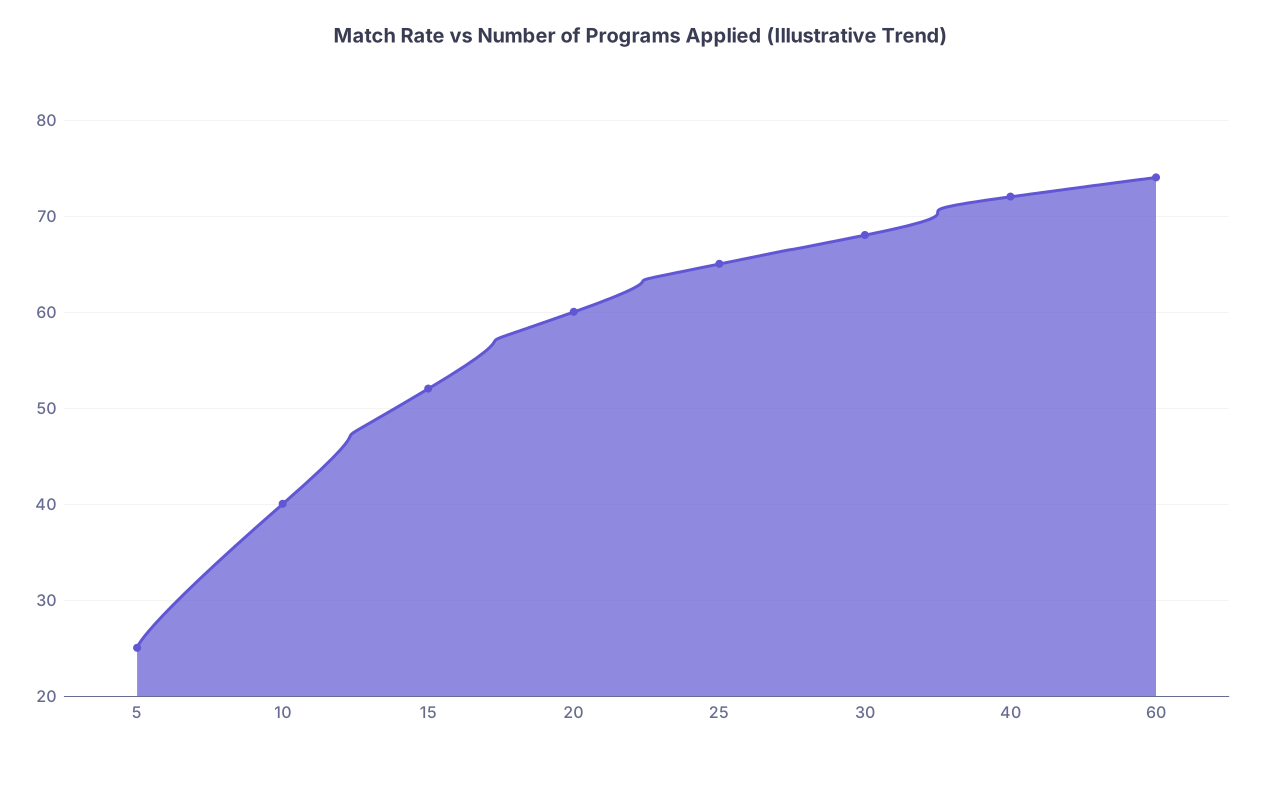
The number of applications is one of the most critical decisions in your Caribbean medical school residency journey. You must balance match probability, budget, and burnout.
General Volume Guidance for Caribbean IMGs Applying to TY
These ranges assume you are only applying to Transitional Year programs. If you are also applying to preliminary internal medicine or surgery, your total applications may be higher.
1. Higher Competitiveness (strong scores, no visa issues)
- Recommended TY programs: 25–40
- Rationale:
- TY positions are limited in number.
- Even with strong stats, preference for U.S. MDs exists.
- 25 is an absolute minimum; 30–40 gives better safety.
2. Moderate Competitiveness (solid but not stellar, or visa needed)
- Recommended TY programs: 40–60
- Rationale:
- As a Caribbean IMG with average scores, you face real competition.
- 40+ gives a buffer to adjust for hidden preferences and filters.
- Consider adding preliminary IM programs to increase your total interviews.
3. Higher Risk Profiles (low scores, failures, older grad, major visa constraints)
- Recommended TY programs: 60–80
- Rationale:
- You’ll be filtered out at many places.
- You must compensate with volume and strategic choices (applying broadly including community-based programs).
- Combine with categorical or preliminary IM programs to widen your net.
When to Consider More Than 80 Applications
You might consider 80+ total residency applications (TY + prelim + categorical) if:
- You have multiple red flags (failures, gaps).
- You are a very recent graduate with a low Step 2 CK score.
- You need H-1B (which TY programs rarely sponsor) and are also applying to IM programs.
In that case, TY is likely a secondary target, and your main focus should be prelim and categorical internal medicine.
Financial and Time Considerations
Application costs and time must be factored:
- More programs = higher ERAS fees.
- Each program requires:
- Program-specific research
- Possibly minor customization of personal statements
- Tracking interviews, signals (if applicable), and communications
Actionable advice:
- Set a budget ceiling early (e.g., $800–$1500 for ERAS fees).
- Prioritize TY programs where you meet basic filters, then expand outward.
- Track your list in a spreadsheet with columns for:
- Program name
- City/State
- IMG friendliness
- Visa policy
- Required scores
- Personal priority (e.g., A/B/C tier)

Step 4: How to Choose Residency Programs – A Structured Selection Strategy
Beyond “how many programs to apply,” the quality and fit of your list are crucial. A smart program selection strategy prevents you from overloading your list with places that will never seriously consider a Caribbean IMG.
1. Identify IMG-Friendly Transitional Year Programs
Start by building a first-pass list of programs more likely to consider you:
- Use tools and resources:
- NRMP’s “Charting Outcomes in the Match”
- FREIDA (filter by Transitional Year, then check program details)
- Alumni match lists (e.g., SGU residency match outcomes, AUC, Ross)
- Caribbean medical school residency advising office data
Look for:
- Programs that have matched IMGs (especially Caribbean) in recent years
- Community-based or community-university affiliated hospitals
- Hospitals in less saturated geographic locations (Midwest, South, smaller cities)
Red flag for Caribbean IMGs:
- Highly prestigious university hospitals that match nearly all U.S. MD/DOs and 0–1 IMGs annually may not be worth many applications unless you’re an outlier candidate.
2. Categorize Your List: Reach, Realistic, and Safety
Assign tiers, similar to medical school applications:
Reach programs:
- Very competitive TYs (often attached to top radiology/anesthesia programs).
- Located in major cities or top-tier university centers.
- You may apply to a limited number as “lottery tickets.”
Realistic programs:
- Historically match both U.S. and non-U.S. IMGs.
- Located in mid-sized cities or less competitive states.
- Fit your academic profile reasonably well.
Safety programs:
- High proportion of IMGs.
- Community hospitals, perhaps in underserved areas.
- Less desirable locations for many U.S. grads (but solid for training).
Aim for approximate distribution (for moderate competitiveness):
- 20–30% Reach
- 40–50% Realistic
- 30–40% Safety
3. Assess Program Characteristics That Matter for TY
For each program, evaluate concrete features:
IMG & Caribbean-friendliness
- Have they matched SGU, AUC, Ross, or similar historically?
- Do faculty or leadership have IMGs on staff?
Visa policy
- Do they explicitly state J-1 sponsorship?
- Any history of H-1B for TY (rare, but worth noting if needed)?
Clinical structure
- Balance of inpatient vs. outpatient
- Required rotations vs. electives
- Possibility to do electives in your interest specialty (radiology, anesthesia, etc.)
Support and culture
- Size of the intern class
- Presence of mentorship, wellness support
- Feedback from current or former residents (online reviews, alumni contacts)
Location and lifestyle
- Cost of living
- Proximity to support networks (family, friends)
- Safety and transportation
4. Avoid Common Program Selection Mistakes
As a Caribbean IMG, avoid these traps:
Overweighting location
Applying mostly to California, New York City, or Florida just because of weather or family, while ignoring less competitive regions, can severely reduce your odds.Ignoring IMG history
Applying to many programs that have never matched a Caribbean graduate is a waste of your limited resources.Not reading program websites carefully
Some explicitly state: “We do not sponsor visas” or “We require graduation within 3 years.” Don’t apply if you don’t meet these cutoffs.Applying too narrowly by setting specialty bias
For example, choosing only TY programs associated with radiology hoping for a future in that department, despite being underqualified.
Step 5: Tactical Considerations for Caribbean IMGs Targeting TY
Once you’ve decided how many programs to apply to and how to choose residency programs, refine your approach with these practical tactics.
1. Combine TY with Preliminary and Categorical Applications
To de-risk your match:
- Apply to a mix of:
- Transitional Year programs
- Preliminary Internal Medicine (or Surgery) programs
- Categorical Internal Medicine (if interested and your scores are adequate)
Why this helps:
- Increases total potential interviews.
- Gives you more secure paths to complete a clinical year.
- Preserves the option of completing full IM residency if TY or advanced specialty plans don’t work out.
Example Mix (Moderate-competitiveness Caribbean IMG):
- 45 TY programs
- 30 Preliminary IM programs
- 20 Categorical IM programs
Total: ~95 programs (adjust by budget and competitiveness).
2. Use a Program Selection Spreadsheet
Track key fields:
- Program name and ACGME ID
- Location (city, state, region)
- Type (TY, Prelim IM, Categorical IM)
- IMG percentage, Caribbean presence
- Visa policy
- Minimum score cutoffs (if available)
- Your self-rated interest (e.g., 1–5)
- Status (applied, II received, waitlisted, rejected)
This organizational step:
- Helps avoid duplicate effort.
- Keeps you grounded in data, not emotion.
- Clarifies which programs to rank highly if you receive multiple interviews.
3. Align Your Application Materials with Your Strategy
Your program selection strategy should be visible in your:
Personal Statement
- Clearly state why a Transitional Year fits your broader career goals.
- For advanced-track applicants, briefly connect TY experiences to your future specialty (e.g., “A broad-based intern year will prepare me to be a better radiologist by strengthening my clinical reasoning.”)
Experiences section in ERAS
- Highlight clinical rotations and work that show adaptability and broad-based clinical skills.
- Emphasize teamwork, communication, and flexibility—highly valued in TY.
Letters of Recommendation
- Target letters from core specialties (IM, Surgery, EM, Pediatrics).
- If aiming for an advanced specialty later, try to secure at least one letter in that field if possible.
4. Understand How Program Directors View TY Applicants
Program directors (PDs) reviewing a Caribbean IMG for transitional year residency may ask:
- Is this applicant likely to work hard and be reliable for one year?
- Do they bring solid clinical skills and communication ability?
- Are they trainable and professional, with no major red flags?
- Will they be a good colleague to categorical residents and other TYs?
Your application should make it easy for PDs to answer “yes” to those questions:
- Strong MSPE and dean’s letter
- No professionalism concerns
- Consistent work/volunteer involvement
- Clear, coherent narrative (even if you previously attempted another path)
Step 6: Example Program Selection Scenarios for Caribbean IMGs
To make this practical, consider three sample applicant profiles and how they might build their lists.
Scenario A: SGU Grad, Strong Scores, No Visa Needed
- Step 2 CK: 245
- No gaps, U.S. citizen
- Good internal medicine and surgery letters
Strategy:
- Total applications: ~40–50 TY programs
- Program distribution:
- 10–15 reach TY programs (some academic centers, desirable locations)
- 20 realistic community/university-affiliated TYs
- 10 safety TYs (higher IMG percentage, less competitive regions)
- Optional: Add 10–15 preliminary IM programs as backup.
This applicant can afford a more focused list but should still retain some geographic and institutional diversity.
Scenario B: Caribbean IMG, Average Scores, J-1 Visa Needed
- Step 2 CK: 230
- One-year gap after graduation, covered with research and observerships
- Needs J-1 sponsorship
Strategy:
- Total applications:
- 40–60 TY programs
- 20–30 preliminary IM programs
- Focus:
- Carefully filter out non–visa sponsoring programs.
- Prioritize community-based programs in Midwest, South, smaller cities.
- Limit reach programs to 5–10; emphasize realistic/safety programs heavily.
This applicant must be disciplined about applying widely and not over-emphasizing brand names or coastal locations.
Scenario C: Caribbean IMG With Step Failure and Older Graduation Date
- Step 2 CK: 220 after one retake of Step 1
- 4 years since graduation; some non-U.S. clinical work
- Needs J-1 visa
Strategy:
- Recognize TY alone may be too competitive; main focus should be IM categorical and prelim.
- Total applications:
- 30–40 TY programs (targeting very IMG-heavy, visa-friendly, underserved areas)
- 60–80 categorical/preliminary IM programs
- Emphasize:
- Strong explanation of red flags in a concise, honest way.
- Clear record of ongoing clinical work and improvement.
This applicant’s “program selection strategy” is really a broad, risk-managed approach, with TY as one of several pathways.
FAQs: Program Selection Strategy for Caribbean IMG in Transitional Year
1. As a Caribbean IMG, is Transitional Year harder to match than Internal Medicine?
Often, yes. Many TY programs are tied to competitive advanced specialties and prefer U.S. MD/DO graduates, especially those already holding PGY-2 positions. For Caribbean IMGs, categorical Internal Medicine may actually offer more positions and higher IMG match rates. That’s why combining TY, prelim IM, and categorical IM applications often makes sense.
2. How many TY programs should I apply to if I’m also applying to categorical IM?
If you’re moderately competitive:
- TY programs: ~30–45
- Categorical IM: ~25–40
- Preliminary IM: optional 10–20
Adjust based on your scores, visa status, and budget. The key is to ensure you have enough total applications (often 70–100+) across all program types to realistically secure a sufficient number of interviews.
3. Do program directors look down on Caribbean IMGs in TY programs?
Most program directors primarily care about your performance, professionalism, and reliability. However, they are aware of the variability in Caribbean training and may rely more heavily on:
- USMLE/COMLEX performance
- Quality of U.S. clinical experiences
- Strength of letters of recommendation
That’s why building a strong, honest application and targeting IMG-friendly programs is crucial.
4. If I don’t match into a TY, will it hurt my chance at future advanced specialties?
Not necessarily, but it complicates your path. You can:
- Reapply directly to categorical/preliminary IM or other categorical specialties.
- Strengthen your application with research, USCE, or Step 3.
- Consider a future attempt at TY or advanced specialties after more experience.
Programs usually care more about your total clinical training and performance than about which specific PGY-1 track you followed, as long as you have completed an appropriate ACGME-accredited intern year.
A thoughtful, data-driven program selection strategy—centered on honest self-assessment, realistic expectations, and carefully chosen TY, preliminary, and categorical programs—gives Caribbean IMGs the best chance to secure a transitional year residency and build a strong foundation for the rest of their careers.