

Understanding the Landscape of Clinical Informatics Training
Clinical informatics has evolved from a niche interest to a formal medical subspecialty with a rapidly growing footprint. As a residency graduate or practicing physician considering a clinical informatics fellowship, your program selection strategy will shape not only your training experience but also your long‑term career trajectory in health IT, analytics, and digital transformation.
Unlike some core residencies where programs are relatively similar in structure, clinical informatics fellowships vary widely in:
- Institutional focus (academic, community, health system, industry‑partnered)
- Depth and type of health IT training
- EHR platforms and digital tools you’ll work with
- Research expectations and funding
- Technical rigor (e.g., coding, data science, AI/ML)
- Operational exposure and leadership opportunities
This variability makes a deliberate program selection strategy essential. You’re not just deciding where to train; you’re choosing how you’ll position yourself in a fast‑changing field.
This guide will walk you through:
- Clarifying your career goals and “must‑have” training experiences
- Mapping programs to those goals using a structured framework
- Answering the practical question of how many programs to apply to
- Evaluating program culture, mentorship, and hidden curriculum
- Avoiding common mistakes applicants make when choosing programs
Throughout, we’ll keep the focus squarely on clinical informatics fellowship programs, but many principles will also support your broader thinking about how to choose residency programs or other subspecialty training.
Step 1: Clarify Your Career Vision and Training Needs
Before comparing programs, you need clarity about yourself. Clinical informatics is broad; your ideal program selection strategy starts with what you want to do after fellowship.
Define Your Target Career Archetype
Most careers in clinical informatics blend several of these roles, but it helps to decide which 1–2 you’d like to prioritize:
Operational CMIO / Clinical Informatics Leader
- Focus: EHR optimization, clinical workflows, governance, implementation, change management
- Typical role: Associate CMIO, CMIO, Director of Clinical Informatics
- You need: Strong exposure to governance structures, large‑scale implementations, clinician engagement, enterprise‑level projects.
Academic Clinical Informatician
- Focus: Research, grants, publications, teaching, national leadership roles
- Typical role: Faculty in informatics, PI on informatics grants, education program director
- You need: Protected research time, mentorship from funded investigators, publications during fellowship.
Data Science / Analytics‑Driven Informatician
- Focus: Predictive modeling, AI/ML, advanced analytics, data pipelines
- Typical role: Director of Clinical Analytics, Medical Director of AI, physician–data scientist
- You need: Deep exposure to data warehouses, analytics platforms, statistical/programming training (R, Python, SQL).
Digital Health / Product‑Oriented Informatician
- Focus: Startups, health tech, product design, UX, interoperability, virtual care, apps
- Typical role: Medical director at a health IT company, CMO at startup, product clinical lead
- You need: Industry partnerships, product development projects, user‑centered design exposure.
Public Health / Population Health Informatician
- Focus: Registries, population analytics, quality improvement, public health surveillance
- Typical role: Medical informatics lead for public health agency, population health director
- You need: Exposure to registries, quality programs, payor or public‑health collaborations.
You don’t have to commit permanently, but ranking these interests (e.g., “I’m 1) operational, 2) academic”) will focus your search.
Translate Career Goals into Training Requirements
Next, identify specific experiences you want from a clinical informatics fellowship:
Technical focus
- Do you want formal training in SQL, R, Python, or ML?
- Or primarily workflow, governance, and implementation science?
EHR and vendor environment
- Epic vs Cerner vs other systems vs home‑grown EHRs
- Do you want broad experience across multiple systems, or depth in one major vendor?
Research and scholarly activity
- Do you want first‑author publications?
- Access to clinical/claims data, grant infrastructure, or IRB support?
Leadership and management
- Participation in steering committees, change‑control boards, governance councils?
- Shadowing CMIOs/CIOs, involvement in strategic planning?
Industry and innovation
- Partnerships with startups, payors, or digital health companies?
- Opportunities to work on apps, decision support tools, or virtual care platforms?
Educational environment
- Formal didactic sequences in informatics (AMIA 10×10, in‑house curriculum, degree programs such as MS in Biomedical Informatics)?
Make a written list of:
- Non‑negotiables (e.g., “must have Epic experience,” “must allow part‑time clinical in my primary specialty,” “must support research”)
- High‑priority wants (e.g., “access to data science mentorship”)
- Nice‑to‑haves (e.g., “big city,” “same EHR as my current organization”)
This will anchor your program selection strategy and prevent being swayed purely by name recognition or location.
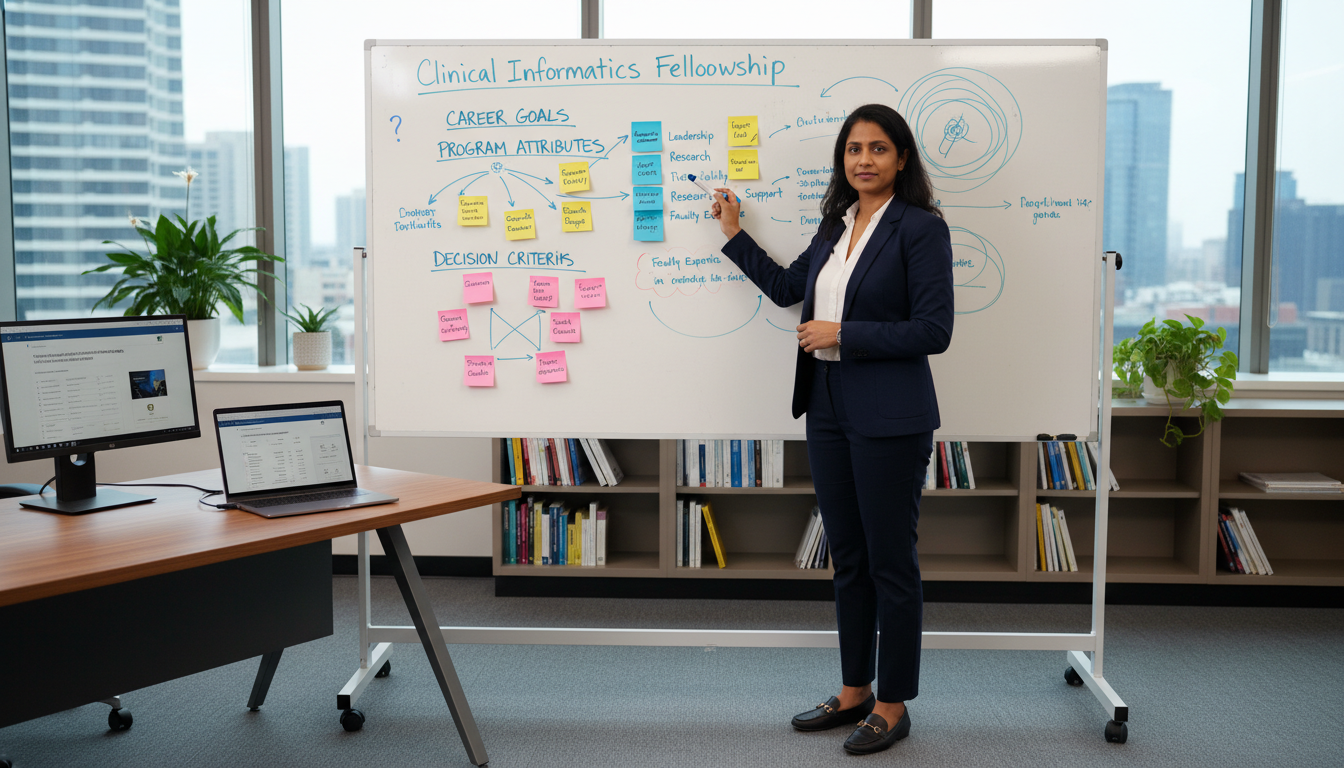
Step 2: Build a Structured Program Selection Framework
Once you know what you want, you can evaluate programs using a structured framework instead of gut feeling. This is especially important when you’re uncertain how many programs to apply to and how to prioritize interview offers.
Core Domains to Compare Across Programs
Use the following domains to build a comparison spreadsheet or scoring rubric:
Institutional and Health System Context
- Size and type of health system (academic tertiary center, integrated delivery network, community system)
- Number of hospitals and clinics on the same EHR
- Presence of other informatics, data science, or bioinformatics teams
- Relationship with IT (shared services vs highly integrated clinical IT)
Clinical Informatics Scope and Maturity
- Is there a formal CMIO/associate CMIO structure?
- Governance: Are there robust committees covering ordersets, CDS, data standards, etc.?
- Major ongoing or recent projects: EHR transitions, large‑scale optimizations, AI implementations.
Health IT Training and Technical Depth
- Specific tools: EHR build tools, analytics platforms (Tableau, Power BI, Qlik, custom tools), data warehouses (Clarity, Caboodle, etc.)
- Formal coursework: master’s degree options, AMIA 10×10, university informatics courses
- Hands‑on vs observer: Will you actually build CDS, dashboards, data pipelines, or primarily attend meetings?
Mentorship and Faculty Expertise
- Number of board‑certified clinical informaticians on faculty
- Mix of roles: operational CMIOs, physician–data scientists, industry‑experienced faculty
- Track record: Fellows’ publications, conference presentations, job placement.
Research, Innovation, and Scholarship
- Availability of protected research time
- Access to data sets (EHR data, registries, claims, device data)
- Support structures: biostats, data science teams, IRB/process support.
Fellow Responsibilities and Autonomy
- Balance of operations vs education vs research
- On‑call expectations (if any)
- Degree of ownership over projects: Are you a note‑taker or project lead?
Culture, Support, and Flexibility
- How fellows describe the culture: supportive vs sink‑or‑swim
- Flexibility to shape your elective time and projects
- Support for unique interests (e.g., public health, entrepreneurship, AI).
Location and Lifestyle Fit
- Cost of living, family and partner considerations, commute
- Work‑life balance, remote/hybrid options for some tasks.
Build your own scoring columns (e.g., scale 1–5) for each domain. Don’t over‑engineer, but do create a repeatable, side‑by‑side way to compare programs.
Sourcing Information Efficiently
To populate your comparison framework:
- Program websites
- Look for curriculum outlines, rotation descriptions, affiliations with informatics departments or schools of engineering.
- Faculty and fellow profiles
- Check for recent publications and their topics.
- PubMed and Google Scholar
- Search the institution + “clinical informatics,” “medical informatics,” “EHR,” “AI,” “CDS.”
- Conferences and professional organizations
- See which programs are active in AMIA, HIMSS, and specialty informatics meetings.
- Direct contact
- E‑mail or set up informal chats with current fellows; ask targeted questions about their daily work and opportunities.
This deliberate data‑gathering process is your evidence base for how to choose residency programs or fellowships in a complex, heterogeneous field like clinical informatics.
Step 3: Deciding How Many Programs to Apply To (and Why)
One of the most practical—and anxiety‑provoking—questions is: how many programs to apply to in clinical informatics. There is no single correct number, but you can reach a rational decision.
Factors That Influence Your Application Volume
Competitiveness of Your Profile
- Board scores, residency performance, letters of recommendation
- Prior informatics experiences (projects, committees, analytics work, publications)
- Distinguishing features (dual degree, relevant industry experience, strong technical skills)
Specificity of Your Training Goals
- Very niche goals (e.g., “must have Epic, must offer MS in Data Science, must be in the Midwest”) → You’ll need to apply more broadly to find a match.
- More flexible goals (e.g., “strong operational exposure, any major EHR, open to many cities”) → You might safely apply to fewer programs.
Geographic Constraints
- Couples match, family obligations, visa issues, or must‑be‑near‑X‑city → often require more applications because your location filter is stricter.
Program Size and Availability
- Many clinical informatics fellowships have only 1–3 fellows per year.
- A limited number of total positions nationally means you generally should not apply to just a handful of programs.
Your Risk Tolerance
- Are you comfortable reapplying next year if you don’t match?
- Or is matching this year a high priority (e.g., contract ending, visa timelines)?
Practical Heuristics for Application Numbers
While official match data may vary year to year, a pragmatic strategy for clinical informatics fellowship applicants might look like:
Highly competitive applicant with strong informatics background, flexible on geography and program type:
- Target: ~8–12 programs
- Rationale: You’re likely to generate multiple interviews; focus on high alignment with your goals.
Solid applicant with some informatics exposure, moderate geographic constraints:
- Target: ~12–18 programs
- Rationale: Increases the chance of receiving 8–10 interview invitations, which often yields a robust rank list.
Applicant with limited formal informatics experience or major constraints (tight geography, visa, unusual background):
- Target: ~18–25 programs
- Rationale: Wider net to ensure sufficient interviews despite constraints.
Key principle: Don’t apply to more programs than you can reasonably research and interview with thoughtfully. A smaller, carefully chosen list beats a huge, random list where you can’t articulate why you’re interested in each program.
Strategic Tiers: Prioritizing Your List
To keep your program selection strategy organized, categorize programs into tiers:
Tier A (5–7 programs):
Ideal matches for your career goals and personal priorities. You would be thrilled to match here. These may include “reach” programs.Tier B (8–12 programs):
Good alignment with your training needs; fewer ideal features but still strong. You’d be genuinely happy to train here.Tier C (as needed):
Backup options—fewer of your “must‑haves” but acceptable if top tiers don’t work out.
This tiering also helps you decide how much time to invest in tailoring each application: Tier A gets the most customization; Tier C enough to be professional but efficient.

Step 4: Evaluating Fit During Interviews and Visits
Applications and websites give you the outline; interviews and second looks fill in the details. Use them to refine your program selection strategy and update your tiers.
Key Questions to Ask Programs
Organize your questions around the domains that matter most to you. For example:
On clinical and operational experience
- “Can you describe the typical distribution of a fellow’s time between meetings, project work, direct EHR build, and research?”
- “What are some examples of projects recent fellows have led from start to finish?”
On health IT training and technical skills
- “Are fellows expected or encouraged to learn SQL, R, Python, or similar tools? Is there formal instruction?”
- “To what extent do fellows have access to the data warehouse or analytics team?”
On mentorship and career development
- “How are mentors selected? Do fellows typically have more than one mentor?”
- “Where have recent graduates gone after fellowship—roles and institutions?”
On research and scholarship
- “What proportion of fellows graduate with publications or conference presentations?”
- “Is there protected time for scholarship, and how is it safeguarded in practice?”
On culture and expectations
- “How would you describe the program’s culture, especially around autonomy and support?”
- “What are common characteristics of fellows who thrive in this program? Who tends to struggle?”
For current fellows (often the most revealing)
- “If you were choosing again, would you pick this program?”
- “What surprised you after starting here—good or bad?”
- “How easy is it to shape your own rotations and projects around your interests?”
Assessing Hidden Curriculum and Culture
Culture is often the deciding factor when programs look similar on paper. Look for:
Respect for informatics as a discipline
- Do clinicians see informatics as a strategic partner or a “fix my EHR” helpdesk?
Inclusion in decision‑making
- Are fellows invited to key governance meetings?
- Are their voices valued, or are they passive observers?
Attitude toward failure and experimentation
- Is there psychological safety to try new tools and learn from missteps?
Workload realism
- Are fellows consistently overwhelmed, or is there a manageable balance?
Make notes right after each interview day; impressions fade quickly but are invaluable later for ranking.
Virtual Interview Considerations
If interviews are virtual:
- Ask explicitly for opportunities to speak with current fellows without faculty present.
- Request sample project lists or example fellow schedules.
- Use video “walkthroughs” or additional informal Zoom calls if offered to get a feel for the environment.
Step 5: Constructing Your Rank List with Strategy and Intent
After interviews, you’ll likely have more nuanced views of fit, culture, and opportunity. Your final program selection strategy culminates in your rank list.
Weighing Competing Priorities
Revisit your original priorities:
- Do programs meet your non‑negotiables?
- Which programs best position you for your top career archetype (operational, academic, data science, etc.)?
- Where did you feel the strongest personal and professional alignment with mentors and culture?
You can build a simple decision matrix combining:
- A quantitative component (scores for key domains: training quality, mentorship, research, technical depth, culture)
- A qualitative “gut” component (how you felt during interactions, how clearly you can picture yourself there)
If numbers and intuition diverge, dig into why. For example:
- If a program scores high on paper but you didn’t click with anyone, ask whether that’s a red flag for day‑to‑day satisfaction.
- If a program scores modestly but you felt strongly supported and energised, consider whether that environment might catalyze your growth more than perfect metrics.
Strategic Ranking Principles
Rank in your true order of preference.
Match algorithms generally reward honesty. Don’t game the system by ranking places you’d accept but don’t actually prefer above better fits.Account for long‑term positioning.
A program with strong mentorship and project ownership can be more valuable than a bigger name with limited fellow autonomy.Consider the “option value” of skills.
Training that gives you portable skills (e.g., analytics, CDS design, interoperability, leadership across EHRs) increases your range of career options later.Align with your realistic career direction.
If you have little interest in a research‑heavy career, don’t rank a program that’s 70% grant‑driven scholarship just because it’s prestigious.Avoid over‑prioritizing geography unless necessary.
Location matters, especially for family, but early‑career specialization is high‑leverage. Sometimes a 2‑year move is worth major career upside.
Example: Two Competing Offers
Program A
- Highly ranked academic center, heavy focus on AI/ML research, strong publication track record
- Most fellows become faculty or physician–data scientists
- Culture described as intense but supportive
Program B
- Large community system with strong CMIO leadership, many hospitals on a single EHR
- Deep operational exposure, high autonomy, less formal research
- Most fellows move into CMIO/operational leadership roles
If your goal is operational CMIO leadership with optional research involvement, Program B may be strategically better despite less academic prestige. Your program selection strategy should be anchored in who you want to be in 5–10 years, not only in external perceptions.
Frequently Asked Questions (FAQ)
1. How many clinical informatics fellowship programs should I apply to?
For most applicants, a target of 12–18 programs is reasonable, adjusted based on your competitiveness, geographic flexibility, and risk tolerance:
- Very strong, flexible applicants: ~8–12
- Solid applicants with some constraints: ~12–18
- Applicants with limited experience or major constraints: ~18–25
The key is to ensure you cultivate enough high‑quality interviews to build a robust rank list—but not so many that you can’t research and interview thoughtfully.
2. What’s the most important factor in choosing a clinical informatics fellowship?
There is no universal “most important” factor, but for many applicants, the top three are:
- Mentorship quality and availability
- Opportunities for hands‑on project ownership (not just observation)
- Alignment with your target career archetype (operational, academic, data science, digital health, etc.)
A strong name brand cannot compensate for a lack of mentorship or misalignment with your long‑term goals.
3. How technical do I need my health IT training to be?
It depends on your target role:
- If you aim for AI/ML, advanced analytics, or physician–data scientist roles, seek programs with formal or informal training in programming (SQL, R, Python), machine learning, and data engineering.
- For operational CMIO–type roles, you still benefit from understanding data and basic analytics, but deep coding skills may be less critical than governance, change management, and workflow optimization.
In your program selection strategy, be explicit about whether you want to write code, interpret analytics, or lead teams that do both—then choose accordingly.
4. How do I compare clinical informatics programs that look very similar on paper?
When programs appear similar, focus on:
- Culture and interpersonal fit: Who felt invested in your growth? Where did conversations feel natural and energizing?
- Fellow roles in real projects: Ask for concrete examples of fellow‑led initiatives.
- Graduate outcomes: Where do alumni work, and do those paths align with your goals?
- Flexibility: How much can you tailor the fellowship to your interests?
Your subjective impressions—grounded in objective questions—often break ties better than minor differences in institutional prestige.
A deliberate, reflective program selection strategy for clinical informatics fellowship will help you move beyond “apply everywhere and hope” toward a targeted approach that fits your aspirations. By clarifying your career vision, building a structured evaluation framework, deciding thoughtfully how many programs to apply to, and interrogating culture and mentorship during interviews, you position yourself to choose not just a program—but the right one for the informatician you want to become.


