Understanding the Landscape: Dermatology as a DO Graduate
Dermatology is among the most competitive specialties in the residency match, and this is true for both MD and DO applicants. As a DO graduate, you face a particular challenge: while the single accreditation system has unified ACGME accreditation, some programs still have implicit preferences or historical patterns that favor MD applicants. That doesn’t mean a successful derm match is out of reach—but it absolutely means you must be strategic and intentional about program selection.
Your program selection strategy will directly influence:
- Your likelihood of matching at all
- The number of interviews you receive
- How many programs you need to apply to
- Where you ultimately train and build your career
This article focuses on how a DO graduate in dermatology should think about:
- How to choose residency programs
- How many programs to apply to
- How to build a targeted, realistic yet aspirational application list
- How to factor in DO-friendliness, competitiveness, geography, and personal fit
Throughout, you’ll see repeated references to:
- DO graduate residency dynamics in a competitive field
- The concept of an osteopathic residency match in the current unified ACGME era
- Specific practical considerations for a dermatology residency and the derm match
Step 1: Know Your Applicant Profile—Honestly and Precisely
Before you can design a smart program selection strategy, you need a clear sense of your competitiveness. For dermatology, even small differences in your metrics and experiences can have a big impact on your match odds, especially as a DO graduate.
Core Components of Your Profile
Key elements to assess:
Exam Performance
- USMLE Step 1 (if taken; now pass/fail but still reviewed)
- USMLE Step 2 CK score
- COMLEX Level 1 and 2 scores
- Whether you have both USMLE and COMLEX or only COMLEX
Academic Performance
- Class rank or quartile (if available)
- Clinical grades in core rotations, particularly IM, Surgery, Pediatrics
- Honors or AOA/Sigma Sigma Phi (if applicable)
Dermatology-Relevant Experiences
- Dermatology rotations (home institution and away/sub-I)
- Research experience (dermatology vs non-derm, publications, posters)
- Derm interest groups, volunteer work, free clinics, skin cancer screenings
Letters of Recommendation
- At least 2–3 strong letters from dermatologists
- One letter from a non-derm core specialty or department chair (per program requirements)
Additional Factors
- Red flags (exam failures, professionalism issues)
- Gaps in training or non-traditional background
- Geographic ties and personal constraints
Stratifying Yourself: Competitive vs. Solid vs. At-Risk
While cutoffs vary by year and program, you can roughly think in three tiers. These are general dermatology guidelines and should be interpreted cautiously and in context.
1. Highly Competitive DO Applicant
- Step 2 CK: ~255+ (if taken)
- COMLEX Level 2: ~640+ (or equivalent high percentile)
- Strong derm research (multiple abstracts/manuscripts, ideally at least one derm publication)
- Multiple dermatology away rotations with strong evaluations
- Several derm faculty letters from academic institutions
- No red flags; strong clinical performance
2. Solid / Middle-of-the-Road DO Applicant
- Step 2 CK: ~240–255
- COMLEX Level 2: ~580–640
- Some derm-involved research or case reports
- At least one away rotation in dermatology with good evaluations
- 2+ derm letters, but from less research-intensive or smaller programs
- Good clinical grades, maybe one minor stumble but no serious red flags
3. At-Risk / Underdog DO Applicant
- Step 2 CK: below ~240, or no USMLE with only moderate COMLEX scores
- COMLEX Level 2: below ~580 or first attempt fail
- Limited or no derm-specific research
- Few derm rotations or late interest in dermatology
- Red flags in application (exam failures, professionalism concerns)
- Limited geographic flexibility
This honest self-categorization drives your program selection strategy and helps you decide how many programs to apply in the derm match.
Step 2: Understanding the Dermatology Residency Landscape for DOs
Single Accreditation but Not a Single Experience
The merge of AOA and ACGME accreditation means there is no longer a separate “osteopathic residency match,” but the reality is more nuanced:
- Many programs historically trained DOs and remain distinctly DO-friendly
- Some university-based dermatology residencies still rarely interview or rank DOs
- A subset of programs will strongly value dual USMLE/COMLEX performance
- Some formerly AOA derm programs or community-based programs remain more accessible to DOs
Identifying DO-Friendly Dermatology Programs
You should actively look for signs of DO-friendliness:
Current and Recent Residents
- Review program websites and resident bios
- Are there DO residents in the last 5–10 years?
- Are DOs present across multiple classes, or is it a rare occurrence?
Match Lists and Social Media
- Your school’s match list: where have DOs from your institution matched in derm?
- National DO derm match communities, online forums, and alumni networks
- Program social media: do they feature DO residents or mention osteopathic trainees?
Program Disclosures
- Some programs explicitly state that they accept COMLEX-only
- Some require or strongly prefer USMLE for DOs; others are flexible
- A few still explicitly request USMLE scores from DO applicants
Informal Intelligence
- Talk to recent DO derm applicants, especially from your school or region
- Ask your derm mentors which programs genuinely consider DOs
Why DO-Friendliness Matters for Program Selection
As a DO graduate in dermatology, your program selection strategy must heavily weigh DO-friendliness. It affects:
- Interview yield (number of invites you receive per applications sent)
- The balance of “reach” vs “realistic” vs “safety” programs
- Your decision about how many programs to apply to overall
You can think of DO-friendly programs as higher-yield targets. Non-DO-friendly programs may still be worth including (especially if you have exceptional metrics or strong connections), but they should not dominate your list.

Step 3: Building a Program List—Reach, Realistic, and Safety
Once you understand your competitiveness and the derm landscape, you can plan how to choose residency programs logically.
Categorize Programs by Competitiveness and DO-Friendliness
For each program, consider:
- Overall competitiveness (university vs community, research intensity)
- Number of spots per year (3–4 vs 1–2)
- Historical DO presence (none, rare, occasional, regular)
- Your geographic ties
- Your research or rotation connections there
Create rough categories:
“Reach” Programs
- Top-tier university programs, especially those with little DO representation
- Extremely research-heavy programs (major academic centers)
- Programs in hyper-competitive locations (NYC, San Francisco, Boston) without DO history
“Realistic” Programs
- Mid-tier university programs that have had DO residents
- Community-based or hybrid academic/community programs with some research activity
- Programs where you did a rotation or have a strong connection
“Safety” Programs (in relative terms)
- Historically DO-friendly programs, especially former AOA or community-based programs
- Programs in less saturated geographic regions or smaller cities
- Programs with a track record of taking multiple DOs
Note: In dermatology, there is no truly “safe” program, but some are relatively more accessible for DOs than others.
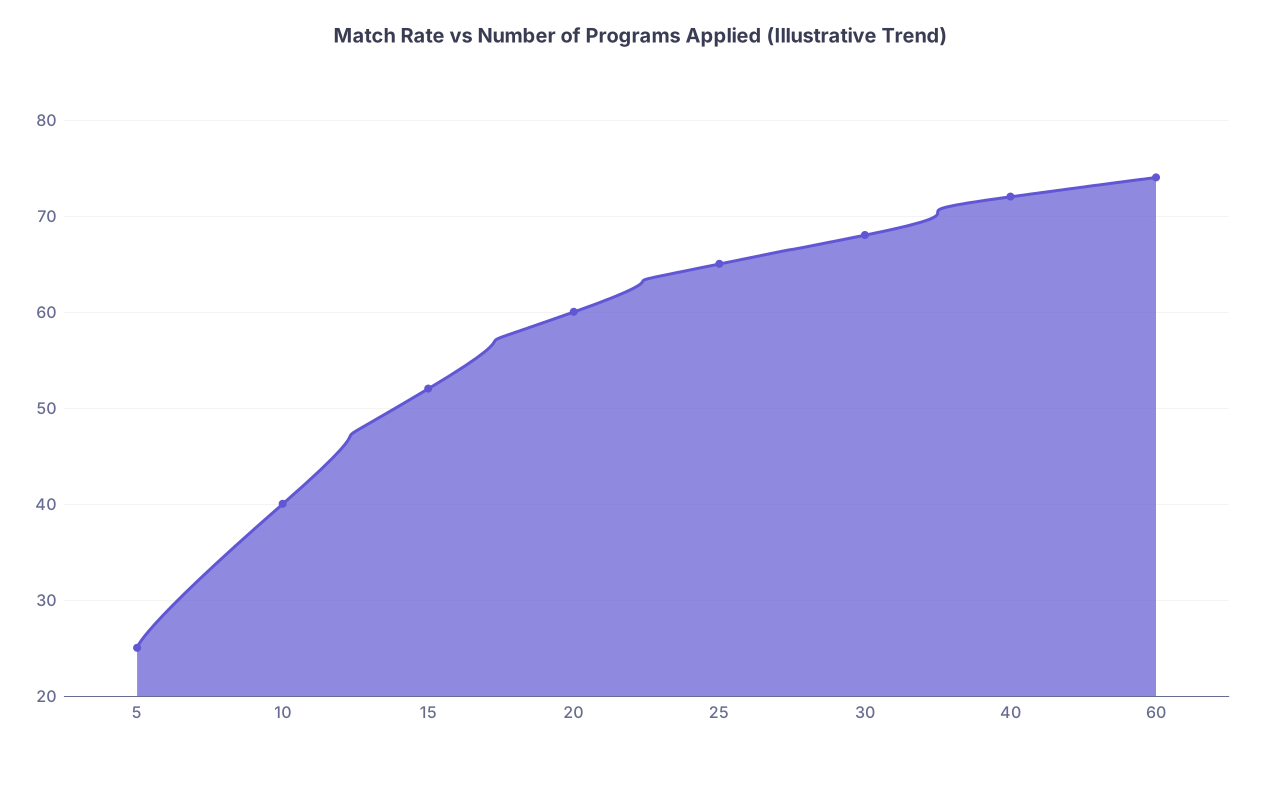
How Many Programs to Apply To: Dermatology-Specific Guidance for DOs
Dermatology is a field where “how many programs to apply” often feels like “as many as you can afford.” But a thoughtful approach is better than blind volume. Below is general guidance for DO applicants; your mentor or advisor should help tailor this to you.
1. Highly Competitive DO Applicant
- Suggested application range: ~60–80 dermatology programs
- Composition:
- 20–30% “reach”
- 50–60% “realistic”
- 20–30% “safety” (DO-friendly, mid-tier/community)
- Rationale:
- You have the profile to be competitive at a wide range of places, including many historically MD-heavy programs.
- You still want a strong core of DO-friendly and realistic programs to ensure interview volume.
2. Solid / Middle-of-the-Road DO Applicant
- Suggested application range: ~80–110 dermatology programs
- Composition:
- 15–20% “reach”
- 50–55% “realistic”
- 25–35% “safety” (highly DO-friendly, community or smaller academic programs)
- Rationale:
- You need broad coverage due to both specialty competitiveness and DO status.
- Emphasis on programs that consistently interview and match DOs.
3. At-Risk / Underdog DO Applicant
- Suggested application range: ~100–130+ dermatology programs
- Composition:
- 10–15% carefully chosen “reach” (where you have connections or special ties)
- 45–50% “realistic” (DO-friendly and mid-tier programs)
- 35–45% “safety” (strong DO representation, community-based, smaller cities)
- Rationale:
- You may need very broad applications to secure interviews.
- You might also consider parallel planning (e.g., applying to a preliminary year and a more accessible backup specialty).
These numbers may seem high, but dermatology is one of the most competitive specialties. For a DO graduate residency path in derm, a high-volume but strategic application pattern is common.
Integrating Your Preliminary Year Strategy
Dermatology typically requires:
- 3 years of dermatology (PGY-2 to PGY-4)
- 1 year of preliminary or transitional training (PGY-1) in medicine, surgery, or transitional year
You must also decide:
- Whether to apply to preliminary medicine, surgery, or transitional year programs
- How many prelim/TY programs to apply to (commonly 15–25, but varies by risk tolerance and geography)
Your derm match strategy and your prelim year strategy need to be coordinated. For DOs, some prelim programs are more welcoming; look for programs with prior DO interns.
Step 4: Layering in Geography, Lifestyle, and Personal Fit
Your goal is not only to match, but to match into a place where you can thrive personally and professionally. Still, for a DO graduate aiming at dermatology, pure preference has to be balanced with realism.
Geography: Flexibility vs. Constraints
Ask yourself:
- Are you open to relocating anywhere in the country?
- Do you have non-negotiable family or personal obligations?
- Are there regions where DOs historically match more easily in dermatology (often Midwest, South, some smaller markets)?
Greater geographic flexibility = higher match probability.
If you can, avoid narrowing your list to major coastal cities only. Many DO-friendly dermatology residencies are in:
- Midwest academic centers with strong clinical reputations
- Southern programs in mid-size cities
- Community-based programs affiliated with larger health systems
If you are geographically restricted (e.g., due to spouse, children, visa issues), compensate by:
- Applying to virtually every derm program within your region, regardless of prestige
- Maximizing DO-friendly and connection-based programs there
- Applying more broadly to prelim/TY programs in your region to secure a PGY-1 spot
Program Features That Matter for Dermatology
As you refine how to choose residency programs beyond just match odds, consider:
Clinical Volume and Variety
- Breadth of medical dermatology, surgical derm, and cosmetics
- Exposure to complex cases (e.g., immunobullous disease, cutaneous lymphoma)
Faculty Size and Subspecialties
- Presence of Mohs surgeons, pediatric dermatologists, dermpath specialists
- Opportunities to learn in subspecialty clinics
Research Infrastructure
- Protected research time
- Ongoing clinical trials or basic science projects
- Mentorship for publications and conferences (AAD, SID)
Culture and Education
- Program’s reputation for being supportive vs. high-pressure
- Didactic structure: weekly conferences, journal clubs, grand rounds
- Resident satisfaction indicators (word of mouth, alumni feedback)
Career Outcomes
- Where graduates go: fellowships vs. private practice vs. academics
- Do graduates match into competitive fellowships (Mohs, pediatric derm, dermpath)?
As a DO, you may especially want to look at how accessible faculty are and whether the program demonstrates commitment to teaching and inclusivity.

Step 5: Making Your List Strategic, Not Random
A strong program selection strategy weaves together competitiveness, DO-friendliness, geography, and personal priorities into a coherent plan.
Practical Steps to Build and Refine Your List
Start Broad with a Master Spreadsheet
- Include all ACGME dermatology programs
- Columns: DO residents present, program type (academic/community), city/state, # of positions, USMLE required?, your connections (rotations, research), personal interest level
Tag Programs by DO-Friendliness
- “High DO-friendly”: Regular DO residents, former AOA programs, DO leadership or faculty
- “Moderate DO-friendly”: Occasional DO residents, open language on website
- “Low DO-friendly”: Rare/no DO history, unclear or strict USMLE requirements
Overlay Your Competitiveness
- Mark where your scores and research align or exceed averages (based on public data, mentors’ input, or national stats)
- Identify realistic vs reach based on this comparison
Incorporate Geography and Personal Constraints
- Color-code regions based on your willingness to relocate
- Highlight programs in areas where you have ties (family, medical school, undergrad)
Trim Down to a Final List Aligned with Your Category
- Using the target ranges discussed above (e.g., 80–110 for a solid DO applicant), select:
- A moderate number of reach programs that you truly want
- A large core of DO-friendly, realistic programs
- A robust safety segment with strong DO representation
- Using the target ranges discussed above (e.g., 80–110 for a solid DO applicant), select:
Share Your List with Mentors
- Ask a dermatology faculty mentor and a dean/advisor familiar with DO graduates to review
- Specifically ask: “Given my profile, does this distribution of reach/realistic/safety look reasonable for the derm match?”
Avoiding Common Program Selection Mistakes
Overloading on Prestige
- Too many top-10 or ultra-competitive programs and not enough DO-friendly or mid-tier options
- This can drastically reduce your interview count
Narrow Geography Without a Strong Reason
- Restricting to one or two major cities without compelling personal need
- This often backfires for DO applicants in dermatology
Ignoring DO Match Data
- Not looking at where DOs actually match each year
- Missing historically DO-friendly programs that may offer strong opportunities
Underestimating How Many Programs to Apply
- Applying to 30–40 derm programs as a DO and expecting a strong interview season
- In dermatology, volume matters—but volume must be structured.
Not Applying Broadly Enough in Prelim/TY
- Failing to secure a preliminary year can derail your path even if you match derm (in certain match formats or future attempts)
- Treat your PGY-1 search seriously, with its own program selection plan
Putting It All Together: Example Scenarios
Example 1: Strong DO Applicant with National Flexibility
Profile:
- COMLEX Level 2: 660, Step 2 CK: 258
- Several derm publications, 2 away rotations with excellent feedback
- No geographic constraints
Strategy:
- Apply to ~70 derm programs
- ~20 “reach” (top academic centers, big coastal cities)
- ~35 “realistic” (mid-tier academic with some DO history, strong clinical training)
- ~15 “safety” (community-based or historically DO-friendly programs)
- Apply to ~20 prelim/TY programs spread across multiple regions
Outcome:
- Likely to receive a broad slate of interviews, including from mid/high-tier academic programs and DO-friendly institutions.
Example 2: Solid DO Applicant with Moderate Geographic Preference
Profile:
- COMLEX Level 2: 600, Step 2 CK: 246
- 1 derm publication, 2 posters, one away rotation
- Prefers Midwest and South but open to others
Strategy:
- Apply to ~90–100 derm programs
- ~15 “reach” (major academic centers in preferred regions)
- ~50 “realistic” (programs with known DO residents in Midwest/South + other regions)
- ~25–30 “safety” (smaller cities, community or hybrid programs)
- ~20 prelim/TY programs in Midwest/South, plus a few in other regions as backup
Outcome:
- Balanced strategy that maximizes interview opportunities while prioritizing preferred regions when possible.
Example 3: At-Risk DO Applicant with Geographic Constraints
Profile:
- COMLEX Level 2: 560, no USMLE, late derm interest
- Limited research, no away derm rotations
- Needs to stay within two adjacent states for family reasons
Strategy:
- Apply to every derm program within those states (even reaches)
- Expand to all DO-friendly derm programs in neighboring regions, even if personal preference is low (to increase chances)
- Total derm applications: ~110–130
- Heavy emphasis on programs with DO residents and community-based training
- Robust prelim/TY strategy: apply widely within allowed region (20–25+ prelim/TY programs)
Outcome:
- Lower probability overall due to constraints, but this strategy maximizes chances within realistic boundaries. Also consider a parallel plan (e.g., medicine or IM-preliminary with re-application, if derm is still the goal).
FAQs: Program Selection Strategy for DOs in Dermatology
1. As a DO, do I need to take USMLE in addition to COMLEX for dermatology?
Taking USMLE Step 2 CK is strongly recommended for DO applicants to dermatology, unless you have a specific reason not to. Many academic programs still use USMLE for internal comparisons, and some list USMLE as a requirement or strong preference. A solid Step 2 CK score helps programs contextualize your performance and can open doors that might be closed with COMLEX alone.
2. How many dermatology programs should I apply to as a DO if I’m on a tight budget?
If funds are limited, prioritize:
- Programs with a strong DO track record
- Regions where you have strong geographic ties
- Places where you’ve done rotations or have faculty connections
Even with budget constraints:
- Most DO applicants should aim for at least ~60–70 carefully selected derm programs.
- Work with your school’s financial aid office to explore fee assistance or application cost support.
- Consider trimming “reach” programs that are unlikely to look seriously at DOs, and focus on realistic and DO-friendly options.
3. How can I tell if a dermatology residency is truly DO-friendly?
Look for multiple converging signs:
- DO residents or faculty currently at the program
- Public match lists or social media posts that feature DOs
- A history of DOs in the program across several years (not just a single class)
- Open, welcoming language on the website regarding COMLEX and DO applicants
- Positive feedback from DO alumni or mentors familiar with the program
If uncertain, you can ask your advisor or even respectfully reach out to a current resident (not the program director) to get a sense of the culture.
4. Should I apply to a backup specialty in addition to dermatology?
This depends on your competitiveness and risk tolerance:
- Highly competitive DO applicants may focus solely on derm, with a robust prelim/TY strategy.
- Middle-of-the-road applicants often apply dermatology-only but should be prepared with a contingency plan (e.g., re-application after a research year, or internal medicine or transitional year).
- At-risk applicants might benefit from a parallel application strategy (e.g., IM or categorical prelim programs) to maintain training momentum while exploring future derm opportunities.
Discuss options with your mentors and dean’s office early. Your backup strategy should be integrated with your program selection strategy so you’re not scrambling late in the cycle.
A carefully designed program list—grounded in honest self-assessment, DO-friendly data, and a clear understanding of how many programs to apply to—is one of the most powerful tools you have in the derm match. As a DO graduate, strategic program selection can be the difference between a scattered, low-yield application season and a targeted, interview-rich pathway toward the dermatology residency you’re working for.