Understanding the Landscape: ENT Residency for DO Graduates
Otolaryngology–Head and Neck Surgery (ENT) is one of the most competitive specialties in the Match, and this is especially true for a DO graduate residency applicant. You are competing not only within a small number of total positions, but also in a field that still has variable experience—and sometimes bias—toward osteopathic applicants.
A thoughtful, data‑driven program selection strategy will influence:
- Whether you match at all
- The number of interviews you receive
- Your stress level and cost throughout the application cycle
Before deciding how many programs to apply and which ones, you need to understand the territory you’re operating in.
Key Realities for DO Applicants in Otolaryngology
High Competitiveness, Low Numbers
- ENT offers relatively few positions compared with internal medicine or family medicine.
- Many programs receive hundreds of applications for just a few spots.
- A smaller absolute number of DO applicants match into ENT each year compared with MDs, but the number is growing post-single accreditation.
Variable DO-Friendliness
- Some otolaryngology programs have a long track record of taking DO graduates or have former osteopathic programs integrated into them.
- Other programs have never (or very rarely) ranked a DO applicant.
- Past DO residents in a program are one of your strongest signals of DO friendliness.
Standardized Benchmarks Matter
- Step 2 CK and COMLEX Level 2 are important, especially if you lack Step 1 scores or have pass/fail results.
- Research productivity and letters of recommendation from otolaryngologists weigh heavily.
- For DOs, a strong record can help overcome unfamiliarity or bias at some institutions.
You Must Build a Wide, Strategic List
- Because ENT is highly competitive, “spray and pray” (applying everywhere) is extremely expensive and not necessarily smarter.
- Instead, you need a targeted, tiered list based on your competitiveness, DO friendliness, geography, and career aims.
The rest of this article breaks down how to build that list systematically, how many programs to apply to as a DO graduate seeking an ENT residency, and how to prioritize your energy and resources.
Step 1: Know Your Profile and Competitiveness
Before deciding where to apply, you must honestly evaluate who you are as an applicant. Your program selection strategy should reflect your strengths, weaknesses, and goals.
A. Core Metrics to Review
Board Exams
- USMLE Step 2 CK (if taken): Compare your score to recent matched ENT data (often well above the national mean).
- COMLEX Level 2-CE: Programs that understand osteopathic exams will consider this carefully.
- If you did not take USMLE, prioritize programs that have historically interviewed and matched DOs based solely on COMLEX.
Medical School Performance
- Class rank/quartile
- Honors in core clinical rotations
- Any ENT or surgery rotation honors
- Membership in Sigma Sigma Phi or other honor societies
ENT-Specific Experience
- Number and quality of ENT letters (ideally 2–3 from otolaryngologists)
- ENT research output (posters, abstracts, publications)
- Away rotations or sub-internships in ENT
Research and Academic Output
- Total number of publications (especially in ENT or surgical fields)
- Case reports, quality improvement projects, or basic science ENT work
- Involvement in ENT interest groups or national otolaryngology organizations
Red Flags
- Any exam failures (COMLEX or USMLE)
- Significant gap in training
- Professionalism issues or withdrawals from rotations
B. Rough Applicant Tiers (ENT, DO Graduate Context)
These are approximate categories to guide your program selection strategy, not rigid labels.
Highly Competitive DO Applicant
- Strong Step 2 CK (e.g., high 240s+ or equivalent), strong COMLEX Level 2
- Multiple ENT letters from well-known faculty
- Several ENT-related research products or strong research portfolio
- Honors in surgery, ENT, and good class rank
- Strong performance on away rotations
Solid / Middle-Range DO Applicant
- Step 2 CK around national average to moderately above (or COMLEX in a solid range)
- Good but not exceptional research; some ENT exposure
- 1–2 strong ENT letters
- Good rotation evaluations; perhaps fewer leadership or scholarly achievements
More Challenged / At-Risk DO Applicant
- Lower board scores or an exam failure
- Limited ENT research or letters
- Fewer away rotations or weaker clinical evaluations
- Late decision to pursue ENT
Your self-assessment determines:
- How aggressive your geographic preferences can be
- How many “reach” programs vs “safer” DO-friendly programs you need
- Whether you should also generate a parallel plan (e.g., another specialty application)

Step 2: How Many ENT Programs Should a DO Graduate Apply To?
“How many programs to apply” is one of the most common and anxiety‑provoking questions. The answer depends on competitiveness and risk tolerance, but for a DO applicant in ENT, the bar for a safe number is usually higher than for MD peers.
A. General Ranges for ENT (DO Applicants)
Note: Exact numbers vary by year and applicant cohort, but these ranges are reasonable starting points.
Highly Competitive DO Applicant
- If you have stellar metrics and strong ENT backing:
- Recommended range: ~45–60 otolaryngology programs
- You may go on the lower end if you have strong home program support and a clear regional focus with many DO-friendly programs.
Solid / Middle-Range DO Applicant
- Competitive but not top-of-the-pile, which describes many successful DO applicants.
- Recommended range: ~60–80 otolaryngology programs
- This broader net increases interview chances, especially when DO friendliness is variable.
At-Risk / More Challenged DO Applicant
- Significant weaknesses (exam failure, minimal ENT exposure) make ENT especially challenging.
- Recommended range: Often 80+ otolaryngology programs plus:
- A carefully planned parallel specialty application (e.g., general surgery, transitional year, or another field you would be content to train in).
These ranges assume you are fully committed to pursuing ENT in the main Match. If you are seriously at risk, it may be safer to apply broadly to ENT and another specialty, rather than only increasing ENT applications indefinitely.
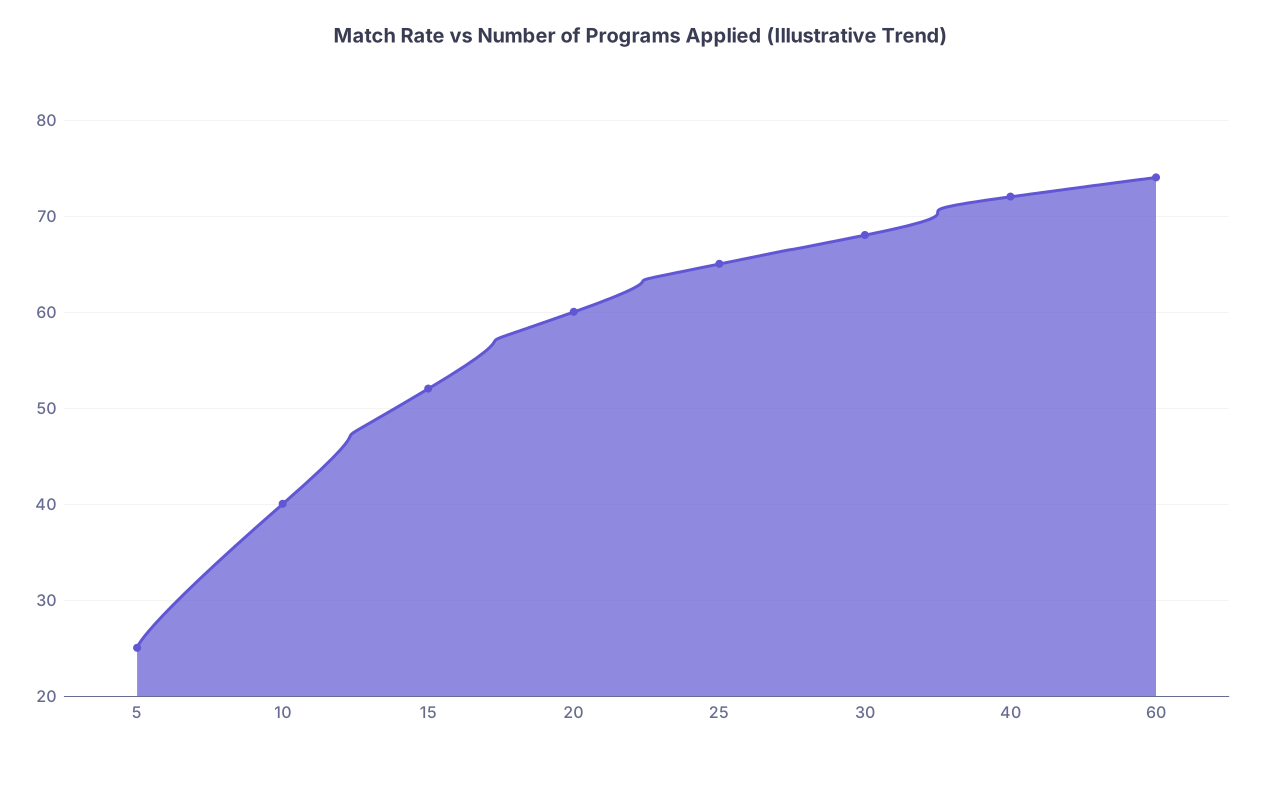
B. Cost, Effort, and Diminishing Returns
Applying to more programs:
- Increases your total ERAS and NRMP expenses
- Makes it harder to individualize applications
- Returns fewer new interview offers per program beyond a certain point
As a DO graduate residency applicant, you do benefit from a larger list due to variable DO friendliness across the otolaryngology match. But beyond ~80–90 applications, your marginal benefits decrease significantly, especially if your application doesn’t change.
C. Balancing ENT with a Backup Plan
For DO graduates, ENT is high-risk, high-reward. Consider:
If you would be devastated not matching ENT, but open to a strong backup specialty:
- Apply broadly to ENT (60–80+ programs) and also apply to a “backup” where your chances are higher.
- Discuss this with your ENT mentors and your dean’s office.
If ENT is the only acceptable option to you right now:
- Apply very broadly (80+ ENT programs) and be prepared to use SOAP or a reapplication strategy if you do not match.
- This approach carries more risk and stress; it requires full awareness of your odds.
Step 3: Identifying DO-Friendly Otolaryngology Programs
A central pillar of your program selection strategy as a DO applicant is weighting DO-friendly programs more heavily. These programs might not be explicitly labeled, but you can identify them through methodical research.
A. Signals of DO Friendliness
Current or Recent DO Residents
- Check program websites and social media; look at resident lists and bios.
- Programs with one or more DO residents in the past 3–5 years are historically more open.
Former Osteopathic or Community Programs
- Some programs were previously osteopathic or community-based before single accreditation.
- These often retain a culture of including DO graduates.
Stated COMLEX Acceptance
- Programs that explicitly state:
- “We accept COMLEX alone” or
- “USMLE not required for DOs”
are generally safer bets if you did not take USMLE.
- Programs that explicitly state:
Networking Intel
- Ask your ENT faculty, advisors, and recent graduates:
- “Which otolaryngology programs have been DO-friendly in recent years?”
- Join ENT or DO forums, specialty interest groups, and national societies where program reputation is actively discussed.
- Ask your ENT faculty, advisors, and recent graduates:
Interview and Match Patterns
- Your school’s Graduate Medical Education office may track where prior DO students applied, interviewed, and matched.
- Ask alumni who matched into ENT where they felt welcomed as DOs.
B. Weighing DO-Friendliness in Your List
Instead of a generic list, create categories:
Tier 1: DO-Friendly ENT Programs
- Documented DO residents and COMLEX acceptance
- These should form a large portion of your applications.
Tier 2: Neutral / Mixed Programs
- No explicit DO bias, little data either way
- Still worth applying to, especially if your metrics are strong.
Tier 3: Historically DO-Unfriendly Programs
- No DO residents ever, or explicit preference for USMLE-only with no COMLEX mention
- You might still apply to a limited number if:
- Your application is outstanding, or
- You have a strong geographic tie or faculty connection.
Your goal is not to avoid prestigious or university-based programs, but to ensure your portfolio of applications emphasizes programs that have historically valued DOs.

Step 4: Building Your Actual ENT Program List
Once you understand your competitiveness and DO friendliness, you need a structured program selection strategy that balances data with your personal life and goals.
A. Key Filters to Use
Geographic Preference
- Group programs by region (Northeast, Midwest, South, West, etc.).
- Flag locations where you:
- Have significant ties (grew up, family, undergrad, spouse/partner)
- Could realistically see yourself living for 5+ years
- In ENT, geography preferences should be flexible for most DO applicants, especially if you are risk-averse.
Program Type and Size
- Academic medical centers vs community-based or hybrid programs.
- Larger programs may have more residents and broader clinical exposure, but also more competition.
- Former osteopathic or mid-sized programs may be particularly DO-friendly.
Training Experience and Case Mix
- Head and neck oncology volume
- Otology/neurotology exposure
- Pediatric ENT experience
- Robotics, facial plastics, rhinology, etc.
- Align these with long-term interests, but remember that all accredited ENT programs must meet core training standards.
Research Emphasis
- If you enjoy or excel in research, academic powerhouse programs may be appealing.
- If you prefer a clinically focused environment, community-leaning or less research-heavy programs may be better.
Culture and Fit
- Review mission statements, social media accounts, resident life posts.
- Look for:
- Collegial interactions among residents
- Diversity and inclusion initiatives
- Support for wellness and mentorship
- Fit is hard to measure pre-interview, but initial impressions matter.
B. Creating a Tiered List
Build a spreadsheet with columns for:
- Program name and location
- DO-friendliness rating
- Geographic tie (yes/no/weak)
- Program type (academic/community/hybrid)
- Research intensity (high/moderate/lower)
- Personal interest score (1–5)
Then group programs into:
Top Priority / High Fit Programs
- Strong DO-friendly signals
- Good geographic or personal fit
- Reasonable competitiveness compared with your metrics
Moderate Priority / Neutral Fit Programs
- Less DO-specific data, but acceptable geographically and academically
- More competitive academics, but possible stretch options
Reach Programs
- Very prestigious or highly competitive institutions
- No or minimal DO history
- You apply because of particular interest, prestige, or strong faculty connections
For a solid DO applicant targeting ~70 programs, a possible distribution:
- 30–40 Top Priority / DO-friendly programs
- 20–25 Moderate Priority programs
- 5–10 Reach programs
Adjust these tiers based on your profile; at-risk applicants should lean even more heavily on DO-friendly and moderate programs.
C. Customizing Application Materials
Even though you may apply to dozens of programs, you should still:
- Tailor your personal statement (or program-specific paragraphs) to your top priority programs whenever possible.
- Emphasize:
- ENT mentors and research
- Your interest in serving specific communities or regions
- How your osteopathic background complements ENT’s holistic view of head and neck conditions
This tailoring helps programs see that you’re not just mass-applying, but making thoughtful choices aligned with their mission.
Step 5: Strategic Use of Away Rotations and Networking
In ENT, away rotations and relationships can significantly shape your otolaryngology match outcome and inform how to choose residency programs more strategically.
A. Choosing Away Rotation Sites
Consider 1–3 away rotations at programs that are:
- DO-friendly or at least DO-open
- Realistic match targets based on your profile
- Aligned with your geographic interests
Use away rotations to:
- Demonstrate work ethic, teachability, and collegiality
- Secure strong ENT letters of recommendation
- Gauge in-person fit with the program’s culture
When weighing where to rotate, prioritize programs where:
- You could genuinely see yourself training
- You might otherwise struggle to stand out on paper
B. Networking and Visibility
Your program selection strategy should include intentional networking:
- Attend regional or national otolaryngology conferences as a student.
- Join organizations like AAO-HNS and osteopathic specialty societies.
- Reach out to DO ENT residents or faculty with genuine, concise emails asking:
- About their program’s culture
- Advice for DO applicants
- Whether their program is open to reviewing DO candidates with COMLEX
Good networking offers:
- Insider intel on DO-friendliness
- Names and faces that may later recognize your application
- Opportunities for research or collaborative projects
Frequently Asked Questions (FAQ)
1. As a DO graduate, do I need to take USMLE to match into ENT?
Not always, but it can help. Some otolaryngology programs:
- Require or strongly prefer USMLE Step 2 CK.
- Are comfortable evaluating COMLEX alone, especially if they have DO residents.
If you have not taken USMLE:
- Prioritize programs that explicitly accept COMLEX as sufficient.
- Talk to your ENT mentors and dean’s office about how your scores compare.
- Recognize that having USMLE scores may broaden your program pool, but it is not an absolute requirement everywhere—especially in historically DO-friendly programs.
2. How many ENT programs should I apply to if I’m an average DO applicant?
A “solid, average” DO applicant interested in ENT should typically consider applying to around 60–80 otolaryngology programs, with:
- A large portion being DO-friendly or DO-open programs
- Some moderate and reach programs included
These numbers are guidelines, not guarantees. If you have additional risk factors (exam failure, late decision to pursue ENT, limited ENT exposure), leaning toward the higher end or considering a parallel specialty is wise.
3. Should I also apply to a backup specialty?
If your metrics are borderline or significantly below typical matched ENT applicants, or if you have meaningful red flags, applying to a backup specialty is a rational safety measure. You should consider:
- Whether there’s another specialty you would genuinely be content to train in.
- Whether you have time and bandwidth to prepare two strong applications.
- Discussing options (e.g., general surgery, prelim year, transitional year, or another field) with both your ENT mentor and your dean’s office.
For at-risk DO applicants, a dual application can provide valuable security.
4. How can I quickly gauge if a program is likely to consider DO applicants?
Use this quick checklist:
- Does the program list current or recent DO residents on its website?
- Does the website or program FAQ state that COMLEX is accepted (with or without USMLE)?
- Have DO graduates from your school or other osteopathic schools interviewed or matched there in recent years?
- Do DO ENT residents or faculty from that program appear at meetings or in professional societies?
If you can answer “yes” to one or more of these, the program is more likely to be DO-friendly and worth prioritizing in your list.
A strong program selection strategy for a DO graduate targeting an otolaryngology match combines honest self-assessment, broad but targeted applications, deliberate focus on DO-friendly programs, and careful attention to geography, fit, and backup planning. Thoughtful choices now will increase your chances of not only matching, but matching into a residency where you can thrive as an osteopathic otolaryngologist.