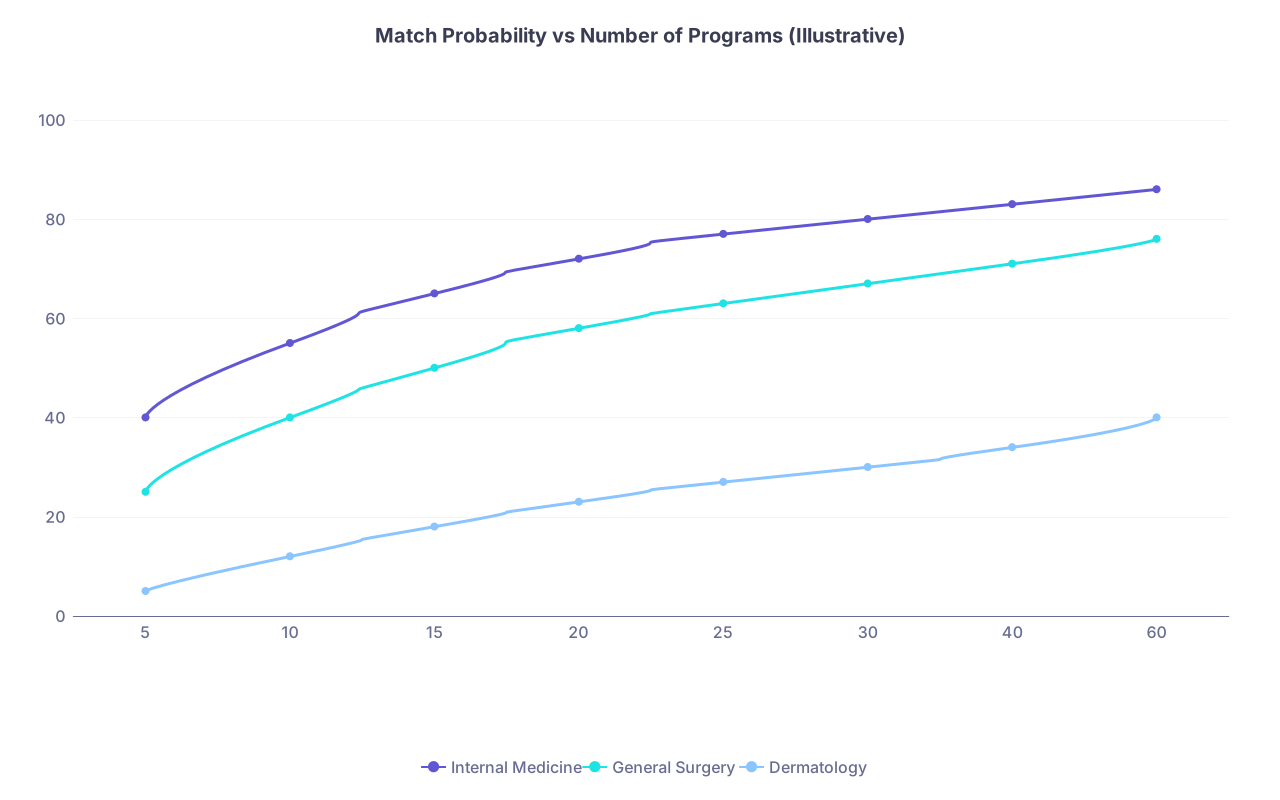
Understanding the Landscape: FM Match for the DO Graduate
For a DO graduate entering the family medicine residency (FM) match, the program selection strategy is not just “how many programs to apply” but which programs, why those programs, and how to build a balanced, realistic list that maximizes your chances of matching while aligning with your long-term goals.
Family medicine is generally considered a less competitive specialty compared with dermatology or orthopedic surgery, and DO graduates traditionally match well into FM. However, competition has been steadily increasing, driven by:
- Growth of U.S. MD and DO graduates
- A single, unified ACGME accreditation system
- Increasing interest in primary care and lifestyle-friendly specialties
That means you cannot simply apply to a handful of nearby programs and expect a guaranteed result. You need a clear program selection strategy tailored to:
- Your individual competitiveness as a DO graduate
- Your geographic and lifestyle needs
- Your career goals (urban vs rural practice, academic vs community, OB-heavy vs office-based, sports medicine, etc.)
In this article, we’ll walk through a structured approach to program selection for a DO graduate interested in family medicine residency, including:
- How to realistically assess your competitiveness
- How to choose residency programs and build a targeted list
- How many programs to apply to given your profile
- Strategic tips specific to DO graduates in the osteopathic residency match era (now unified under NRMP/ACGME)
Throughout, we’ll weave in practical tools and examples so you can translate general advice into your own program list.
Step 1: Assess Your Competitiveness as a DO Applicant
Before you can build a smart program selection strategy, you need an honest assessment of your own application. For a DO graduate, competitiveness is multidimensional—much more than just scores.
1. Academic Metrics
Consider:
- COMLEX-USA Level 1 / Level 2-CE scores
- USMLE Step 1 / Step 2 CK (if taken)
- Any exam failures or repeats
- Class rank and transcript trends (upward or downward)
Family medicine programs typically emphasize fit and broad clinical ability. Many are comfortable with COMLEX-only applicants, but some more competitive or academic programs still prefer or require USMLE.
Rough academic categories (for FM, DO applicants):
High-tier:
- COMLEX Level 2-CE ≥ 620
- USMLE Step 2 CK ≥ 245 (if taken)
- No failures, generally strong transcript, some honors
- Could target competitive academic FM programs, urban “name” institutions
Mid-tier:
- COMLEX Level 2-CE ~550–615
- USMLE Step 2 CK ~225–244 (if taken)
- No red flags, mostly solid clinical evaluations
- Competitive at most community and many academic programs
Safety-tier / at risk:
- COMLEX Level 2-CE < ~540, or any exam failure
- USMLE Step 2 CK < ~220 (if taken)
- Noticeable academic struggles but overall passing
- Should prioritize osteopathic-friendly community programs, smaller or more rural sites, and higher application counts
These ranges are approximate and vary by year and region, but they help frame how broad your program search needs to be.
2. Clinical Performance and Letters
Family medicine emphasizes clinical skills and interpersonal warmth.
Factors that improve your competitiveness:
- Strong family medicine rotation evaluations
- At least two high-quality FM letters of recommendation, ideally from:
- A core FM clerkship director
- A community FM preceptor or FM sub-I supervisor
- A strong, narrative MSPE (Dean’s Letter) with few areas of concern
If your metrics are average but your letters and clinical reviews are outstanding, you may be more competitive than your score alone suggests—especially in FM.
3. DO-Specific Considerations
As a DO graduate, think about:
COMLEX-only vs COMLEX + USMLE:
- COMLEX-only is fine for many family medicine programs, especially historically osteopathic or community-based programs.
- USMLE opens more doors at ACGME-allopathic–origin academic programs, especially if you’re aiming for urban or university-based FM.
Osteopathic recognition and training environment:
- Some FM residencies have Osteopathic Recognition and deliberately integrate OMT and osteopathic principles.
- These programs are often especially welcoming to DO graduates and may view your osteopathic background as a clear asset.
Perception of DO graduates:
- In FM, DOs are highly represented and generally well-respected.
- Historically osteopathic programs may have a majority DO resident body and DO leadership, which can enhance mentorship and support.
4. Personal and Career Factors
Finally, your competitiveness is modified by your constraints and goals:
- Need to remain near a specific city or partner
- Strong preference for rural vs urban practice
- Interest in obstetrics, sports medicine, academic medicine, leadership, or global health
- Financial constraints limiting total number of applications or interviews
A DO applicant with strong metrics but strict geographic limits may be at higher risk than a candidate with more modest scores but nationwide flexibility.
Step 2: Define Your Priorities Before You Search
Before you dive into databases or ask “how many programs to apply,” define what you want from a family medicine residency. Otherwise, you’ll end up with a bloated, unfocused list.
Key Priority Domains for Family Medicine
Geography and Lifestyle
- Region(s) where you can realistically live and thrive
- Proximity to family, partner, or support system
- Preference for urban, suburban, or rural environment
- Climate tolerance (e.g., winters, humidity, heat)
Program Type and Setting
- Community-based vs university-based:
- Community: often more hands-on responsibility, strong continuity clinics, less research pressure
- University: more subspecialty exposure, academic connections, sometimes more competitive
- Unopposed vs opposed:
- Unopposed programs: FM residents are primary residents in the hospital, often more autonomy and procedural volume
- Opposed programs: multiple residencies share services; good for interdisciplinary learning but sometimes less autonomy
- Community-based vs university-based:
Training Content Emphasis
- Obstetrics and women’s health (including whether you want to do deliveries or full-scope OB)
- Inpatient vs outpatient balance
- Procedures (joint injections, skin procedures, colonoscopies in some programs, etc.)
- Behavioral health integration
- Geriatrics, pediatrics, sports medicine, addiction medicine
Osteopathic Culture
- Programs with Osteopathic Recognition
- Presence of DO faculty and leadership
- Support for OMT clinics or continuity of osteopathic practice
Career and Fellowship Goals
- Interest in FM fellowships: sports medicine, geriatrics, palliative care, OB, addiction medicine, etc.
- Academic vs community career path
- Research expectations (important if you want an academic role later)
Culture, Support, and Fit
- Resident wellness initiatives
- Diversity and inclusion
- Program size and call schedule
- Faculty teaching style and mentorship
Write these priorities down in order of importance. This list becomes your compass as you evaluate programs.

Step 3: How to Choose Residency Programs: Research and Filters
With your priorities defined, now you can start building your program list in a structured way.
1. Use Multiple Data Sources
For a DO graduate, rely on more than one database:
- FREIDA (AMA) – basic program info, size, benefits, some requirements
- NRMP/ACGME program search – accreditation and key structural details
- Program websites – specifics on curriculum, OB exposure, osteopathic recognition, resident bios
- AACOM and state osteopathic associations – insights into historically osteopathic and DO-friendly sites
- Colleagues, alumni, and mentors – real-world reputation and DO experiences
2. Identify DO-Friendly and Osteopathic-Focused Programs
In the osteopathic residency match era, many historically AOA programs now participate in the NRMP. As a DO graduate, this is an advantage.
Clues a program is DO-friendly:
- A majority of current residents are DOs or a strong DO presence
- Osteopathic Recognition or specific mention of osteopathic training
- Program director or core faculty are DOs
- Website explicitly states COMLEX-only applicants are welcome
- Past graduates from your DO school have matched there
Ask your school’s advising office for a list of FM programs where your alumni have matched; this is a great starting point.
3. Filter by Hard Requirements
Before falling in love with any program, check:
- Whether they accept COMLEX-only scores
- Any stated score thresholds (e.g., COMLEX Level 1/2 cutoffs)
- Limits on years since graduation
- Policies on visa sponsorship (if applicable)
- Required rotations (e.g., audition/sub-I at their site)
Eliminate programs that:
- Explicitly do not accept DOs (rare in FM, but check)
- Explicitly require USMLE when you do not have it
- Fall outside key non-negotiable factors (e.g., region where you absolutely will not live)
4. Evaluate Program Fit Using Specific Questions
For each program that passes basic filters, evaluate it against your priorities:
- Does the program’s OB volume match your goals (high OB vs minimal)?
- Are graduates going into careers similar to what you envision (rural full-scope vs urban outpatient)?
- Is there protected time for didactics and evidence-based learning?
- Are there opportunities for teaching, leadership, or research if you want them?
- Is there explicit support for osteopathic principles and OMT?
Create a simple spreadsheet and rank each program (e.g., 1–5) on your key priority domains. This will help you later when you need to trim your list.
Step 4: How Many Programs to Apply to in Family Medicine as a DO Graduate
This is the question nearly every applicant asks: “How many programs to apply?” The answer depends on your risk tolerance and competitiveness.
1. General Ranges for Family Medicine (DO Applicant)
Numbers evolve each cycle, but approximate guidance for a DO graduate targeting family medicine:
Very competitive DO applicant (high-tier metrics, no red flags, geographic flexibility):
- Often 15–20 applications may be sufficient
- Many will apply to 20–25 for additional security
Average DO applicant (mid-tier metrics, no major red flags):
- Aim for 25–35 programs
- Increase toward the upper end if you have significant geographic constraints
At-risk DO applicant (below-average scores, exam failures, or strict geography):
- Consider 35–50+ programs
- Focus heavily on DO-friendly, community, and smaller or more rural programs
- Geography constraints may require a higher count if you’re only able to consider one or two regions
These aren’t strict rules, but they reflect how many interviews you’re likely to generate in FM and your desired margin of safety.
2. Target Number of Interviews
Instead of fixating solely on how many programs to apply, think in terms of how many interviews you need:
- For a DO graduate in family medicine, 10–12 interviews generally provide a strong likelihood of matching.
- 8–10 interviews may still be adequate for many, especially without red flags.
- >12 interviews usually moves your risk of not matching quite low in FM, assuming you rank sincerely.
Your application count should be large enough—given your profile—to realistically generate 8–12 interviews.
3. Adjusting for Geography
Geographic restriction is one of the biggest hidden risk factors.
- If you are open to most of the country, you may not need a huge number of applications.
- If you must stay in a single metro area or one small state, your risk goes up, even with strong metrics.
Example:
- DO applicant with mid-tier scores, good letters, but must stay within one state because of family obligations.
- The state has 6 FM programs.
- You should probably apply to all 6, plus consider bordering states where commuting might be possible or where you’d realistically relocate if needed.
- Your total applications might still end up in the 25–35 range, but with a very heavy emphasis on that primary region.
4. Cost and Time Considerations
Remember: every application costs money and time. Applying to 70 programs when you truly only want to live in 2 regions is wasteful.
Use a tiered approach:
- Apply broadly enough to be safe.
- If you begin getting early interview invites and quickly approach 10–12 interview offers, you may not need to add more programs (unless your advisors recommend it).

Step 5: Structuring Your List: Reach, Target, and Safety Programs
Just as with medical school applications, a smart residency list balances reach, target, and safety programs.
1. Define the Three Tiers
Reach programs:
- More competitive academic centers, high-demand urban locations, or “name-brand” institutions
- May prefer USMLE or higher percentile scores
- You meet minimum criteria but may be below their average stats
Target programs:
- Your profile is well-aligned with their typical residents
- You’d be a solid, realistic candidate based on scores, geography, and background
- Community or university-affiliated programs in moderately competitive regions
Safety programs:
- Clearly DO-friendly, often with many DOs in the residency
- Historically osteopathic or community-based, including some rural sites
- Your metrics are at or above their typical accepted range
2. Suggested Distribution of Programs
For an average DO graduate applying to family medicine:
- 20–30% Reach
- 40–50% Target
- 20–30% Safety
If you have red flags (exam failures, professionalism issues), shift your list more toward safety programs and increase your total number of applications.
Example for a mid-tier DO applicant applying to 30 programs:
- 7–8 reach programs (e.g., big-city academic centers, highly desired cities)
- 14–16 target programs (mixed community and academic, DO-friendly metro and suburban sites)
- 7–8 safety programs (smaller cities, rural or unopposed programs, strong DO presence)
3. Reducing the List from 60+ to a Final Target
Many applicants start with a huge “long list” of 60–80+ programs. Use your spreadsheet to narrow it down:
- Remove programs that don’t meet non-negotiables (geography, visa, scores, DO acceptance).
- Score each remaining program on top factors (0–5 scale):
- Geography
- Program type (community/university, unopposed vs opposed)
- OB/procedural volume
- Osteopathic environment
- Resident culture
- Eliminate the bottom third of programs (lowest composite scores or poor fit).
- Cross-check for list balance (not all in one city or only in one competitiveness tier).
This intentional trimming keeps your final list within a financially and logistically manageable range, while still strategically broad.
Step 6: Special Strategic Considerations for DO Graduates in Family Medicine
As a DO graduate, you can lean into your strengths and navigate remaining biases wisely.
1. Use Your Osteopathic Identity as an Asset
Many family medicine programs value the holistic, patient-centered training DO graduates bring, especially in community-based and primary care–oriented settings.
Ways to highlight this:
- Emphasize OMT and osteopathic principles in your personal statement, where relevant to FM.
- Mention continuity clinic cases where osteopathic philosophy helped address biopsychosocial needs.
- For programs with Osteopathic Recognition, clearly state your interest in continuing and expanding your OMT skills.
2. Be Strategic with USMLE (If You Don’t Have It)
If you did not take USMLE:
- Prioritize programs that:
- Explicitly accept COMLEX-only
- Have a high DO resident proportion
- Be cautious about applying heavily to highly academic, historically MD-dominant programs that emphasize USMLE in their selection.
If you did take USMLE:
- Report it if it’s consistent with or stronger than your COMLEX performance.
- If it’s significantly weaker, discuss strategy with an advisor, but keep in mind many FM PDs look holistically and appreciate COMLEX familiarity.
3. Using Audition Rotations (Sub-Internships)
For DO applicants, especially those aiming for a specific region or competitive program:
- Audition rotations (sub-Is) at family medicine residency sites can significantly improve your chances, if you perform well.
- You’ll gain:
- A strong home program advocate
- A tailored letter of recommendation
- Insider knowledge of culture and expectations
Don’t over-rotate, but consider one or two strategically chosen FM rotations in summer/early fall at top-choice programs.
4. Watch for Hidden Pitfalls
- Underestimating community/rural programs: Some of the best training for full-scope FM comes from smaller unopposed sites with strong OB and procedural curriculum. Don’t ignore these for “name” recognition alone.
- Over-focusing on prestige: In FM, program quality and fit affect your everyday work far more than national brand.
- Assuming DO-friendliness without verifying: Even in FM, some university programs may rarely take DOs or may require USMLE. Check their resident roster and stated requirements.
Step 7: Putting It All Together – Example Scenarios
Example 1: Strong DO Graduate, Broad Geography
- COMLEX Level 2-CE: 620
- USMLE Step 2 CK: 244
- No red flags, excellent FM letters, broad geographic interest
Program selection strategy:
- Total applications: ~22–25 programs
- Distribution:
- 8 reach (urban academic centers, high-demand cities)
- 10–12 target (mix of university-affiliated and strong community programs)
- 4–5 safety (DO-heavy programs in less competitive areas)
- Emphasis: Programs with OB, sports medicine tracks, or Osteopathic Recognition
Example 2: Mid-Tier DO Graduate, Moderate Geography Limits
- COMLEX Level 2-CE: 565
- No USMLE
- Needs to stay in Mid-Atlantic or Northeast for family reasons
- Solid letters, no exam failures
Program selection strategy:
- Total applications: ~30–35
- Apply to all FM programs in preferred states that accept COMLEX-only and DOs
- Distribution:
- 6–7 reach (magnet cities like DC, Boston, NYC, major university centers)
- 16–18 target (suburban and smaller metro programs, mix of community and university-affiliated)
- 8–10 safety (rural, unopposed, historically osteopathic, DO-majority)
- Goal: Secure 10–12 interview offers; consider audition rotation at a top-choice safety/target site
Example 3: At-Risk DO Graduate, Geographic Flexibility
- COMLEX Level 2-CE: 520
- One failed Level 1 attempt (passed on second try)
- No USMLE
- Willing to go almost anywhere in the U.S.
Program selection strategy:
- Total applications: ~45–55
- Heavy emphasis on DO-friendly, community, and rural programs with DO-majority residents
- Limit reach programs to 5–6 (a few academic centers that are explicitly DO-welcoming)
- Focus safety programs in multiple states/regions (Midwest, Southeast, Mountain West), including smaller cities
- Aim to secure at least 8–10 interviews; respond quickly to invites and schedule early
FAQs: Program Selection Strategy for DO Graduates in Family Medicine
1. As a DO graduate, do I need to take USMLE to match into a family medicine residency?
Not necessarily. Many family medicine residencies—especially those that are historically osteopathic, community-based, or have Osteopathic Recognition—accept COMLEX-only applicants and are very DO-friendly. However, some academic or highly competitive urban programs may still strongly prefer or require USMLE scores. If you already have strong COMLEX scores and primarily target DO-friendly programs, USMLE is optional. If your dream programs are MD-heavy academic centers in large metro areas, having USMLE can help.
2. How many family medicine programs should a typical DO graduate apply to?
For most DO applicants, a range of 25–35 programs is common for family medicine. Strong, broadly competitive DO graduates with no red flags and flexible geography might apply to 15–25. Applicants with weaker metrics, exam failures, or tight geographic constraints might need 35–50+ applications. Your goal is to secure around 10–12 interviews, which usually provides a high probability of matching in FM.
3. Is it better to prioritize DO-heavy programs or branch out to more academic MD programs?
It depends on your goals and comfort level. DO-heavy or historically osteopathic programs often provide a supportive cultural fit and appreciation for OMT and osteopathic principles. Academic MD programs can offer more research infrastructure, subspecialty exposure, and certain fellowship pathways. Many DO graduates successfully train in both settings. A balanced strategy is to include a mix: several DO-heavy programs for safety and target, plus a few academic programs as reaches if they align with your career goals.
4. How can I tell if a program is really DO-friendly?
Look for multiple indicators:
- A sizable proportion of current residents are DOs (check resident bios)
- The program has Osteopathic Recognition or mentions osteopathic/OMT training
- Website or FREIDA listing explicitly welcomes COMLEX scores
- Program leadership includes DO faculty or a DO program director
- Your school’s alumni have previously matched there and had positive experiences
If you’re unsure, you can email the program coordinator with a specific question about COMLEX acceptance or DO applicant history. Their response (and tone) can be revealing.
A deliberate, data-informed program selection strategy—tailored to your strengths as a DO graduate and your goals within family medicine—will help you build a list that is broad but not random, ambitious but not reckless. With thoughtful planning, you can maximize both your chances of matching and your satisfaction with where you’ll spend three pivotal years of training.