Understanding the Med-Peds Landscape as a DO Graduate
Medicine-Pediatrics (Med-Peds) is a unique, highly versatile specialty that prepares you to care for both adults and children, often with complex, chronic conditions that bridge both age groups. For a DO graduate, developing a thoughtful program selection strategy is essential—not just to match, but to match into a program where you will thrive.
As a DO applicant, you are entering an increasingly competitive, unified residency environment after the AOA–ACGME merger. The osteopathic residency match is now part of the single NRMP Match, and most Med-Peds programs are ACGME-accredited, with varying levels of experience training DO residents. Your program selection strategy needs to balance realism (where you are most likely to match) with ambition (programs that will stretch and support your long-term goals).
This article will help you:
- Understand how Med-Peds programs evaluate DO applicants
- Decide how many programs to apply to in Med-Peds specifically
- Build a tiered, data-informed program list
- Strategically target programs that fit your learning style, geography, and career plans
- Optimize your application as a DO graduate aiming for the medicine pediatrics match
Key Factors Programs Consider for DO Applicants
Before you can build a smart list, you need to understand what Med-Peds programs care about and how being a DO might change the equation.
Academic Metrics: COMLEX, USMLE, and Class Rank
Med-Peds is moderately competitive. In recent years, the fill rate has been high, and U.S. DOs make up a meaningful portion of matched applicants, but there’s still selection pressure at most programs.
Scores and transcripts:
COMLEX vs USMLE
- Many Med-Peds programs are now “COMLEX-friendly,” but some still prefer or require USMLE scores.
- If you have USMLE scores, they’re often used as the primary screen.
- If you only have COMLEX, you’ll need to target programs that explicitly accept COMLEX or have a strong track record of matching DOs.
Score competitiveness (general guidance)
- Above-average scores (e.g., USMLE Step 2 CK > 245, COMLEX Level 2 > ~630): You can reasonably aim for more academically oriented programs and university-based Med-Peds residencies.
- Solid but not standout scores (USMLE Step 2 CK ~230–245, COMLEX Level 2 ~560–630): You should build a balanced mix of academic and community/“hybrid” programs.
- Below-average or marginal scores: Focus on DO-friendly programs and institutions with a history of supporting learners with diverse academic profiles.
Class rank and academic flags
- Class quartile, failed courses, or board failures matter more in smaller, competitive specialties like Med-Peds because programs take relatively fewer residents per year.
- If you have a red flag, you may need to increase the number of programs you apply to, and prioritize programs with clear DO support and holistic review.
Clinical Rotations and Letters of Recommendation
In Med-Peds, your clinical performance can carry significant weight, sometimes more than raw scores, especially in DO-friendly environments.
High-yield experiences for Med-Peds:
- Strong evaluations in:
- Internal Medicine inpatient and sub-internships
- Pediatrics inpatient and NICU/ward experiences
- Med-Peds electives (if available) or combined continuity clinic experiences
Letters of Recommendation (LORs):
Aim for 3–4 strong letters, such as:
- 1 from an Internal Medicine attending (preferably inpatient or sub-I)
- 1 from a Pediatrics attending (preferably inpatient or sub-I)
- 1 from a Med-Peds physician, if possible
- Optional: Additional letter from research mentor or another core rotation if truly strong
For a DO graduate, a letter from a Med-Peds physician—especially at a program where you’d like to match—is particularly powerful; it signals clear understanding of the specialty and fit for combined training.
Osteopathic Identity and Program Culture
You should not hide that you are a DO; instead, you should identify programs that truly understand osteopathic training:
- Look for programs that:
- List current or recent DO residents on their website
- Explicitly state “COMLEX accepted” or “DO-friendly”
- Have faculty who are DOs or offer osteopathic recognition
Programs that have never trained a DO may still consider you, but your chances are better where they already know and trust DO training.

How Many Med-Peds Programs Should a DO Graduate Apply To?
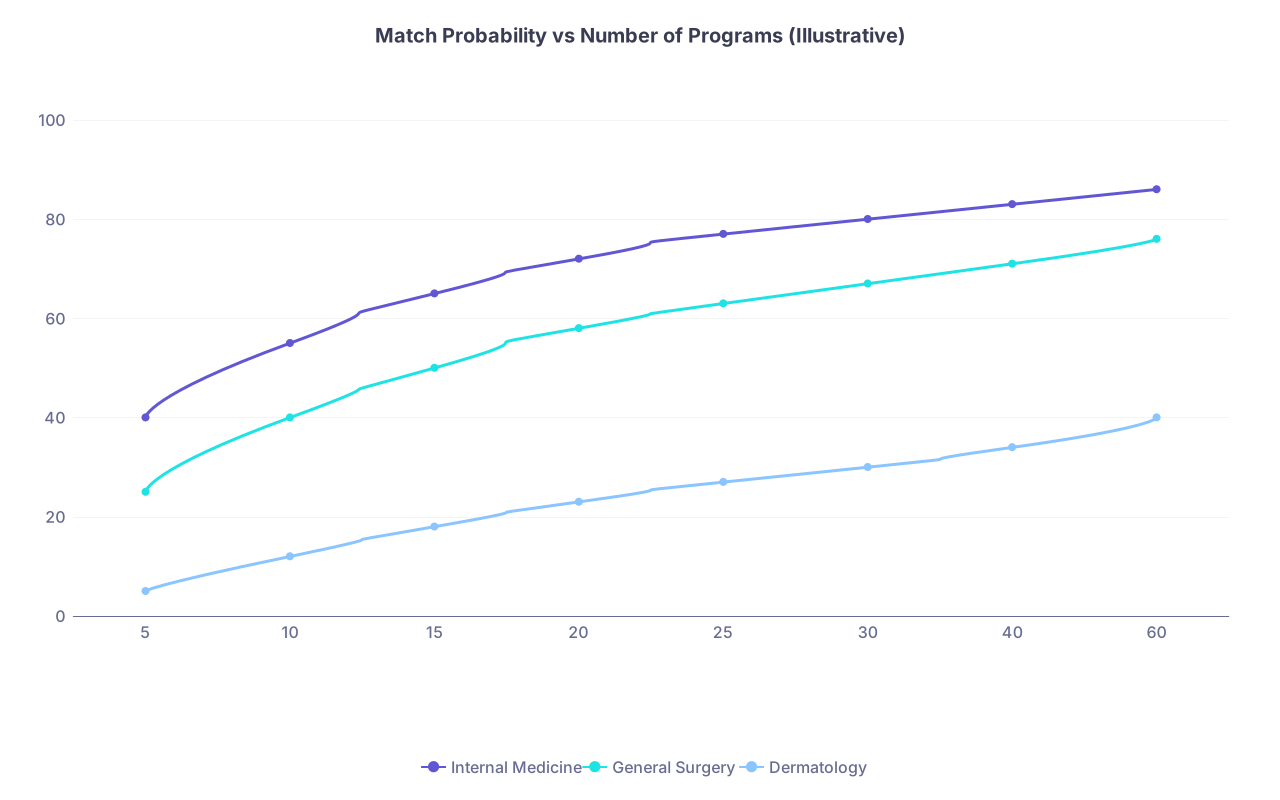
One of the most common—and anxiety-provoking—questions for Med-Peds applicants is: how many programs to apply to? There is no single right number, but you can make a rational decision based on your competitiveness and goals.
General Ranges for Med-Peds Applicants
Med-Peds is a smaller specialty, with far fewer programs than categorical Internal Medicine or Pediatrics. That alone changes your strategy.
Typical recommended ranges:
- Very strong applicant (high scores, honors, research, strong LORs, no red flags)
- 15–20 Med-Peds programs
- Solid applicant (average to slightly above-average metrics, good clinical feedback)
- 20–30 Med-Peds programs
- Applicant with red flags or concern about competitiveness (low scores, repeat year, etc.)
- 25–35+ Med-Peds programs, and strongly consider a “parallel plan” (e.g., applying to categorical IM and/or Pediatrics as well)
As a DO graduate, you should generally:
- Add 5–10 more programs than a similarly situated MD applicant would, unless your profile is very strong and you’re targeting clearly DO-friendly institutions.
Adjusting Numbers Based on Your Profile
Build your program selection strategy using these levers:
Academic Strength
- Higher scores and honors in IM and Peds → fewer applications may be needed
- Board failures or low scores → increase your list; cast a wider geographic net
Geographic Flexibility
- Willing to train in any region → you can focus more on fit and less on absolute number
- Strict geographic limits (e.g., “only Northeast” or “only Pacific Northwest”) → you must apply to a larger proportion of programs in that region and often raise your total number
Type of Program
- Only academic university-based programs: fewer total programs exist; you may need to widen geography or increase total applications
- Willing to consider academic, community, and “hybrid” programs: you’ll have more options and often stronger match safety
Parallel Planning
Many Med-Peds applicants, especially DOs, consider a parallel plan:
- Med-Peds + Categorical Internal Medicine
- Med-Peds + Categorical Pediatrics
- Med-Peds + both IM and Peds (for those very risk-averse)
If you parallel plan, your overall application volume will be higher, but your Med-Peds list might remain in the 15–30 range while you add additional categorical programs for security.
Practical Example: Three Hypothetical DO Applicants
Applicant A (Strong DO Profile)
- COMLEX Level 2: 640, USMLE Step 2 CK: 247
- Honors in IM and Peds; research project in transitional care
- Strong LORs including from a Med-Peds faculty
- Flexible geography
Strategy:
- Apply to ~18–22 Med-Peds programs
- List includes a mix of academic and hybrid programs, with some top-tier university programs
- No categorical backup needed if personal risk tolerance is moderate
Applicant B (Average DO Profile)
- COMLEX Level 2: 575, Step 2 CK: 234
- Mostly high passes; good clinical comments
- No major red flags, but no Med-Peds LOR
- Prefers Midwest and Southeast
Strategy:
- Apply to ~22–28 Med-Peds programs
- Ensure most have DO residents and explicitly accept COMLEX
- Strongly consider adding 6–10 categorical IM or Peds programs as a parallel plan
Applicant C (Challenging DO Profile)
- COMLEX Level 2: 520, no USMLE
- One repeat on COMLEX Level 1
- Solid recent clinical performance, improved trajectory
- Wants to stay within one region (e.g., Northeast only) for family reasons
Strategy:
- Apply to nearly all DO-friendly Med-Peds programs in the target region and possibly beyond (~25–35)
- Consider widening geographic scope if possible, or adding a robust list of categorical IM and/or Peds programs
- Target programs with history of taking DOs and documented holistic review
Building a Tiered, Data-Driven Program List
Once you know roughly how many programs to apply to, you need to decide which programs. A strong program selection strategy for the medicine pediatrics match uses a tiered, data-informed approach.
Step 1: Clarify Your Personal and Professional Priorities
Before browsing program websites, ask yourself:
- Do you prefer an academic environment with heavy exposure to subspecialists and research?
- Are you drawn to community-oriented practice, underserved populations, or primary care?
- Is geography (family, partner, cost of living, climate) a non-negotiable?
- Do you plan to:
- Practice combined Med-Peds primary care?
- Work as a hospitalist (adult, pediatric, or combined)?
- Pursue fellowship (e.g., adult cards, peds heme/onc, ID, endocrine)?
- Work in global health or public health?
Med-Peds programs vary widely in strength across these domains, and your future career goals should shape your list.
Step 2: Use Available Data Sources
Useful resources for the osteopathic residency match in Med-Peds include:
- Program websites and resident rosters
- Look for DO residents and Med-Peds-specific curriculum
- FREIDA and official ACGME program pages
- Number of residents per year, board pass rates, scholarly activity
- NRMP/Charting Outcomes reports (for Med-Peds, IM, Peds)
- Trends in scores and match rates for DO vs MD
- Med-Peds specific groups and forums
- National Med-Peds Residents’ Association (NMPRA) resources
- Online forums (with caution—use them as qualitative data, not gospel)
Step 3: Categorize Programs into Tiers
Create your own 3-tier system:
Reach Programs
- More competitive based on scores, reputation, and research profile
- Often large university or quaternary-care hospital programs
- You may be slightly below or at the lower end of their historical metrics
Target Programs
- Programs where your metrics and experiences match well with current residents
- Often mix of academic and hybrid institutions
- You see evidence of DO residents and DO-friendly culture
Safety Programs
- Programs that have repeatedly matched applicants with similar or lower metrics
- Often community or smaller academic affiliates
- Strong DO presence; explicit acceptance of COMLEX-only candidates
For a balanced list of 24 Med-Peds programs, you might aim for:
- 5–7 Reach
- 10–12 Target
- 5–7 Safety
Adjust those numbers based on your risk tolerance and the strength of your profile.
Step 4: Evaluate DO-Friendliness and Fit
To refine your list, consider:
- DO representation: How many DOs are currently in the program?
- COMLEX policies: Do they state “COMLEX accepted” clearly, or list it only as “considered”?
- Osteopathic recognition: Some institutions have osteopathic recognition tracks or osteopathic faculty; this can support your professional identity.
- Culture and size: Small, close-knit vs large, high-volume; structured vs flexible curriculum.
If you’re unsure about DO-friendliness, you can:
- Email the program coordinator: politely ask if they accept COMLEX-only scores and how often they match DOs.
- Attend virtual or in-person open houses to sense culture and ask about current DO residents.

Strategic Considerations Unique to Med-Peds for DO Graduates
Med-Peds training spans both Internal Medicine and Pediatrics, so your program selection strategy must account for what you want from each side of the combined curriculum.
Balance of Internal Medicine and Pediatrics Strength
Programs differ in how “strong” each side is:
- Some are anchored in powerhouse adult medicine departments but have smaller pediatric hospitals.
- Others sit within world-class children’s hospitals but more modest adult medicine departments.
- A few have top-tier strength on both sides.
Consider:
- If you see yourself more in adult subspecialty fellowship, a robust Internal Medicine side may matter more.
- If you anticipate pediatric fellowship or complex pediatric care, you may prioritize renowned children’s hospitals.
- If you want broad, combined community practice, the exact level of tertiary complexity may matter less than well-rounded training and strong outpatient experiences.
Continuity Clinic Structure and Combined Identity
Med-Peds identity is reinforced in the outpatient setting:
- How many Med-Peds continuity clinics will you have?
- Are clinics combined (seeing both adults and kids in same half-day) or separated?
- Is there dedicated Med-Peds faculty mentorship?
- How many Med-Peds residents per class (critical mass for community and support)?
Programs with robust Med-Peds identity often:
- Have formal Med-Peds conferences
- Offer Med-Peds-specific leadership roles
- Encourage Med-Peds-focused quality improvement or research
Fellowship and Career Outcomes
Even if you’re not certain you’ll pursue fellowship, it’s smart to consider:
- What fellowships do graduates enter (adult, pediatric, combined tracks)?
- Are there strong mentors on both sides who have helped trainees match into competitive fellowships?
- For those who practice combined primary care or hospitalist medicine, where are they now? Urban, rural, academic, community?
As a DO graduate, if fellowship is a likely goal, look carefully at:
- How often the program’s DO grads (if any) match into fellowship
- Whether there is any informal “bias” in fellowship selection at that institution
Practical Steps to Implement Your Program Selection Strategy
Finally, turn all of this into an actionable plan.
Step 1: Initial Broad List (40–60 Programs)
Start with:
- All Med-Peds programs in your preferred and secondary geographic regions
- Filter based on minimum criteria: DO acceptance, COMLEX vs USMLE requirements, any absolute dealbreakers (e.g., call structure, location, visa issues if applicable)
From this broad list, quickly flag:
- Programs with clear DO representation
- Programs that align with your career interests (primary care, hospitalist, fellowship)
Step 2: Deeper Research and Tiering
For each program on your shortlist:
- Review websites for curriculum, call schedules, clinics, and scholarly opportunities
- Look at current residents’ backgrounds—schools, degrees (DO vs MD), interests
- Scan for any red or green flags (e.g., repeated resident attrition, or exceptional support structures)
Then assign each program to Reach, Target, or Safety tiers. Be honest; err on the conservative side.
Step 3: Final List and Application Volume
From your tiered list:
- Trim to your target total number of applications (e.g., 20–30 Med-Peds programs)
- Ensure a healthy distribution across tiers
- Double-check DO-friendliness and any application quirks (extra essays, early deadlines)
If you’re also applying to categorical Internal Medicine or Pediatrics, decide:
- Which programs you’d attend only for Med-Peds vs those where IM or Peds alone would still be acceptable
- How to rank them later based on your true preferences, not fear
Step 4: Align Your Application with Your Strategy
Your personal statement, experiences, and activity descriptions should:
- Clearly articulate why Med-Peds (not just “I like both adults and kids”)
- Highlight experiences that demonstrate adaptability, long-term relationships with patients, and interest in transitions of care
- Show understanding of Med-Peds career paths (primary care, complex care, hospital medicine, global health, etc.)
As a DO, you might also:
- Briefly and confidently acknowledge your osteopathic training and what it brings: holistic approach, strong musculoskeletal exam skills, focus on patient-centered care
- Consider a short, well-crafted secondary statement or paragraph for programs that ask specifically about your background or dual interests
FAQs: Program Selection Strategy for DO Graduates in Med-Peds
1. As a DO, do I need to take USMLE to be competitive for Med-Peds?
You can match into a Med-Peds residency with COMLEX-only scores, especially at programs that explicitly accept COMLEX and have a history of matching DO residents. However, having USMLE Step 2 CK can significantly widen your options, particularly among academic university programs that historically lean on USMLE for screening. If you have not taken USMLE and are early enough in training, discuss with your advisor whether taking Step 2 CK aligns with your goals and realistic preparation timeline.
2. How many Med-Peds programs should I apply to if I’m only willing to live in one region?
If you are geographically constrained (for example, you must stay in the Midwest or Northeast), you should:
- Apply to most or all DO-friendly Med-Peds programs in that region, and
- Increase your total number of applications within that region (often 25–35) if you have any academic concerns.
Because Med-Peds programs are relatively few and small, narrow geographic preferences inherently increase risk. In such cases, a parallel plan with categorical Internal Medicine and/or Pediatrics in the same region becomes especially important.
3. Should I apply to both Med-Peds and categorical programs at the same institution?
Yes, in many cases this can be a very smart program selection strategy:
- Applying to Med-Peds plus the institution’s Internal Medicine and/or Pediatrics programs can:
- Demonstrate genuine commitment to that institution and city
- Provide a “safety net” if Med-Peds spots are limited
- However, be transparent if asked about your priorities, and think carefully about how you will structure your rank list later. Your final rank list should reflect where you’d actually be willing to train, not just where you could match.
4. Are community or hybrid Med-Peds programs worse for fellowship prospects as a DO?
Not necessarily. Many community or hybrid Med-Peds residencies have excellent fellowship match records, particularly when they:
- Are affiliated with strong tertiary-care centers
- Have engaged mentors in both Medicine and Pediatrics
- Support scholarly work, QI projects, and presentations at national conferences
As a DO graduate aiming for fellowship, you should:
- Look at specific fellowship outcomes of recent graduates (including DOs)
- Assess available mentorship, research time, and institutional reputation in your field of interest
A well-supported DO at a “less famous” but robustly structured program can often be more successful than a poorly supported resident at a big-name institution.
A thoughtful program selection strategy—grounded in realistic self-assessment, Med-Peds-specific priorities, and an understanding of how DO graduates are viewed—will help you build a list that maximizes your chances not just to match, but to match into a program where you will truly grow as a Medicine-Pediatrics physician.