Understanding the Unique Landscape of Medicine-Psychiatry for a DO Graduate
Medicine-Psychiatry (med psych residency, often called “Medicine-Psychiatry combined”) is a small, highly specialized niche. As a DO graduate, you are entering this space with some distinct advantages—robust training in holistic care, musculoskeletal medicine, and often a strong primary care orientation—but also some questions: How many programs to apply? How do you choose where to apply? What’s a solid program selection strategy specifically for a DO applicant in Medicine-Psychiatry?
Program selection is not just about maximizing your chances to match; it’s about finding training environments that fit your long-term goals and where you will truly thrive. Because combined Medicine-Psychiatry programs are few and relatively competitive, your osteopathic residency match strategy must be more intentional than the average categorical Internal Medicine or Psychiatry applicant.
In this article, we’ll walk through a step-by-step, practical strategy you can use to build and refine your med psych residency program list—from defining your goals, to understanding data, to deciding how many programs to apply to as a DO graduate.
Step 1: Clarify Your Career Vision and Personal Priorities
Before you open a single program website, get clear on what you actually want from a Medicine-Psychiatry combined residency. Your answers will directly drive your program selection strategy.
Clarify your long-term career goals
Ask yourself:
Do you see yourself primarily in:
- Academic medicine (teaching, research, leadership)?
- Safety-net/community practice?
- Integrated care (FQHCs, VA, collaborative care models)?
- Consultation-liaison psychiatry or psychosomatic medicine?
- Addiction, geriatric psychiatry, or primary care for patients with severe mental illness?
How do you imagine splitting your time after training?
- Mostly internal medicine with some psychiatry?
- Mostly psychiatry with some internal medicine?
- Truly dual-practice (50/50 or close)?
Are you considering fellowship training?
- Psych (CL, addiction, geriatric, forensics, child and adolescent)
- Medicine (cardiology, hospitalist tracks, palliative, ID, etc.)
- Or combined/behavioral health leadership roles?
Med psych residency programs vary widely: some are more medicine-heavy and hospitalist-oriented; others emphasize chronic psychiatric illnesses in complex medical patients, integrated care clinics, or academic psychiatry. You want programs aligned with your likely post-residency path.
Define your personal and geographic priorities
Rank your personal constraints and preferences:
- Geography
- Must be in or near a specific city/region?
- Open to moving away for 5 years?
- Proximity to partner/family/support system?
- Lifestyle and cost-of-living
- Coastal urban centers vs. mid-sized, affordable cities?
- Will you be the primary income earner or supporting a family?
- Program size and culture
- Do you prefer smaller, close-knit programs or large academic centers?
- Need strong mental health support and wellness structures?
- Diversity and inclusion environment important to you?
Write down:
- Your non-negotiables (e.g., must be within 2 hours of family, or must sponsor visas).
- Your strong preferences (e.g., urban setting, academic reputation).
- Your flexible “nice-to-haves” (e.g., specific research niche).
You’ll use this list as a filter once you start researching programs.
Step 2: Understand the Medicine-Psychiatry Combined Training Landscape
The medicine psychiatry combined pathway is small compared with categorical residencies. That has major implications for how to choose residency programs and how many programs to apply to.
Key features of med psych residency programs
Most Medicine-Psychiatry programs:
- Are 5-year combined residencies, leading to eligibility for dual board certification (Internal Medicine and Psychiatry).
- Are based at academic medical centers or large teaching hospitals.
- Offer:
- Inpatient and outpatient internal medicine (general and subspecialty)
- Inpatient and outpatient psychiatry (general and subspecialty)
- Integrated Med-Psych units and consultation-liaison experiences
- Sometimes specialized tracks (addiction, primary care for SMI, VA integrated programs)
Because the number of programs is limited, your “universe” of potential med psych residency options is much smaller than for standard IM or Psych. That means you may reasonably aim to apply to almost all of them—then strategically supplement with categorical programs depending on your risk tolerance and application profile.
What this means for a DO graduate
As a DO applicant in the osteopathic residency match era (now unified ACGME system), you should be aware of:
- Program familiarity with DOs
- Some programs are historically DO-friendly, with current or recent DO residents and faculty.
- Others are primarily MD-heavy but still open to strong DO applicants.
- COMLEX vs. USMLE
- Many med psych programs accept COMLEX alone.
- Some still prefer or require USMLE scores, especially highly academic centers.
If you only have COMLEX, focus on programs that:
- Explicitly state they accept COMLEX only, or
- Feature current DO residents on their websites or social media.
If you have both COMLEX and USMLE, you’ll be eligible for a broader set of programs, including some that don’t list COMLEX information clearly.

Step 3: Realistic Self-Assessment as a DO Applicant
Your program selection strategy must be anchored in an honest appraisal of your competitiveness. This is not about discouragement; it’s about smart targeting.
Academic metrics
Consider:
- COMLEX Level 1 / Level 2-CE (and optionally USMLE Step 1 / Step 2 CK)
- Are your scores:
- Above average for your class?
- Roughly average?
- Below average or with a fail attempt?
- Are your scores:
- Clinical grades and class rank
- Honors in core clerkships (IM, Psych, FM, Surgery)?
- Any remediation?
For combined Medicine-Psychiatry residency, both Internal Medicine and Psychiatry departments will evaluate you. Strong performance in IM and Psych rotations, even at community hospitals, is a meaningful plus.
Clinical experience and letters of recommendation
Key strengths for a med psych residency application:
- Rotations in both IM and Psychiatry, ideally including:
- At least one sub-internship or acting internship in Internal Medicine.
- At least one advanced Psychiatry rotation (inpatient, C/L, ED psych, or specialized area).
- Letters of recommendation:
- At least 1 strong Internal Medicine letter (preferably from a core faculty or clerkship director).
- At least 1 strong Psychiatry letter.
- Ideally, 1 letter from someone who can speak directly to your fit for combined training (e.g., someone who has worked with Med-Psych residents, or a mentor in integrated care).
As a DO, additional strengths include:
- Any rotations at ACGME-accredited academic centers, especially where you worked with med psych, C/L, or integrated care teams.
- Evidence you’re comfortable working in large teaching hospitals, not only in community settings.
Personal attributes that programs value
Medicine-Psychiatry programs look for:
- Adaptability and resilience
- Strong interpersonal and communication skills
- Interest in complex, dual-diagnosis populations
- Comfort with ambiguity and chronic illness management
- Longitudinal commitment to underserved populations or mental health
If your CV highlights consistent work with patients who have both medical and psychiatric complexity, this directly strengthens your osteopathic residency match profile for med psych.
Perform a rough categorization of your candidacy:
- Highly competitive: Above-average scores, multiple honors, strong IM + Psych letters, research or meaningful scholarly work, strong narrative fit.
- Solid/average: Around-average scores, good clinical performance, at least one strong letter in each core discipline, some exposure to integrated care.
- Underdog: Lower scores or a fail, gaps or interruptions in training, fewer honors, but strong narrative, resilience, and meaningful clinical experiences.
Your category will help determine how many programs to apply to and how broad you should go geographically.
Step 4: Building a Targeted Program List
Now you’re ready to build your initial list of Medicine-Psychiatry combined programs and then refine it using a structured program selection strategy.
1. Start with the full list of Med-Psych programs
Use official and reliable sources:
- ACGME program search for combined Internal Medicine/Psychiatry.
- NRMP and individual program websites.
- Professional organizations and combined training sections (e.g., APA/ACP med-psych communities).
Export or copy the list into a spreadsheet with columns for:
- Program name
- City/State
- Institution type (university, university-affiliated community, VA-heavy, etc.)
- Number of med psych positions per year
- DO-friendly? (Yes / Maybe / Unknown)
- COMLEX accepted? (Y/N/Unknown)
- Geographic fit (High/Medium/Low)
- Your perceived competitiveness (Reach/Target/Safety)
- Notes (special tracks, integrated clinics, med psych units, etc.)
2. Preliminary DO-friendliness and COMLEX sorting
For each program, check:
- Current or recent DO residents listed on the website.
- Stated exam requirements:
- Explicit “DO applicants welcome”
- “USMLE required” vs. “USMLE or COMLEX accepted”
- Presence of DO faculty in IM or Psychiatry.
Color-code or label programs:
- Green – Clearly DO-friendly (current DO residents, COMLEX accepted).
- Yellow – Unclear DO-friendliness; no DOs evident, but no explicit restriction.
- Red – Strong preference for USMLE; explicit MD-only language (rare, but note if present).
As a DO graduate, you don’t have to avoid yellow programs, but make sure your application is otherwise strong if you apply there.
3. Match your goals and their strengths
Use your earlier career and personal priorities to assess fit:
Academic vs. community orientation
- If you want a career in academic medicine, prioritize programs with:
- Robust research opportunities
- Prior graduates in fellowship or faculty positions
- If you want community practice, programs with heavy community hospital and clinic exposure may be ideal.
- If you want a career in academic medicine, prioritize programs with:
Clinical emphasis
- Programs with well-defined med-psych units or strong C/L services are great if you’re interested in psychosomatic medicine or integrated inpatient care.
- Programs with robust outpatient integrated clinics, VA primary care-mental health integration, or special populations (addiction, SMI primary care) are ideal if you want to work in integrated or collaborative care models.
Geographic and lifestyle factors
- Cross off programs in locations that violate your true non-negotiables.
- Keep some “stretch” geographical options if your constraints are flexible.
At this stage, you might end up with:
- A “core” med psych list of 8–20 programs, depending on how many exist at the time and your preferences.
- Some programs flagged as top choice, strong fit, and acceptable fit.

Step 5: Deciding How Many Programs to Apply To (Med-Psych + Backup)
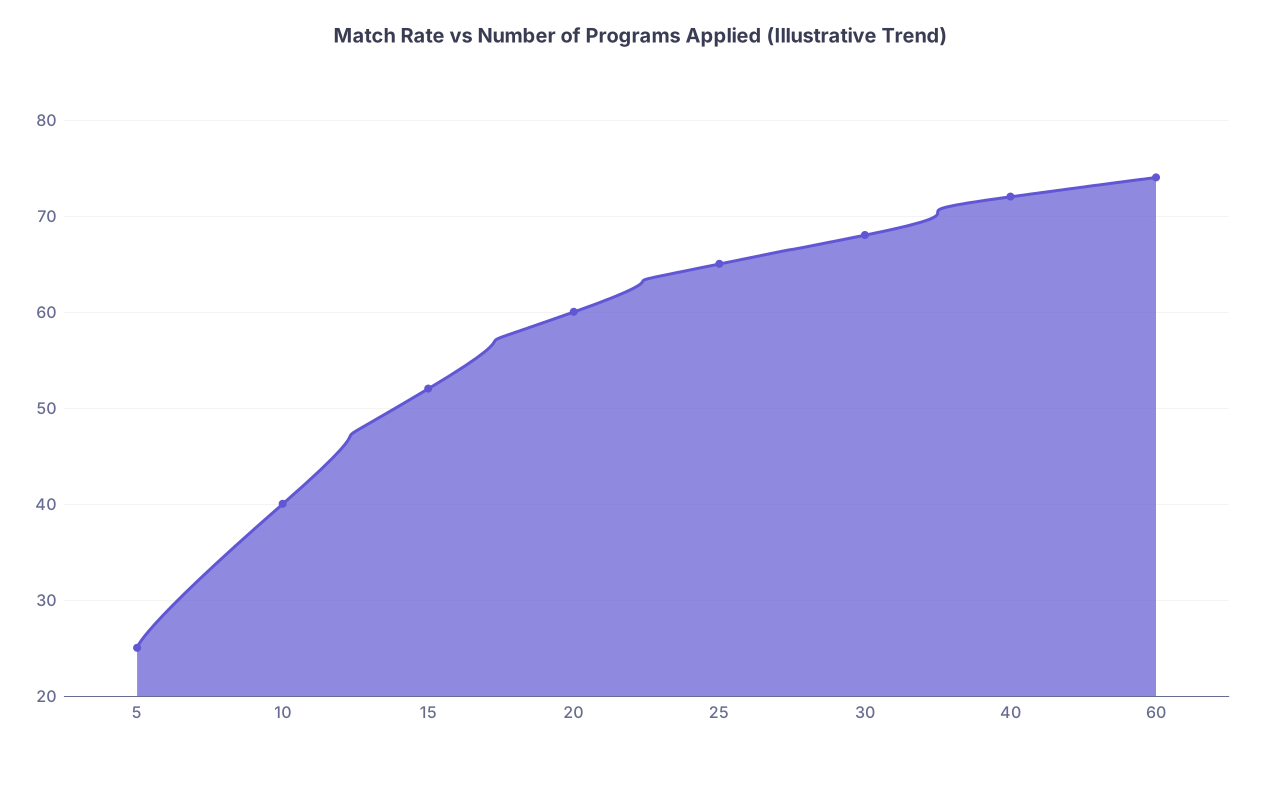
The question “how many programs to apply” is crucial in your category of HOW_MANY_PROGRAMS_SHOULD_YOU_APPLY_TO. For a DO graduate targeting Medicine-Psychiatry combined training, you need both a core med psych residency list and a thoughtful backup strategy.
Factors that determine your application volume
Your total number of applications should reflect:
- Your competitiveness (high, average, underdog).
- Risk tolerance:
- Is it “med psych or bust”?
- Or are you equally happy matching in IM or Psychiatry categorical programs and then building a combined career?
- Geographic flexibility:
- Wider geographic flexibility allows you to apply to more programs with less redundancy.
- Budget and time:
- ERAS fees increase with the number of programs.
- Interview time and travel (if not fully virtual) must be manageable.
General numerical guidelines for DO applicants in Medicine-Psychiatry
Because the total number of Medicine-Psychiatry programs is small, your numbers will be framed differently than for large specialties. As of recent cycles (approximate guidelines):
Core Medicine-Psychiatry combined programs
- If feasible, apply to nearly all med psych residency programs unless you truly would not attend certain ones.
- For most DO applicants, this means 10–20 combined programs, depending on the exact national count and your deal-breakers.
- Limit exclusions only for locations or settings you absolutely could not live or train in for 5 years.
Categorical backup programs Your backup strategy should balance Internal Medicine and Psychiatry according to your preferences:
If you’d be happy in either IM or Psych:
- Apply to 8–15 categorical Internal Medicine programs (mix of academic and community, heavily DO-friendly).
- Apply to 8–15 categorical Psychiatry programs with strong interest in integrated or C/L work.
If you strongly prefer Psychiatry as backup:
- Apply to 12–20 categorical Psychiatry programs.
- Add 6–10 Internal Medicine programs if you’d still consider IM.
If you strongly prefer Internal Medicine as backup:
- Apply to 12–20 categorical Internal Medicine programs (especially DO-friendly, hospitalist or primary care oriented).
- Add 6–10 Psychiatry programs to keep some flexibility.
Total application range for a typical DO med psych applicant:
- Low end (highly competitive, geographically flexible, willing to match categorical): ~30–40 total programs.
- Moderate (average candidate, some geographic preferences): ~40–60 total programs.
- High end (underdog metrics, strict geography, or “med psych or bust”): may approach 60–80 programs (including combined + categorical options), but be mindful of cost and interview manageability.
Practical example: Sample application portfolios
Example 1: Strong DO med psych applicant, flexible geography
- Med-Psych combined: 15 programs (almost all available)
- Categorical Psychiatry: 10 programs
- Categorical Internal Medicine: 10 programs
Total: 35
Example 2: Average DO applicant, wants to stay in Midwest/Northeast
- Med-Psych combined: 12 programs (filtered for region)
- Categorical Psychiatry: 15 DO-friendly programs
- Categorical Internal Medicine: 15 DO-friendly programs
Total: 42
Example 3: Underdog metrics, non-negotiable family location in one region
- Med-Psych combined: 8 programs in or near chosen region
- Categorical Psychiatry: 18 programs across academic and community settings in that region
- Categorical Internal Medicine: 18 programs in that same region
Total: 44 (plus possibly a few national virtual-only options)
Your final answer to “how many programs to apply” will depend on your specific constraints, but using this structured range prevents both under-applying and overextending yourself.
Step 6: Refining and Prioritizing Your List
With a preliminary list built, you now refine and prioritize based on deeper research.
Use a structured rating system
For each program—combined and categorical—rate them on a 1–5 scale in key domains:
- Fit with long-term goals (clinical exposure, subspecialty strengths, integrated care opportunities)
- DO-friendliness (history of DOs, COMLEX acceptance)
- Academic and fellowship opportunities
- Location and lifestyle
- Program culture and support
- Your competitiveness (your chances realistically)
Create an overall “priority score” (e.g., average of these domains, or weighted to what matters most to you). Flag:
- Tier 1: Top-choice programs (aim to strongly tailor your application to these).
- Tier 2: Solid fits where you’d be happy to train.
- Tier 3: Safety/backup programs you’d still be willing to attend.
Deep-dive research sources
Program websites
- Curriculum structure and med-psych integration.
- Med psych resident biographies (backgrounds, DO presence, interests).
- Research areas, fellowships, special clinics.
Virtual open houses / information sessions
- Ask directly about DOs, COMLEX, and combined training culture.
- Clarify any questions about how residents balance IM and Psychiatry responsibilities.
Current med psych residents and alumni
- Reach out politely via email or LinkedIn.
- Ask:
- How DO-friendly is the environment?
- What’s the day-to-day reality of med psych training there?
- How supportive are faculty from both departments?
Your school advisors and mentors
- Many DO schools now have graduates in integrated or combined roles.
- Ask if anyone from your school has matched to med psych or strong IM/Psych programs.
Tailor your application strategy
Once you’ve prioritized programs:
- For Tier 1 med psych programs:
- Strongly tailor your personal statement to highlight your passion for medicine psychiatry combined training.
- Emphasize integrated care experiences, dual-interest projects, and reflection on working with complex, comorbid populations.
- For categorical Psychiatry and IM programs:
- Adjust your narrative:
- In Psychiatry, highlight how your medicine skills strengthen your psychiatric care.
- In Internal Medicine, highlight your comfort with mental health and complex psychosocial presentations.
- Adjust your narrative:
This targeted approach shows programs you understand their mission while maintaining a coherent overall story about who you are as a DO graduate.
Step 7: Common Pitfalls in Program Selection (and How to Avoid Them)
Pitfall 1: Over-focusing on prestige
Highly prestigious academic centers can be attractive, but:
- They may have fewer DOs historically.
- They may not offer the specific integrated clinic or med-psych unit experience you want.
- Matching success depends less on “brand name” and more on program fit, mentorship, and how you’re supported.
Solution: Balance “reach” programs with DO-friendly institutions and strong community or VA-based programs that truly match your goals.
Pitfall 2: Underestimating categorical backup importance
Some applicants treat med psych residency as the only acceptable outcome—then apply to very few categorical programs. This is risky in a niche specialty.
Solution: Build a realistic plan B—either IM or Psychiatry (or both)—that you would genuinely be willing to pursue. Combined careers can be built from categorical training using additional fellowship or focused practice, even if you don’t match to a formal combined program.
Pitfall 3: Ignoring your personal constraints
It is tempting to say “I’ll go anywhere,” only to realize later that the financial, social, or family strain might be unsustainable.
Solution: Define your non-negotiables early and use them honestly—but also recognize that broadening your geographic scope by even one or two regions can significantly increase your match options.
Pitfall 4: Applying too broadly without strategy
Sending out 80+ applications without any structure leads to:
- ERAS fee overload.
- Interview offers from programs you never really wanted.
- Burnout during interview season.
Solution: Use a tiered, data-informed program selection strategy. Every program on your list should be one where you would realistically attend and which aligns to at least some of your goals.
FAQs: Program Selection Strategy for DO Graduates in Medicine-Psychiatry
1. As a DO applying to Medicine-Psychiatry, do I need USMLE scores or is COMLEX enough?
Many Medicine-Psychiatry programs accept COMLEX alone, especially those with a history of DO residents. However:
- Some highly academic programs strongly prefer or require USMLE.
- If you already have strong USMLE scores, this broadens your options.
- If you only have COMLEX, prioritize programs that explicitly state COMLEX is accepted and show evidence of DO residents.
If you’re early enough in your training and strongly committed to med psych residency at academic centers, taking USMLE Step 2 CK (if feasible and supported by your advisors) may be helpful—but it’s not mandatory at all programs.
2. How should I balance my applications between med psych combined and categorical IM/Psych?
Use a structure like this:
- Apply to as many Medicine-Psychiatry combined programs as reasonably fit your goals and geography, often 10–20.
- Then decide on a primary backup:
- If you’re more drawn to psychiatry: 12–20 categorical Psychiatry programs + 6–10 Internal Medicine.
- If more drawn to medicine: 12–20 Internal Medicine + 6–10 Psychiatry.
- If equally open to both: about 8–15 in each.
The exact numbers depend on your competitiveness and flexibility, but this framework ensures you’re not overly reliant on a small set of combined slots.
3. Are there specific experiences that make me stand out as a DO med psych applicant?
Yes. Particularly valuable experiences include:
- Longitudinal work with patients who have both serious mental illness and significant medical comorbidity (e.g., rotations or volunteer work in community mental health centers, VA, safety-net clinics).
- Work on consult-liaison psychiatry, integrated primary care/behavioral health teams, or med-psych units.
- Quality improvement or research projects related to:
- Depression management in chronic disease
- Substance use and medical outcomes
- Readmissions in patients with comorbid psychiatric illness
- Leadership roles in mental health or wellness initiatives at your school.
Highlight how your osteopathic training in whole-person care and biopsychosocial perspectives naturally extends into the medicine psychiatry combined model.
4. If I match categorical Internal Medicine or Psychiatry, can I still have a “med psych” style career?
Absolutely. Many physicians in integrated or psychosomatic roles are categorical graduates. Options include:
Psychiatry graduates:
- Consultation-liaison fellowship.
- Addiction or geriatric psychiatry with strong medical overlap.
- Working in collaborative care or integrated medical settings (VA, large systems, FQHCs).
Internal Medicine graduates:
- Developing expertise in managing patients with SMI in primary care.
- Hospitalist roles focusing on complex behavioral-health populations.
- Additional training or certificates in integrated care, addiction, or psychosomatic medicine.
While formal med psych residency provides structured dual board eligibility, a combined medicine-psychiatry style practice can still be built thoughtfully from categorical training.
By approaching your program selection strategy deliberately—clarifying your goals, realistically assessing your competitiveness as a DO graduate, understanding the unique med psych residency landscape, and deciding how many programs to apply to with intention—you greatly increase both your chances of matching and your odds of landing in a program that truly fits you.
Use your DO background as a strength: your training in whole-person, patient-centered care is exactly what Medicine-Psychiatry combined programs are looking for.