
Understanding the Ophthalmology Landscape as a DO Applicant
Ophthalmology is one of the most competitive specialties, and the residency match can feel especially intimidating for a DO graduate. As a DO, you may wonder:
- How many ophthalmology programs should you apply to?
- Do you have to approach program selection differently than MD applicants?
- What’s the best osteopathic residency match strategy in a specialty that historically favored MDs?
The reality: DO graduates can and do match successfully into ophthalmology every year—but success depends heavily on a deliberate, data-driven program selection strategy.
This article breaks down how to build a smart, personalized list of programs for the ophtho match, tailored specifically to DO applicants. You’ll learn:
- How to assess your competitiveness realistically
- How to identify DO-friendly ophthalmology residency programs
- How to choose residency programs based on your profile and priorities
- How many programs to apply to, with real-world ranges and decision points
- How to build a step-by-step application strategy that maximizes your match chances
Throughout, we’ll focus on the unique perspective of a DO graduate residency applicant navigating the ophthalmology match.
Step 1: Honestly Assess Your Competitiveness as a DO Ophthalmology Applicant
Before deciding how to choose residency programs or how many programs to apply to, you must understand where you stand in the ophtho applicant pool.
Key Competitiveness Factors in Ophthalmology
For both MD and DO applicants, ophthalmology programs typically focus on:
- Board scores (COMLEX and/or USMLE)
- Clinical performance (clerkship grades, honors, rotations)
- Ophthalmology-specific experiences (electives, sub-Is, away rotations)
- Research and scholarly activity (especially ophtho-related)
- Letters of recommendation (ideally from ophthalmologists)
- Personal fit and professionalism (interviews, MSPE, personal statement)
As a DO applicant, you have an additional consideration:
How you’ve demonstrated comparability to MD peers, particularly through USMLE scores, research, and home/away ophtho experiences.
Boards: COMLEX vs USMLE for DO Ophtho Applicants
Ophthalmology programs are more likely to be familiar with USMLE. Many will still consider COMLEX, but when stakes are high, you want as few barriers as possible.
- If you took USMLE Step 1 and/or Step 2 CK:
- This significantly broadens your accessible program pool.
- Strong scores can help minimize perceived bias against DOs.
- If you did not take USMLE:
- You’re not excluded, but you should focus on:
- Programs explicitly stating they accept or welcome COMLEX-only applicants.
- Programs with prior DO residents.
- Building a larger list for safety.
- You’re not excluded, but you should focus on:
Rough Competitiveness Benchmarks (Not Official Cutoffs)
These are broad, unofficial ranges that can help frame expectations:
Highly competitive profile
- USMLE Step 1 (if available) and/or Step 2 CK: typically ≥ 245–250+
- Strong COMLEX scores (e.g., Level 1 and 2 above national mean)
- One or more ophthalmology rotations with excellent evaluations
- Multiple ophtho-related research experiences, posters, or publications
- Strong letters from academic ophthalmologists
Moderately competitive profile
- USMLE scores maybe in the 235–245 range
- COMLEX scores around or a bit above the mean
- At least one ophtho rotation and some involvement in research or projects
- Good but not “superstar” letters
Less competitive profile / at-risk profile
- Below-average board scores, exam failures, or attempts
- Limited research or no ophtho-specific scholarly work
- Few direct ophtho experiences
- Application submitted late or with weaker letters
Your honest self-assessment drives your program selection strategy and the ultimate answer to how many programs to apply to in the ophtho match.
Step 2: Understand DO-Specific Dynamics in Ophthalmology Program Selection
As a DO, you’re not just picking “good” programs—you’re picking programs likely to consider you seriously.
MD vs DO: Structural Realities in Ophthalmology
- Ophthalmology has historically been MD-dominated and highly competitive.
- Some programs have never taken a DO or have done so only rarely.
- Other programs consistently interview and match DOs and view them very favorably.
This doesn’t mean you should avoid highly academic programs, but it does mean:
You’ll get the best return on your application fees by prioritizing DO-friendly ophthalmology programs.
How to Identify DO-Friendly Ophthalmology Programs
Use multiple sources:
FREIDA, SF Match, and Program Websites
- Look for:
- Statements welcoming DOs
- Requirements mentioning COMLEX and/or USMLE
- Language such as “We welcome applications from DO graduates” or “We accept COMLEX scores.”
- Scan current residents:
- Are any DOs in the program?
- Are there recent DO graduates in the last 5–10 years?
- Look for:
Resident and Student Networking
- Talk to:
- DOs currently in ophthalmology residency
- Recent graduates of your DO school who matched into ophtho
- Ask directly:
- “Which programs were DO-friendly?”
- “Any programs that told you they don’t consider DOs?”
- Talk to:
Faculty Advisors and Ophthalmology Mentors
- Ask academic ophthalmologists (especially those who write your letters) if they know:
- Programs that have a history of taking DOs
- Programs that are more numbers-driven vs holistic
- Ask academic ophthalmologists (especially those who write your letters) if they know:
Institutional Culture Clues
- Programs at institutions with:
- A DO residency program in any specialty
- A history of integrating DO and MD trainees
often have a more inclusive mindset.
- Programs at institutions with:
Build a working list of DO-friendly programs as your foundation, then add others strategically based on your specific competitiveness and goals.

Step 3: Build Your Personal Criteria: What Matters Most to You?
An effective program selection strategy balances match probability with personal fit. Even in a competitive field like ophthalmology, you’re not just trying to match anywhere; you’re trying to match somewhere you can thrive.
Consider these core dimensions as you decide how to choose residency programs:
1. Geographic Priorities
Ask yourself:
- Do I have non-negotiable geographic needs?
- Family, partner’s job, health considerations, children’s schooling, visa issues?
- Am I willing to train anywhere for 3–4 years if it improves my chances?
Scenarios:
If you’re highly geographically restricted, you may need:
- More programs within your target region
- A strong parallel plan (e.g., preliminary year or backup specialty)
If you’re flexible, you can:
- Apply more broadly (especially beneficial for a DO applicant)
- Target DO-friendly programs across the country
2. Academic vs Community Orientation
Ophthalmology programs vary from highly academic to more community-based.
Academic-heavy programs
- Pros: Research, subspecialty exposure, fellowship connections
- Cons: Often more competitive; may prefer MDs, higher scores
Community-focused programs
- Pros: Often more DO-friendly, strong surgical volume, less research pressure
- Cons: Less emphasis on academic careers and research
As a DO applicant:
- If you have strong research and top board scores, you can confidently include more academic programs.
- If your portfolio is more clinically oriented, emphasize community and hybrid programs with a track record of training strong surgeons and taking DOs.
3. Program Size and Culture
Consider:
Program size (e.g., 2–6 residents per year)
- Smaller programs may be tight-knit but more competitive due to fewer positions.
- Larger programs may be more flexible and have more room for diverse backgrounds.
Culture and support
- Do residents seem happy?
- Are faculty approachable?
- Does the program value teaching, wellness, and mentorship?
While these are hard to gauge pre-interview, you can:
- Read resident bios
- Attend virtual open houses
- Ask your mentors for inside perspectives
4. Research Expectations and Your Career Goals
If you want a very academic career or highly competitive fellowship:
- Include programs known for strong research support.
- Prioritize institutions with active clinical or basic science ophthalmology research.
If you’re primarily interested in comprehensive practice or private practice:
- Surgical volume, autonomy, and practical training may matter more than publication counts.
Aligning your list with your long-term goals will help you feel satisfied with your match outcome, not just relieved.
Step 4: How Many Ophthalmology Programs Should a DO Graduate Apply To?
This is one of the most common and most anxiety-provoking questions: How many programs to apply to?
There is no single correct number, but we can define reasonable ranges for DO applicants, adjusted by competitiveness and risk tolerance.
General Guidance for DO Graduate Ophthalmology Applicants
Because ophthalmology is competitive and some programs remain hesitant about DOs, DO applicants typically benefit from applying more broadly than equivalent MD applicants.
Below are approximate ranges to help shape your program selection strategy:
If You Are a Highly Competitive DO Applicant
Profile:
- Strong USMLE (e.g., ≥245–250) and/or very strong COMLEX
- Robust ophtho research and strong letters
- Positive home and/or away ophtho rotations
Suggested range:
- 25–40 ophthalmology programs
Rationale:
- You have a realistic shot at many places, but as a DO, some programs may still be less familiar with your background.
- Applying broadly while being selective about fit (DO-friendly, geographic preferences, academic goals) is reasonable.
If You Are a Moderately Competitive DO Applicant (Most DO Applicants Fall Here)
Profile:
- Solid but not top-tier scores
- Some ophtho exposure and perhaps limited research
- Good letters, maybe 1–2 strong ophtho advocates
Suggested range:
- 40–60 ophthalmology programs
Rationale:
- You may be competitive at many DO-friendly and mid-range academic/community programs.
- Applying to a wide set of DO-friendly programs across the country is essential to offset hidden biases and high overall competitiveness.
If You Are a Less Competitive / At-Risk DO Applicant
Profile:
- Below-average scores, exam attempts, or limited ophtho exposure
- Little or no research
- Mixed strength letters
Suggested range:
- 60–80+ ophthalmology programs, with a very strong parallel plan
Rationale:
- You’ll need to cast a very wide net.
- You should simultaneously:
- Strengthen your file where possible (late research, strong personal statement, targeted away rotation if time allows).
- Pursue a carefully chosen backup specialty to ensure you match into something.
Financial and Time Considerations
Application fees and the time needed to tailor materials are real constraints. Strategies to manage them:
- Prioritize:
- Programs that accept DOs and/or COMLEX
- Programs with DOs currently in or recently graduated
- De-prioritize:
- Programs with explicit or de facto “MD only” patterns (no DOs ever, no mention of COMLEX, known historical bias)
- Use a tiered list (see next section) so if you reach your financial limit, you’ve at least ensured coverage across high-yield targets.
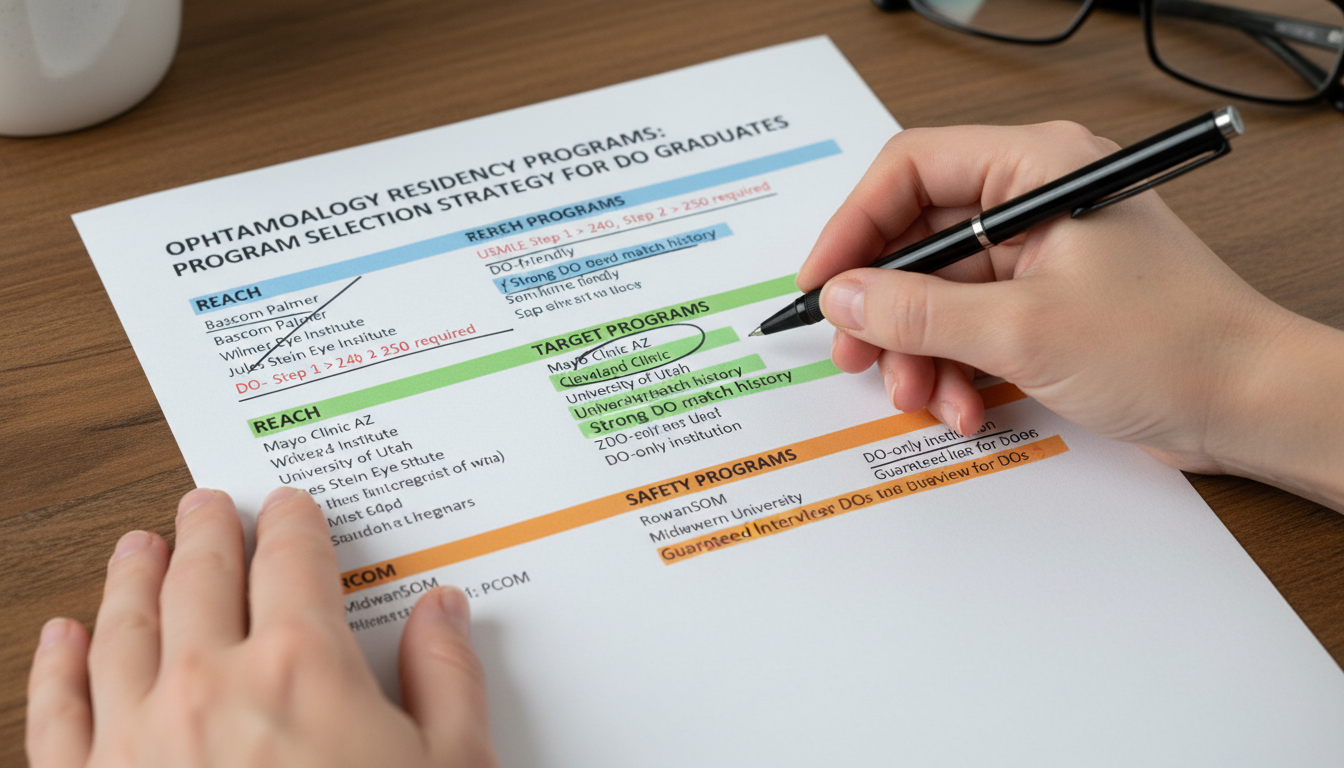
Step 5: Create a Tiered Program List (Reach, Target, Safety)
To move from vague uncertainty to a clear program selection strategy, organize your list into three tiers:
- Reach programs
- Target programs
- Safety (or safer) programs
1. Reach Programs
Characteristics:
- Highly competitive, research-heavy, or prestige-driven
- Historically match top-of-the-class applicants
- May not have a clear track record of taking DOs
For a DO applicant:
- Choose reach programs strategically, not emotionally.
- Examples:
- Programs at top-tier academic centers where your mentors have direct connections.
- Places you dream about but understand are a long shot.
Suggested proportion:
- 15–25% of your list
- You want aspirational options, but not at the expense of more realistic choices.
2. Target Programs
Characteristics:
- You match their typical profile in scores, research, and clinical performance.
- They are DO-friendly or at least DO-neutral.
- Your advisors/mentors agree you’re a solid match.
For a DO applicant:
- This is the core of your strategy.
- Programs where:
- Current residents include DOs, or program mentions DOs explicitly
- They accept COMLEX, especially if you don’t have USMLE
- Geography and program structure make sense for your life
Suggested proportion:
- 50–60% of your list
- This is where most of your interview invites and eventual rank list will likely come from.
3. Safety (or Safer) Programs
No program in ophthalmology is truly “safe,” but some are relatively more attainable for you based on prior DO matches and your academic profile.
Characteristics:
- Regularly match DOs or applicants with similar scores
- May be in less competitive geographic areas
- Often community or hybrid programs rather than ultra-academic
For a DO applicant:
- These programs are crucial for building a stable match floor.
Suggested proportion:
- 20–30% of your list, especially if you’re not in the highly competitive category.
Step 6: Timing, Away Rotations, and Letters—Linking Strategy to Reality
Your program selection strategy should integrate with your broader ophtho match plan.
Away Rotations and Their Strategic Role
Away rotations in ophthalmology are often critical, especially for DO applicants.
Use away rotations to:
- Showcase your clinical skills and work ethic
- Earn strong letters from academic ophthalmologists
- Demonstrate that you can perform at the same level as MD peers
- Signal serious interest in specific programs or geographic regions
Strategic tips:
- Target at least one DO-friendly academic ophthalmology department for an away if possible.
- If you have a specific city or region you’d like to match in, try to rotate at a program nearby. Even if you don’t match there, faculty may advocate for you locally.
Letters of Recommendation and Program List Alignment
You’ll likely have 2–3 strong letters from ophthalmologists. Build and prioritize your list around:
- Programs where your letter writers have direct connections or prior trainees.
- Institutions or regions where your letter writers can send targeted emails on your behalf.
A strong letter + a personal email from your letter writer can meaningfully increase your odds of being noticed at certain programs.
Early, Organized Application Submission
For a competitive specialty like ophthalmology:
- Aim to have your personal statement, CV, and letters finalized as early as the system allows.
- Ophthalmology programs may start screening early—late applications can be a disadvantage.
Combine early timing with a well-researched list to get the most out of each application you submit.
Step 7: Backup Planning and Risk Management for DO Applicants
Even with a strong program selection strategy, ophthalmology remains a risk. DO applicants should be especially intentional about backup plans.
Parallel Planning: Preliminary/Transitional Year vs Backup Specialty
Typical approaches:
Preliminary/Transitional Year only (if you’re confident):
- Apply broadly to prelim medicine, prelim surgery, or transitional years plus ophtho.
- Higher risk if your ophtho profile is not strong.
Backup specialty + ophthalmology:
- Choose a second specialty that you genuinely could see yourself in.
- Apply competitively to that specialty alongside ophthalmology.
- This is often the safer strategy for moderately competitive or at-risk DO applicants.
When to Consider Strengthening Your Application First
Some DO applicants may benefit from:
- A dedicated research year in ophthalmology
- A postgraduate year (PGY-1) followed by a reapplication with a stronger portfolio
- Additional USMLE exam attempt (if not already taken and if still allowed)
This can be especially relevant if:
- You learned about ophthalmology late
- You had early academic struggles but are now improving
- You want a more competitive shot at academic ophtho programs
Discuss these options with advisors who know both your record and the ophthalmology landscape.
Putting It All Together: A Sample Strategy for a DO Ophthalmology Applicant
To make this concrete, consider an example profile:
- DO graduate with COMLEX above average, USMLE Step 2 CK 238
- One ophtho elective at home institution, one away at a DO-friendly academic center
- One ophtho poster and one case report
- Three strong letters: two ophtho attendings (one academic, one private), one IM chair
A reasonable program selection strategy might be:
- Apply to ~50 ophthalmology programs
- 10–12 reach (strong academic centers, a few with weaker DO track record but mentor connections)
- 25–30 target (mix of academic and community-based programs with DO-friendly history)
- 10–15 safer programs (more community-, hybrid-, or regionally focused programs with DOs in their recent classes)
- Apply concurrently to a backup specialty (e.g., internal medicine or neurology) with:
- 15–25 programs appropriate to your competitiveness
- Select away rotations intentionally at:
- One institution with a history of matching DOs
- One in your preferred region
This balance allows a realistic shot at matching ophthalmology while reducing the risk of going unmatched altogether.
FAQs: Program Selection Strategy for DO Graduates in Ophthalmology
1. Do I need to take USMLE as a DO to match into ophthalmology?
You can match ophtho with COMLEX only, but taking USMLE significantly expands your options. Many ophthalmology residency programs:
- Are more familiar with USMLE score interpretation
- May unofficially favor applicants with USMLE for easier comparison
If you’re early enough in your training and aiming for ophtho, USMLE Step 2 CK (at minimum) is strongly recommended. If you’ve already committed to COMLEX-only, focus on DO-friendly programs and apply more broadly.
2. How can I quickly tell if a program is DO-friendly?
Look for these signs:
- Current or recent DO residents listed on the program website
- Clear statements that they accept COMLEX and/or welcome DO applicants
- Word of mouth from DO upperclassmen, alumni, or DO ophtho residents
- Historically, presence of any AOA/osteopathic programs or affiliations within the same institution
If a program has never had a DO resident and does not mention COMLEX, it’s not necessarily off-limits—but it should probably be in your reach category, not your core target group.
3. As a DO, is it worth applying to very top-tier academic ophthalmology programs?
Yes—with realistic expectations and a balanced list.
- If you have top-tier scores, strong research, and powerful letters, you should absolutely apply to a select handful of top academic programs, especially where your mentors have connections.
- But these should not dominate your list. For most DO applicants, 15–25% reach programs is a healthy upper limit.
Always counterbalance with plenty of DO-friendly target and safer programs.
4. What’s the biggest mistake DO applicants make when choosing ophthalmology programs?
Common pitfalls include:
- Applying too narrowly—limiting to just a few regions or mostly prestige programs.
- Ignoring DO-friendliness—wasting applications on programs that rarely or never consider DOs.
- Underestimating the need for a backup plan—especially for mid- or lower-tier profiles.
- Waiting too long to organize letters, away rotations, and applications.
A structured approach—honest self-assessment, DO-friendly prioritization, broad but targeted applications, and a realistic backup—gives you your best shot at a successful osteopathic residency match in ophthalmology.
By combining an honest look at your credentials, a DO-conscious program selection strategy, and a clear understanding of how many programs to apply to based on your competitiveness, you can approach the ophthalmology match with intention instead of guesswork.