Understanding the Unique Position of DO Graduates in Preliminary Medicine
As a DO graduate considering a Preliminary Medicine year, you’re navigating several overlapping decisions at once:
- How to choose residency programs that fit both your credentials and long-term goals
- How many programs to apply to in a highly variable and often misunderstood pathway
- How your osteopathic background, COMLEX scores, and potential USMLE scores factor into your osteopathic residency match or ACGME match strategy
- Whether to pursue prelim IM only, or prelim IM plus categorical Internal Medicine or another specialty
A Preliminary Medicine year (prelim IM) is a one‑year, non-categorical internal medicine position. Common reasons DO graduates pursue a prelim year include:
- As a required clinical year for advanced specialties (e.g., Neurology, Anesthesiology, Radiology, PM&R, Dermatology)
- As a bridge year when you’re reapplying to another specialty
- To strengthen US clinical experience or letters of recommendation
- As a way to stay clinically active while exploring options
The challenge: prelim medicine positions are not all the same. Some are designed primarily to support advanced programs; others are more resident‑friendly and educationally robust. Your program selection strategy—and especially understanding how many programs to apply to—will heavily influence your match outcome and the quality of your eventual year.
This guide breaks down a systematic way to build your list, assess competitiveness as a DO graduate, and create a realistic yet ambitious application strategy.
Step 1: Clarify Your Goals for the Preliminary Medicine Year
Before you can refine a program list, you must be clear on why you’re doing a prelim IM year. Your program selection strategy will differ depending on your primary objective.
Common Goal Scenarios
You matched (or plan to match) into an advanced specialty requiring a prelim year.
- Example: Anesthesiology (PGY‑2) position starting 2027; you need a PGY‑1 prelim medicine year.
- Priority: Location coordination, schedule compatibility, reasonable workload, adequate but not necessarily intensive internal medicine training.
You did not match into your desired specialty and need a bridge year.
- Example: Reapplying to Dermatology, Radiology, or Orthopedics.
- Priority: Strong internal medicine training, access to research, letters of recommendation, exposure to your target specialty, mentorship, and time for interviews.
You’re considering eventual transition into categorical Internal Medicine.
- Priority: Programs open to converting prelim residents into categorical positions, strong teaching culture, good fellowship placements, and a balanced call schedule.
You’re still undecided but want a solid clinical year while figuring it out.
- Priority: Broad exposure, supportive environment, minimal toxic culture, flexibility to explore interests.
Your goal will determine:
- The types of hospitals you prioritize (academic vs. community)
- How much you care about research vs. lifestyle vs. location
- Whether you should dual‑apply (e.g., advanced specialty + prelim medicine, or prelim IM + categorical IM)
Write a one‑paragraph personal mission statement for your prelim year. Example:
“As a DO graduate planning to reapply to Neurology, my prelim IM year should provide strong inpatient medicine experience, supportive faculty for letters, and enough flexibility for interviews while remaining in the same state where I hope to match for my advanced specialty.”
Use this as a north star when choosing programs.
Step 2: Know Where You Stand as a DO Graduate
Your competitiveness as a DO graduate in the osteopathic residency match and ACGME match environment will shape not just which programs to target, but how many programs to apply to.
Key factors:
- COMLEX scores (and USMLE if taken)
- Clinical performance and class rank (if available)
- MSPE and letters of recommendation
- Red flags (failed attempts, extended time, professionalism issues)
- Visa status (if applicable)
- Geographic preferences or limitations
Understanding DO-Specific Dynamics
COMLEX vs. USMLE
- Many internal medicine programs are now more accustomed to COMLEX-only applicants, but policies vary.
- Some still prefer or require USMLE scores. Check program websites carefully.
Program “DO-friendliness”
- Programs with a consistent history of DO residents in either categorical IM or prelim IM are generally lower risk for you.
- Use residency data (freida, program websites, Doximity, etc.) and resident lists to identify DO representation.
Score Tiering (Approximate)
While scores are only one part of your application, they influence where you’re likely to be competitive:Highly Competitive DO Applicant (Upper Tier)
- COMLEX Level 1: ≥ 600, Level 2: ≥ 600 (or USMLE Step 1 pass, Step 2 CK ≥ 245)
- Strong clinical grades, no red flags
- May be competitive at mid to upper‑tier prelim IM programs and many academic centers.
Moderately Competitive DO Applicant (Middle Tier)
- COMLEX Level 1: ~525–595, Level 2: 525–595 (or Step 2 CK ~230–245)
- Solid but not outstanding academic record
- Suitable for a broad mix of academic-community hybrids and strong community programs.
More Vulnerable or At-Risk DO Applicant (Lower Tier)
- COMLEX Level 1: < 520, Level 2: < 520; failed attempt(s); or other application concerns
- Should focus on community programs and DO-friendly institutions, and apply more broadly in volume.
Your program selection strategy must be honest about where you fit. Overreaching or underapplying are common reasons DO graduates struggle in the osteopathic residency match landscape—especially in prelim medicine where applicants sometimes underestimate competition.

Step 3: Building a Smart Program List for Preliminary Medicine
Once you understand your goals and competitiveness, it’s time to decide how to choose residency programs for your prelim IM list.
3.1 Academic vs. Community vs. Hybrid Programs
Consider the benefits and trade-offs:
Academic Medical Centers (University Hospitals)
- Pros:
- Strong teaching, subspecialty exposure, research, and name recognition
- Better if you’re reapplying to a competitive specialty or planning academic career
- Cons:
- Often heavier workload, more call, higher acuity
- May be more competitive for DO applicants and may prefer categorical residents over prelims
Community Hospitals
- Pros:
- Often more DO-friendly
- Sometimes better quality of life, collegial environment
- Good clinical training, more responsibility early on
- Cons:
- Less research, fewer subspecialty services
- Reputation may matter in future academic or highly competitive applications
Hybrid (Community-based University-Affiliated Programs)
- Pros:
- Best of both worlds: decent research, good teaching, and often DO-friendly
- Reasonable workload and support
- Cons:
- Highly variable program to program
For DO graduates, a balanced list across these categories is often safest.
3.2 Evaluating Programs for Fit
Use the following checklist:
DO-Friendliness & COMLEX Acceptance
- Does the current or recent resident roster include DOs?
- Does the website explicitly say “COMLEX accepted”?
Prelim-Specific Structure
- Do prelim residents share the same rotations and conferences as categorical IM residents?
- Is there dedicated orientation and mentorship for prelims?
- Are prelims integrated or treated like “extra coverage”?
Workload, Call, and Schedule
- Q4 vs. night float vs. 24-hour calls?
- Culture around duty hours and wellness
- Any known reputation for malignant or supportive environment?
Geographic and Personal Factors
- Proximity to family/partner or to your advanced program
- Cost of living and commute
- State licensure considerations (if reapplying to competitive specialties)
Opportunities for Letters and Growth
- Accessibility of faculty mentors
- Research or QI projects
- Track record of prelim graduates successfully matching into competitive or advanced fields
3.3 Categorizing Programs into Tiers
A helpful program selection strategy is to place programs into three tiers based on your perceived fit and competitiveness:
- Reach Programs:
- More competitive academic centers, top‑tier locations, or programs with limited DO representation.
- Target Programs:
- Programs where your stats and profile are well‑aligned with typical residents.
- Safety Programs:
- Programs with strong DO presence, slightly lower average scores, or less desirable locations but still solid training.
Aim for a pyramid-shaped list: a few reach, a larger number of target, and a strong base of safety programs.
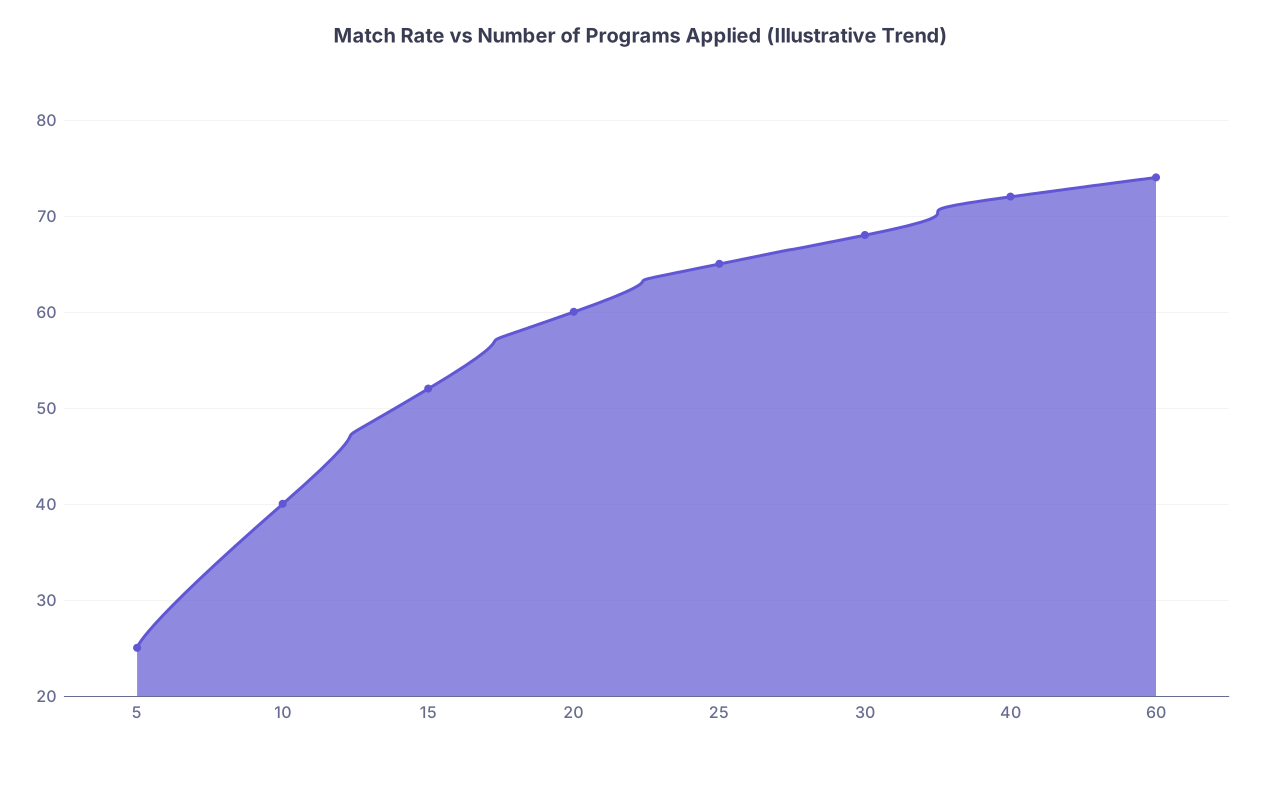
Step 4: How Many Programs to Apply to for a Prelim Medicine Year
This is the central tactical question: how many programs to apply to, specifically for a DO graduate seeking a Preliminary Medicine position.
Factors That Affect Application Volume
- Your competitiveness (scores, CV, red flags)
- Whether you are dual-applying (e.g., advanced specialty + prelim IM)
- Whether you also applied to categorical IM as a backup
- Geographic restrictions (e.g., tied to spouse’s job, visa limitations)
- Budget constraints
Suggested Ranges for DO Graduates in Prelim IM
These ranges are general guidance, not guarantees, and assume you are applying primarily for prelim IM (with or without an advanced position already secured):
Highly Competitive DO Applicant (Upper Tier)
- Goals: Prelim IM in specific geographic regions or at higher‑tier programs
- Typical Range: 15–25 prelim IM programs
- If you already hold a secured advanced PGY‑2 position:
- You can be somewhat selective, focusing on location and schedule fit.
- If you are reapplying to a competitive specialty:
- Consider toward the upper end of the range (20–25) emphasizing DO‑friendly academic and hybrid programs.
Moderately Competitive DO Applicant (Middle Tier)
- Typical Range: 25–40 prelim IM programs
- Why more?
- Prelim IM positions can fill unpredictably; some programs prioritize internal candidates or advanced‑track applicants.
- If you’re also applying to categorical IM as a backup:
- Devote a similar or slightly higher number (30–45) of applications to categorical IM, in addition to prelim.
At-Risk or Less Competitive DO Applicant (Lower Tier)
- Typical Range: 40–60 prelim IM programs
- Especially if you have:
- Failed attempts, lower scores, or visa requirements
- You may also want to apply to categorical IM at community and DO-heavy programs as another parallel pathway (often another 40–60 programs).
When to Adjust Up or Down
Increase your application numbers if:
- You have significant red flags
- You are geographically constrained (e.g., only 1–2 regions)
- You’re relying heavily on a prelim year to reposition for a very competitive specialty (e.g., Derm, Ortho, Rad Onc)
You may cautiously decrease your numbers if:
- You already hold a guaranteed advanced PGY‑2 spot and mainly need geographic alignment
- Your application is clearly strong, and you have broad geographic flexibility
- You can realistically rank many programs (interviews are coming in steadily and early)
In all cases, the guiding principle: it is safer to apply slightly more broadly than you think you need, especially as a DO graduate in the current match environment.

Step 5: Integrating Prelim Medicine into a Broader Match Strategy
Your program selection strategy for a Preliminary Medicine year rarely exists in isolation. Most DO graduates are simultaneously thinking about:
- An advanced specialty (e.g., Anesthesiology, Neurology, Radiology)
- Categorical Internal Medicine as a backup or secondary interest
- Long-term geographic and career goals
5.1 Common Strategy Patterns for DO Graduates
Advanced Specialty + Prelim IM (Classical Path)
- Apply to:
- 20–40 advanced positions (depending on specialty)
- 20–40 prelim IM programs
- Priorities: Align prelim location with likely advanced programs if possible; ensure prelim year is recognized and acceptable for your specialty.
- Apply to:
Reapplication Strategy: Competitive Specialty + Prelim IM + Categorical IM Backup
- Example: Reapplying to Radiology after a non-match year
- Apply to:
- 20–30 Radiology programs
- 30–50 prelim IM programs (targeting programs with strong IM and Radiology departments)
- 30–50 categorical IM programs as ultimate safety net
- This strategy is heavy but can be appropriate for DO graduates seeking to maximize options.
Exploratory Path: Prelim IM while Deciding between IM and Another Field
- Apply mainly to:
- 25–40 prelim IM programs
- Select categorical IM programs if you have any strong leaning toward internal medicine
- Choose prelim programs with good exposure to subspecialties and flexible electives.
- Apply mainly to:
5.2 Applying Strategically, Not Randomly
To avoid a scattershot approach:
Group programs by region and type.
Make clusters (e.g., “Northeast academic,” “Midwest community DO-friendly,” “West Coast hybrid”) and allocate application numbers per cluster based on preference and competitiveness.Prioritize DO-friendly and COMLEX-accepting programs first.
These often yield the best interview return on investment.Use a “core list” and an “expansion list.”
- Core: 20–30 programs you are confident are a good fit and realistic.
- Expansion: Another 10–30 programs you’ll add if early application season feedback (interview invitations) is weaker than expected.
5.3 Monitoring and Adjusting in Real Time
As interview season unfolds:
- Track invitations by program type and geography.
- If you’re not getting interviews from your target tier:
- Add more safety programs, especially DO-heavy community hospitals.
- If you have many interviews and strong interest:
- You may not need to send late, additional applications.
Remember that prelim IM spots sometimes open later (post-interview season or during SOAP) due to shifting advanced matches or internal shuffling. Do not panic early; instead, keep communication lines open with programs and stay adaptable.
Step 6: Practical Tips for DO Graduates to Optimize Program Selection
To make your program selection strategy truly effective, pair it with these actionable steps:
6.1 Leverage Data and Networking
- Use FREIDA, program websites, and state osteopathic associations to find:
- Programs historically matching DO graduates
- Hospitals with osteopathic heritage or prior AOA accreditation
- Talk with:
- Recent alumni from your DO school who matched into prelim IM or your target specialties
- Faculty advisors who understand both the osteopathic residency match and the ACGME landscape
6.2 Tailor Your Application to Prelim IM
Even though it’s a one‑year position, programs want residents who are:
- Reliable, teachable, and team-oriented
- Capable of managing acute medical issues and admitting patients efficiently
- Good representatives of the program in the hospital
Align your personal statement and experiences with:
- Commitment to strong clinical training
- Interest in internal medicine as a foundation for your chosen specialty
- Willingness to work hard, learn, and be a supportive team member
6.3 Rank List Strategy for Prelim IM
When it’s time for the Rank Order List:
- Rank based on:
- Safety and wellness
- Educational quality
- Alignment with your advanced specialty and geographic goals
- Avoid overranking a program solely because of prestige if:
- Resident reports suggest a malignant culture
- Prelim residents are clearly undervalued compared to categoricals
6.4 Contingency Planning
Even with a thoughtful program selection strategy and appropriate volume in how many programs to apply, unexpected outcomes happen:
If you do not match a prelim IM spot:
- Be prepared to engage vigorously in SOAP, especially at DO-friendly community hospitals.
- Have updated letters and a concise explanation of your goals ready.
If you match a prelim IM but not your advanced specialty:
- Plan to maximize that prelim year with research, mentorship, and strong letters.
- Early in the year, discuss reapplication strategies with both internal medicine and your target specialty mentors.
FAQs: Program Selection Strategy for DO Graduates in Preliminary Medicine
1. As a DO graduate, is it realistic to apply to only prelim IM programs without a categorical backup?
It can be, but it carries risk. If you are a strong candidate with an advanced position already secured, or you are geographically flexible and applying broadly (e.g., 25–40 prelim IM programs), you may reasonably focus only on prelim IM. If you have red flags, lower scores, or are reapplying to a competitive specialty, including categorical IM as a backup often provides a safer long‑term path.
2. Should I prioritize DO-friendly community programs over higher-prestige academic centers for a prelim year?
For many DO graduates, DO-friendly community or hybrid programs offer the best combination of match probability, supportive culture, and manageable workload. However, if you are reapplying to a highly competitive specialty or aiming for a research‑oriented academic career, it’s reasonable to include some academic centers—just don’t let your list skew so heavily academic that you risk under-matching.
3. If I only have COMLEX scores and no USMLE, will I be at a disadvantage for prelim IM programs?
Some programs still prefer or require USMLE, but an increasing number accept COMLEX-only applicants. Make COMLEX acceptance and DO presence a key filter in your program selection strategy. Identify and prioritize programs that explicitly mention COMLEX on their websites or have DOs currently in training. If you’re early enough in training, taking USMLE Step 2 CK can broaden options, but it’s not mandatory everywhere.
4. How late is too late to add more prelim IM programs if I’m not getting enough interviews?
While the highest yield is early in application season, programs occasionally review and invite late applicants—particularly if they have evolving needs or cancellations. If, by mid to late October, your interview numbers are low (e.g., <5 interviews) and you applied to few programs initially, it is still worth adding more DO-friendly and community-based prelim IM programs. Also be prepared to actively engage in SOAP later if needed.
By being clear on your goals, honest about your competitiveness, and strategic in both program selection and how many programs to apply to, you can significantly improve your chances of securing a prelim IM year that supports your long-term success as a DO graduate.