Understanding the Unique Position of a DO Graduate Pursuing Preliminary Surgery
For a DO graduate, designing an effective program selection strategy for a preliminary surgery year is both an opportunity and a challenge. You’re navigating three overlapping realities:
- You’re a DO graduate entering a landscape where many programs still have subtle (or overt) preferences.
- You’re applying to prelim surgery residency positions, which function very differently from categorical general surgery.
- You may be using your preliminary surgery year as a bridge—into categorical surgery, another specialty (e.g., anesthesia, radiology), or to strengthen your profile for a future match.
Because of this, the way you think about how to choose residency programs, how many programs to apply to, and your overall program selection strategy must be more deliberate than simply “apply everywhere.”
This article breaks down a stepwise, practical approach—tailored specifically for DO graduates—so you can build a smart and realistic list of preliminary surgery programs and maximize your odds of success in the osteopathic residency match (now under the unified NRMP match system).
Step 1: Clarify Your Goals for a Preliminary Surgery Year
Before you can build a program list, you must know why you’re pursuing a preliminary surgery residency. Your goals will heavily influence which programs fit you best.
Common Goals for a Preliminary Surgery Year
Bridge to categorical general surgery
- Intent: Use a prelim surgery year to later secure a categorical PGY‑2/PGY‑1 spot in surgery—either at the same institution or elsewhere.
- Implication: You need programs known to “advance” prelims into categorical positions.
Stepping stone to another specialty
- Intent: Strengthen your application for fields that often accept applicants who’ve done a surgical prelim, such as:
- Anesthesiology
- Radiology/IR
- PM&R (less common but possible)
- Certain competitive internal medicine tracks or subspecialties
- Implication: You may prioritize programs with:
- Strong letters of recommendation (LoRs) potential
- Big academic name recognition
- A track record of prelims matching well into advanced positions in other specialties
- Intent: Strengthen your application for fields that often accept applicants who’ve done a surgical prelim, such as:
Improving a weaker application
- Intent: Address red flags (low scores, failed attempts, limited research, lack of US clinical experience) before re-entering the match.
- Implication: You need a program that:
- Is realistically attainable
- Offers robust clinical exposure and mentoring
- Provides time and support to reapply successfully
Uncertain final path, but want surgical exposure
- Intent: Keep doors open while exploring your fit for surgery versus other options.
- Implication: Broad exposure, supportive culture, and career counseling are crucial.
How Your Goal Shapes Program Fit
Your program selection strategy and eventual ranking should directly align with your primary aim:
Want a categorical surgery spot down the line?
- Target programs that explicitly state they consider prelims for categorical advancement.
- Look for past match lists showing prelims moving into PGY‑2/PGY‑1 categorical spots.
Want to pivot into another specialty?
- Look for institutions with:
- Multiple residency programs (anesthesia, radiology, etc.)
- High fellowship placement rates
- A track record of prelims matching into those fields.
- Look for institutions with:
Need to rehabilitate your application?
- Prioritize programs that:
- Have accepted DOs and IMGs historically
- Are not ultra-competitive brand-name programs only taking stellar applicants
- Provide clear feedback and advising.
- Prioritize programs that:
Action Step: Write down your top 2 goals (e.g., “1. Categorical surgery, 2. Backup: anesthesia”) and keep them visible as you build and refine your program list.

Step 2: Understand the Landscape for DO Graduates in Preliminary Surgery
The DO graduate residency experience in surgery has improved since the single accreditation system, but some barriers remain.
DO Status: What It Means in Surgery
General surgery—and by extension prelim surgery residency—historically skews more MD-dominant at many academic centers. However:
- Many community and university-affiliated programs actively recruit DOs.
- Some academic programs list “DO friendly” histories on forums or present/previous resident rosters.
When evaluating programs, systematically ask:
- Do they currently have DO residents in any PGY level?
- Do they explicitly mention being DO friendly or accepting COMLEX alone?
- Are osteopathic graduates visible on their website, resident bios, or alumni lists?
COMLEX vs USMLE for DO Applicants
For prelim surgery:
- If you have USMLE scores, programs can easily compare you.
- If you only have COMLEX, some programs:
- Accept COMLEX alone.
- Prefer USMLE but will consider COMLEX.
- Officially require USMLE (explicit in their criteria).
Review each program’s website and ERAS description:
- If a program requires USMLE and you did not take it, do not waste an application there.
- If a program is COMLEX-friendly, note it as “DO-friendly” in your tracking spreadsheet.
Competitiveness of Prelim Surgery
Preliminary surgery spots:
- Are less competitive than categorical surgery, but:
- Some institutions use them to attract strong candidates for later categorical openings.
- Top-tier academic centers may have highly competitive prelim positions.
As a DO, your competitiveness relative to MD applicants depends on:
- Step/COMLEX performance.
- Class rank and MSPE.
- Letters of recommendation from surgeons.
- Surgical rotations, sub-I’s, audition rotations.
- Any research or demonstrated commitment to surgery.
Your program selection strategy should be realistic about where your profile will be competitive as a DO.
Step 3: Define Your Target Program Types and Tiers
Rather than asking “is this a good program?”, think in categories that match your goals and competitiveness.
Major Program Types in Preliminary Surgery
University Academic Programs
- High volume, strong research infrastructure, complex cases.
- Often more competitive and may prefer applicants with:
- Higher board scores
- Research experience
- Strong letters from academic surgeons
- Advantages:
- Strong name recognition
- Easier networking into specialties like anesthesia, radiology.
- DO considerations:
- Some are very DO-friendly; others barely interview DOs.
- Look for current DO residents in any surgical year or related departments.
University-Affiliated / Hybrid Programs
- Community hospitals with university affiliations.
- Balanced mix of hands-on operative exposure and academic support.
- Often more open to DOs and IMGs.
- Advantages:
- Good letters
- Robust clinical exposure
- Realistic chance to later transition into categorical spots.
Community Programs
- Often high operative volume, earlier hands-on experience.
- Less research-heavy but can provide excellent clinical training.
- Advantages:
- Potentially more DO-friendly
- May be more accessible if your metrics are mid-range.
- Consider:
- Their connections to other specialties if you’re planning a pivot.
Large Safety-Net or County Systems
- Often high acuity and volume, strong trauma exposure.
- Can be very demanding but yield outstanding clinical experience.
- These can be excellent for building resilience and strong LoRs.
Tiers Within Each Type
Create 3 broad competitiveness tiers based on your profile and the program’s historical selectivity:
Reach Programs
- Historically strong academic centers, high average board scores.
- Minimal or no DO presence but not explicitly excluding DOs.
- You should apply to some, especially if you have strong metrics or unique strengths.
Target Programs
- Where your scores, experiences, and DO background fit the typical resident profile.
- They have a track record of accepting DOs or COMLEX.
Safety Programs
- Programs with:
- Lower average board scores
- Higher proportion of DOs or IMGs
- Less competitive geographic locations
- You would be clearly above or near the top of their usual applicant pool.
- Programs with:
Action Step: For each potential program, label it as Reach / Target / Safety based on your honest self-assessment. Aim for a healthy mix across all tiers.
Step 4: How Many Programs to Apply To (For a DO in Prelim Surgery)
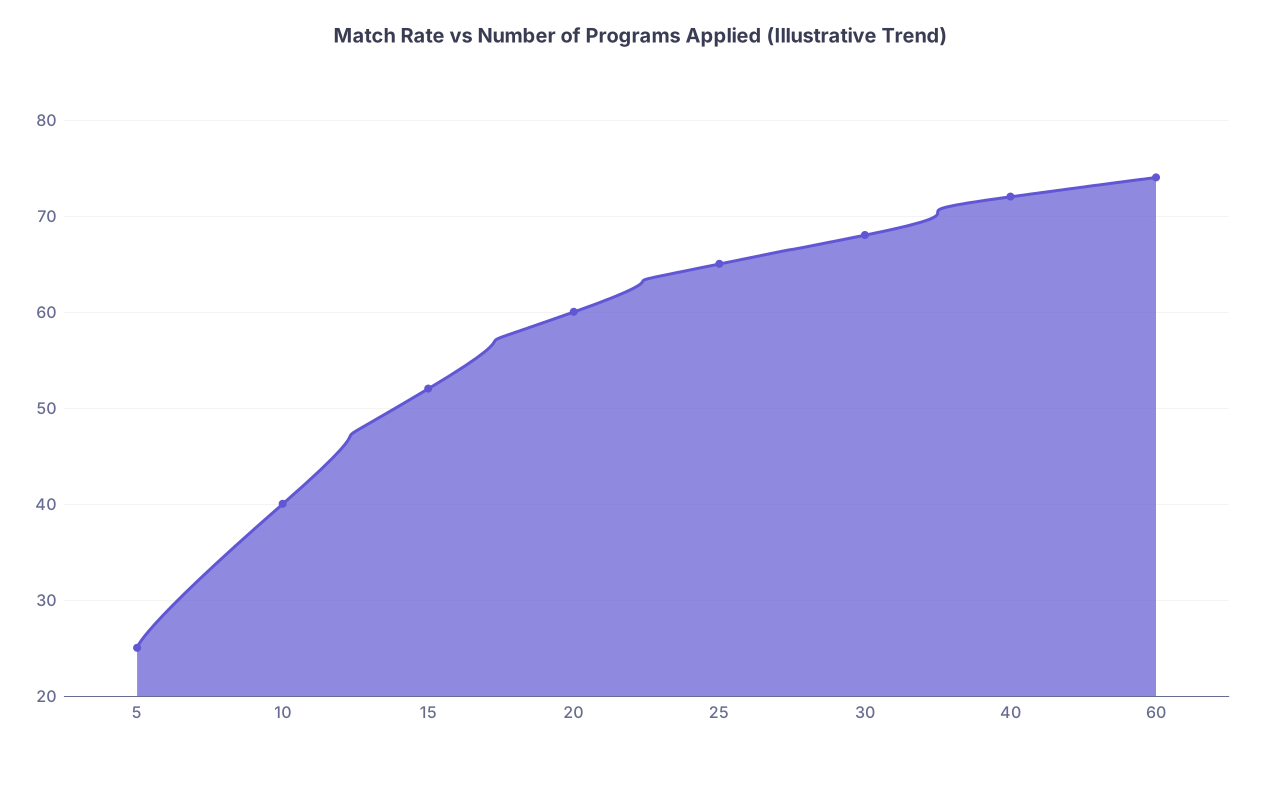
“How many programs should you apply to?” depends on your competitiveness, but as a DO applicant to preliminary surgery, you generally need to overshoot rather than under-apply.
Key Factors Influencing Application Volume
Board Scores and Academic Record
- Strong (e.g., ~> 235+ USMLE Step 2 or equivalent high COMLEX; no fails):
- You might safely apply to fewer prelim programs than someone with borderline scores.
- Borderline or low scores, or a fail attempt:
- Apply more broadly, including many safety programs.
- Strong (e.g., ~> 235+ USMLE Step 2 or equivalent high COMLEX; no fails):
Clinical and Research Experience
- Strong sub-I’s, honors in surgery, meaningful research:
- Increases chance at academic or hybrid programs.
- Limited exposure, few surgical letters:
- You’ll need more community and DO-friendly options.
- Strong sub-I’s, honors in surgery, meaningful research:
Geographic Flexibility
- Willing to go almost anywhere:
- You can spread applications across multiple regions and increase your odds.
- Restricting to 1–2 regions:
- You must apply more heavily within those areas because competition is denser.
- Willing to go almost anywhere:
Suggested Ranges for a DO Galen Applying to Prelim Surgery
These numbers are general guidelines; always individualize.
Stronger DO Applicant
(Good scores, no fails, strong surgery letters, US clinical rotations, maybe some research):- Prelim surgery programs: ~20–35
- Plus any categorical surgery or other specialty applications if applicable.
Average DO Applicant
(Median scores, one or two minor application weaknesses, limited research):- Prelim surgery programs: ~35–50
- Ensure a robust mix of target and safety programs.
DO Applicant with Red Flags
(Exam fails, gaps, limited US experience, or significant academic issues):- Prelim surgery programs: ~50–70+
- Focus heavily on:
- Community programs
- DO/IMG-friendly institutions
- Less competitive locations (Midwest, South, rural areas).
If you are couples matching or simultaneously applying to other specialties, your numbers may need further adjustment.
Balancing Cost vs Benefit
Application fees can add up quickly. To keep your strategy sustainable:
- Prioritize programs where:
- You meet stated criteria (USMLE/COMLEX requirements).
- There is documented DO representation.
- The program aligns with your stated goals (e.g., open to advancing prelims to categorical, or strong in your potential pivot field).
Practical Tip: If you’re deciding between adding 10 extra “long-shot” academic programs versus 10 more realistic community/affiliated ones, lean toward the programs where you will be competitive. Prelim positions are short-term; being in a program matters more than the brand name when you’re trying to build a career.

Step 5: Choosing Programs Strategically – Filters That Matter for DO Prelim Applicants
Now that you have a target application volume, you need a filter system for how to choose residency programs—especially as a DO.
Core Filters for Your Program Selection Strategy
DO Friendliness
- Evidence to look for:
- Current or recent DO residents.
- Alumni lists showing DO grads.
- Program mentions of accepting COMLEX or DOs.
- Action:
- Mark these clearly on your spreadsheet; they’re likely target or even safety programs depending on your stats.
- Evidence to look for:
USMLE/COMLEX Requirements
- Check:
- “USMLE required,” “USMLE strongly preferred,” or “COMLEX accepted.”
- Action:
- Do not apply to programs where you clearly don’t meet non-negotiable test requirements.
- Consider contacting programs only if their language is ambiguous and you’re otherwise a strong candidate.
- Check:
Prelim-to-Categorical Advancement Track Record
- For those seeking eventual categorical surgery:
- Does the website mention prior prelims being taken on as categorical PGY‑2/PGY‑1?
- Ask current residents (during virtual sessions or away rotations) about this:
- “In the last 3–5 years, how many prelims have been advanced to categorical spots here or elsewhere?”
- Programs fall into:
- Explicitly no pipeline for prelims (just 1-year service).
- Rarely but occasionally move prelims to categorical.
- Regularly consider prelims when positions open.
- Action:
- Rank high those where prelims are seen as “potential future categorical colleagues” rather than just extra labor.
- For those seeking eventual categorical surgery:
Case Volume and Operative Exposure
- Especially important if:
- You want strong letters or plan to pursue surgery categorically.
- Consider:
- Average case numbers.
- Opportunities for interns to scrub in and perform parts of cases.
- Ask:
- “How early do prelim interns get operative exposure?”
- “Do prelims get similar OR time as categoricals?”
- Especially important if:
Culture & Support for Prelim Residents
- Red flag signs:
- Prelims never on the website.
- Prelims excluded from conferences or wellness/support activities.
- Ask:
- “Are prelims integrated into the conference/teaching curriculum?”
- “Do prelims have a formal advising system to help them during re-application?”
- Aim for:
- Programs that view prelims as valued learners, not just extra hands.
- Red flag signs:
Reputation & Connections to Other Fields
- If your long-term goal is anesthesia, radiology, or another specialty:
- Are those departments strong at that institution?
- Have prelims successfully matched into those programs afterward?
- Action:
- Note if anesthesia/radiology PDs or faculty are accessible and supportive of prelims.
- If your long-term goal is anesthesia, radiology, or another specialty:
Geographic and Personal Factors
- Consider:
- Proximity to family or support systems.
- Cost of living (important for a busy intern on a resident salary).
- Visa considerations (if applicable).
- Prelim year is intense; the environment outside the hospital matters.
- Consider:
Example: Comparing Three Hypothetical Programs
Program A – Big University Hospital
- No current DOs, USMLE required, heavy research.
- Strong pipeline from prelim to categorical, big-name reputation.
- For a DO with high scores and strong research, this is a reach program worth applying to.
- For a DO with borderline scores and no USMLE, this is probably not a wise use of resources.
Program B – University-Affiliated Community Hospital
- Several DOs among residents.
- COMLEX accepted; moderate research opportunities.
- Prelims occasionally advance to categorical.
- Excellent fit as a target program for many DO applicants.
Program C – Community Hospital in Less Popular Region
- Multiple DO and IMG residents.
- High operative volume, strong LoRs from hands-on experience.
- Limited research; no official pathway to categorical at that institution.
- A strong safety choice, especially for DOs needing to rebuild or expand their portfolio.
Step 6: Integrating Your Strategy – Building and Refining Your Final List
Once you’ve filtered programs by DO-friendliness, requirements, culture, and prelim track record, you’ll have a large initial list. Now you refine.
Build a Program Spreadsheet
At minimum, track:
- Program name and NRMP code
- Type (university, hybrid, community)
- Location
- DO friendliness (Y/N, plus notes)
- USMLE/COMLEX requirements
- Prelim-to-categorical pipeline (strong / weak / none)
- Presence of desired specialties (anesthesia, radiology, etc.)
- Your tier label: Reach / Target / Safety
- Personal notes (culture, impressions, connections)
This structured approach prevents emotional or last-minute decisions and clarifies your program selection strategy at a glance.
Check for Balance Across Tiers and Regions
Aim for a distribution such as:
- 20–25% Reach
- 40–50% Target
- 30–40% Safety
If your application has significant weaknesses, shift more heavily toward target/safety.
Spread applications across several regions unless you have strict limitations. Some areas are more saturated with applicants (e.g., Northeast, West Coast) than others (e.g., some parts of the Midwest, South).
Use Advisers and Mentors Strategically
As a DO graduate, leverage:
- Your COM/medical school’s advising office.
- Faculty surgeons who know your work.
- Recent DO alumni who matched into surgery or did preliminary surgery.
Ask specific questions:
- “Given my scores and strengths, what range of programs should I prioritize?”
- “Are there particular programs you know to be DO-friendly for prelim surgery?”
- “Where do you think I’m clearly competitive vs overreaching?”
Their input can help you adjust how many programs to apply to and fine-tune your reach/target/safety buckets.
Be Honest but Optimistic
Recognize:
- As a DO, you may need to apply to more programs than MD colleagues, especially in surgery.
- A preliminary surgery year, even at a less-known program, can be extremely valuable if:
- You gain strong clinical skills.
- You secure enthusiastic letters.
- You use the year effectively to strengthen your overall application.
Focus on fit, opportunity, and trajectory, not prestige alone.
Frequently Asked Questions (FAQ)
1. As a DO graduate, should I prioritize DO-friendly programs for a preliminary surgery year?
Yes. For a DO graduate, DO-friendly programs should form the core of your list, especially among your target and safety options. These programs are more likely to:
- Understand COMLEX scores.
- Have faculty familiar with osteopathic training.
- Be comfortable offering interviews and positions to DOs.
You can still apply to some historically MD-dominant, higher-tier academic programs as reach options, but your main strategy should revolve around places with a track record of accepting DO residents.
2. Is it better to do a preliminary surgery year or a non-surgical transitional/prelim medicine year if I’m undecided?
It depends on your long-term goals:
- If you are strongly considering categorical general surgery or another surgically oriented field (like anesthesia or IR), a prelim surgery residency will usually be more convincing and relevant.
- If you’re leaning toward medicine-based fields (cardiology, GI, hospitalist track) or are very unsure, a transitional year or prelim medicine year may be more versatile.
Your program selection strategy should reflect those long-term leanings. If surgery remains a strong possibility, a preliminary surgery year gives you more direct surgical exposure, stronger surgery letters, and a clearer demonstration of commitment.
3. Do prelim surgery residents often get converted to categorical surgery at the same institution?
It varies widely by program. Some institutions have a well-known pathway for strong prelims to become categorical when spots open (due to attrition, expansion, or other reasons). Others explicitly treat prelim positions as one-year-only service roles with no realistic path to categorical.
That’s why, when researching programs, you should:
- Check the website and talk with current residents about the track record of prelims advancing to categorical.
- Ask directly during interviews or Q&A sessions (tactfully):
“In recent years, have any prelim interns been offered categorical positions here?”
Programs with a positive history of advancing prelims should be prioritized if your goal is eventually to secure a categorical surgery spot.
4. If I have a failed board attempt as a DO, how should I adjust my program selection strategy for prelim surgery?
With a failed attempt, you need to:
- Apply more broadly: likely 50–70+ prelim surgery programs.
- Emphasize community and university-affiliated programs that have a history of accepting DOs and IMGs.
- Be realistic about top-tier academic centers; some will filter out applicants based on failures.
- Strengthen other parts of your application:
- Strong recent clinical performance (especially in surgery rotations).
- Excellent letters from surgeons.
- Clear explanation and upward trend in performance.
Your safety and target lists will matter even more. Focus on programs where your overall profile—beyond the exam failure—will still be competitive and valued.
By methodically clarifying your goals, understanding the DO-specific landscape, and building a balanced list across program types and tiers, you can create a program selection strategy for preliminary surgery that is both ambitious and realistic. As a DO graduate, your success doesn’t depend on getting into the most famous name; it depends on finding a prelim surgery residency where you can train hard, earn powerful letters, and launch the next phase of your career with momentum.