Understanding the Landscape: Triple Board and Peds-Psych Pathways for DO Graduates
If you’re a DO graduate interested in Pediatrics-Psychiatry, you’re already looking at one of the most unique and competitive training pathways: Triple Board (Pediatrics–Psychiatry–Child & Adolescent Psychiatry) and other integrated Peds-Psych options. Because there are relatively few programs nationally, your program selection strategy and application numbers matter even more than in larger specialties.
This article focuses on:
- How a DO graduate can strategically approach the osteopathic residency match (via ERAS/NRMP, recognizing former AOA and ACGME merger context)
- Understanding what makes a strong peds psych residency or Triple Board candidate
- How to choose residency programs in Pediatrics-Psychiatry
- Determining how many programs to apply to while balancing ambition, competitiveness, and fit
While exact match statistics and program numbers can change year to year, the principles below will help you build a rational, data-informed, and self-aware program selection strategy.
Step 1: Clarify Your Goals in Pediatrics-Psychiatry
Before you start building your program list, you need to be clear on what you want from your training. Pediatrics-Psychiatry training can look different depending on the pathway:
Classic Triple Board (Peds–Psych–Child & Adolescent Psych)
- Usually 5 years
- Leads to eligibility for three boards: Pediatrics, General Psychiatry, and Child & Adolescent Psychiatry
- Highly structured curriculum integrating all three disciplines
Pediatrics with strong integrated behavioral health or psych focus
- Categorical pediatrics programs with robust behavioral, developmental, and mental health experiences, but not formal psychiatry board eligibility
Psychiatry with strong child/adolescent and pediatric liaison focus
- Psych programs that emphasize child rotations and pediatric consult-liaison; you later pursue Child & Adolescent Psychiatry fellowship
Other combined programs (where available)
- Occasionally combined Pediatrics–Psychiatry tracks or special focus pathways
Key questions to clarify your personal training goals
Ask yourself:
Do I want triple board certification or just strong exposure to child mental health?
- If you want all three board certifications, you’ll need to apply specifically to Triple Board programs.
- If you want to be a pediatrician with strong mental health skills, a behavioral pediatrics–strong categorical peds residency may be sufficient.
How sure am I about a lifelong dual/triple practice (peds + psych)?
- If you’re still somewhat uncertain, it might be safer to apply to a mix of:
- Triple Board programs, and
- Categorical Pediatrics and/or Psychiatry programs that are DO-friendly.
- If you’re still somewhat uncertain, it might be safer to apply to a mix of:
How much do lifestyle, geography, and program culture matter versus the specific program brand name?
This will later influence how aggressively you need to broaden your application list.How important is academic vs community orientation?
- Triple Board programs are typically at large academic centers.
- Some peds or psych programs with strong child focus may exist in more community-based settings.
Clarifying your top 3–4 priorities (e.g., triple board certification, geographic region, strong mentorship in child psychiatry, DO-friendly culture) will shape every subsequent decision about how to choose residency programs.
Step 2: Understand Your Applicant Profile as a DO Graduate
Because peds psych residency and Triple Board programs are relatively small and often academically focused, you must honestly assess your strengths and potential concerns as a DO graduate.
Core profile elements programs evaluate
Academic metrics and exams
- COMLEX Level scores (and USMLE if taken)
- Class rank, honors, remediation history
- Trends: improvement over time vs. inconsistent performance
Clinical performance
- Pediatrics, Psychiatry, and Medicine rotations (grades and comments)
- Sub-I or acting internship performance, especially in peds/psych
Osteopathic identity
- DO schools can be less represented at some academic centers
- Programs may look for a clear narrative: why DO, why Peds-Psych, how your osteopathic training adds value
Research and scholarly activity
- Pediatric, psychiatry, child development, or mental health projects
- Quality > quantity, but in Triple Board, even a small number of focused projects can be a plus
Letters of recommendation (LoRs)
- At least one strong pediatrics letter and one psychiatry letter (ideally)
- If applying Triple Board, letters that explicitly speak to your ability to integrate perspectives
Personal statement and narrative
- Coherent explanation of:
- Why Pediatrics
- Why Psychiatry
- Why Children’s mental health in particular
- Why Triple Board or combined approach
- Coherent explanation of:
Reality check for DO graduates
For a DO graduate residency candidate in Triple Board:
- Some programs are historically more familiar with DOs and more flexible about COMLEX-only applicants.
- Others may strongly prefer or effectively require USMLE scores.
- Your program selection strategy must factor in:
- Which programs have a known history of interviewing or matching DOs
- Whether your exam profile is competitive for academically oriented, small-number programs
You don’t need a perfect record, but you need a clear, compelling story and evidence that you can handle the academic and emotional demands of caring for complex pediatric and psychiatric populations.

Step 3: Researching Programs and Building a Target List
Once you understand your goals and profile, you can begin constructing a list of programs using a structured program selection strategy.
1. Mapping the triple board and Peds-Psych landscape
Start by identifying:
- All Triple Board (Pediatrics–Psychiatry–Child & Adolescent Psychiatry) programs in the country
- Any true combined Peds-Psych programs (if available during your cycle)
- Categorical Pediatrics programs with:
- Strong integrated behavioral health
- Child psychiatry, developmental-behavioral pediatrics, or psychology collaborations
- Categorical Psychiatry programs with:
- Strong Child & Adolescent Psychiatry exposure
- Pediatric consult-liaison experiences
- Pediatric hospital affiliations
Use:
- FRIEDA, program websites, and NRMP data
- Program social media and open house webinars
- Online forums and DO-specific match resources for DO-friendliness insights
2. Identifying DO-friendly and peds-psych-friendly programs
For each program, ask:
- Have they recently matched DO residents?
- Does their website explicitly welcome DO applicants or state “COMLEX accepted”?
- Are current residents or faculty DOs (visible in program bios)?
- Do they highlight interests in:
- Behavioral health integration
- Child psychiatry
- Complex medical-psychiatric conditions in children
This is essential for an osteopathic residency match strategy in a niche field.
3. Categorizing programs: Reach, Target, and Safety
Given that Triple Board programs are highly selective and small, you must broaden your list beyond them.
Create three categories:
Reach programs
- Very competitive academic centers
- Limited or no DO representation historically
- You may still apply if you have strong scores, robust research, or unique experiences
Target programs
- DO-friendly or historically DO-inclusive
- Match your academic profile reasonably well
- Have clear interest in integrated pediatric-psychiatric care
Safety programs (relative, not guaranteed)
- DO-friendly pediatric or psychiatry programs
- Slightly below your academic profile or in less competitive regions
- Offer solid child mental health or developmental experiences
4. Integrating mixed program types into your list
Because of the small number of true Triple Board spots, many applicants build hybrid lists:
Scenario A: Strongly committed to Triple Board
- Apply to all Triple Board programs
- Add:
- 10–20 DO-friendly Pediatrics programs with strong behavioral health
- 10–20 DO-friendly Psychiatry programs with strong child focus
Scenario B: Open to multiple paths (Peds OR Psych OR Triple Board)
- Still apply to all Triple Board programs that fit your profile
- Heavily invest in either:
- Peds programs with psych emphasis, or
- Psych programs with strong child emphasis
- This offers multiple paths to similar end goals (e.g., peds + later child psych fellowship, or psych + child & adolescent fellowship)
Scenario C: Primarily peds-focused with interest in mental health
- Apply to a smaller subset of Triple Board programs that align well with your strengths
- Prioritize DO-friendly Pediatrics programs with explicit mental/behavioral health strengths
Your program selection strategy should match the clarity of your career goal and the risk you’re willing to take.
Step 4: How Many Programs to Apply to in Pediatrics-Psych as a DO
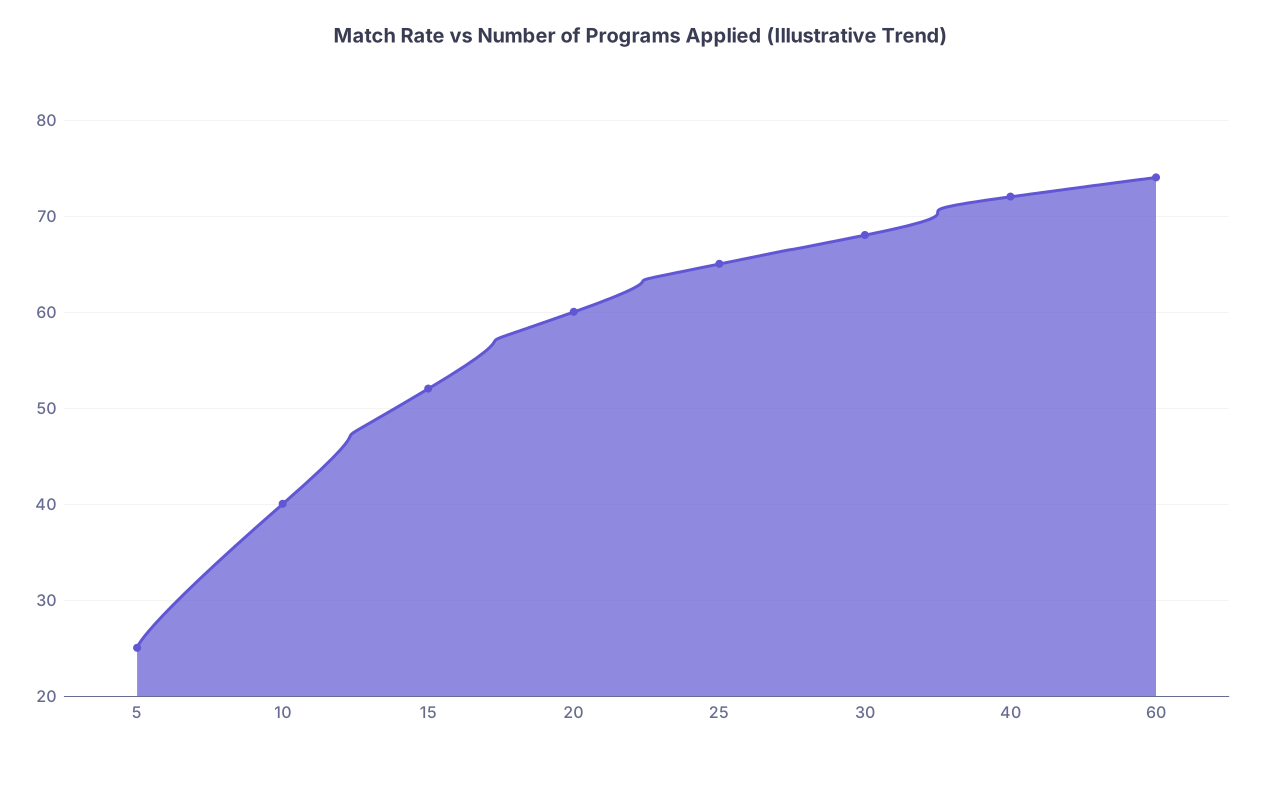
Because you’re in a niche combined area and a DO graduate, the question of how many programs to apply to is crucial. There is no single perfect number, but you can use structured reasoning to arrive at a range.
Factors that determine application volume
Competitiveness of Triple Board/peds psych
- Very few positions nationwide
- Typically located at academic centers
- High ratio of applicant interest to available spots
Your objective competitiveness
- Strong exam scores + research + clear peds-psych narrative → you can lean slightly lower on backup numbers
- Modest scores or limited peds/psych exposure → increase number of backup applications
Geographic flexibility
- If you’re flexible on location, you can improve your odds without an extreme number of applications.
- If you are geographically restricted (family, visas, etc.), you may need to apply broadly within that region and lean on both Peds and Psych options.
Financial and logistical constraints
- Application and interview costs can add up
- Being strategic about which programs are realistic is critical
Practical ranges for DO graduates interested in Triple Board/peds psych
These are general guidance ranges, not guarantees, and should be tailored with advisor input:
Triple Board programs
- Because the total number of programs and positions is small, the typical strategy is:
- Apply to all programs that:
- Accept DOs
- Are not clear mismatches in terms of exam requirements or visa policies (if applicable)
- Apply to all programs that:
- For many applicants, this might be 8–15 Triple Board applications total, depending on the year’s program offerings.
- Because the total number of programs and positions is small, the typical strategy is:
Categorical Pediatrics + Psychiatry (combined backups)
- For a DO applicant aiming for a secure match while targeting Triple Board:
- Total applications (Triple Board + Peds + Psych): often 40–70
Breakdown example:- 8–15 Triple Board
- 15–30 Pediatrics
- 10–25 Psychiatry
- Total applications (Triple Board + Peds + Psych): often 40–70
- For a DO applicant aiming for a secure match while targeting Triple Board:
More competitive DO candidates (strong scores, research, honors)
- Might reasonably apply in the range of 35–55 total programs
- Still include all viable Triple Board programs
- Slightly fewer backup programs, but still enough for security
Less competitive DO candidates (lower scores, limited exposure, or red flags)
- Might target 55–80 total programs
- Heavier emphasis on DO-friendly, mid-tier Pediatrics and Psychiatry programs
- Still apply to Triple Board where possible, but do not rely on them for match security
The key is that your overall application portfolio needs to reflect that:
- Triple Board alone is not a safe match strategy.
- You should treat Triple Board as a highly desirable but small “track,” anchored by a robust foundation of categorical Peds and/or Psych applications.

Step 5: Weighing Program Fit: How to Choose Residency Programs Wisely
Once you know approximately how many programs to apply to, you must choose which programs make the cut. For a DO graduate in Pediatrics-Psychiatry, program fit includes several specific domains.
1. Evidence of genuine integrated care
For Triple Board and peds-psych–interested applicants, look for:
- Shared faculty across Pediatrics and Psychiatry
- Joint conferences or multidisciplinary case conferences
- Rotations that formally integrate medical and psychiatric care for children (e.g., eating disorders, neurodevelopmental clinics, psychosomatic or consultation-liaison services)
Red flag: Programs that list “interest in behavioral health” but show no actual integrated curriculum or shared educational structures.
2. DO-friendliness in practice (not just in theory)
Specific markers:
- Recent DO residents in peds, psych, or Triple Board
- Program statements about accepting COMLEX alone, or requiring/strongly preferring USMLE
- Openness to osteopathic manipulative treatment (OMT) or holistic care discussions (especially valuable in pediatrics)
If a program has never had a DO resident in any of its peds or psych training tracks, view it as a reach unless your application is particularly strong.
3. Child and adolescent psychiatry exposure
For both Triple Board and categorical tracks, prioritize:
- Strong rotations in:
- Child inpatient psychiatry
- Outpatient child clinics
- School-based or community mental health settings
- Opportunities to work with:
- Neurodevelopmental disorders
- Trauma and attachment
- Chronic pediatric illness with psychiatric comorbidity
Ask: Will this residency truly prepare me to understand the full biopsychosocial picture of children and families?
4. Institutional support and culture
Pay attention to:
- Size and visibility of child mental health services: Is child psych an afterthought or a major institutional priority?
- Cross-department collaboration: Do Peds and Psych residents see each other, work together, and attend joint education?
- Faculty mentorship: Are there faculty who clearly hype Triple Board or peds-psych integrated careers and support DO residents?
For a peds psych residency or triple board environment, you need a culture that values interdisciplinarity and respects different training backgrounds.
5. Geography, lifestyle, and personal factors
Even in a highly focused niche, do not ignore:
- Proximity to support systems (family, partner, community)
- Cost of living
- Call schedule and wellness resources
- Opportunities for your partner’s career or your dependents’ schooling, if applicable
A “perfect” program on paper may not be perfect if you’re burnt out or isolated.
Step 6: Putting It Together – A Sample Strategy for a DO Triple Board Applicant
To make this concrete, imagine a DO graduate with:
- COMLEX scores around the national mean
- No USMLE scores
- Strong clinical comments in Pediatrics and Psychiatry
- One small child mental health QI project
- Clear narrative in personal statement about integrated care for children with complex medical and psychiatric needs
Step-by-step strategy
Clarify goal:
Target Triple Board if possible, but maintain high match security. Open to categorical Pediatrics or Psychiatry with strong child focus.Research programs:
- Identify all Triple Board programs
- Mark which have:
- Recent DO residents
- COMLEX acceptance
- Identify 20–25 DO-friendly Pediatrics programs with behavioral health strengths
- Identify 15–20 DO-friendly Psychiatry programs with robust Child & Adolescent exposure
Categorize:
- Triple Board:
- 2–4 Reach (less DO history, highly academic)
- 4–8 Target (some DO representation, COMLEX-friendly)
- Pediatrics:
- 5–10 Reach (top academic centers)
- 10–15 Target
- 5–10 Safety
- Psychiatry:
- 5–10 Target
- 5–10 Safety
- Triple Board:
Finalize numbers:
- Apply to 10–12 Triple Board
- Apply to ~20–25 Pediatrics
- Apply to ~15–20 Psychiatry
→ Total: Approximately 45–55 programs.
Tailor applications:
- Adjust personal statements:
- One focused on Triple Board and integrated care
- One for Pediatrics emphasizing mental health and holistic child care
- One for Psychiatry emphasizing child/adolescent focus and collaboration with pediatrics
- Request letters that speak explicitly to:
- Your ability to integrate perspectives
- Your interpersonal skills with families and children
- Your adaptability moving between medical and psychiatric settings
- Adjust personal statements:
This structured plan balances ambition and realism, aligning with the realities of the osteopathic residency match in a niche combined field.
Frequently Asked Questions (FAQ)
1. As a DO graduate, do I need USMLE scores to be competitive for Triple Board or peds-psych programs?
Not universally, but they can help. Some Triple Board and academic programs accept COMLEX only and have matched DO residents without USMLE scores. Others strongly prefer or effectively require USMLE due to institutional policies or board pass rate tracking.
For your program selection strategy, you should:
- Check each program’s website or contact coordinators regarding COMLEX vs USMLE acceptance.
- Prioritize DO-friendly programs if you did not take USMLE.
- If you already have USMLE scores and they are solid, highlight them appropriately.
2. How many Letters of Recommendation should focus on pediatrics versus psychiatry?
For a peds psych residency or Triple Board application:
- Aim for at least one strong pediatrics letter and one strong psychiatry letter.
- The remaining letter(s) can come from:
- Another core specialty (e.g., Internal Medicine) if it speaks to your clinical reliability
- A research mentor in child mental health or development
- A subspecialty relevant to integrated care (e.g., developmental-behavioral pediatrics, child psych)
For categorical Peds or Psych applications, you can flex the ratio toward the specialty you’re targeting, but keep at least one cross-specialty letter when possible to support your integrated narrative.
3. If I don’t match into Triple Board, can I still build a similar career through other paths?
Yes. You can construct a career that looks very similar to Triple Board through other combinations, for example:
Match into Pediatrics, then pursue:
- Fellowship in Child & Adolescent Psychiatry (where available/feasible), or
- Developmental-Behavioral Pediatrics, or
- Work closely with child psychiatry teams and integrated behavioral health
Match into Psychiatry, then:
- Complete Child & Adolescent Psychiatry fellowship
- Work in pediatric hospitals or pediatric consult-liaison roles
- Build strong collaborations with pediatricians
Triple Board is a unique and powerful pathway, but it is not the only route to a career in integrated pediatric-psychiatric care.
4. Should I apply to both Pediatrics and Psychiatry categorical programs, or just pick one as a backup?
If your primary goal is integrated pediatric-psychiatric care and you’re pursuing Triple Board:
- Applying to both Pediatrics and Psychiatry categorical programs increases your flexibility:
- More total interview opportunities
- More chances to match into a pathway that still supports your long-term integrated goals
You might lean more heavily toward one (e.g., more Peds than Psych) depending on which identity feels primary to you, but including some of both generally strengthens your overall program selection strategy and match security.
By combining a clear sense of your goals, an honest assessment of your DO profile, and a structured plan for how to choose and how many programs to apply to, you can approach the peds psych residency and Triple Board application process with confidence and intentionality.