Understanding the Landscape: Cardiothoracic Surgery Training for DO Graduates
Cardiothoracic surgery is one of the most competitive and demanding surgical fields, and developing an effective program selection strategy is crucial—especially for a DO graduate. As the residency landscape has transitioned to a single ACGME accreditation system, DO graduates now compete directly with MD applicants for cardiothoracic surgery residency positions. That creates both new opportunities and new challenges.
For cardiothoracic surgery, there are two main training pathways in the U.S.:
Integrated (I-6) Cardiothoracic Surgery Residency
- 6-year program straight from medical school
- Limited number of spots nationwide
- Highly competitive; heavy emphasis on academic metrics and research
Traditional 5+2 (or 5+3) Pathway
- 5 years of general surgery residency
- Followed by 2–3 years of cardiothoracic surgery fellowship
- More positions overall but two competitive steps (GS then CT fellowship)
As a DO graduate, you need to be exceptionally deliberate about:
- Where to apply
- How many programs to apply to
- How to choose residency programs that align with your profile and goals
- How to balance “reach,” “target,” and “safety” programs
This article focuses on program selection strategy—not how to write your personal statement or build your CV—but on the practical question: Which programs should you target, and how many?
We’ll discuss this mainly through the lens of the integrated (I-6) cardiothoracic surgery residency, with side notes for the traditional 5+2 pathway where relevant.
Assessing Your Competitiveness as a DO Applicant
Before you can build a smart program list, you need an honest assessment of your application. For cardiothoracic surgery, DO graduates are evaluated by essentially the same metrics as MDs, but you must account for residual bias and structural disadvantages (e.g., fewer home academic CT programs, less built-in research infrastructure).
Core Components of Competitiveness
Consider each of these domains:
Exam Scores and Academic Performance
- USMLE Step 1 (if taken) and Step 2 CK
- COMLEX-USA Level 1 and Level 2-CE
- Class rank, AOA/Sigma Sigma Phi (if applicable), honors in surgery-related rotations
- Performance in sub-internships (especially CT and general surgery)
Research and Scholarly Activity
- Cardiothoracic or cardiac/vascular research heavily preferred
- Number and quality of:
- Publications (PubMed-indexed is best)
- Abstracts, posters, and presentations
- Book chapters and review articles
- Evidence of continuity in research (not just a single summer)
Clinical Exposure to Cardiothoracic Surgery
- Observerships, electives, or away rotations in CT surgery
- Operative experience during rotations (even as a student)
- Letters of recommendation from recognized cardiothoracic surgeons
- Demonstrated understanding of heart surgery training and lifestyle
Institutional Background
- DO school reputation and prior match history into surgery/surgical subspecialties
- Access to a home cardiothoracic or robust cardiac surgery program
- Mentorship from CT or high-level general surgeons
Signals of Commitment to the Field
- National society memberships (e.g., STS, AATS, AOA/ACOS)
- Attendance at cardiothoracic conferences
- Involvement in CT interest groups, QI projects, or outcomes research
- A coherent narrative of long-standing interest in cardiothoracic surgery
Self-Categorizing: High, Moderate, or Developing Competitiveness
For a DO graduate cardiothoracic applicant, you can roughly group yourself as:
Highly competitive
- USMLE Step 2 CK significantly above national mean (often ≥ 245–250+)
- Multiple CT-related publications, including first-author work
- Strong letters from well-known academic cardiothoracic surgeons
- Successful away rotations at academic CT centers
- Significant leadership, QI, or meaningful research experience
Moderately competitive
- USMLE Step 2 CK around the national mean or modestly above (e.g., 230–245)
- At least one CT-related scholarly product, plus some surgery research
- Solid letters from CT or general surgery faculty, though not all nationally known
- Good performance on sub-Is and away rotations
- Clear commitment to the field but less extensive research
Developing competitive profile
- Limited research or non-CT related scholarly work
- Scores below mean, or only COMLEX scores without USMLE (depending on programs)
- Fewer or no CT-specific rotations
- Letters primarily from general surgery faculty; minimal exposure to CT leaders
Your program selection strategy depends heavily on where you fall in this spectrum.
How Many Programs To Apply To (and Why Volume Matters for DOs)
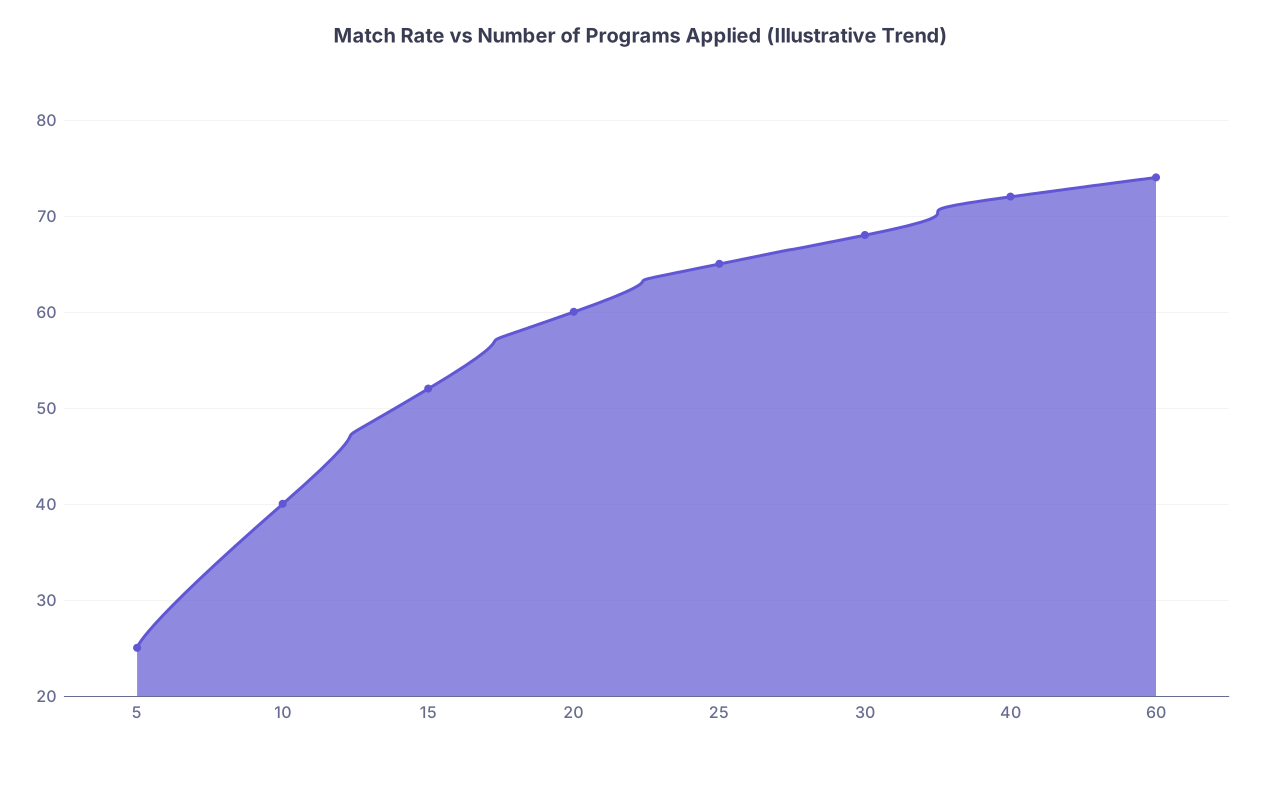
One of the most common questions is simply: how many programs to apply? For cardiothoracic surgery, because of its extreme competitiveness and the relatively small number of I-6 positions nationwide, DO graduates usually need to over-apply rather than under-apply.
Integrated Cardiothoracic (I-6) Programs
There are only a few dozen integrated CT programs in the U.S., many offering just 1–3 positions per year. That means:
- The total number of available I-6 seats is small
- Many applicants will apply to nearly all programs
General Guidelines (DO-specific)
These ranges are not absolute rules, but reasonable starting points:
Highly competitive DO applicant
- Apply to 80–100% of I-6 programs (often 30–40+ programs, depending on the year)
- Consider adding:
- A parallel application to general surgery at academic centers with strong CT departments, if you’re open to the 5+2 route
- Rationale: Even very strong applicants may be affected by DO bias at some institutions; “full court press” maximizes interview chances.
Moderately competitive DO applicant
- Apply to all I-6 programs (essentially 100%)
- Strongly consider a dual-application strategy:
- CT I-6 and general surgery
- Choose general surgery programs with proven CT fellowship matches
- Rationale: The integrated match is high-risk; diversifying with general surgery greatly improves your overall match probability.
Developing competitive DO applicant
- If applying to I-6:
- Apply to all I-6 programs, recognizing this is a reach category
- Emphasize a strong primary focus on general surgery programs (40–60+ GS programs, depending on your profile)
- Target general surgery with excellent cardiac surgery exposure and CT fellowship pipelines
- Rationale: For many DOs, the 5+2 route is more realistic; I-6 becomes a high-risk “lottery ticket.”
- If applying to I-6:
Across all categories, the core message is:
For a DO graduate in cardiothoracic surgery, err on the side of applying to more programs rather than fewer, especially for integrated I-6 positions.
Traditional General Surgery + CT Fellowship Path
If your primary pathway is general surgery (GS) followed by a CT fellowship:
- General guidance for GS applications as a DO interested in CT:
- Highly competitive: 30–40+ general surgery programs
- Moderate: 45–60+ programs
- Developing: 60–80+ programs (with a mix of academic and community programs)
- Then, during residency, you will later apply to cardiothoracic surgery fellowship with a separate, targeted strategy.
This dual-path thinking is integral to an intelligent program selection strategy—you’re not just applying to a residency; you’re choosing a sequence of training steps that will shape your heart surgery training for a decade.

How To Choose Residency Programs: Building a Smart List
“How to choose residency programs” is ultimately about balancing fit, feasibility, and future opportunities. For a DO graduate, there are additional filters you must apply carefully.
1. Filter by Structural Factors
Start by eliminating or flagging programs that have:
- Explicit exam requirements you don’t meet:
- Some programs require USMLE scores even for DOs.
- Others may accept COMLEX only but have minimum cutoffs.
- No history (or very rare history) of DO residents
- Not an automatic no-go, but a caution sign: ask whether you’re willing to be the first or one of very few.
- Location constraints
- Geographies you absolutely cannot or will not move to (family, visa, financial reasons).
Actionable step:
Create a spreadsheet with columns for:
- Program name
- Location
- Exam requirements and cutoffs
- Historical DO presence (if any)
- Number of I-6 spots
- Accreditation status
- Your preliminary “apply/consider/avoid” rating
2. Evaluate Academic Environment and Case Volume
For cardiothoracic surgery, the quality and breadth of operative exposure is crucial:
- Case volume and diversity
- Adult cardiac, general thoracic, and, if important to you, congenital cardiac
- Presence of advanced procedures: LVADs, ECMO, transcatheter valve interventions, advanced aortic surgery, transplant
- Institutional reputation
- Major academic centers usually offer broader exposure and more research
- Consider alignment with your career goals (academic vs. community practice)
Programs may list case logs, or you can infer from:
- Size of their cardiac surgery service
- Number of full-time faculty
- Presence of transplant or aortic programs
- Designation as a comprehensive cardiac center
3. Consider DO-Friendliness and Culture
This is particularly critical for DO graduate residency planning:
- Look at current or recent DO residents or fellows in:
- Cardiothoracic surgery
- General surgery
- Ask mentors, alumni, or senior residents:
- “Have DOs matched there recently?”
- “How supportive is the culture toward osteopathic trainees?”
- Review program websites and social media:
- Some highlight osteopathic residents and faculty
- Some historically have had a strong osteopathic presence (often former AOA-accredited institutions)
Programs that have repeatedly taken DOs—especially in surgical specialties—often indicate a more level playing field.
4. Geographic Strategy and Personal Considerations
Location is not just about lifestyle; it affects:
- Your ability to build a support system (which is vital in a demanding specialty)
- Cost of living and debt management
- Proximity to future fellowship opportunities (if entering through general surgery)
Strategic considerations:
- Primary geographic preference: If you have strong ties to a region, emphasize programs there; geographic preference may slightly boost your chances.
- Secondary regions: Identify backup regions where you could realistically live and thrive.
- Avoid over-constraining location as a DO in a hyper-competitive specialty—too narrow a radius can significantly reduce your chances.
5. Research and Academic Opportunities
Cardiothoracic surgery is highly academic. For heart surgery training, it matters whether your program:
- Has ongoing clinical trials or outcomes research in:
- Valve surgery
- Aortic pathology
- Coronary revascularization
- Thoracic oncology
- Mechanical circulatory support or transplant
- Supports residents in:
- Attending national meetings (STS, AATS, etc.)
- Publishing and presenting research
- Protected research time (especially in integrated programs)
For a DO who may start with less built-in research infrastructure, joining a program with robust academic support can be career-defining.
6. Graduates’ Outcomes and Fellowship Placement
Whether you’re aiming for:
- A high-profile academic CT surgery career
- A community-based cardiothoracic practice
- Further subspecialization (e.g., transplant, structural heart)
You must look at where graduates go:
- For I-6:
- Academic faculty positions?
- Prestigious centers of practice?
- For general surgery programs (if considering the 5+2 route):
- How many residents match into CT fellowships?
- At what kinds of institutions?
This is a critical part of your program selection strategy: you’re not just matching into a program; you’re selecting a launch platform.

Structuring Your List: Reach, Target, and Safety Programs
Once you’ve identified potential programs that meet your basic criteria (eligibility, location, DO-friendliness, academic fit), the next step is tiering them into categories.
1. Defining Program Tiers (Relative to You)
Your tiers are relative to your competitiveness, not based on general reputation alone.
Reach programs
- Top-tier academic centers with:
- Very high average board scores
- Heavy research expectations
- Extremely low acceptance rate per applicant
- Limited or no history of taking DOs
- Often “name-brand” institutions consistently ranked nationally
- Top-tier academic centers with:
Target programs
- Solid academic or hybrid academic-community centers
- Some evidence of DO-friendliness (even in general surgery or other specialties)
- Profiles that match your exam scores and research roughly
Safety programs (more relevant for the GS parallel path)
- Programs where your metrics are above average compared to typical residents
- Institutions with consistent DO representation
- Community or hybrid programs with reasonable operative exposure and a track record of graduates entering CT fellowships (if via GS)
For I-6 CT programs, the “safety” category is inherently limited because all I-6 spots are competitive. Safety is more feasible conceptually for your general surgery list.
2. Suggested Distribution for a DO Applying I-6 + GS
For a DO applicant applying both integrated CT and general surgery, a possible breakdown:
I-6 Cardiothoracic Surgery (assuming ~30–40 total programs)
- 30–50% reach
- 50–70% target
- There are very few true “safety” I-6 programs, so think of all as at least target-level difficulty.
General Surgery (GS) (numbers vary by competitiveness)
- 20–30% reach
- 40–50% target
- 20–30% safety
Explicit example (moderately competitive DO):
- I-6:
- Apply to all 35 programs (e.g.)
- Identify:
- ~15 “reach”
- ~20 “target”
- General surgery:
- Apply to 50 programs
- ~10 “reach” academic centers with strong CT exposure
- ~25 “target” programs (solid academic or hybrid)
- ~15 “safety” community or smaller academic centers with DO residents
- Apply to 50 programs
This kind of program selection strategy ensures you maintain aggressive pursuit of cardiothoracic surgery while preserving a high probability of matching into a quality surgical pathway.
3. Integrating Personal Priorities Without Undermining Strategy
You should incorporate personal priorities, but avoid letting them dominate to the point that you severely narrow your options. Examples:
- Family proximity: Maybe prioritize but still include some far-away programs if they fit your goals.
- Urban vs. rural: If you strongly prefer one, favor it but don’t exclude the other entirely.
- Program size: Some prefer smaller, intimate settings; others prefer large teams. Reflect that in your “target” and “safety” selections rather than your entire list.
Practical Tactics and Timing: Making Your Strategy Work
Beyond “how many” and “which,” there are practical steps that refine your overall approach.
1. Early Mentorship and Feedback
- Seek mentors in:
- Cardiothoracic surgery
- General surgery
- Review your program list with:
- A CT surgeon (if available)
- A surgery program director or associate PD
- A dean or advisor experienced with the osteopathic residency match
Ask for direct, honest feedback:
- “Which of these are realistic reach vs. target for me as a DO?”
- “Are there DO-friendly cardiothoracic programs I’m missing?”
- “Should I adjust how many programs to apply in each category?”
2. Using Away Rotations Strategically
Away rotations are particularly powerful for a DO graduate residency applicant in a competitive field:
- Aim to rotate at:
- At least one integrated CT program that historically has taken DOs OR
- A high-volume CT center with strong general surgery and CT fellowship
- Goals of away rotations:
- Earn strong letters of recommendation from CT faculty
- Demonstrate your capabilities in a setting that might otherwise screen you out on paper
- Clarify whether the program is truly a good fit
After an away rotation, update your list:
- Programs where you rotated and performed well might move from “reach” to “target.”
- You may remove programs that clearly don’t align with your learning style or culture preferences.
3. Data-Driven Refinement Using Match Outcomes
Use publicly available resources:
- NRMP Charting Outcomes
- NRMP Program Director Survey
- ACGME and program websites
- Alumni match lists
Look for:
- Average scores of matched applicants
- Percentage of DOs in previously matched classes
- Program size and typical interview-to-match ratios (if publicly shared)
Although cardiothoracic I-6 match data is limited compared to larger specialties, even small clues help refine your strategy.
4. Recalibrating After Interview Invitations
Your program selection strategy continues after applications go out:
- If you receive fewer I-6 interviews than expected:
- Take general surgery interviews very seriously.
- Pursue strong GS programs with CT exposure and fellowships.
- If you receive more GS interviews and very few I-6:
- Consider your appetite for risk:
- Are you willing to potentially go unmatched trying to SOAP into surgery or prelim spots?
- Or would you prioritize a stable categorical general surgery position as a launch point?
- Consider your appetite for risk:
At this stage, talk with mentors again to recalibrate your ranking and long-term plan.
FAQs: Program Selection Strategy for DO Graduates in Cardiothoracic Surgery
1. As a DO, should I take USMLE in addition to COMLEX if I want cardiothoracic surgery?
In most cases, yes. Many competitive surgical programs still strongly prefer or require USMLE scores for DO applicants. Having both exams:
- Expands the number of programs you’re eligible to apply to
- Facilitates comparisons with MD applicants on a standardized scale
If you’re early enough in training and aiming for cardiothoracic surgery, sitting for USMLE Step 2 CK (at minimum) can be a major strategic advantage.
2. Is it realistic for a DO graduate to match directly into an integrated cardiothoracic surgery residency?
It is possible but challenging. DO applicants have matched into I-6 programs, but:
- Numbers are small
- Competition is intense
- Some programs remain hesitant about DOs or have never taken one
For many DOs, a dual strategy (I-6 + general surgery) provides a safer path to heart surgery training. You can still become a cardiothoracic surgeon via the 5+2 route, which remains the more common pathway overall.
3. How far should I prioritize DO-friendly programs versus “name-brand” institutions?
A balanced approach is best:
- Include some top-tier name-brand programs as reaches—especially if you have strong scores and research.
- Give extra emphasis to programs that:
- Have previously trained DOs in surgery or CT
- Are transparent and welcoming about osteopathic applicants
In your program selection strategy, DO-friendly programs are often where you’ll receive more serious consideration and stronger interview yields, but it’s reasonable to keep a few “aspirational” applications in the mix.
4. If I don’t match into I-6, will I still be competitive for CT fellowship later as a DO general surgery resident?
Yes—if you choose your general surgery program thoughtfully and perform well. To remain competitive for future cardiothoracic fellowship:
- Select GS programs with:
- Strong CT services
- A track record of graduates matching into CT fellowships
- During residency:
- Seek out CT rotations and mentorship early
- Engage in CT-related research or QI projects
- Build a strong operative and academic record
Your initial residency match doesn’t permanently define your chances; what you do during general surgery training has a major influence on future cardiothoracic surgery fellowship opportunities.
Designing a thoughtful, data-informed program selection strategy as a DO graduate is one of the most important steps in pursuing cardiothoracic surgery. By honestly assessing your competitiveness, understanding how many programs to apply to, targeting DO-friendly yet robust training environments, and diversifying your pathways through both I-6 and general surgery options, you maximize your chances of ultimately achieving your goal: a rigorous, fulfilling career in heart and thoracic surgery.