Understanding Your Path: DO Graduate + Global Health Focus
As a DO graduate committed to global health, your program selection strategy needs to account for three overlapping realities:
- You are entering the residency match as a DO graduate (with its own considerations).
- You are aiming for a global health–oriented career (clinical + international medicine).
- You must answer the practical question: how many programs to apply to and which ones.
Unlike traditional program selection articles, your approach must balance:
- Clinical training quality in your chosen core specialty
- Strength and structure of a global health residency track
- Openness of programs to DO graduates
- Visa, travel, and safety considerations for international medicine
- Long‑term career goals (academic, NGO, policy, humanitarian, etc.)
This article walks through a step‑by‑step program selection strategy tailored specifically to a DO graduate in global health, including:
- How to research and filter programs
- How many programs to apply to in different competitiveness scenarios
- How to evaluate global health tracks realistically
- How to address DO‑specific match issues and biases
- Common pitfalls and FAQs
Step 1: Clarify Your Global Health Career Vision (Before You Build Your List)
Before you search “global health residency programs” or “international medicine,” you need a clear vision of what global health means to you. This shapes your program selection strategy more than any other factor.
Define Your Professional End Goal
Ask yourself:
Do you imagine yourself:
- Practicing clinically overseas long‑term?
- Based in the U.S. with periodic international projects?
- Working in academic global health, research, and teaching?
- Focusing on policy, health systems, and humanitarian response (e.g., WHO, MSF, NGOs)?
What patient populations or issues are you drawn to?
- Refugee and migrant health
- Infectious diseases (HIV, TB, malaria)
- Maternal and child health
- Non‑communicable diseases in low‑resource settings
- Disaster response and humanitarian crises
How procedural do you want your day‑to‑day practice to be?
- Highly procedural (e.g., EM, surgery, OB/GYN)
- Moderately procedural (e.g., IM with procedures, FM with OB)
- Primarily cognitive (e.g., internal medicine, pediatrics)
Your answers directly affect:
- Which base specialty you should prioritize (FM, IM, EM, OB/GYN, Pediatrics, Surgery, etc.)
- Which type of global health residency track is most suitable
- The trade‑off between program prestige vs. specific global health opportunities
Choose a Primary Specialty First, Global Health Second
Residency is where you become a competent clinician first. Global health is the lens and context you bring to that training.
For global health‑oriented work, common residency choices:
- Family Medicine
- Broadest clinical scope (adults, peds, OB in some programs)
- Highly valued in low‑resource and rural settings
- Often strong global health or underserved tracks
- Internal Medicine
- Strong foundation for Infectious Disease, global primary care, academic global health
- Can lead to careers in policy, research, and system‑level work
- Pediatrics
- Excellent for child health, vaccine programs, malnutrition, global maternal‑child health
- Emergency Medicine
- Valuable in humanitarian response, disaster relief, trauma, acute care
- OB/GYN
- High‑impact field in maternal health in low‑resource settings
- General Surgery and Subspecialties
- High need globally, but more complex logistics and longer training
For a DO graduate, some specialties and locations may be more receptive to DOs than others. Family Medicine, Internal Medicine, and Pediatrics have broadly strong DO representation; some highly competitive EM or surgical programs may still be more MD‑leaning.
Actionable step:
Write a one‑paragraph “career mission statement” summarizing:
- Your chosen core specialty
- Your envisioned global health role
- Your primary patient populations or regions of interest
You’ll use this mission statement to evaluate whether each program meaningfully advances your goals.
Step 2: Build a Targeted Initial List of Programs
Now that you know your specialty and global health direction, you can build a long list of potential programs, then refine. Your program selection strategy here should combine:
- Global health alignment
- DO friendliness
- Geographic and lifestyle fit
- Competitiveness realism
Where to Find Global Health–Oriented Residency Programs
Look for:
- Programs with a formal global health residency track or “international health track”
- Residency websites highlighting:
- Regular international rotations (not just a single elective every few years)
- Dedicated global health faculty or division
- Partnerships with hospitals or NGOs abroad
- Scholarly output in global health, global surgery, or international medicine
Use sources such as:
- ACGME and program websites (search “global health,” “international health,” “global medicine”)
- Society websites (e.g., American Academy of Family Physicians, internal medicine societies) that list global health or underserved tracks
- Global health centers at universities (e.g., “Center for Global Health” & affiliated residencies)
Be cautious: “international mission trips” or “one week per year” language may not equate to a structured, safe, and ethical global health residency track.
Identify DO‑Friendly Programs
As a DO graduate in global health, you must factor in:
- Programs with a history of accepting DOs
- No “MD‑only” language on their site
- Past residents’ backgrounds (check current residents’ bios)
- States and institutions historically more open to DO grads (e.g., Midwest, community programs, many academic centers now)
Use:
- NRMP “Charting Outcomes in the Match” for DO data (if available for your specialty)
- Program websites – look at resident rosters for DO representation
- Ask upper‑level DO residents, advisors, and mentors directly
If global health and DO friendliness conflict (e.g., a very strong global health track but no DOs in the last 5 years), you’ll need a more cautious, diversified program selection strategy, especially around how many programs to apply.
Categorize Programs by “Fit Type”
As you research, begin to sort programs into:
Ideal Fit Programs
- Strong global health residency track or international medicine opportunities
- Clear DO representation
- Geographic/location preferences you like
- Your stats and experiences are around or above their typical match profile
Good Fit Programs
- Some global health or underserved opportunities (perhaps more domestically focused)
- DOs present, or at least no obvious DO bias
- Reasonable competitiveness match with your application
Reach Programs
- Highly prestigious or competitive (e.g., big‑name academic centers)
- Strong global health focus but few or no DOs historically
- Or you are slightly below their typical academic metrics
Safety/Backup Programs
- DO‑friendly, slightly less competitive
- May have limited but some global or underserved focus
- You would still be comfortable training clinically there, even if global health is less prominent
This categorization will guide both program selection and how many programs to apply in each bucket.

Step 3: How Many Programs to Apply To as a DO Interested in Global Health
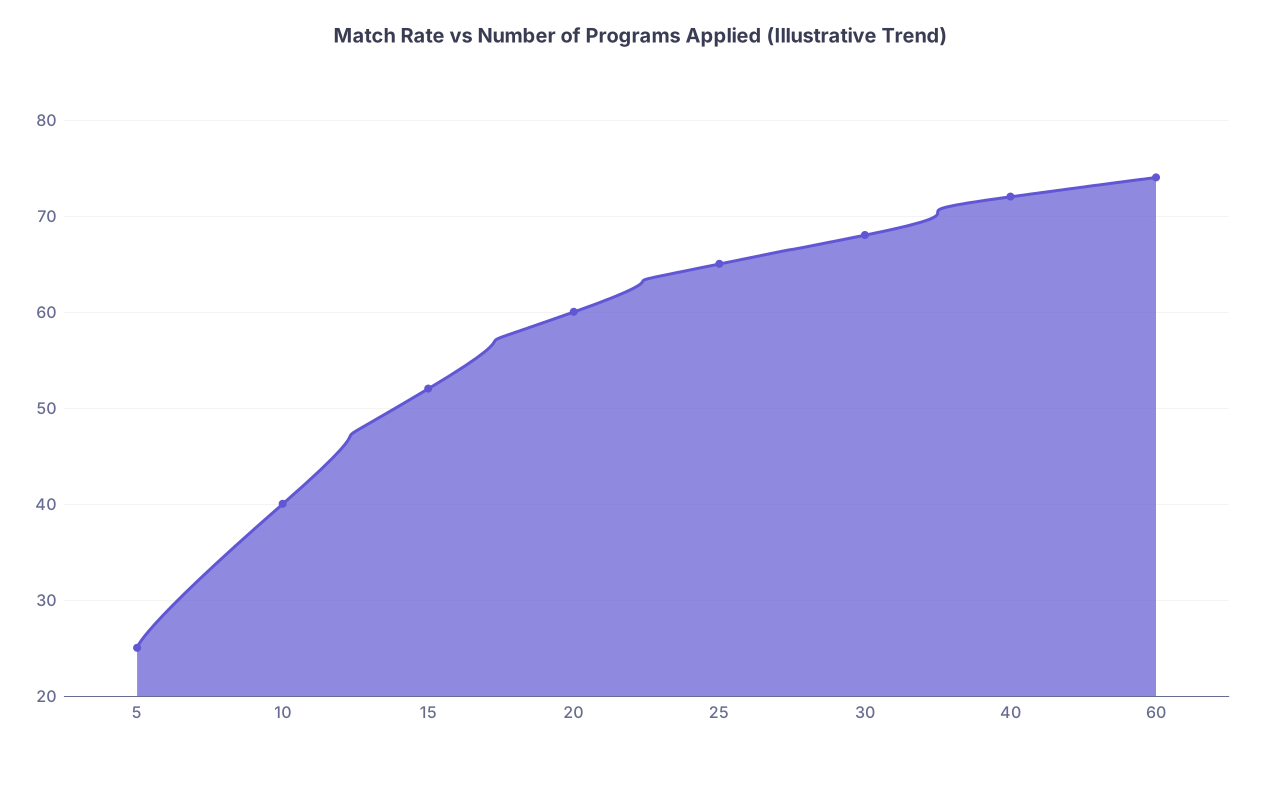
The question “how many programs to apply” is especially relevant for a DO graduate targeting a relatively niche focus like global health. You are often filtering for:
- A compatible specialty
- DO friendliness
- Robust global health opportunities
This reduces your pool compared to a generic applicant.
General Application Volume Guidelines (By Competitiveness)
These are broad benchmarks for U.S. DO graduates applying to relatively DO‑friendly core specialties like FM, IM, Pediatrics, and some EM programs:
Highly competitive candidate
- Strong USMLE/COMLEX scores, honors, strong global health experiences, strong letters
- Applying to FM/IM/Peds with known DO friendliness
- Approximate range: 20–30 programs
Average competitive candidate (typical DO profile)
- Solid but not stellar scores, some global health or underserved work, good letters
- Approximate range: 30–45 programs
Below‑average or at‑risk candidate
- Any of: score failures, red flags, late specialty decision, very few clinical grades, limited U.S. LORs
- Approximate range: 45–60+ programs depending on specialty and risk factors
For relatively more competitive specialties (EM, OB/GYN, some IM academic programs with strong global health reputations), add 10–15 more applications.
Adjusting Numbers for a Strong Global Health Focus
Because you’re filtering for global health residency tracks and international medicine, you will have:
- A small group of highly targeted global health programs
- A larger group of general programs with some underserved or international exposure
A practical program selection strategy could look like this for an average DO applicant in Family Medicine or Internal Medicine:
- 10–15 “Ideal Fit” global health programs
- Strong global health track, DO‑friendly enough, realistic stretch
- 15–20 “Good Fit” programs
- Some global health or underserved opportunities; you can build your own global health experience via electives and mentors
- 10–15 “Safety/Backup” programs
- Good clinical training, DO‑friendly, may have limited global health but allow enough elective flexibility
Total: 35–50 programs depending on your competitiveness and risk tolerance.
If you’re less competitive or targeting a more competitive region (e.g., West Coast academic EM program with global health track), you may push toward 50–60+ applications, including:
- 10–20 reach programs (global health heavy, academic, competitive)
- 20–25 solid mid‑tier programs
- 15–20 safety/back‑up programs
Financial and Time Considerations
Applying broadly is expensive and time‑intensive:
- ERAS application fees rise steeply after certain program numbers
- Each additional interview (travel/time, even virtual) carries opportunity cost
You need a program selection strategy that is broad but not random: every program on your list should be one where:
- You can see yourself actually ranking it
- You can potentially craft a convincing narrative about fit and interest
If you wouldn’t realistically attend or rank a program, it usually doesn’t belong on your list—even if it feels like “free insurance.”
Step 4: Evaluate Programs Beyond the Brochure
Not all “global health” branding is equal. As a DO graduate, your limited years in residency must genuinely move you closer to your goals in international medicine. Look beneath the surface.
Questions to Ask About the Global Health Residency Track
Structure & Commitment
- Is there a formal track with defined curriculum, or just ad‑hoc electives?
- How many residents participate per year?
- Is there protected time for global health (e.g., longitudinal seminars, projects)?
International Rotations
- Are there established, recurring partnerships (same sites, local faculty, long‑term commitment)?
- What is the duration and frequency (e.g., 4–8 weeks/year vs one elective block in PGY‑3)?
- Are rotations ACGME‑approved and covered by malpractice insurance?
- How are safety, housing, and supervision handled?
Ethics and Sustainability
- Does the program emphasize bidirectional exchange (e.g., hosting international partners)?
- Is there a focus on capacity building rather than short‑term “medical tourism”?
- Are residents expected to respect local guidelines and scope of practice?
Mentorship and Career Outcomes
- Are there faculty committed to global health who actively mentor residents?
- Do graduates go on to global health fellowships, NGOs, academic global health posts?
- Does the program help with global health research or quality improvement projects?
Funding
- Are international rotations funded (fully or partially)?
- Is there institutional or grant support for global projects?
If a program mentions “mission trips” but cannot describe structured educational goals, supervision, or sustainable partnerships, treat it as a red flag rather than a robust global health residency track.
Evaluating DO Friendliness in Detail
In addition to counting DOs on the roster:
- Look at leadership attitudes:
- Program director or associate PD history of mentoring DOs or training in osteopathic programs
- Explicit statements of support for osteopathic training
- Ask residents:
- “Do DOs here feel fully integrated? Any differences in expectations or opportunities?”
- “Have DOs had equal access to the global health track or international electives?”
Clinical Training Comes First
Even if a program has an incredible global health track, you must ask:
- Will I be clinically competent and confident if I spend several months abroad or in underserved settings?
- Does the program provide broad procedural exposure if that’s important for low‑resource work (e.g., obstetrics for FM, ultrasound for EM, acute care skills for IM)?
- Does call schedule and patient volume ensure readiness for real-world global settings?
You can always supplement global health experiences post‑residency with fellowships, but you cannot easily “fix” poor core clinical training.

Step 5: Align Your Application Profile With Your Program Strategy
Your program selection strategy and your application content must reinforce each other. As a DO graduate in global health, you are often combining:
- Osteopathic training strengths (holistic view, primary care orientation)
- Demonstrated global health interest and readiness
- A realistic approach to competitiveness
Highlight the DO Perspective as a Strength
When programs consider DO graduates for global health tracks, they may value:
- Training in holistic, biopsychosocial models of care
- Exposure to underserved populations, community clinics, or rural rotations
- Osteopathic principles applied in resource‑limited settings (functional, person‑centered assessments)
Make sure your personal statement and interviews emphasize how:
- Your DO training has prepared you for cross‑cultural, patient‑centered care
- You are comfortable with hands‑on physical exam, problem‑solving with limited tests
- You value interprofessional collaboration, a core feature of global health
Strengthen Your Global Health Narrative
Even if your global health experience is limited, frame it clearly and honestly:
- Any international clinical or non‑clinical experience (service, research, public health)
- Work with immigrant, refugee, or underserved U.S. communities
- Involvement with:
- Global health interest groups
- Telehealth or international case discussions
- Public health or epidemiology projects
For each program on your list, ask:
- Does my story about why global health and why this specialty make sense for this institution?
- Can I write a program‑specific paragraph in my personal statement or email that:
- References their global health curriculum
- Mentions specific faculty or partner sites
- Shows I’ve done more than skim their website?
Tailor Your Strategy to the Global Health Landscape in Your Specialty
Examples:
Family Medicine DO graduate
- Many FM programs have global or underserved tracks
- You can be moderately selective and still apply to 30–45 programs
- Emphasize versatility, continuity of care, maternal‑child health, and procedures
Internal Medicine DO graduate
- Focus on programs with ID, HIV, or global health faculty
- Apply to a mix of academic and strong community programs
- Plan for possible global health fellowship after residency
Emergency Medicine DO graduate
- Some EM programs with strong global emergency medicine fellowships
- EM is more competitive; consider 40–60+ applications depending on stats
- Emphasize acute care, disaster medicine, and flexibility
In all cases, anchor your program selection strategy in the question:
“Will this residency make me the clinician I need to be for the global health work I envision?”
Step 6: Finalizing Your List and Approaching Interviews Strategically
As deadlines near, review your list one more time.
A Simple 3‑Question Filter for Every Program
For each program on your spreadsheet, ask:
Training Quality:
Will I become a strong, independent clinician in my chosen specialty if I train here?Global Health Alignment:
Does this program offer:- A formal or semi‑formal global health residency track, OR
- Enough flexibility (electives, mentorship) to develop my own path?
DO Feasibility:
Is the program realistically attainable for a DO graduate with my profile?
If the answer is “no” to two or more of these, consider removing the program—unless it is a strategic outlier (e.g., a dream reach with strong personal reasons).
On Interview Day: What to Ask About Global Health and DO Support
Suggested questions:
- “Can you describe the structure of your global health track and how residents balance it with core requirements?”
- “How often do residents go abroad, and what kind of supervision and safety mechanisms are in place?”
- “What do graduates who participated in the global health track tend to do after residency?”
- “How have DO graduates integrated into your program, and have any DOs participated in the global health opportunities here?”
- “How flexible are you in allowing residents to design individualized global health or underserved projects?”
Pay attention not just to answers, but to tone: do they seem genuinely engaged or just reciting brochure lines?
Ranking Strategy: Balancing Global Health vs. Match Security
When it comes time to rank programs:
- Rank based on true preference, not perceived chances—NRMP’s algorithm rewards this.
- If two programs are similar clinically:
- Prefer the one with more robust or structured global health support, provided it is DO‑friendly and you felt welcomed.
- Retain some non‑global‑health‑focused but strong clinical programs that you would truly attend if they were your only option. You can still build a global health career through:
- Electives
- Post‑residency fellowships
- NGO or academic partnerships
A common path: DO graduates match at solid, DO‑friendly residencies with some underserved focus, then deepen international medicine work through global health fellowships, MPH degrees, or NGO field placements.
FAQs: Program Selection Strategy for DO Graduate in Global Health
1. As a DO graduate, should I prioritize DO‑friendly programs over stronger global health tracks?
You need a balanced approach:
- Strong DO‑friendly programs with moderate global health resources are often your core list.
- Add a set of reach programs with exceptional global health offerings, even if DO representation is currently low—especially if your application is strong.
- Avoid applying only to high‑prestige global health programs with no DOs and ignoring solid, DO‑friendly programs; that’s a high‑risk strategy.
In practice, most DO graduates benefit from:
- A majority of DO‑friendly programs
- A minority of aspirational global health “dream” programs
2. Can I build a global health career if my residency doesn’t have a formal global health track?
Yes. A formal global health residency track helps, but it’s not essential. You can:
- Use elective time to arrange supervised international rotations through NGOs, universities, or church/mission organizations (ensuring ethical, sustainable partnerships).
- Partner with global health centers at your institution or regionally for research, teaching, and policy work.
- Attend global health conferences and join professional societies.
- Pursue a global health, international medicine, or humanitarian fellowship after residency (often in EM, IM, FM, Pediatrics).
- Engage in local global health work (refugee clinics, mobile units, border health, migrant farmworker clinics).
Residency is only the first chapter; many leaders in international medicine come from standard residencies but pursued global health intentionally afterward.
3. How can I tell if a program’s global health opportunities are meaningful or just “mission trips”?
Look for:
- Curriculum and structure: Formal courses, seminars, defined learning objectives.
- Long‑term partnerships: Same global sites revisited over years, not rotating through new countries annually.
- Faculty involvement: Dedicated global health faculty who publish or lead ongoing projects.
- Resident autonomy vs. supervision: Clear supervision, not “go abroad and practice independently without oversight.”
- Bidirectional relationships: Visiting scholars from partner countries, training and capacity building, not one‑way short‑term visits.
If global health seems to be one faculty member’s passion project with minimal institutional support and no long‑term partnerships, its sustainability may be limited.
4. Should I take USMLE if I’m a DO aiming for global health–oriented residencies?
If you’re early in the process and still deciding, taking USMLE Step 1 and Step 2 CK can:
- Increase your competitiveness at some academic or university programs with strong global health reputations
- Make it easier for programs that are still MD‑oriented to compare you directly
However:
- Many residencies—even academic ones—have become more DO‑friendly.
- If you are late in your training or already have COMLEX scores, it may not be necessary to retroactively add USMLE if you target DO‑friendly programs.
Discuss with mentors in your specialty:
- Their sense of which programs or regions truly require USMLE
- Whether your existing profile is strong enough for your planned program selection strategy
By grounding your program selection strategy in your long‑term global health vision, understanding DO‑specific match dynamics, and being intentional about “how many programs to apply” across tiers of fit, you can build a list that is both ambitious and realistic. Your residency will shape who you are as a clinician; choose programs that will prepare you not only to match, but to serve effectively in the global communities you’re called to.