Understanding the Transitional Year for DO Graduates
A Transitional Year (TY) residency can be a powerful springboard for a DO graduate, but only if you approach program selection with strategy rather than desperation. For many osteopathic graduates, a TY program is:
- A flexible PGY-1 year before an advanced specialty (e.g., radiology, anesthesiology, PM&R, neurology, dermatology)
- A way to gain strong clinical skills while keeping future options open
- A buffer year to strengthen your application for a more competitive residency
However, the osteopathic residency match landscape has changed substantially with the single accreditation system. The old “AOA-only” pathways are gone; all DO graduates now compete in the same pool for ACGME-accredited programs. This makes your program selection strategy—and decisions about how many programs to apply to—more important than ever.
In this article, you’ll learn a structured approach to:
- Understand how a DO graduate residency profile is evaluated in the osteopathic residency match
- Build a rational list of transitional year residency programs
- Decide how many programs to apply to based on your risk profile
- Prioritize programs that truly fit your goals
- Avoid common pitfalls specific to DO applicants targeting TY programs
Throughout, we’ll keep the focus on pragmatic, step-by-step planning rather than generic advice.
Step 1: Clarify Your Goals and Constraints as a DO Applicant
Before pulling up ERAS and filtering for transitional year residency programs, you need clarity on two things: your end-goal specialty and your realistic competitiveness as a DO graduate.
A. Identify Your End-Goal Pathway
Transitional Year programs fall into three broad usage patterns:
Linked or Categorical Pathway
- Some TY programs are linked to advanced specialties (e.g., radiology, anesthesiology) at the same institution.
- These may allow you to match TY + advanced position at once.
- Strategy: If you already know your specialty, prioritize TY programs that feed into that department.
Standalone TY with Planned Advanced Match
- You match only to a TY program now and apply separately to advanced specialties (PGY-2) later.
- Strategy: Choose TY programs known for strong clinical training and good match outcomes to advanced specialties.
Exploratory TY Year
- You’re undecided or want to improve your competitiveness (board scores, research, letters).
- Strategy: Seek programs with flexible electives, strong mentorship, and career guidance.
Clarifying which path you’re on will drive your program selection strategy. For a DO graduate, this matters because some institutions are more DO-friendly and some advanced specialties are dramatically more competitive.
B. Honestly Assess Your Competitiveness
Your “DO graduate residency” competitiveness profile is a combination of:
- Boards:
- COMLEX scores (Level 1, Level 2)
- USMLE scores (if taken; increasingly important for some advanced specialties)
- Class Rank and Clinical Performance
- Clerkship grades (especially medicine, surgery, and sub-I’s)
- Dean’s letter summary / MSPE comments
- Letters of Recommendation
- Especially from ACGME faculty and in your intended advanced specialty
- Research and Scholarship
- Particularly important for radiology, dermatology, PM&R, anesthesiology at academic centers
- Geographic and Personal Constraints
- Ties to a region, family needs, visa status (if applicable)
Create a one-page “competitiveness snapshot” summarizing these. This will be your anchor as you decide how many programs to apply to and what kind of programs (academic vs community, region, etc.) are within realistic reach.

Step 2: Understand the Transitional Year Landscape for DO Graduates
A sound program selection strategy requires understanding what you’re actually selecting from.
A. Typical Features of Transitional Year Programs
Transitional Year residency programs generally:
- Provide broad-based exposure:
- Internal medicine, surgery, emergency medicine
- Electives (e.g., radiology, anesthesiology, PM&R, neurology)
- Have variable intensity:
- Some are “lifestyle-friendly” with lighter call
- Others are very rigorous, functioning like preliminary medicine or surgery
- Differ in structure:
- Some heavily structured with fixed rotations
- Others offer large amounts of elective time (excellent for exploring or doing research)
When evaluating a TY program, DO graduates should especially look for:
- Elective flexibility in their intended specialty
- Faculty and institutional culture toward DOs
- Graduate outcomes—where TY grads match into PGY-2 positions
- Support for board prep, research, and mentorship
B. DO-Specific Considerations in the Osteopathic Residency Match
In the single accreditation era, DO graduates are evaluated for transitional year residency alongside MD students. However, there are important nuances:
COMLEX vs USMLE
- Some TY programs are comfortable with COMLEX alone.
- Others strongly prefer or require USMLE scores.
- For DO graduates without USMLE, this can narrow the list of programs—your program selection strategy must account for this filter.
Historical DO-Friendliness
- Many programs have track records of taking DOs annually.
- Some previously AOA-accredited TY programs are now ACGME, often remaining DO-friendly.
- Strategy: Look up resident rosters on program websites and use resources like FREIDA, Doximity, or alumni networks to identify DO-heavy programs.
Advanced Specialty Competitiveness
- If you’re aiming for highly competitive fields (e.g., derm, rad onc) your TY program’s reputation and research opportunities matter more.
- For relatively less competitive advanced specialties, breadth of training and strong letters may matter most.
Step 3: Construct a Rational Program List (Breadth and Balance)
Once you understand your profile and the landscape, you can build a targeted list of TY programs. This is where “how to choose residency programs” becomes practical.
A. Decide How Many Programs to Apply To
“How many programs to apply” is not a one-size-fits-all number; it depends on your risk profile.
Here’s a general framework for DO graduates targeting a transitional year residency:
Lower-Risk DO Applicant
(Strong scores, solid clinical grades, USMLE taken, clear geographic flexibility, no major red flags)
- Target: 15–25 TY programs
- Especially if also applying to prelim IM or a categorical backup specialty.
Moderate-Risk DO Applicant
(Mid-range COMLEX/USMLE, average clinical grades, limited research, some geographic preference)
- Target: 25–35 TY programs
- Plus additional prelim IM/Surg programs and/or a less competitive categorical backup.
Higher-Risk DO Applicant
(Low scores, gaps in training, no USMLE, significant geographic restriction, needing visa sponsorship, or major red flags)
- Target: 35–50 TY/prelim programs (combined)
- You should strongly consider:
- Parallel applying to a less competitive categorical field (e.g., IM, FM)
- Including community-based programs in multiple regions
- Applying broadly to prelim medicine or surgery as backup
- You should strongly consider:
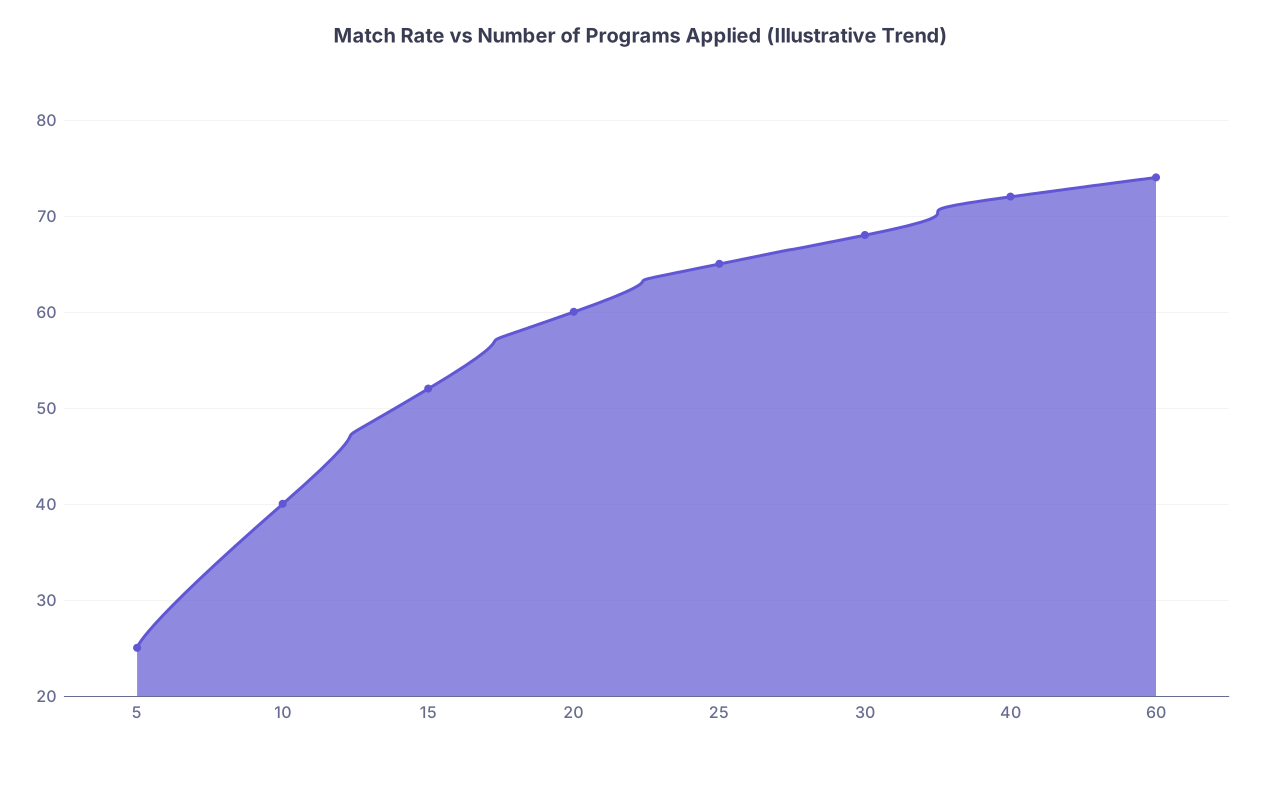
Remember, this is a category: HOW_MANY_PROGRAMS_SHOULD_YOU_APPLY_TO problem. For DO graduates, erring slightly on the side of over-application for a TY year is reasonable, because:
- There are fewer TY slots than categorical IM/FM slots
- Many TY programs are sought after by applicants going into competitive advanced specialties
- You may be competing with MDs who have robust research and high USMLE scores
However, balance this with cost and application fatigue. Applying to 70–80 programs rarely adds proportional benefit unless your situation is extreme.
B. Build a Tiered List: Reach, Target, and Safety Programs
Your program selection strategy should categorize your program list into three tiers:
Reach Programs
- More competitive TY residencies at academic medical centers
- Historically match high-scoring applicants and many into competitive advanced specialties
- Fewer DOs on resident rosters
- Apply to ~20–30% of your list here, depending on competitiveness
Target Programs
- Programs where your metrics align with their typical residents
- Often mid-sized community or community-academic hybrids
- Some DOs on the roster, moderate research infrastructure
- These should make up ~40–60% of your list
Safety/Anchor Programs
- Programs with a clear history of DO acceptance
- Community programs, or those in less competitive geographic regions
- May be less well-known, but still provide solid clinical training
- Aim for ~20–30% of your list from this category
This tiered approach reduces the temptation to apply only to “shiny” academic TYs that may not be realistic for every DO graduate.
C. Use Data and Networks to Refine Your List
To operationalize this:
Use public data and program websites:
- Look for:
- Current residents’ backgrounds (how many DOs?)
- Affiliated advanced specialty programs
- Required vs preferred exams (USMLE vs COMLEX)
- Rotation structure and electives
- Look for:
Leverage your DO network:
- Talk to:
- Recent graduates from your school who did a TY program
- Residents and attendings you’ve worked with
- Ask specifically:
- “How DO-friendly is your program?”
- “Do TY residents get good support in matching into their chosen fields?”
- Talk to:
Ask your school’s GME office or advisors:
- Many osteopathic schools track match outcomes by program.
- Ask for:
- Where past graduates with similar stats matched
- Programs that have historically liked your school’s students

Step 4: Evaluate Each Program Beyond the Name
Many DO graduates fall into the trap of focusing only on hospital brand names. Instead, use a structured checklist to decide how to choose residency programs that actually fit your needs.
A. Clinical Training and Schedule
Questions to ask and research:
- What is the balance between inpatient, outpatient, and electives?
- How heavy is the call schedule?
- Are there ICU rotations and ED exposure?
- How many elective months are available?
- If you’re still exploring specialties, more elective time is beneficial.
- If you already know your specialty, confirm you can spend substantial elective time in that department.
For a TY program, a good clinical base is crucial, but “malignant” schedules may limit your ability to do research or audition rotations.
B. Alignment with Your End-Goal Specialty
If you’re using your TY year as a bridge into a specific field:
- Does the institution have that advanced specialty on-site?
- Do TY residents routinely rotate with that department?
- Are there faculty in your specialty who are open to mentoring DOs?
- What is the track record of TY graduates matching into that field?
Example:
A DO graduate planning to pursue diagnostic radiology might prioritize a TY program where:
- There is a radiology residency at the same hospital
- Previous TY residents matched into that radiology program or comparable ones
- Electives in radiology are formally built into the schedule
C. DO-Friendliness and Culture
Subtle but vital elements of your program selection strategy:
- Are there DOs on the faculty or in leadership?
- How many current residents are DOs?
- Does the program website or coordinator explicitly welcome DO applicants?
- In interviews, do you sense respect for osteopathic training, or backhanded comments about “just DO” status?
You want a place where being a DO graduate is seen as an asset, not a liability.
D. Location, Support, and Personal Factors
Beyond training quality, you must account for:
- Geography: Can you realistically live there for a year?
- Cost of Living and Salary: Transitional year residency salary can vary; in expensive cities this matters.
- Family and Support: Will you have support during a demanding PGY-1 year?
- Visa Sponsorship (if applicable): Confirm whether TY programs sponsor J-1 or H-1B visas; not all do.
For many DO graduates, geographic ties can also increase chances of an interview and eventual match. Be sure to highlight these in your application where relevant.
Step 5: Strategic Application and Interview Management
A strong program selection strategy is only useful if you implement it well through the application and interview process.
A. Tailor Your Application for TY Programs
Even though you’re a DO graduate, you can stand out by crafting your application for the transitional year specifically:
Personal Statement:
- Clearly explain:
- Why a transitional year residency is the right step for you
- How it fits with your long-term career goals
- Avoid making TY sound like a “backup” or “placeholder.”
- Clearly explain:
Experience Framing:
- Emphasize broad clinical interests and adaptability.
- Highlight rotations that demonstrate readiness for PGY-1 responsibilities:
- Sub-internships
- ED or ICU rotations
- If you have osteopathic manipulative medicine (OMM) experience, frame it as an added skill that improves patient care.
Letters of Recommendation:
- At least one strong letter from internal medicine or general surgery
- If you know your ultimate specialty, obtain 1–2 letters from that field
- Ensure at least some letters are from ACGME faculty to reassure allopathic programs
B. Managing Interviews Across Tiers
As interview offers arrive:
Prioritize by Fit, Not Prestige Alone
- Revisit your tiered list.
- Consider:
- Culture, DO-friendliness
- Fit with your long-term goals
- Supportive environment vs name recognition
Be Ready to Discuss Being a DO Graduate
- Confidently explain your choice of osteopathic school.
- Articulate how your DO training (including OMM philosophy) enriches your approach to patient care.
Ask Targeted Questions
- “How do your TY residents typically use their elective time?”
- “Where have your recent TY graduates matched for PGY-2?”
- “What support do you provide for residents applying to advanced specialties?”
- “How many DO residents are in the program currently?”
C. Ranking Strategy
When it’s time to submit your rank list:
- Rank by desirability, not probability
- The algorithm favors your true preferences; rank your dream TY highest if you interviewed.
- Balance Advanced and TY Positions
- If you’re also ranking advanced specialties:
- Ensure your TY rank list is broad and realistic.
- Avoid pairing ultra-competitive advanced programs with only ultra-competitive TY programs, unless you also have preliminary backups.
- If you’re also ranking advanced specialties:
For DO graduates, one robust strategy is:
- Rank all advanced positions you truly want.
- Rank a deep list of TY and/or prelim medicine programs as PGY-1 options.
- Consider parallel planning with a categorical IM/FM list if your risk profile is higher.
Common Pitfalls for DO Graduates and How to Avoid Them
Pitfall 1: Underestimating Competition for TY Programs
Some DO applicants assume TY programs are “easier” than categorical spots. In reality, many are highly sought after by applicants bound for competitive specialties. Avoid:
- Applying to only 5–10 programs
- Focusing only on large academic centers in popular cities
- Ignoring prelim medicine/surgery as important backups
Pitfall 2: Ignoring COMLEX/USMLE Expectations
If you only have COMLEX scores:
- Explicitly filter for programs that accept COMLEX.
- If time permits and it aligns with your goals, consider taking USMLE Step 2 CK to increase options.
- Do not waste application slots on programs that unofficially or officially prefer USMLE only.
Pitfall 3: Neglecting Program Fit for Your Specialty Path
If your end goal is, for example, anesthesiology:
- A TY program with no anesthesia presence, no ICU exposure, and limited elective options may not serve you well.
- Conversely, a strong community TY with robust ICU and OR exposure, and anesthesiology mentorship, may be significantly more helpful than a brand-name institution where you’re peripheral.
Pitfall 4: Failing to Plan a Backup Path
Every DO graduate, regardless of strength, should consider:
- A parallel application to prelim IM or a categorical specialty that you would actually be willing to do
- At least some safety programs on the rank list
- A realistic plan if you do not match in osteopathic residency match on the first attempt
A transitional year can be a powerful tool, but it should sit within a broader, resilient career strategy.
Pulling It All Together: A Sample Strategy for a DO Graduate
Imagine a DO graduate with:
- COMLEX Level 1: 540, Level 2: 565
- USMLE Step 2: 235
- Solid clinical grades, 1 radiology research poster, wants diagnostic radiology
- No major geographic restrictions
A rational program selection strategy might look like:
Apply to:
- 20–25 TY programs (mix of academic and community, DO-friendly)
- 10–15 prelim internal medicine programs as backup
- 30–40 diagnostic radiology programs (depending on competitiveness)
Program mix:
- 6–8 reach TY programs at major academic centers with radiology residencies
- 10–12 target TY programs with good radiology exposure and history of DOs
- 5–7 safety TY/community internal medicine programs
Priorities:
- Strong elective time in radiology
- On-site radiology department with a track record of taking TY grads
- DO-friendly culture (visible DO residents/faculty)
Applying this framework, you align your transitional year residency choice directly with your long-term goals while managing DO-specific risks in the match.
FAQs: Program Selection Strategy for DO Graduates in Transitional Year
1. As a DO graduate, do I really need to take USMLE for a transitional year residency?
Not always. Many TY programs accept COMLEX scores alone, especially those with a history of training DO residents. However, if you aim for highly competitive advanced specialties or top-tier academic TYs, USMLE Step 2 CK can broaden your options and make it easier for PDs to compare you with MD applicants. Your decision should factor in your current COMLEX scores, time availability, and long-term specialty goals.
2. How many transitional year programs should I apply to if I have only COMLEX scores?
If you are otherwise a strong applicant but only have COMLEX, aim for roughly 25–35 TY/prelim programs, ensuring that:
- All explicitly accept COMLEX
- Many have a track record of matching DOs
If your scores are borderline or you have other risk factors (gaps, visa needs, strict geographic limits), consider increasing this number and including more prelim IM programs as backup.
3. Are former AOA (osteopathic) TY programs still good choices for DO graduates?
Yes. Many former AOA-accredited programs that transitioned into ACGME accreditation remain very DO-friendly and understand osteopathic training well. These can be excellent options for DO graduates, often with leadership and faculty who are DOs themselves. Always check the current resident roster and talk to alumni, because each program has evolved differently under single accreditation.
4. If I’m undecided about my specialty, is a transitional year a good idea?
It can be—if you choose the right TY program. Look for:
- Generous elective time across different fields
- Strong mentorship and advising
- A balanced workload that leaves time for exploration and reflection
However, if you’re truly undecided and want long-term security, a broad categorical specialty like internal medicine or family medicine may offer more flexibility and a guaranteed pathway without needing to reapply for PGY-2.
A well-planned program selection strategy—grounded in self-awareness, data, and DO-specific realities—can transform a transitional year from a “holding pattern” into a deliberate launchpad for your career.