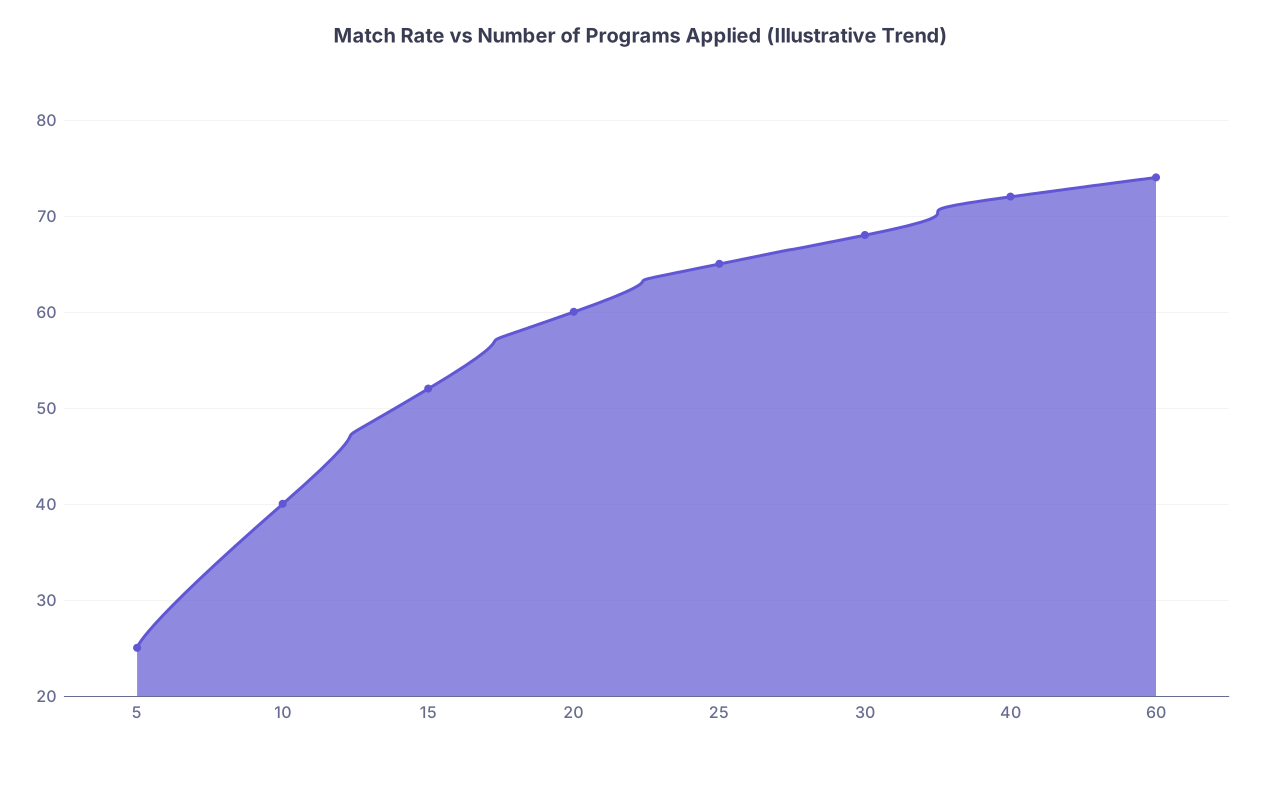
Understanding the EM–IM Combined Pathway for the MD Graduate
Emergency Medicine–Internal Medicine (EM IM) combined residency offers a unique, intensive training route for MD graduates who want dual board eligibility in both emergency medicine and internal medicine. As an MD graduate residency applicant, especially from an allopathic medical school, your program selection strategy is a critical determinant of your allopathic medical school match success.
This pathway is distinct from categorical EM or IM:
- Length: Typically 5 years
- Outcome: Dual board eligibility (ABEM + ABIM)
- Career options: Academic EM, hospital medicine, critical care fellowship, administration, hybrid ED/inpatient roles, community practice with broad flexibility
Because EM–IM combined programs are fewer, more competitive per spot, and highly variable in focus and culture, you cannot simply recycle a generic “EM list” or “IM list.” You need a deliberate strategy that clarifies:
- Which types of programs fit your goals
- How many programs to apply to
- How to choose residency programs based on your competitiveness and priorities
- How to balance EM–IM applications with categorical EM or IM
This article walks step-by-step through a rational program selection strategy tailored to the MD graduate pursuing EM–IM.
Step 1: Clarify Your Career Goals and Why EM–IM Fits
Before you build a program list, you need a precise answer to: “Why EM–IM specifically?” Your career goals will shape which programs you target and how many programs to apply to.
Common Career Paths for EM–IM Graduates
Academic hybrid clinician–educator
- Split time between ED and inpatient wards or consult services
- Teach residents and medical students in both departments
- Engage in curriculum development or educational leadership
- Best fit: Programs with strong academic institutions, robust teaching cultures, and clear opportunities for clinician–educator development.
Critical care–oriented physician
- Pursue fellowships (Pulm/CC, IM-CCM, EM-CCM, anesthesia CCM depending on program and boards)
- Work in ICUs, ED resuscitation bays, or ED-ICU hybrids
- Best fit: Programs with respected ICUs, strong critical care faculty, and established fellowship pathways.
Hospital leadership & systems roles
- ED or hospital administration, quality improvement (QI), operations, patient safety
- Dual training offers insight into throughput, sepsis pathways, observation units, etc.
- Best fit: Programs emphasizing QI, systems-based practice, leadership training, and exposure to hospital operations.
Community hybrid practice
- Work ED shifts and inpatient service weeks in a community or regional hospital
- Possibly take on medical director roles or group leadership positions
- Best fit: Programs with community affiliates, strong community rotations, and training that isn’t exclusively tertiary-referral focused.
Undecided but wants flexibility
- Enjoy both resuscitation/acute care and longitudinal management
- Still exploring long-term niche (academics vs community, ICU vs ED vs wards)
- Best fit: Programs with broad exposure and mentorship in multiple areas, not narrowly tailored to one track.
Aligning Goals with Program Features
To build an effective program selection strategy, write down:
- Your top 2–3 realistic career paths
- Whether you want to work primarily:
- Academic vs community
- ICU-heavy vs ED-heavy vs mixed
- Admin/leadership vs pure clinical
Use these answers to guide which EM–IM combined programs you consider “high-priority.” A program that doesn’t support your most likely career directions should fall lower on your list, even if it’s prestigious.

Step 2: Assess Your Competitiveness as an MD Graduate
For an MD graduate residency applicant from an allopathic medical school, EM–IM combined programs usually expect strong credentials because they are small and intensive. Competitiveness is relative; your goal is an honest self-assessment so your program list is both aspirational and realistic.
Core Metrics to Review
USMLE Scores (Step 1/2 or pass/fail context)
- Historically, combined EM–IM programs have preferred applicants at or above the mean for EM and IM.
- In the pass/fail era for Step 1, Step 2 CK performance and clinical evaluations carry more weight.
Clinical Performance
- EM rotations (especially at home or away/audition)
- Internal Medicine core and sub-internships
- Narrative comments about work ethic, communication, and independence
Standardized Letters of Evaluation (SLOEs) and Letters of Recommendation
- At least one or two EM SLOEs are often expected
- Strong IM letters from sub-I or inpatient rotations
- Dual-discipline programs highly value evidence you thrive in high-intensity teams and complex diagnostic work.
Scholarly Activity and CV
- QI projects, research, presentations, leadership, teaching roles
- EM or IM-related scholarly work is helpful but not mandatory in every case
Red Flags
- Course failures, professionalism concerns, long leaves without explanation
- Addressable but may require applying to a broader mix of program types
Rough Competitiveness Tiers (EM–IM Context)
These tiers are approximate and should be used cautiously:
Tier 1 – Highly Competitive
- Strong clinical honors, excellent SLOEs, strong IM letters
- Above-average Step 2 CK (if reported), robust CV
- Little to no academic concerns
Tier 2 – Solid / Competitive
- Mix of honors/high passes, good SLOEs and IM letters
- Step 2 CK at/near national average
- Decent CV, some leadership or QI, no major red flags
Tier 3 – Less Competitive / Risk Category
- Below-average Step 2 CK, or significant academic difficulty
- Mixed evaluations, weaker SLOEs or lack of EM exposure
- Need to demonstrate fit and resilience in your application narrative
Your tier informs not just which EM–IM combined programs you choose, but also how many categorical EM or IM programs you include to create a safe and realistic application portfolio.
Step 3: How Many Programs to Apply to in EM–IM and Overall
Because there are relatively few EM–IM combined programs nationwide, the central question is not “How many EM–IM programs exist?” but rather how to balance EM–IM with categorical EM or IM applications.
General Principles for “How Many Programs to Apply” in EM–IM
Apply to nearly all EM–IM programs that are a reasonable fit.
- The EM–IM combined universe is small enough that, for an MD graduate, applying broadly is rational.
- You can exclude:
- Locations you truly cannot live in for 5 years
- Programs whose structure or culture clearly does not match your goals
Anchor your total application strategy in risk tolerance and competitiveness.
- More competitive applicants can afford a somewhat narrower total list.
- Less competitive applicants should broaden both EM–IM and categorical lists.
Consider dual-application strategies.
- Many EM–IM applicants also apply to:
- Categorical EM
- Categorical IM
- Sometimes EM + IM at the same institution
- Many EM–IM applicants also apply to:
Suggested Ranges for EM–IM and Total Applications
These are approximate ranges, recognizing that program counts and match data evolve:
Highly Competitive Applicant (Tier 1)
- EM–IM: Apply to most or all programs that fit geographically (often ~10–15 if available in your target regions)
- Categorical EM and/or IM: 10–20 additional programs
- Total: ~20–30 programs across combined + categorical
Solid Applicant (Tier 2)
- EM–IM: Apply to nearly all EM–IM combined programs you’d consider living at
- Categorical EM and/or IM: 20–30 programs
- Total: ~30–40 programs
Less Competitive / Risk Category (Tier 3)
- EM–IM: Still apply widely, but realistically use EM–IM as one part of your plan, not the only path
- Categorical EM and/or IM: 30–40+ programs, with a strong IM component as a “safety net”
- Total: ~40–50 programs
Your program selection strategy should explicitly define:
- How many EM–IM programs you will target
- How many categorical EM and/or IM programs you will add
- Minimum target number of interviews (e.g., “I aim for at least X total interviews, with at least Y in a residency I’d be happy to match.”)

Step 4: How to Choose Residency Programs – EM–IM Specific Filters
Once you have ballpark numbers for how many programs to apply, you need a structured way to choose which EM–IM combined and categorical programs go on your list. This is your program selection strategy in action.
1. Geographic and Personal Factors
Start with non-negotiables:
- Regions where you will and will not live (family, partner career, visa issues)
- Urban vs suburban vs rural preferences
- Cost of living, climate, proximity to support system
Practical advice:
- Mark each EM–IM program on your initial list as:
- “Green” – would happily live there
- “Yellow” – acceptable, but not ideal
- “Red” – realistically would not go even if matched
Remove the reds early to avoid wasted applications and interview slots.
2. Program Structure and Curriculum
EM–IM programs are not standardized in the same way as categorical programs. Critical questions:
Balance of EM vs IM time per year
- Are rotations integrated annually, or clustered (e.g., first 2 years more IM-heavy)?
- Does the schedule feel coherent for how you like to learn?
Critical care exposure
- How many ICU months?
- Dedicated ED-ICU or resuscitation rotations?
- Opportunities for advanced procedures?
Night float and shift structure
- EM shift patterns vs IM call schedules
- How often do you switch disciplines (e.g., block vs weaving EM and IM monthly)?
5th year expectations
- Is PGY-5 more supervisory, leadership oriented, or heavily clinical?
- Are there protected time opportunities (research, education, admin)?
Programs often publish sample schedules; if not, request them during interview season.
3. Academic Strengths and Niche Focus
Align your goals with program strengths:
Critical care–strong EM–IM programs:
- Multiple ICU rotations (MICU, SICU, CCU, Neuro ICU)
- Faculty deeply involved in critical care research and fellowships
- ED resuscitation teams, shock teams, or sepsis pathways you can lead
Education-focused programs:
- Medical education fellowships in EM or IM
- Resident-as-teacher curricula
- Opportunities to lead med student courses or conferences
Research-oriented programs:
- Track record of publications by EM–IM residents
- Protected research time and mentorship
- Institutional support for conferences, grant writing
Operations and QI–oriented programs:
- ED and inpatient throughput projects
- Hospital medicine and ED leadership exposure
- Dedicated QI curriculum and committee involvement
Investigate:
- Program websites and social media
- Recent resident scholarly projects
- Fellowship match lists of graduates
4. Culture, Support, and Fit
Dual training is demanding. Culture matters more than many applicants realize.
Look for:
EM–IM resident community size
- Are there multiple residents per class or only 1?
- Do EM–IM residents feel integrated or isolated?
Relationship between EM and IM departments
- Do they collaborate well?
- Do EM–IM residents report scheduling conflicts or “tug-of-war” between departments?
Wellness and support
- How does the program handle burnout, conflicts, or serious life events?
- What is the tone from current residents when they speak off-script?
Red flags include:
- Residents consistently warning about “two residencies for the price of one” without clear support
- Descriptions of antagonism between EM and IM leadership
- Heavy service responsibilities with minimal teaching
5. Outcomes and Alumni Careers
EM–IM is about your long-term trajectory, not just 5 years of training.
Look for:
- Where recent graduates practice:
- ED-only, IM-only, hybrid roles, ICU, or nonclinical
- Fellowship match rates and types
- Leadership roles alumni hold (medical directors, academic faculty, program directors)
If your ideal path is not represented among alumni, ask explicitly if the program can support it. If they cannot give concrete examples or plans, move that program lower on your list.
Step 5: Integrating EM–IM with Categorical EM and IM Applications
A robust program selection strategy for EM–IM often includes categorical programs, especially if you are concerned about match risk or want flexibility.
Strategies for Combining EM–IM, EM, and IM Applications
EM–IM + Categorical EM
- Best if your priority is EM and you want dual training but would be happy as an EM-only physician.
- Apply EM–IM broadly, then add a standard EM list sized according to your competitiveness.
EM–IM + Categorical IM
- Best if you see yourself as a hospitalist, intensivist, or subspecialist but love acute care.
- EM–IM becomes your “stretch/ideal,” IM is your baseline pathway.
EM–IM + EM + IM
- Used by applicants who strongly desire dual training but prioritize simply matching into a residency they will be happy with, regardless of combination.
- Requires careful management of:
- Personal statement variations
- Interview scheduling
- A coherent narrative that makes sense to all program types
Application Narrative Consistency
Whatever mix you choose, your narrative must be coherent:
- Your core theme: You are drawn to both undifferentiated acute evaluation (EM) and longitudinal or complex diagnostic work (IM), and you value systems-level understanding of patient flow and outcomes.
- For categorical EM: Emphasize your passion for emergency care, then mention how IM has enriched your approach (without suggesting you are “settling” for pure EM).
- For categorical IM: Emphasize your love for diagnostic reasoning, continuity, and complex medical management, while describing how EM sharpened your acute care skills.
Programs can see all applications you send to their institution. Your story must make sense whether they’re reading your EM–IM, EM, or IM file.
Step 6: Practical Tools and Timeline for Program Selection
A strong program selection strategy is not just conceptual; it’s logistical.
Build a Centralized Program Spreadsheet
Include columns for:
- Program name and institution
- Specialty type (EM–IM, EM, IM)
- City/State and region
- Program size and EM–IM class size
- Notable strengths (ICU, education, QI, research)
- Personal priority rating (1–5)
- Competitiveness difficulty (your estimate)
- Notes from current residents or mentors
- Application status, interview offer, and final rank status
Update this regularly. This spreadsheet will guide where you send applications, which interviews you accept, and ultimately your rank list.
Involve Mentors Early
Seek advice from:
- EM and IM faculty at your medical school
- Any EM–IM trained physicians (even outside your institution)
- Recent graduates who matched into EM, IM, or EM–IM
Ask specifically:
- Which programs they would consider “must apply” for someone with your profile
- Where they think your competitiveness stands
- Whether your plan for how many programs to apply is adequately safe
Timeline Considerations
- 6–12 months before ERAS opens:
- Clarify goals, begin researching EM–IM programs, identify mentors.
- 3–6 months before ERAS:
- Finalize your general program selection strategy (EM–IM + EM, EM–IM + IM, or all three).
- Build your preliminary program spreadsheet.
- 1–3 months before ERAS:
- Refine list based on updated information, Step 2 CK results, new letters, and mentor feedback.
- Decide final approximate numbers: how many EM–IM combined vs categorical programs.
- After ERAS submission:
- As interview offers develop, reassess your risk:
- If EM–IM and EM interviews are few, consider expanding your IM reach (if still open).
- If you’re over-subscribed on interviews, prioritize programs that best fit your long-term goals.
- As interview offers develop, reassess your risk:
FAQs: Program Selection Strategy for EM–IM MD Graduates
1. As an MD graduate from an allopathic medical school, do I have an advantage for EM–IM combined programs?
Generally, yes. EM–IM combined programs are almost all based at allopathic academic centers and are very familiar with MD curricula, grading systems, and SLOEs. Being an MD graduate residency applicant from an allopathic medical school can help, but competitiveness is still driven by your individual performance, SLOEs, and letters. Strong DO and IMG applicants can also match, but MD graduates often have fewer systemic barriers.
2. What if I’m not 100% sure I want dual training in emergency medicine internal medicine? Should I still apply EM–IM?
You should only pursue EM–IM if you can articulate clear, genuine reasons for wanting dual training and are comfortable with a 5-year commitment. If you are uncertain and primarily drawn to one discipline, it is usually better to focus on that field (EM or IM) and potentially add fellowships (e.g., critical care, hospital medicine, ultrasound) to shape your career. Use shadowing and mentorship to clarify this before applications open.
3. How different is the program selection strategy for EM–IM compared to categorical EM or IM alone?
The foundational principles of how to choose residency programs are similar—geography, culture, curriculum, and career outcomes. However, EM–IM adds layers of complexity:
- Fewer programs, so your list is necessarily more national in scope
- Greater emphasis on how EM and IM departments relate to each other
- Need to protect yourself with categorical applications in at least one specialty
- More focus on long-term flexibility (hybrid roles, ICU, leadership)
Thus, EM–IM applicants must be more deliberate and systematic in constructing their lists and determining how many programs to apply to across categories.
4. If I have a weaker Step score or an academic red flag, should I still apply to EM–IM combined programs?
You can, but you should not rely on EM–IM alone. For applicants with red flags or lower scores, EM–IM becomes a high-reward but higher-risk target. Your strategy should:
- Include EM–IM programs where your mentors think you have a realistic shot
- Substantially broaden your categorical EM and/or IM applications
- Use your personal statement and interviews to address challenges head-on and highlight growth, resilience, and clinical strengths
In other words, EM–IM can remain on your list, but your safety and match probability will come more from a robust categorical EM or IM application strategy.
By clarifying your goals, honestly assessing your competitiveness, and thoughtfully planning how many programs to apply to across EM–IM and categorical EM/IM, you can construct a program selection strategy that maximizes your chances of matching into a residency that truly fits your vision for a career in emergency medicine internal medicine.