Understanding the ENT Residency Landscape as an MD Graduate
For an MD graduate residency applicant, the otolaryngology match can feel uniquely high‑stakes. ENT residency is one of the more competitive specialties in the allopathic medical school match, with relatively few spots, strong applicants, and significant variability between programs in case mix, research emphasis, and culture. A thoughtful program selection strategy is not optional—it’s essential.
Before deciding how many programs to apply to or which ones to target, you need a realistic understanding of:
- The competitiveness of ENT overall
- Where you fit in the applicant pool
- The types of programs that exist (academic vs community, research‑heavy vs clinical)
- Geographic and lifestyle factors that matter to you
This article breaks down a stepwise, practical program selection strategy tailored to MD graduates pursuing an otolaryngology match. You’ll learn how to:
- Analyze your competitiveness using objective and subjective metrics
- Build a smart list of “reach,” “target,” and “safer” programs
- Decide how many programs to apply to given your profile
- Use data (not rumors) to guide choices
- Avoid common pitfalls that hurt match chances
Throughout, assume you are an MD graduate from an LCME‑accredited allopathic medical school applying in the current or upcoming cycle; if your path differs (e.g., MD‑PhD, reapplicant, or dual‑apply), the core principles still apply with some adaptation.
Step 1: Honestly Assess Your Competitiveness in ENT
Before you think about how to choose residency programs, you must understand what you bring to the table. ENT is holistic in many ways, but there are some relatively consistent dimensions programs consider:
1. Academic Metrics
Even with USMLE Step 1 now pass/fail, program directors still lean heavily on:
Step 2 CK score
- Historically, matched ENT applicants often scored well above the national mean.
- A strong Step 2 (e.g., ~250 or above) improves your odds at more competitive programs; a solid but more average score will push you to be more strategic and broad.
Medical school performance
- Clinical clerkship grades (especially surgery and related rotations)
- Honors/AOA or Gold Humanism if applicable
- Class rank or quartile, where reported
Actionable tip:
Write down your Step 2 CK score (or projected score), class standing, and key clerkship grades. Compare them with national ENT applicant data (NRMP Charting Outcomes in the Match, otolaryngology specialty reports, and your school’s match data). This gives you a realistic starting point.
2. ENT‑Specific Exposure and Letters of Recommendation
ENT residency programs look closely at:
- ENT rotations (home and away/sub‑I rotations)
- Strength and specificity of your ENT letters of recommendation
- Evidence that you truly understand the specialty and will thrive in it
Aim to have:
- At least 2–3 strong ENT letters from faculty who know you well
- Ideally one from a department chair or program director, if possible
- At least one from an away rotation if your home ENT department is limited or if you’re targeting a different region
If your letters are coming from well‑known ENT faculty who can speak to your work ethic, operative potential, and personality, that effectively increases your competitiveness tier.
3. Research Profile
ENT is very research‑friendly, especially in academic programs. Programs look at:
- Number of publications, abstracts, and presentations
- Whether ENT‑related or in another field
- Depth of involvement (first‑author projects, continuity, meaningful role)
- Any advanced degrees or dedicated research time (e.g., research year)
A rough heuristic:
- High research profile: Multiple ENT‑focused publications, national presentations, maybe a research year or MD‑PhD
- Moderate research profile: A few projects, including at least some ENT‑related; maybe a poster or oral presentation
- Minimal research: Little to no scholarly work; or non‑ENT research only
The more academic and research‑heavy the program, the more this dimension matters.
4. Non‑Cognitive and Personal Factors
Programs pay close attention to:
- Professionalism, reliability, and teamwork (from letters and rotation feedback)
- Communication skills and bedside manner
- Diversity of experiences, leadership, volunteerism, or unique life story
- Evidence of resilience, maturity, and a positive presence in the OR and clinic
These factors often become decisive when selecting interviewees among academically similar candidates.
Translating Self‑Assessment into a Competitiveness Tier
To start building a program selection strategy, place yourself—honestly—into a rough tier:
Tier 1 (Highly Competitive):
- Strong Step 2 CK; honors in key clerkships
- Multiple strong ENT letters from known faculty
- Robust ENT research record
- Excellent evaluations and strong home ENT support
Tier 2 (Competitive/Typical Matched Applicant):
- Solid Step 2 CK and overall transcript
- Good ENT letters; at least some ENT research or scholarly work
- No major red flags; strong clinical performance
Tier 3 (More Challenged Applicant):
- Below‑average Step 2 CK, lower class rank, or non‑honors clerkships
- Limited ENT exposure or research
- Red flags (course failures, professionalism concerns, etc.)
- Or coming from a school without a home ENT program or minimal institutional support
Your tier is not destiny, but it should drive your program selection strategy, including how many programs to apply to and which types.

Step 2: Clarify Your Priorities and Constraints
Once you understand your competitiveness, clarify what you want out of ENT residency. A realistic, prioritized list of preferences helps you create a rational program selection strategy rather than an emotional or random one.
1. Geographic Preferences
Ask yourself:
- Are there non‑negotiable regions (e.g., spouse’s job, family needs, visa constraints)?
- Are you open to training anywhere, or do you strongly prefer urban vs suburban vs rural?
- Are there areas where you would not be happy living for 5+ years?
For a competitive specialty like ENT, geographic flexibility increases match chances. If you are highly constrained geographically, you may need to:
- Apply to every ENT program in that region, including smaller and mid‑tier institutions
- Consider a dual‑apply strategy (e.g., ENT + general surgery) if extremely limited
2. Academic vs Community Emphasis
ENT programs vary along a spectrum:
Academic, research‑intensive programs
- Strong emphasis on basic science or clinical research
- High subspecialty exposure and fellowship placement
- Heavier academic expectations, potential research electives or required projects
Hybrid or community‑based academic programs
- Solid clinical volume, maybe less basic science research
- Strong clinical training with decent fellowship prospects
- Often a good “middle ground” for many applicants
Clarify whether your long‑term goal is:
- An academic career with NIH‑funded research
- Clinically oriented academic practice
- Private practice or community‑based ENT
This will influence whether you prioritize research reputations or clinical autonomy.
3. Case Mix and Subspecialty Exposure
Some programs are known for:
- Strong otology/neurotology, head and neck oncology, pediatrics, or rhinology
- Extensive trauma or emergency ENT exposure
- High surgical volume but limited subspecialty breadth, or vice versa
If you already have a strong interest (e.g., pediatric ENT), seek programs with dedicated faculty and robust case volume in that area. If you’re undecided, prioritize balanced programs with broad exposure.
4. Culture, Size, and Support
Some elements are harder to see on paper but strongly affect your quality of life:
- Program size (e.g., 2 vs 4–5 residents per year)
- Call structure and work hours
- Faculty approachability and resident autonomy
- Formal mentorship structures and wellness initiatives
- Diversity, equity, and inclusion efforts
You’ll refine your impressions later through residents, interviews, and virtual content, but start by deciding what matters to you: do you thrive in a tight‑knit small program or a large, bustling academic department?
Step 3: Use Data and Tools to Build an Initial ENT Program List
Once you know your competitiveness and priorities, the next step is a data‑driven list. Resist the temptation to rely solely on reputation or word of mouth.
1. Start with Comprehensive Program Directories
Use several sources:
- FREIDA (AMA residency database) for ENT
- The American Academy of Otolaryngology–Head and Neck Surgery residency listings
- Individual program websites and institutional GME pages
- Your school’s ENT advisors or match lists from recent graduates
Create a spreadsheet including:
- Program name and institution
- Location (city, state, region)
- Program size (residents per year)
- Clinical setting (university, community, hybrid)
- Research infrastructure (labs, publication expectations, T32 grants)
- Website impressions (resident bios, fellowship placements, diversity, etc.)
2. Integrate Objective Match Data
For an MD graduate residency applicant, your best friends are data sources like:
- NRMP Program Director Survey for otolaryngology
- NRMP Charting Outcomes in the Match (especially allopathic medical school match data for ENT)
- Any specialty‑specific match analyses shared by ENT organizations
These resources can help you estimate:
- Typical Step 2 CK ranges for matched ENT applicants
- Average number of contiguous ranks for matched vs unmatched applicants
- Impact of research volume on match success
- How many programs ENT applicants usually apply to and rank
Use this to calibrate your expectations. For example:
- If typical successful ENT applicants rank ~10–12 programs, that implies they obtained roughly that many interviews; most applied to significantly more.
- If you are below average in a key metric, you may need to apply more broadly and cast a wider net.
3. Use School‑Specific and Advisor Input
Leverage:
- Recent ENT match lists from your home institution
- Advice from your ENT department leadership or program director
- Feedback from senior residents who know your application well
Ask specifically:
- “Given my profile, am I a strong, average, or borderline ENT candidate?”
- “What range of programs have applicants like me matched into from our school?”
- “Are there programs we have particularly good or poor match histories with?”
Advisors can help distinguish realistic “reach” programs from “fantasy” ones.
Step 4: How Many Programs Should You Apply to in ENT?
There is no single number that fits every MD graduate. However, there are principled guidelines based on your competitiveness tier, geographic flexibility, and application strength.
General Considerations
Consider:
- ENT is a competitive specialty with limited spots.
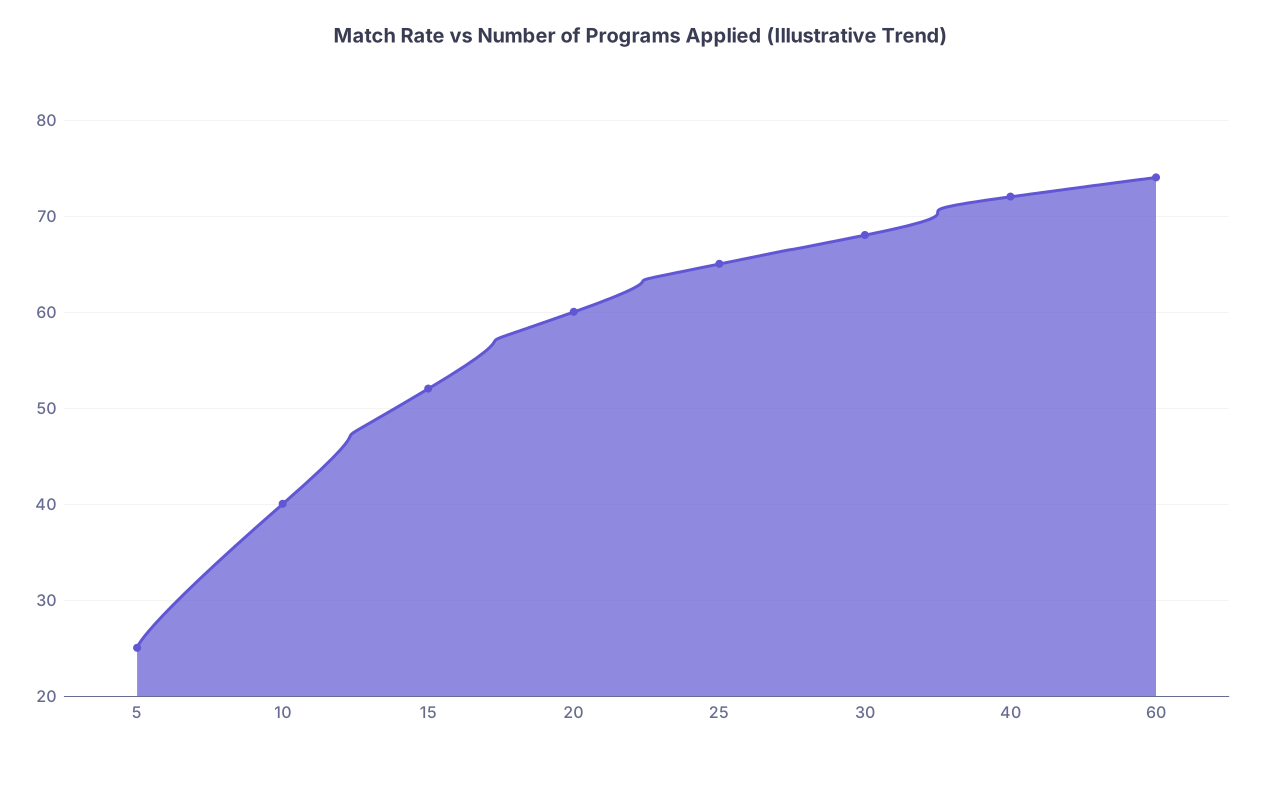
- Application inflation means most applicants now apply to many programs—often 50+ programs.
- More applications cost more money and time, but too few can be catastrophic.
Your program selection strategy should balance maximizing match chances with avoiding waste.
Suggested Application Ranges by Competitiveness Tier
These are ballpark numbers; always adjust with advisor input.
Tier 1 (Highly Competitive MD Applicant)
- Strong academics, robust ENT research, great letters
- Reasonable geographic flexibility
You might:
- Apply to 35–50 ENT programs
- Focus on a mix of top‑tier academic centers and solid mid‑tier/hybrid programs
- Reserve some applications for “safety” or less competitive regions
Tier 2 (Typical Competitive MD ENT Applicant)
- Solid but not stellar metrics, good ENT exposure, some research
You might:
- Apply to 50–70 ENT programs
- Be geographically broad, including large and smaller cities, and across regions
- Include a substantial number of “mid‑tier” and less renowned programs where your profile is well‑aligned
Tier 3 (More Challenged or Borderline ENT Applicant)
- Lower scores, limited research, or notable red flags
- Or highly constrained geography
You might:
- Apply to 70+ ENT programs, possibly all that are realistically feasible given your constraints
- Strongly consider a dual‑apply strategy (e.g., ENT + another surgical specialty)
- Include every ENT program in preferred regions plus many in less competitive regions and smaller markets
Remember: the question “how many programs to apply” cannot be divorced from which programs and what your profile looks like.
Balancing Quantity and Quality
More applications ≠ better strategy unless they’re well‑chosen. It’s better to:
- Thoughtfully apply to 55 programs that genuinely fit your profile and interests
- Than to scatter 80+ applications blindly, including many programs unlikely to seriously consider you
Ask yourself for each program:
- Is this a place where my profile is reasonably competitive?
- Would I be happy training here if it were my only match outcome?
If the answer to both is “yes,” it belongs on your list.

Step 5: Categorize Programs: Reach, Target, and Safer Options
A sophisticated program selection strategy for otolaryngology match goes beyond just deciding how many programs to apply to. You also need a balanced distribution among:
- Reach programs (ambitious but not impossible)
- Target programs (well‑aligned with your profile)
- Safer programs (where you are likely above average)
1. Defining Each Category
Reach Programs
- Known for high competitiveness (prestige, location, research intensity)
- Tend to attract very high‑scoring applicants with extensive research
- You may be below average in one or more domains (e.g., Step 2 CK, research volume), but not wildly out of range
Target Programs
- Programs where your academic metrics, research, and letters are on par with or slightly above what you infer from match data and your advisors
- Not necessarily “lesser” programs—often they are excellent hybrid or mid‑tier academic centers
- Often the backbone of your match probability
Safer Programs
- Programs where you likely exceed the typical applicant profile or that may receive fewer total applications (e.g., less popular locations, smaller markets)
- You would still be ready and willing to train there; they are not “throwaway” choices
- Critical for ensuring you have enough interviews
2. Recommended Distribution
As a rough guide:
Tier 1 applicant:
- 30–40% reach, 40–50% target, 10–20% safer
Tier 2 applicant:
- 15–25% reach, 50–60% target, 20–30% safer
Tier 3 applicant:
- 10–15% reach, 35–45% target, 40–50% safer
You can mark each program as R (reach), T (target), or S (safer) in your spreadsheet. The exact proportions will be shaped by your geographic constraints and advisor input.
3. Using Program Characteristics to Estimate Category
Since ENT programs don’t publish cutoffs, you’ll infer categories by:
Comparing your metrics with:
- Known prestige and selectivity (e.g., large academic centers in major cities usually lean “reach”)
- Your school’s match history to that program (if any)
- Your estimated standing relative to recently matched graduates
Looking at:
- Research requirements and scholarly output of residents
- Number of applicants versus positions (either published or inferred)
- Prior ENT match patterns from your school and similar institutions
It won’t be perfect, but even a rough categorization improves your program selection strategy.
Step 6: Refine Your List with Qualitative Information
Once you have a preliminary, numerically balanced list, refine it using qualitative factors.
1. Dive Deeper into Program Websites and Social Media
Look for:
- Resident and faculty bios (backgrounds, interests, fellowships)
- Sample resident schedules, call structure, and rotation sites
- Operative volume and case logs (when available)
- Program‑specific strengths (e.g., cochlear implants, advanced skull base surgery)
- Diversity and inclusion statements and initiatives
- Wellness resources, mentorship programs, professional development
Programs increasingly use social media (e.g., Twitter/X, Instagram) to showcase:
- Resident life
- Research accomplishments
- Community engagement
- Culture and camaraderie
This helps you assess “fit” beyond raw data.
2. Talk to Residents and Recent Graduates
Reach out (politely) to:
- Residents at programs you are seriously considering
- Recent ENT graduates from your medical school
- Students a year or two ahead of you who matched in ENT
Questions to ask (briefly and respectfully):
- “What do you like most and least about your program?”
- “How would you describe the operative autonomy and teaching culture?”
- “What kind of applicants seem to thrive there?”
- “Is there anything you wish you had known before applying or ranking?”
Use these insights to reclassify some programs from reach to target or vice versa, and to identify programs that may not fit your personal priorities.
3. Consider Personal and Lifestyle Factors
Even in a competitive specialty, your happiness matters. In refining your list, think about:
- Cost of living and resident salary
- Spousal/partner employment opportunities
- Proximity to family or support systems
- Climate and city size preferences
- Access to outdoor activities, cultural amenities, or specific religious/ethnic communities
If a program scores very low on multiple non‑negotiable factors, it may not belong on your list, even if it’s otherwise “strong.”
Step 7: Common Pitfalls in ENT Program Selection (and How to Avoid Them)
When designing an otolaryngology match strategy, MD graduates frequently fall into predictable traps:
Pitfall 1: Over‑reliance on Prestige
Focusing mostly on top‑tier academic names without enough mid‑tier and safer programs is a classic setup for an unnecessary SOAP or unmatched year. Remember:
- Many “non‑top‑10” ENT programs provide superb surgical and clinical training.
- Fellowship placement and job prospects often depend more on your own performance than the brand name.
Solution: Ensure your list has a broad mix, not just famous names.
Pitfall 2: Under‑applying Due to Overconfidence
Some MD graduates with strong profiles underestimate how tight the ENT match can be and apply to too few programs (“I’ll apply to 20–25 that I really like”). This is risky.
Solution: Even strong ENT applicants should apply broadly enough (often 35–50+ programs) unless they have exceptional, personalized advisor guidance to do otherwise.
Pitfall 3: Ignoring Geographic Reality
If you strongly limit your geography (e.g., “Northeast only”), you drastically shrink your pool, especially in ENT where programs are not evenly distributed.
Solution:
Be honest about what is absolutely non‑negotiable vs preferred. Open at least some flexibility (e.g., multiple regions) unless life circumstances truly prevent it.
Pitfall 4: Applying to Programs You Would Never Actually Attend
Some applicants pad their list with programs they already know they would never rank highly, often in locations they truly dislike.
Solution:
Only apply to programs where you could genuinely imagine training. You don’t have to love every city, but outright “no chance” locations waste both money and decision‑making bandwidth.
Pitfall 5: Neglecting Backup Plans
In very competitive specialties like ENT, even a well‑executed program selection strategy may not guarantee a match. Some applicants avoid thinking about backup options until it’s too late.
Solution:
Discuss with your advisors early:
- Whether a dual‑apply strategy (e.g., ENT + general surgery or another field) is appropriate
- What you would do in an unmatched scenario (prelim year, research year, reapply strategy)
Planning does not mean you are less committed to ENT—it means you’re realistic.
Putting It All Together: A Sample ENT Program Selection Strategy
To illustrate, consider an example:
Applicant Profile:
- MD graduate from a U.S. allopathic medical school
- Step 2 CK: 247
- Clinical performance: Mostly honors, especially in surgery; AOA
- ENT exposure: Home rotation and one away; good feedback
- Research: 2 ENT publications, 1 poster at a national ENT meeting
- Letters: 3 strong ENT letters (one from chair, one from away)
- Geography: Prefers Northeast or Midwest but open to entire country
- No major red flags
Strategy:
- Self‑assesses as Tier 2 (competitive/typical matched).
- Plans to apply to 55–60 ENT programs.
- With advisor help, categorizes:
- 10–12 reach programs (highly prestigious, heavily research‑oriented big city programs)
- 30–35 target programs (solid academic and hybrid programs in a range of cities and regions)
- 10–15 safer programs (smaller markets, community‑based academic centers where they likely stand out)
- Uses websites, residents’ feedback, and school match history to refine the list.
- Ensures every program on the list is somewhere they would honestly be willing to train.
- Does not dual‑apply, given overall competitiveness and advisor confidence, but has a plan for unmatched scenarios (e.g., research year) just in case.
This kind of disciplined, realistic approach maximizes interview yield and match probability without applying indiscriminately.
FAQs: ENT Program Selection Strategy for MD Graduates
1. As an MD graduate, how many ENT programs should I apply to?
For most MD graduates in otolaryngology, a typical range is:
- Highly competitive applicants: ~35–50 programs
- Average competitive applicants: ~50–70 programs
- Borderline or constrained applicants: 70+ programs, potentially all feasible programs
The exact number depends on your Step 2 CK, grades, research, letters, geographic flexibility, and advisor recommendations. When in doubt, lean slightly toward applying to more programs, but make sure they are chosen strategically, not randomly.
2. Should I dual‑apply if I’m not a top ENT candidate?
It depends on your risk tolerance and your specific profile:
- If you have multiple significant weaknesses (low scores, minimal ENT exposure, or notable red flags) or very narrow geographic constraints, a dual‑apply strategy (ENT + another specialty) is often wise.
- If you are a reasonably competitive MD ENT applicant with some modest concerns, many advisors may still support a single‑apply strategy, with a well‑developed backup plan for reapplication if needed.
Discuss candidly with your ENT mentors and dean’s office; local match history at your school matters.
3. How important is it to have ENT‑specific research for the otolaryngology match?
ENT‑specific research is very helpful, particularly for academic and research‑intensive programs, but not strictly mandatory at every program:
- Highly academic ENT programs often expect ENT‑related publications or significant research work.
- Hybrid/community‑based programs may value research less than solid clinical performance, strong letters, and demonstrated interest.
If you lack ENT‑specific research, try to highlight other scholarly work, your clinical strengths, and your engagement with ENT through rotations, shadowing, and letters.
4. Can I still match in ENT if my Step 2 CK is below the “average” of matched applicants?
Yes, it’s possible, especially as an MD graduate with strong other attributes, but you’ll need:
- Excellent clinical performance and strong, detailed ENT letters
- Evidence of professionalism, teamwork, and fit for the specialty
- A broad and strategic application list with plenty of target and safer programs
- Realistic expectations about which programs are reach vs target vs safer
A lower Step 2 CK means you must be more deliberate about how many programs to apply to and which ones; your program selection strategy becomes even more critical.
A well‑planned program selection strategy for MD graduates in otolaryngology isn’t just a spreadsheet exercise—it’s a structured way to align who you are with where you’re likely to thrive. By honestly assessing your competitiveness, clarifying your priorities, applying to an appropriate number of programs, and distributing them thoughtfully across reach, target, and safer categories, you maximize your chances of a successful allopathic medical school match in ENT while setting yourself up for a fulfilling residency experience.