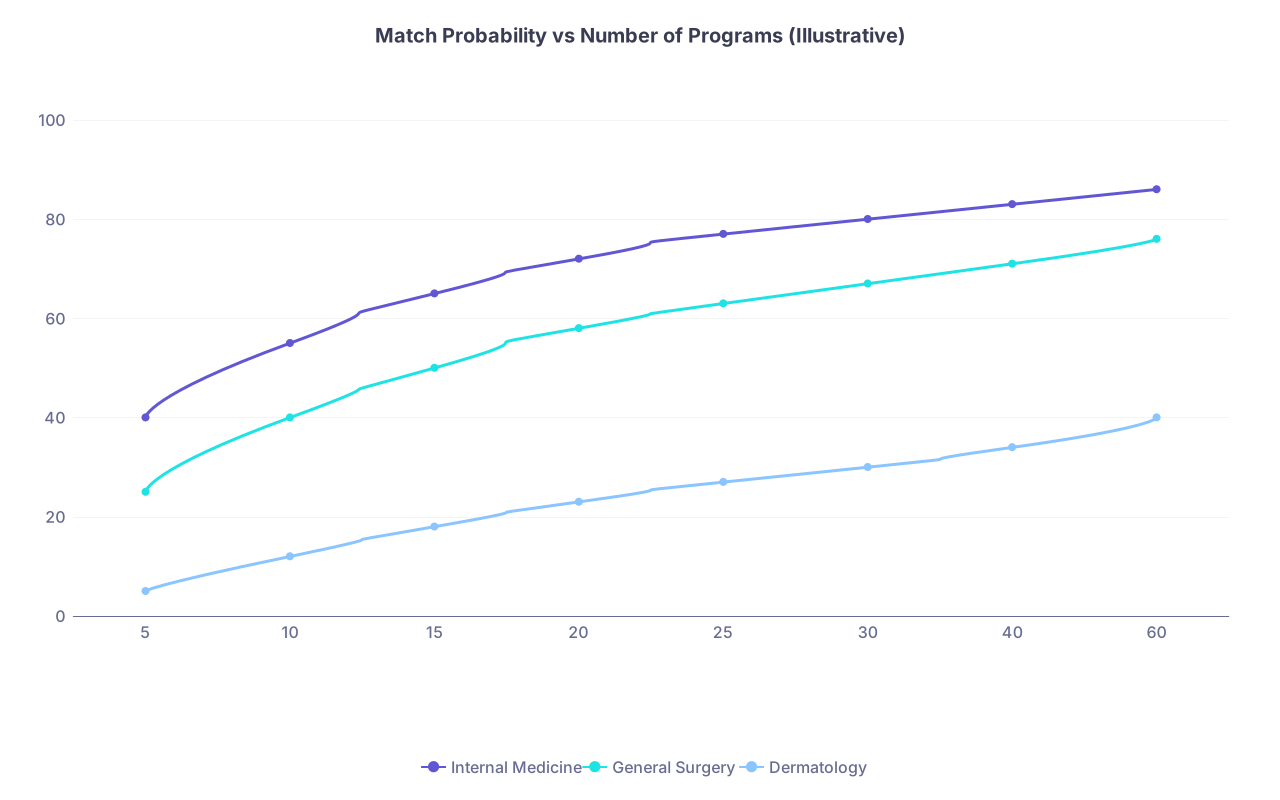
Understanding the ENT Landscape as a US Citizen IMG
Otolaryngology–Head and Neck Surgery (ENT) is one of the most competitive specialties in the Match. For a US citizen IMG (American studying abroad), this competitiveness is amplified by structural barriers: fewer programs willing to rank IMGs, limited away rotation opportunities, and extra scrutiny of your academic record.
This article focuses on program selection strategy—how to build a smart, realistic, and optimized list as you apply to ENT residency. We will address:
- How many programs to apply to as a US citizen IMG
- How to choose residency programs in ENT given your profile
- How to interpret “IMG friendly” and data from prior matches
- Practical steps to segment programs into tiers
- How to balance aspiration vs. realism
- ENT-specific nuances (research, letters, audition electives) that should shape your list
Throughout, keep in mind one core principle:
Your program selection strategy is as important as your personal statement or letters. A strong application sent to the wrong set of programs will still fail.
Step 1: Know Where You Stand as a US Citizen IMG in ENT
Before deciding how many programs to apply to or which ones to target, you need a clear-eyed assessment of your competitiveness. For US citizen IMGs, self-assessment should be brutally honest, because otolaryngology match numbers for IMGs are small.
Key Competitiveness Factors in ENT
USMLE Performance
- Step 1 (now Pass/Fail)
- A pass on first attempt is essential; failures are a significant red flag.
- Step 2 CK Score
- In a competitive field like ENT, program directors typically prefer scores ≥ 240, and for top-tier university programs often ≥ 250.
- As a US citizen IMG, this metric often carries more weight because PDs use it as a proxy for comparison against US MDs.
- Step 1 (now Pass/Fail)
Research and Scholarly Activity
- ENT is research-heavy. Programs value:
- ENT-specific research (clinical, outcomes, basic science)
- Publications, abstracts, and posters at major meetings (e.g., AAO-HNSF)
- Evidence of longitudinal involvement, not just “one summer project”
- For IMGs, a strong research portfolio can partly offset the “IMG bias” at some academic programs.
- ENT is research-heavy. Programs value:
Letters of Recommendation (LORs)
- At least 2 letters from US otolaryngologists are preferred, ideally faculty known nationally or regionally.
- One additional letter from another US physician (e.g., internal medicine, surgery) or your research mentor is common.
- For a US citizen IMG, strong US-based ENT letters signal that:
- You have been vetted by the US system.
- You can function well in US clinical environments.
Clinical Experience and Audition Electives (“Away Rotations”)
- ENT is a small field—face time matters.
- US clinical rotations in ENT (ideally at teaching hospitals) are essential for:
- Generating letters
- Demonstrating operative and clinic performance
- Increasing your odds of interviews at that site
- As an IMG, you may have fewer away rotation options, making strategic choice of where you rotate crucial.
Red Flags
- USMLE failures or multiple attempts
- Significant academic remediation
- Large gaps in training without explanation
- History of professionalism issues
- These don’t automatically disqualify you, but they sharply narrow your program universe and force you toward programs with a track record of flexibility.
Categorizing Yourself: A Practical Framework
Use these rough categories to guide your program selection strategy:
- Highly Competitive US Citizen IMG
- Step 2 CK ≥ 250
- No failures, strong ENT research (ideally publications)
- 2–3 US ENT letters, including one from a well-known faculty member
- Strong US audition rotation evaluations
- Moderately Competitive US Citizen IMG
- Step 2 CK ~ 238–249
- Solid research (at least some ENT involvement, maybe not multiple publications)
- At least 1–2 US ENT letters
- At least one US ENT rotation; no major red flags
- Below-Average/At-Risk US Citizen IMG
- Step 2 CK < 238 or failure on any USMLE exam
- Limited or no ENT-specific research
- No US ENT letters or difficulty securing them
- Minimal US clinical experience
Your tier informs how many programs to apply to and the balance between “reach” and “safer” programs.
Step 2: How Many ENT Programs Should a US Citizen IMG Apply To?
Because ENT is small and competitive, US citizen IMGs often need to apply very broadly.
General Guidelines
For ENT, there are roughly 120–130 ACGME-accredited programs, and each offers very few positions per year. Historically, the number of US citizen IMGs matching into ENT each year is in the single digits or low double digits.
Given this, a reasonable starting point:
- Highly competitive US citizen IMG:
- Apply to 60–80 ENT programs
- You may strategically exclude a small number that clearly do not consider IMGs or have highly restrictive criteria.
- Moderately competitive US citizen IMG:
- Apply to 80–110 ENT programs
- Cast a very wide net; you cannot reliably predict where you will get interviews.
- Below-average/At-risk US citizen IMG:
- Carefully reconsider if applying ENT-only is wise.
- If committed, apply to virtually all ENT programs (100+) that do not explicitly exclude IMGs, and have a parallel plan (e.g., preliminary surgery, categorical another specialty).
Why So Many?
Limited IMG-Friendly ENT Programs
- Many ENT programs simply don’t rank IMGs, or do so very rarely.
- Even if your application is strong, structural bias can limit your interview options.
Small Class Sizes
- Many ENT programs have 2–4 residents per year.
- Interview spots are few, and competition from US MD and DO applicants is intense.
High Variability in Selection Criteria
- Some programs love research; others prioritize clinical skills or local connections.
- You cannot always tell from a website who will consider a strong US citizen IMG.
Application Cost vs. Opportunity Cost
- Additional ERAS applications are expensive, but the cost of going unmatched after devoting 4+ years of medical school and dedicated ENT preparation is far greater.
- For a US citizen IMG, the marginal benefit of one extra program is often higher than for US MDs because every additional “IMG-considering” program is precious.
Step 3: Program Selection Strategy – Building a Targeted ENT List
Once you know the approximate number of programs, the next step is how to choose residency programs that fit your profile and maximize your odds.
3.1 Identify Programs That Historically Consider IMGs
You should first answer: Where have IMGs matched in ENT before?
Data Sources and Tactics
Program websites and resident profiles
- Scan current and recent graduates for:
- IMGs or international medical schools
- US citizen IMGs listed by their foreign medical school names
- If you see zero IMGs in the past 10+ years, treat that as a strong signal.
- Scan current and recent graduates for:
FREIDA (AMA), program directories, and NRMP data
- FREIDA sometimes lists whether they accept IMGs and visa sponsorship, though this isn’t always ENT-specific.
Networking
- Talk to:
- ENT residents and fellows
- Your ENT mentors
- Other IMGs who matched ENT
- Ask directly:
- “Which programs have you seen US citizen IMGs match at?”
- “Are there programs that seem more open to IMGs?”
- Talk to:
Direct outreach (selectively)
- Some programs will disclose whether they typically consider US citizen IMGs.
- Keep communication concise, professional, and respectful of PDs’ time, and do not mass-email every program.
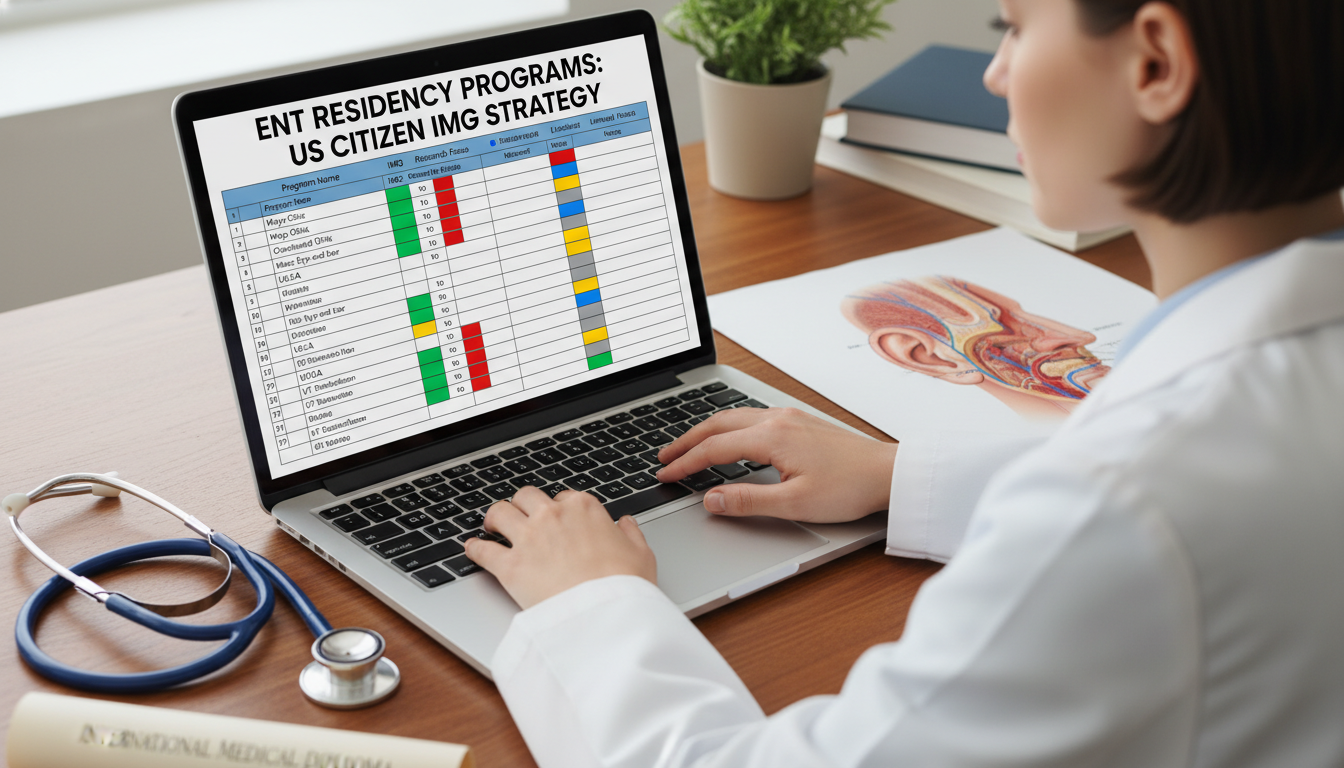
Once you compile this information, create a list (spreadsheet recommended) with columns for:
- Program name and location
- Evidence of prior IMGs (Y/N, notes)
- Visa policy (even as a US citizen IMG, this hints at openness to international graduates)
- Size and academic vs. community orientation
- Personal connections (faculty, mentors, alumni)
3.2 Segment Programs Into Tiers
A sophisticated program selection strategy involves tiering programs into Reach, Target, and Safety (relative safety, given ENT’s competitiveness).
Reach Programs
- Characteristics:
- Top academic centers with strong NIH funding and many publications
- Historically low or no IMG representation
- Very high average USMLE scores and research expectations
- Should you apply?
- Highly competitive US citizen IMG: Yes, choose a meaningful but limited set (e.g., 10–20).
- Moderate or Below-average IMG: Apply sparingly; maybe a few dream programs, but don’t overinvest your list here.
Target Programs
- Characteristics:
- Mid-sized academic or hybrid programs
- Some evidence of prior IMGs or at least openness to them
- Moderate to strong emphasis on research and clinical training
- Reasonable but not hyper-competitive average scores
- Should you apply?
- This should be the core of your application list, especially if you are a moderately competitive US citizen IMG.
- Expect the majority of your interviews to come from this group.
Relative “Safety” Programs
In ENT, there are no true “safety” programs. But relatively safer programs for a US citizen IMG might include:
- Programs with:
- Documented history of taking IMGs
- Smaller or newer academic centers
- Balanced emphasis on research and clinical care, but not requiring powerhouse research portfolios
- Less glamorous locations that may attract fewer US MD applicants
- These are critical for:
- Moderately competitive US citizen IMGs
- Below-average applicants who still want a chance at ENT
3.3 Weighing Location vs. Opportunity
You may be tempted to limit your list to specific regions (e.g., “I only want the Northeast”). For a US citizen IMG in ENT, this is risky.
- Priority hierarchy (especially for your first application cycle):
- Programs that consider IMGs and fit your profile
- Programs with a training culture you can succeed in
- Geographic preference
If you must prioritize location (e.g., family obligations), widen your strategy within that region by:
- Applying to every ENT program in that region that does not explicitly exclude IMGs.
- Being especially strong on research and networking within that region.
Step 4: ENT-Specific Factors to Use When Choosing Programs
Because ENT is uniquely research and skill intensive, certain characteristics should strongly shape how you choose residency programs.
4.1 Research Intensity vs. Your Portfolio
Ask yourself:
- Do I have significant ENT research (multiple projects, publications, conference presentations)?
- Am I aiming for a future academic career (fellowships, research)?
If you have strong research and academic ambitions:
- Include more research-heavy university programs, especially those:
- With NIH funding in head and neck cancer, otology, rhinology, etc.
- That emphasize scholarly productivity in their curriculum
- But as a US citizen IMG, still balance your list with programs more neutral about IMGs; don’t exclusively target elite research centers.
If your research is limited:
- Focus on programs that:
- Highlight strong clinical training, operative experience, and community exposure
- Are less research-intense, or at least not research-obsessed
- You can still publish during residency, but your program selection should reflect where your current record gives you a fair shot.
4.2 Program Size and Culture
Smaller ENT programs (1–2 residents per year):
- Pros:
- Close faculty interaction
- High operative exposure per resident
- Cons:
- Fewer interview slots
- May be more insular or locally focused
- As a US citizen IMG:
- These can be great if they’ve clearly taken IMGs before.
- But they are high risk if there’s no evidence of IMG acceptance.
Larger programs (3–4+ residents per year):
- More interview spots, more diverse resident groups
- May be more flexible in considering strong non-traditional or IMG applicants
- Often have subspecialty fellowships and more formal research infrastructure
Your program selection strategy should sprinkle both types, leaning toward larger programs if you lack clear signals of IMG-friendliness.
4.3 Audition Rotations and Their Impact on Program Selection
As an American studying abroad, your audition rotations (sub-internships) in ENT are pivotal:
- If you rotate at a program and perform well:
- That program becomes a high-yield target on your list.
- Many ENT residents match where they rotated.
- If you cannot rotate widely due to visa/time constraints:
- Choose away sites strategically:
- Programs with known IMG openness
- Regions where you could see yourself long-term
- Choose away sites strategically:
Program list implications:
- Any program where you rotate should be high on your rank list and a definite inclusion in your ERAS submission.
- If you have limited rotation slots (typically 1–3), choose them based on:
- Balance of IMG-friendliness, academic strength, and location preference.

Step 5: Practical Steps to Build and Finalize Your ENT Program List
Here is a step-by-step program selection strategy you can use as a US citizen IMG applying to ENT.
Step 1: Create a Master List
- Use FREIDA, ACGME, and online directories to list all ACGME-accredited ENT programs.
- Include columns for:
- State/city
- University vs. community
- Number of positions
- Website link
- Research emphasis (low/moderate/high)
Step 2: Add IMG-Friendliness Data
For each program, mark:
- “Evidence of IMG” (Yes / No / Unknown)
- “Visa sponsorship” (Yes / No / Not stated)—even as a US citizen IMG, programs that sponsor visas tend to be more open to international graduates.
This quickly shows which programs are more promising.
Step 3: Match Programs to Your Profile
For each program, ask:
Does this program’s average profile (based on website, resident bios, research output) align with my:
- Step 2 CK score range?
- Research record?
- Letters and clinical experiences?
Would I realistically be competitive as a US citizen IMG here, given:
- Their prior IMG presence (or lack of)?
- Their academic intensity?
Tag programs as:
- Reach
- Target
- Relative Safety
Step 4: Adjust for Geographic and Personal Constraints
- Highlight programs in regions where you have:
- Family ties
- Prior training or rotations
- Strong networking links (mentors, research collaborators)
- ENT is a small community; geographic ties can matter more than in some larger specialties.
Step 5: Decide Final Number of Programs
Using your competitiveness estimate:
- Highly competitive IMG: narrow to 60–80 programs
- Moderate IMG: aim for 80–110
- Below-average IMG: keep as many “possible” programs as feasible, recognizing the need for a backup specialty strategy.
Ensure your final list has:
- A healthy proportion of Target and Relative Safety programs with some history of IMGs.
- Some Reach programs where you have strong connections (e.g., did research or rotated there).
Step 6: Common Pitfalls in ENT Program Selection for US Citizen IMGs
Being strategic also means avoiding mistakes that waste applications or harm your odds.
Pitfall 1: Over-concentrating on Elite Academic Centers
Many US citizen IMGs, especially those with strong research, apply predominantly to top-10–15 ENT institutions. That is dangerous because:
- These programs rarely take IMGs, regardless of how strong they are.
- You miss opportunities at lower-profile, IMG-friendlier programs where you may be a great fit.
Solution: Limit your top-tier list; invest most of your applications in mid-level and IMG-friendly programs.
Pitfall 2: Ignoring the Data on Past IMGs
Seeing 0 IMGs over a decade is informative. While not absolute, it strongly suggests:
- Institutional preference for US MD/DO students
- Less willingness to navigate differences in training backgrounds
Solution: Treat the absence of any prior IMGs as a major negative when you are choosing residency programs, unless you have exceptionally strong connections there.
Pitfall 3: Applying Too Narrowly by Geography
Many US citizen IMGs hope to limit themselves to just “coastal” or urban programs. But ENT is small and competitive:
- If you only apply to ~30–40 programs in one region, your chance of getting enough interviews is low, unless you are exceptionally strong and well-connected.
- You may need to consider smaller cities, Midwest/South, or less saturated markets.
Pitfall 4: No Backup Plan
Even with a thoughtful ENT program selection strategy, you may not match—especially as a US citizen IMG. Not having a parallel path is risky.
Backup options can include:
- Applying simultaneously to:
- General surgery categorical
- Preliminary surgery with the intent to reapply ENT
- Another field you are genuinely interested in (e.g., internal medicine, neurology)
- Doing a research year in ENT at a US academic center if you go unmatched, strengthening your profile for the next cycle.
Frequently Asked Questions (FAQ)
1. As a US citizen IMG, how many ENT programs should I apply to?
For otolaryngology, most US citizen IMGs should apply very broadly:
- Highly competitive: 60–80 programs
- Moderately competitive: 80–110 programs
- Below-average/at-risk: As many programs as feasibly possible (100+), combined with a serious backup plan
The bottleneck is not only your individual competitiveness but also program willingness to consider IMGs. More applications increase your chances of securing enough interviews to rank a safe number of programs.
2. How can I tell if a program is “IMG friendly” for ENT?
There is no official label, but you can infer IMG-friendliness by:
- Checking resident lists on program websites for graduates of international medical schools
- Looking for programs that sponsor visas (suggests openness to international backgrounds)
- Asking ENT mentors and residents where they have seen IMGs match recently
- Observing whether previous US citizen IMGs from your or similar schools matched there
If there are zero IMGs over many years, assume low IMG-friendliness unless you have strong, direct connections.
3. Should I focus on programs where I can do an audition rotation?
Yes. For ENT, audition rotations are high-yield. As a US citizen IMG:
- Prioritize away rotations at programs that:
- Have some history of IMGs, and
- Align with your academic or geographic interests
- Programs where you rotate should be “must-apply” and often rank highly on your list, as personal performance can override some bias on paper.
However, do not limit your entire application to only these programs; they should be part of a much broader list.
4. If my Step 2 CK is below 240, is it still worth applying to ENT as a US citizen IMG?
It can still be worth applying, but you must be strategic and realistic:
- Strong ENT research, outstanding letters, and excellent clinical evaluations can partially offset a lower Step 2 CK.
- You will need to:
- Apply to virtually all ENT programs that do not explicitly exclude IMGs
- Avoid over-focusing on elite centers that rarely rank IMGs
- Have a solid parallel or backup plan (e.g., preliminary surgery, another specialty, or a research year if unmatched)
An honest discussion with ENT mentors who know your full profile is crucial before committing to an ENT-focused application.
A deliberate, data-informed program selection strategy is critical for any US citizen IMG pursuing an ENT residency. By understanding your own profile, applying broadly, prioritizing IMG-friendly and target programs, and leveraging away rotations and research connections, you significantly increase your chances of success in a highly competitive otolaryngology match.