Why Program Selection Strategy Matters in Family Medicine
Program selection in family medicine residency is both an exciting and high‑stakes process. You’re not just asking how many programs to apply to—you’re designing the next 3+ years of your life and, in many ways, shaping your long‑term career.
Family medicine offers tremendous diversity: urban academic centers, rural community programs, unopposed training, integrative medicine, obstetrics-heavy tracks, sports medicine emphasis, and more. Without a clear program selection strategy, it’s easy to over‑apply randomly, under‑apply dangerously, or miss programs that fit you best.
This guide walks you step‑by‑step through:
- How to understand your competitiveness for the FM match
- How to decide how many programs to apply to in family medicine
- Key factors in how to choose residency programs strategically
- How to build a balanced list (reach/target/safety programs)
- Common pitfalls and what strong applicants do differently
Use this as a framework, then adapt it to your own goals, constraints, and timeline.
Step 1: Understand Your Competitiveness in the FM Match
Before you can choose family medicine residency programs wisely, you need an honest snapshot of your standing in the FM match. This will drive both how many programs to apply to and how broadly to cast your net.
1.1 Core Competitiveness Factors in Family Medicine
While family medicine is generally considered less numerically competitive than some other specialties, programs still vary widely in selectivity. Programs usually look at:
Exam performance
- USMLE / COMLEX scores (or pass/fail status plus transcript)
- Number of attempts
- Trend over time (improvement vs. decline)
Academic background
- US MD, US DO, or international medical graduate (IMG)
- Clerkship grades, especially in family medicine, internal medicine, pediatrics, OB/GYN, psychiatry
- Any remediation or academic probation
Clinical experience & letters
- Strong FM letters from US clinicians (ideally from different sites)
- Family medicine sub‑internships or acting internships
- Continuity clinic or longitudinal primary care experience
Fit with specialty & mission
- Evidence of long‑term interest in primary care
- Community service, public health, advocacy, leadership
- Rural vs. urban interest, underserved communities focus, global health
Other factors
- Research (not mandatory, but can help for academic programs)
- Visa status (for IMGs)
- Red flags: professionalism issues, unexplained gaps, failed exams
1.2 Rough Competitiveness Categories (for Strategy, Not for Self-Worth)
These broad categories help align your program selection strategy. They are not judgments of your value as a future physician, but tools for planning.
1. Strongly Competitive FM Applicant
- No failed exams
- Strong clinical evaluations
- Often: US MD/DO; IMGs with exceptional profiles may fall here too
- Solid letters from US family physicians
- Consistent interest in primary care or community health
2. Solid / Average FM Applicant
- Typical range for US MD/DO; many IMGs with good experiences
- No major red flags, possibly one academic hiccup but explained
- Decent letters and clinical performance
- Evidence of genuine FM interest
3. At‑Risk / Special Circumstances Applicant
- Failed exam(s) or multiple attempts
- Significant academic remediation
- Non‑US grads with limited US clinical exposure
- Major time gap between graduation and application
- Limited or generic family medicine exposure
You don’t need to label yourself rigidly, but approximate your situation so you can plan:
- How broad should you apply?
- How many “reach” vs. “safety” programs?
- How aggressively do you need to apply geographically?
Action item:
Discuss your competitiveness with:
- A trusted advisor or dean’s office
- A family medicine faculty mentor
- A recent FM resident who has seen the match from the applicant side
Step 2: How Many Programs to Apply to in Family Medicine?
There is no single correct number, but there are data‑informed ranges and contextual factors you should consider. The goal: apply broadly enough to be safe, but not randomly or wastefully.
2.1 General Ranges for Family Medicine
These are typical target ranges for many applicants in recent cycles. Always adjust based on your specific circumstances and the latest NRMP data.
US MD/DO with no major red flags
- Often: ~15–25 FM programs
- Some apply to ~25–35 if they’re geographically restricted or have mild concerns
US DO with some red flags, or US MD with significant geographic restrictions
- Common: ~25–40 programs
IMGs (non‑US) or applicants with substantial red flags
- Often: ~40–70+ programs in family medicine
- Some apply to even more, depending on:
- Visa requirements
- Time since graduation
- US clinical experience
These are not quotas. Use them as a starting framework, not a rigid rule.
2.2 Factors That Should Increase Your Number of Applications
You should lean toward more applications if:
- You require a specific geography (partner’s job, kids in school, immigration reasons)
- You have failed exams or multiple attempts
- You graduated >5–7 years ago
- You have limited US clinical experience
- You need visa sponsorship
- You’re applying late in the season
- You’re dual‑applying and FM is not your primary focus until late
2.3 Factors That May Allow Fewer Applications
You might safely apply on the lower end of the range if:
- You’re a US MD/DO with strong performance and no red flags
- You have robust FM exposure and glowing letters
- You’re geographically flexible (willing to go almost anywhere)
- You have strong mentorship and targeted program selection
- You’ve already had positive program interactions (sub‑Is, away rotations, FMIG connections)
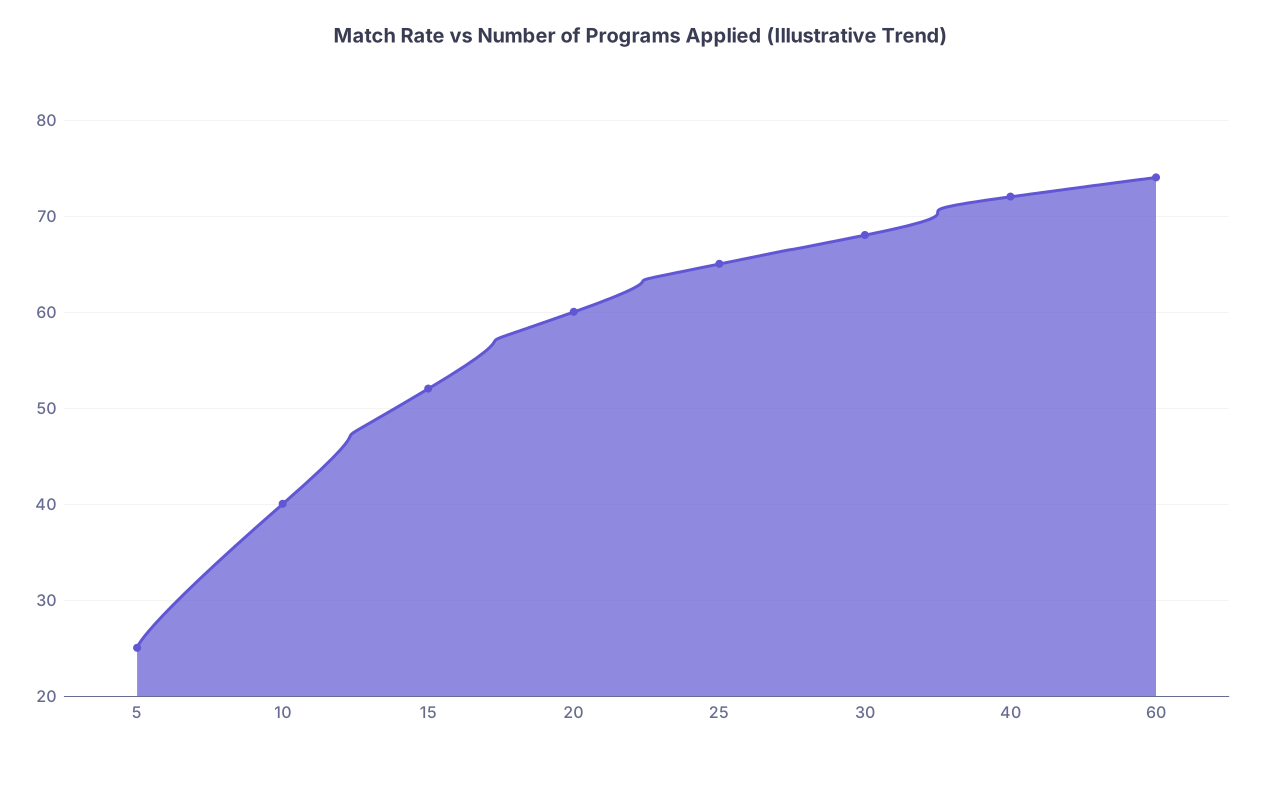
2.4 The “Diminishing Returns” Concept
Adding applications beyond a certain number doesn’t proportionally increase your chance of matching; it can just increase:
- Time spent researching and tailoring applications
- Cost of ERAS fees
- Cognitive overload in tracking programs, deadlines, and communications
Your program selection strategy should aim for the most efficient number of programs—enough to be safe, but not so many that you can’t reasonably engage with them.
Action item:
Based on your competitiveness and constraints, write a provisional target range, e.g., “I plan to apply to 30–35 FM programs,” then refine after deeper research.

Step 3: Core Criteria for Choosing Family Medicine Residency Programs
Once you have a sense of how many programs to apply to, the key question becomes: how to choose residency programs within that number. This is where a smart program selection strategy really matters.
3.1 Define Your Career Goals First
Your choices should reflect where you want to be 5–10 years from now. For family medicine, some common career goals:
- Full‑spectrum family medicine with OB
- Outpatient clinic‑only primary care
- Rural practice with broad procedural skills
- Academic medicine and teaching
- Leadership in population health or healthcare systems
- Sports medicine, geriatrics, addiction medicine, or other fellowship plans
- Global health or underserved urban/rural communities
Write down 3–5 priorities. Example:
- Work in an urban underserved setting
- Strong outpatient training, limited OB
- Academic or leadership opportunities
Your list becomes your north star for filtering programs.
3.2 Program Type and Structure
Key domains to examine:
1. Academic vs. Community vs. Hybrid
- Academic programs (university‑based)
- Often have more research and teaching exposure
- You’ll work with multiple specialties and trainees
- May have more sub‑specialty clinics and complex cases
- Community programs
- Often more continuity and real‑world experience in community settings
- Can be more flexible and relationship‑driven
- Hybrid models
- Community‑based but affiliated with a university
- Can offer the best of both worlds, depending on your goals
2. Opposed vs. Unopposed
- Unopposed FM programs
- Family medicine residents are usually the only residents in the hospital
- Greater procedural opportunity, autonomy, and broad inpatient exposure
- Opposed FM programs
- You’ll share the hospital with IM, surgery, EM, etc. residents
- May have fewer procedures but rich exposure to specialist teams and complex care
3. Clinic and Continuity Site
- FQHC (Federally Qualified Health Center), community clinic, or hospital‑based?
- Patient population: underserved, insured, multilingual, refugee/immigrant?
- Distance from hospital and call responsibilities?
Your ideal structure should align with how you want to practice post‑residency.
3.3 Obstetrics and Procedural Volume
Family medicine training in obstetrics and procedures varies widely:
- Some programs offer full‑spectrum OB, including C‑section training
- Others offer limited OB or no OB at all
- Procedural training (joint injections, derm procedures, women’s health, ultrasound) can vary dramatically
Consider:
- Do you want to do deliveries after residency?
- If yes, you need a program with strong OB numbers and FM‑friendly L&D environment.
- Are you interested in rural or frontier practice?
- These often require more procedural skills and comfort with limited backup.
- Are you leaning toward outpatient, urban clinic practice?
- You may prioritize chronic disease management, behavioral health integration, and team‑based care over OB volume.
3.4 Curriculum, Tracks, and Special Opportunities
Ask: What can this program offer that will specifically move me toward my goals?
Look for:
- Tracks or pathways: rural, urban underserved, global health, HIV medicine, integrative medicine, sports medicine, women’s health
- Fellowship pipelines: does the program have its own fellowships or close ties to them (sports, geriatrics, addiction, palliative, academic medicine)?
- Behavioral health integration: psychologists, social workers, addiction specialists embedded in clinic?
- Scholarly activity support: protected research time, QI projects, mentorship, conference funding?
Programs that clearly articulate their strengths and have a track record of graduates going into roles you admire are strong contenders.
3.5 Location, Lifestyle, and Personal Factors
Location is not an afterthought—it often drives satisfaction and well‑being.
Consider:
- Proximity to family, partner, or support systems
- Cost of living and salary alignment
- Commute times and transportation
- Safety, schools (if applicable), and community fit
- Climate, hobbies (outdoors, arts, religious communities)
Residency is demanding. A location where you can recharge and feel at home is not a luxury; it’s a protective factor against burnout.
Action item:
Rank your top 5–7 selection criteria (e.g., OB exposure, rural emphasis, location, academic environment, fellowship opportunities, call schedule). Use these to evaluate each program instead of vague “feelings.”
Step 4: Building a Balanced List of Family Medicine Programs
Now you know:
- Your approximate competitiveness
- A target number of applications
- Your key selection criteria
The next step is to build a balanced list that increases your odds of matching while aligning with your goals.
4.1 The Reach/Target/Safety Framework
Apply the same logic used in college admissions but grounded in FM‑specific realities.
Reach Programs
- Highly sought‑after locations (major coastal cities, top academic centers)
- Very strong reputations or prestigious affiliations
- Historically lower acceptance of IMGs, lower acceptance of red‑flag profiles
- You like them, they might like you, but the match is less statistically likely
Target Programs
- Your profile aligns well with their typical residents
- You meet or exceed most of their listed criteria
- Solid training with reasonable competitiveness
- You would be happy to train there
Safety Programs
- Programs that are less oversubscribed or in less “popular” locations
- Historically more flexible with exam attempts, IMGs, or non‑traditional paths
- Still meet your minimum training and environment needs
- You can genuinely see yourself attending without regret
A common distribution (adjust to your situation):
Strong applicant, flexible on geography:
- ~20–25 programs total
- 5 reach / 12–15 target / 3–5 safety
Average applicant, some red flags or geographic constraints:
- ~25–35 programs
- 5–8 reach / 12–18 target / 8–10 safety
At‑risk or IMG applicant:
- ~40–70+ programs
- 5–10 reach / 15–25 target / 20–40 safety
4.2 Using Data Wisely (Not Just Reputation)
Instead of relying on hearsay or prestige alone:
- Review program websites for:
- Mission and values
- Resident bios and career paths
- Rotations, call structure, OB volume, procedures
- Look at public data sources:
- NRMP Program Director Survey (for general priorities)
- FREIDA and similar directories
- State or regional FM organizations
- Reach out to:
- Your school’s recent graduates who matched in FM
- Residents from your away rotations or sub‑Is
- FMIG advisors and faculty
Ask specific questions like:
- “How supportive is the program of residents with families?”
- “What do graduates typically do after residency?”
- “How has the program changed in the last few years?”
4.3 Creating a Simple Scoring System
To move from vague impressions to a real program selection strategy, build a simple scoring tool (spreadsheet or note‑taking app) with categories such as:
- Location fit (0–5)
- Training fit (full‑spectrum vs. clinic‑focused) (0–5)
- OB/procedural volume (0–5)
- Mission alignment (underserved, rural, etc.) (0–5)
- Lifestyle/schedule (0–5)
- Supportive culture / wellness (0–5)
- Overall gut feeling (0–5)
Assign approximate scores based on available information and notes from conversations. You don’t need a perfect system—just something systematic enough to prevent purely emotional decisions.
Action item:
Build a 1–2 page spreadsheet listing:
- Program name
- City/state
- Academic/community/unopposed
- Key strengths
- Potential concerns
- Your scores (and final “apply / maybe / no” decision)

Step 5: Special Situations and Common Pitfalls
No program selection guide for family medicine would be complete without addressing special situations and avoidable mistakes.
5.1 For IMGs and Non‑Traditional Applicants
If you’re an IMG or have an atypical path:
- Prioritize programs that:
- Visibly welcome IMGs (check current resident rosters)
- Explicitly mention visa sponsorship (if needed)
- Emphasize mentorship, support, and remediation structures
- Highlight:
- US clinical experiences (FM or primary care, especially)
- Any long‑term commitments to communities, primary care, or teaching
- Language skills and cultural competencies
You may need to apply to a higher number of programs—but still do so intelligently, not by blanket‑applying to every program in the country.
5.2 Couples Matching in Family Medicine
If you’re in the couples match:
- Start with joint geographic zones you both can live with
- Within each zone, list programs in your respective specialties
- Consider:
- Institutions with multiple residency programs
- Regions with many programs in reachable driving distance
- Apply slightly more broadly than if you were solo, because coordination adds complexity
Your program selection strategy should maximize overlapping opportunity: many possible acceptable combinations, not just one ideal pairing.
5.3 Common Pitfalls to Avoid
1. Over‑valuing prestige
- Family medicine is deeply community‑oriented. The best program for you may not be the one with the “biggest name” but the one that best prepares you for your intended practice environment.
2. Ignoring wellness and culture
- Clinical rigor is important, but toxic cultures, chronic understaffing, or unsupportive leadership can harm your learning and well‑being.
- Pay attention to:
- How residents talk about leadership
- Turnover of faculty or program directors
- Resident attrition rates (if disclosed)
3. Under‑applying due to overconfidence
- Even in “less competitive” specialties, applicants can fail to match by applying to too few or too narrowly selected programs.
- Err on the side of safety within reason.
4. Over‑applying without a strategy
- Sending 80+ applications randomly may increase your cost and time burden without meaningfully improving your odds.
- Use your criteria, scoring, and reflection to target your list.
5. Neglecting to reassess mid‑season
- As interviews roll in, re‑evaluate:
- Should you send more applications (if very few invites)?
- Should you decline far‑away or poor‑fit interviews to focus on better matches?
- Be flexible and data‑driven, not rigid.
Putting It All Together: A Sample Program Selection Strategy
To show how all this might look in practice, here’s an example:
Profile:
- US DO student, no exam failures, solid but not stellar scores
- Strong FM letter from sub‑I, good community service background
- Open to most US regions, prefers mid‑size cities or suburban areas
- Wants outpatient‑focused career with some OB exposure
Step 1: Competitiveness
- Self‑assesses as “solid/average” FM applicant
- Advisor agrees: good chance at most community and many hybrid programs
Step 2: How Many Programs to Apply To
- Targets 25–30 family medicine residency programs
Step 3: Criteria
Top priorities defined as:
- Moderate OB exposure (not full‑spectrum, but enough comfort)
- Outpatient‑heavy curriculum
- Resident wellness and supportive culture
- Mid‑sized city or suburban location
Step 4: Building the List
- Starts with 60 programs that look okay on first pass
- After scoring and brief research:
- 8 become reach (highly desired metro areas, academic heavy)
- 18 become target (strong fit with goals)
- 12 become safety (less popular locations but still acceptable)
- Final list: 38
- With mentor guidance, prunes down to:
- 7 reach / 16 target / 7 safety = 30 total FM applications
Step 5: In‑Season Adjustments
- After first month of invites:
- 10 interviews offered across reach/target/safety mix
- Reassesses and sends 5 additional applications to carefully chosen safety programs in under‑applied regions
This kind of deliberate, adaptive approach supports both safety in the match and alignment with long‑term goals.
FAQs: Program Selection Strategy in Family Medicine
1. How many family medicine residency programs should I apply to?
There’s no universal number, but typical ranges:
- US MD/DO, no major red flags: ~15–25 programs
- US DO or MD with some limitations or geography constraints: ~25–35 programs
- IMGs or at‑risk applicants: ~40–70+ programs
Adjust based on your competitiveness, visa or exam issues, and how restricted you are geographically. Use a mix of reach, target, and safety programs.
2. What matters most when choosing family medicine residency programs?
Align programs with your future practice goals and values. Key elements include:
- Type of training (academic vs. community, unopposed vs. opposed)
- OB and procedural volume (especially if you want full‑spectrum or rural practice)
- Clinic setting and patient population
- Tracks (rural, underserved, global health, sports, etc.)
- Culture, wellness, and resident support
- Location and lifestyle issues important to you
Don’t chase prestige alone—prioritize where you’ll get the training and environment you need.
3. Are rural or less “famous” programs good options in family medicine?
Often, yes. Many rural or smaller community programs:
- Offer outstanding procedural and OB experience
- Provide strong autonomy and continuity care
- Have close faculty‑resident relationships and high satisfaction
These programs can be especially strong for applicants wanting broad‑scope practice, rural medicine, or full‑spectrum care. Evaluate training quality and graduate outcomes rather than name recognition alone.
4. How do I know if a program is IMG‑friendly or open to applicants with red flags?
Look for concrete evidence:
- Current or recent residents who are IMGs or had non‑traditional paths
- Program websites explicitly mentioning visa sponsorship or IMG recruitment
- NRMP or FREIDA data showing proportions of IMGs
- Conversations with current residents or alumni about the program’s attitude toward remediation and support
If a program has never taken IMGs or clearly states they do not sponsor visas, it’s likely not a realistic option for IMG applicants needing sponsorship.
A thoughtful program selection strategy in family medicine—grounded in self‑assessment, clear goals, and structured research—helps you answer not only how many programs to apply to but also which programs can truly help you become the physician you want to be.