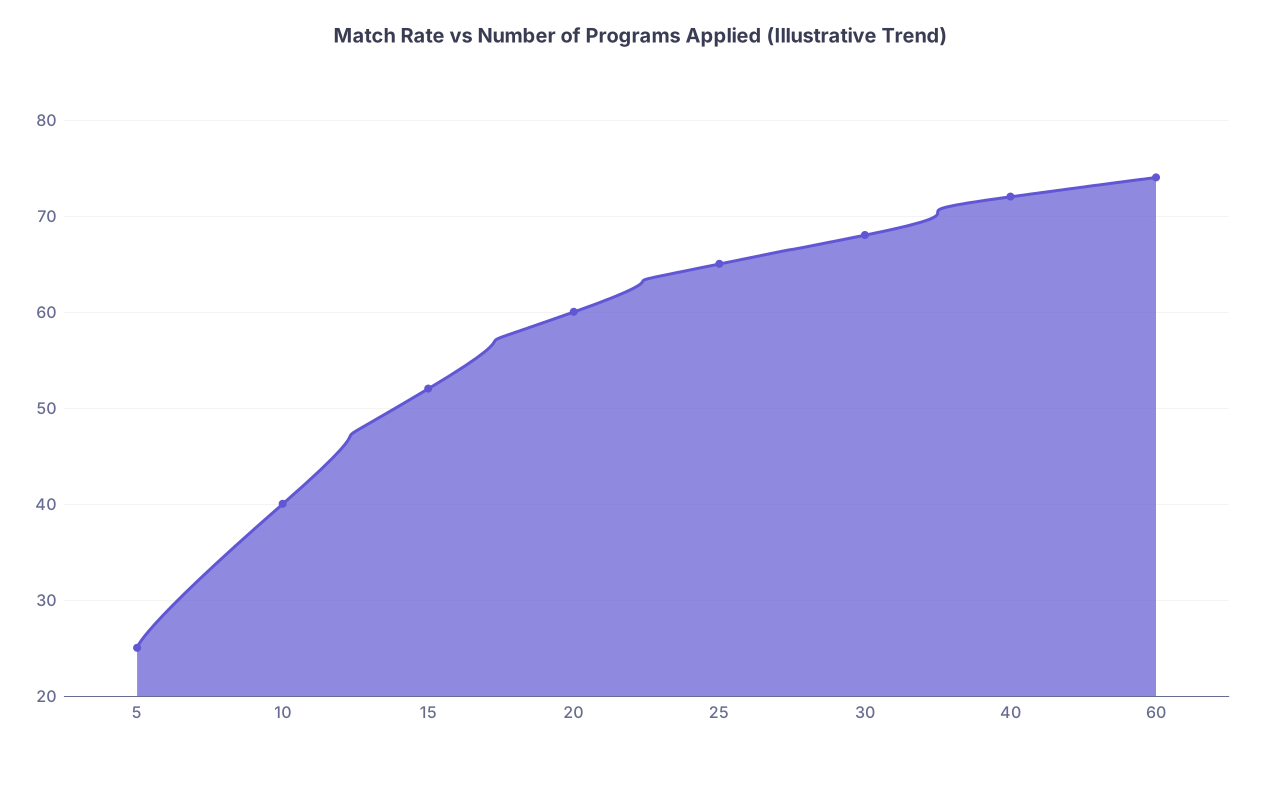
Understanding the Landscape of General Surgery Residency
Program selection in general surgery residency is one of the most consequential decisions of your medical career. It shapes your operative exposure, mentorship, work culture, and ultimately your fellowship and career opportunities. With hundreds of programs and only a limited number of applications you can realistically tailor, a thoughtful program selection strategy is essential.
General surgery is a competitive but accessible specialty for strong, well-prepared applicants. However, competition is uneven: some academic “name-brand” programs and highly desirable locations have far more applicants than positions. This makes it crucial to understand:
- Where you are likely to be competitive
- What types of programs best fit your goals
- How many programs to apply to for a safe surgery residency match
- How to prioritize programs when interview season gets busy
Before constructing a list, you need to be clear about two things:
- Your profile: Academic metrics, clinical performance, research, letters, and personal constraints
- Your priorities: Training style, geography, lifestyle, fellowship goals, and program culture
The rest of this guide walks through a systematic approach to how to choose residency programs in general surgery, with concrete frameworks, examples, and data-driven advice you can immediately apply.
Step 1: Self-Assessment – Know Your Applicant Profile
Your program selection strategy starts with a realistic, honest self-assessment. This isn’t about underestimating yourself—it’s about aligning your applications with where you can both match and thrive.
1. Academic Metrics and Exam Performance
Although USMLE Step 1 is now pass/fail, program directors still evaluate:
- USMLE Step 2 CK / COMLEX Level 2: A critical numeric screen
- Clerkship Grades: Especially surgery and medicine
- Class Rank / AOA / Gold Humanism (if applicable)
You can loosely think of three tiers (these are approximations, not rigid cutoffs):
Highly competitive profile
- Step 2 CK: Often ≥ 250
- Honors in most core clerkships; honors in surgery strongly preferred
- Strong institutional reputation and strong letters
- Research in surgery or surgical subspecialties
Solid profile
- Step 2 CK: ~235–249
- Mix of High Pass and Honors, especially in surgery and medicine
- Good letters, maybe some research or leadership
At-risk or underdog profile
- Step 2 CK: < 235 or failed attempt (still matchable but more challenging)
- Mostly Pass / High Pass, or red flags on transcript
- Limited or no research, fewer strong ties to surgery early on
- Significant gaps, leaves of absence, or professionalism concerns to explain
Your tier should inform:
- The range of competitiveness of programs you target
- How many programs to apply to for adequate safety
2. Clinical Performance and Letters of Recommendation
In general surgery, performance on surgery rotations and sub-internships carries tremendous weight:
- Evaluations describing you as “hardworking, reliable, excellent team member” are often as important as scores.
- Away rotations at target programs can create powerful advocates—especially if those attendings write your letters.
Aim for:
- 3–4 letters total
- At least 2 from general surgeons (one ideally from a department or program leader if possible)
- If you did an away rotation at a place you love and performed well, a letter from there is particularly valuable.
3. Research, Leadership, and Fit with Academic vs Community Training
Research is not mandatory for all general surgery programs, but it becomes increasingly important if:
- You want a highly academic residency
- You plan to pursue a competitive fellowship (surgical oncology, CT, pediatric surgery, etc.)
- You aim for a career in academic surgery or physician–scientist roles
Leadership roles (student groups, surgical interest groups, QI projects) can offset modest research if you show sustained commitment to surgery and team-based work.
4. Personal Constraints and Priorities
Clarify non-negotiables early:
- Geography: Family, partner’s job, visa constraints, proximity to support systems
- Visa status (for IMGs): Which visas programs sponsor (J-1 vs H-1B), prior IMG match history
- Lifestyle considerations: Cost of living, call schedules, moonlighting, support resources
Write these out. Your program selection strategy should reflect both where you can match and where your life can function for 5+ years.

Step 2: Understanding Program Types and Training Environments
To design a smart program selection strategy in general surgery, you need to understand the major categories of programs. Each type has pros and cons depending on your goals.
1. Academic University Programs
Typical features:
- Large, tertiary or quaternary referral centers
- Strong emphasis on research, QI, and academics
- Subspecialty services (HPB, transplant, CT, vascular, surgical oncology, etc.)
- Multiple fellowships on site
Best for:
- Applicants interested in fellowship and academic careers
- Those with a strong research background who want protected research time
- Those who value high-complexity, high-acuity cases
Consider:
- Operative autonomy can vary; fellows may perform many complex cases
- Workloads can be very high; burnout risk is real
- Prestige and name recognition may help with competitive fellowship placement
2. Academic-Community Hybrid Programs
Typical features:
- University-affiliated but with substantial time at community hospitals
- Mix of complex cases and high-volume bread-and-butter general surgery
- Often strong case numbers and good autonomy, especially at community sites
Best for:
- Applicants wanting solid operative experience with some academic exposure
- Those considering a mix of career options (community or academic)
- Applicants who want a more balanced, often more “hands-on” training style
Consider:
- Research infrastructure may be less robust than at major academic flagships
- Fellowship placement can still be excellent, especially with good mentorship
3. Pure Community Programs
Typical features:
- Focus on high-volume, bread-and-butter general surgery
- May have limited or no on-site surgical fellowships
- Smaller faculty, closer trainee–attending relationships
Best for:
- Applicants aiming for a community practice or more generalized surgeon role
- Those prioritizing operative volume and autonomy over research output
- Applicants who may be slightly less competitive academically but are hardworking, mature, and team-focused
Consider:
- Fellowship opportunities still possible, but you may need to be proactive about research and networking
- Fewer subspecialty services can limit exposure to some complex cases
4. Categorical vs Preliminary Positions
For surgery residency match, focus on:
- Categorical positions: 5-year positions intended to lead to board eligibility
- Preliminary positions: 1-year spots; good for applicants trying to strengthen their application, switch specialties, or who were unable to secure categorical positions
Most applicants should prioritize categorical applications. Use prelim applications selectively as a backup (e.g., if you are at higher risk for not matching).
Step 3: How Many Programs to Apply to in General Surgery
The question of how many programs to apply to is central to your strategy. While numbers vary year by year, several principles and NRMP data-driven patterns provide useful guidance.
1. Data-Driven Ranges (U.S. MD, DO, and IMGs)
These are general guidelines; adjust for your personal profile and risk tolerance. Numbers refer to categorical general surgery applications:
For U.S. MD Seniors:
Highly competitive applicants:
- Typically safe with ~25–35 programs
- If targeting highly competitive academic centers in major metros, consider up to 40
Solid applicants:
- Common range: 35–60 programs
- Err on the higher side if you have geographic restrictions or some weak areas (e.g., lower Step 2, little research)
At-risk applicants (low scores, red flags, limited surgery exposure):
- Often 60–80+ programs
- Include a significant number of community and hybrid programs
For U.S. DO Seniors:
Historically, DOs have needed to apply more broadly to secure a surgery residency match, though this is evolving post-single accreditation.
- Strong profiles: 45–70 programs
- Moderate profiles: 60–90 programs
- Higher-risk profiles: 80–100+ programs (emphasizing DO-friendly and community programs)
For International Medical Graduates (IMGs):
IMGs often must apply very broadly due to more limited interview offers.
- Strong IMG (high scores, U.S. clinical experience, research): 80–120 programs
- Moderate IMG: 100–150+ programs
- At-risk IMG: As many appropriate programs as financially feasible, with careful attention to historical IMG matches and visa support
These ranges reflect a balance between safety and practicality. More applications do not guarantee more interviews—especially if your list is poorly targeted. Thoughtful program selection strategy matters more than sheer quantity.
2. Balancing Risk and Cost
Each additional application costs money, and interviews impose time and travel (or virtual) costs. To balance this:
- Set a realistic budget before finalizing your list.
- Prioritize programs where:
- Your profile is at or above their typical metrics
- You have a geographic or mentorship connection
- The program has a clear history of matching applicants like you
3. Using Tiers: Reach, Target, and Safety Programs
Structure your list using a tiered approach:
Reach programs (15–25%)
- Dream academic institutions, highly competitive locations, or places where your metrics are slightly below their typical range.
- You should still be within a plausible range (e.g., not 40+ points below their usual Step 2 averages).
Target programs (50–60%)
- Where your scores, grades, and experiences match or slightly exceed program medians.
- Mix of academic, hybrid, and community programs you would be genuinely happy to attend.
Safety programs (20–30%)
- Programs where you clearly exceed typical applicant metrics OR that historically match many applicants at or below your metrics.
- Often strong community or smaller hybrid programs, sometimes in less competitive regions.
Example for a solid U.S. MD applicant applying to 50 programs:
- 10 reach
- 25 target
- 15 safety
This structure maximizes your chances of both matching and having options you’re excited about.

Step 4: How to Choose Residency Programs – Key Criteria
Once you determine how many programs to apply to, the next step is selecting which ones. Here’s a structured way to approach how to choose residency programs for general surgery.
1. Clinical Volume and Case Mix
Ask:
- What is the operative volume per resident per year?
- What's the balance between:
- Bread-and-butter cases (cholecystectomies, hernias, appendectomies)
- Complex cases (HPB, oncologic resections, advanced vascular, transplant)
A strong program should provide:
- Adequate early exposure and graduated autonomy
- Cases that prepare you for either fellowship or community practice, depending on your goals
Sources: ACGME case logs, program websites, current residents, and interview day discussions.
2. Resident Autonomy and Culture
Consider both how much you operate and how you are treated.
Look for:
- Clear structure of progressive responsibility (junior → senior → chief)
- Faculty who are described as supportive teachers rather than just proceduralists
- Resident testimonials about:
- Approachability of attendings
- Teamwork within the resident cohort
- Responsiveness of leadership to feedback
Ask residents directly (on interview day or via virtual meet-ups):
- “Do chiefs feel comfortable operating independently by graduation?”
- “How are struggling residents supported?”
- “How would you describe the culture—collaborative, competitive, supportive, hierarchical?”
3. Academic and Fellowship Opportunities
If you aim for fellowship or academic surgery, evaluate:
- Availability and quality of research projects and mentorship
- Dedicated research time (1–2 research years for those interested)
- Presence of subspecialty fellowships and how they affect case distribution
- Fellowship match outcomes:
- Where do recent graduates go?
- Are graduates competitive for the fellowships you’re interested in?
4. Workload, Call Structure, and Wellness
General surgery is demanding everywhere, but some programs manage workload and wellness better than others.
Investigate:
- Call frequency and format: Night float vs 24-hour call; weekend coverage
- Average duty hours (compliance with 80-hour rules, home call expectations)
- Support resources:
- Access to counseling/mental health services
- Formal wellness initiatives
- Protected didactics (and whether they’re actually respected)
Ask residents:
- “Do you feel the program respects work-hour rules?”
- “What changes has leadership made in response to resident feedback?”
5. Geography, Cost of Living, and Lifestyle
Your life outside the hospital matters:
- Cost of living: A high salary in a very expensive city may leave you with less net financial comfort than a moderate salary in a low-cost area.
- Support system: Proximity to family or a partner can significantly reduce burnout risk.
- Commute and housing: Ask residents what typical living arrangements look like.
Balance the allure of “prestige” or big cities with the reality that you will spend 5+ intense years in this environment.
6. Program Stability and Leadership
Some programs are in transition (new chair, new PD, or recent ACGME citations). Transition is not always bad; it can bring positive reform, but it also adds uncertainty.
Red and yellow flags:
- High resident attrition rates for non-fellowship reasons
- Multiple recent ACGME citations or probation (disclosed publicly or via the grapevine)
- Large number of vacant or unfilled positions year after year
Positive signs:
- Long-standing, well-respected PD and chair
- Transparent communication and responsiveness to resident concerns
- Stable fill rates in recent match cycles
Step 5: Building and Refining Your Final List
With your self-assessment and program criteria in mind, you can now build a deliberate, data-supported list.
1. Initial Broad List
Start with:
- ERAS/FRIEDA filters for:
- Specialty: General Surgery
- Program type (university, community, etc.)
- Geographic preferences
- Visa status (if applicable)
Then add:
- Programs where your school has strong historical matches
- Programs recommended by mentors based on your profile
- Places where you have personal/geographic ties
You may start with 80–150 programs in your “raw” list before trimming.
2. Gather Program-Specific Information
For each potential program, gather:
- Approximate board pass rates (if published)
- Size of the residency class
- Number of hospitals covered and commute challenges
- Recent fellowship matches
- Notable red/green flags from resident reviews and word of mouth
Use:
- Program websites
- Virtual open houses
- Social media (surgery residency Twitter, Instagram)
- Residents or alumni from your institution who trained there
3. Score and Tier Programs
Create a simple spreadsheet with scoring columns (1–5 or 1–10) for:
- Fit with your career goals (academic vs community)
- Geographic desirability
- Competitiveness alignment (how well your stats fit)
- Culture/wellness impressions
- Fellowship opportunities (if important to you)
Then:
- Sort by total score
- Label as reach, target, or safety
- Remove programs that consistently score very low or fail your “minimum criteria” (e.g., severe culture concerns, poor fellowship placement for your goals)
4. Sanity-Check the Final Number
Compare your total number of applications to the recommended ranges based on your profile. Ask:
- Is my safety program count sufficient?
- Have I over-loaded on dream academic programs with very few back-ups?
- Can I realistically manage the potential interview volume if I get a higher-than-expected hit rate?
Discuss your list with:
- A trusted surgical mentor
- Your dean’s office or career advisor
- Residents a year or two ahead of you, especially those who matched in general surgery
Small refinements at this stage can significantly improve your surgery residency match odds without dramatically increasing costs.
Step 6: Adapting Strategy During Interview Season
Your program selection strategy doesn’t end when you submit ERAS. It continues throughout interview season.
1. Tracking Interviews and Interest
As interviews roll in:
- Maintain a spreadsheet with:
- Invitations, dates, and response deadlines
- Initial impressions and “gut feeling” after interviews
- Program strengths and concerns
You can gently adjust your interview acceptance strategy based on:
- The total number of interviews you receive
- The mix of reach, target, and safety programs
If you have far more interviews than you can reasonably attend, consider declining or canceling:
- Programs that no longer fit your goals or constraints
- Duplicative programs in cities where you already have multiple strong interviews
2. When Interviews Are Scarce
If interview numbers are concerningly low:
- Reach out politely to a small number of programs (especially where you have a connection or did an away rotation) expressing continued strong interest.
- Ask mentors to advocate on your behalf where appropriate.
- Consider applying to additional preliminary positions if the situation is clearly high-risk.
3. Preparing for Ranking
During and after interviews, take systematic notes on:
- Resident happiness and cohesion
- Program leadership’s transparency
- Operative expectations and graduated autonomy
- How well you can envision yourself working and living there for 5 years
This information will later guide your rank list—the final, crucial step of your program selection strategy.
FAQs: Program Selection Strategy in General Surgery
1. What is a reasonable number of interviews to feel comfortable about matching in general surgery?
While there is no guaranteed number, many advisors consider:
- For U.S. MDs: 10–12 well-distributed categorical interviews generally provide a solid chance of matching.
- For DOs and IMGs: More may be needed (often 12–15+), especially if many interviews are at reach programs or prelim-only.
Quality and distribution matter as much as raw numbers: a mix of target and safety categorical programs is crucial.
2. Should I prioritize prestige or operative experience when choosing programs?
It depends on your goals:
- If you are certain you want a very competitive fellowship and academic career, prestige and research infrastructure may carry more weight.
- If you want to be a confident, independent community surgeon, robust operative volume and hands-on autonomy may be more important than academic branding.
Ideally, you find programs that offer both, but if forced to choose, align with your long-term career vision.
3. As an IMG, how can I improve my chances in the surgery residency match beyond applying widely?
Key strategies:
- Obtain U.S. clinical experience, ideally in surgery (observerships, externships).
- Secure strong U.S. letters from surgeons who know your work.
- Target programs known to have historically matched IMGs, and verify visa sponsorship.
- Highlight unique strengths (prior surgical experience, research, language skills, or international perspectives) that add value to their program.
4. How much weight should I give to program location compared to program quality?
Both matter. A very high-quality program in a location where you are miserable or completely unsupported may not be sustainable for 5 intense years. Conversely, a perfect location with weak training might compromise your career development.
Most applicants do best choosing a middle path:
- Set a “geographic boundary” (regions you can realistically live in).
- Within that boundary, prioritize programs that offer solid training, supportive culture, and a track record of graduating competent, confident surgeons.
Thoughtful, honest self-assessment combined with a structured, data-informed program selection strategy will not only maximize your chances of a successful surgery residency match, but also place you in a program where you can truly grow as a general surgeon and as a person.