Understanding Global Health Residency Tracks
Global health has moved from the margins of medicine to the mainstream, and residency training has followed. More and more programs now offer a global health residency track or dedicated curriculum, but these pathways vary enormously in structure, depth, and quality. Choosing wisely is critical if you want to build a sustainable, ethical, and impactful career in international medicine.
Unlike more traditional residency decisions that focus mainly on prestige, location, and fellowship prospects, global health requires you to evaluate additional dimensions:
- What kind of global work you want to do (clinical, policy, implementation, research)
- Where and with whom you want to work (regions, partners, populations)
- How committed a program truly is to global health (beyond website buzzwords)
- Whether the program supports safe, ethical, and sustainable global engagement
This guide will walk you through a program selection strategy specific to global health, help you clarify how to choose residency programs that align with your goals, and provide a framework for deciding how many programs to apply to within this niche interest.
Clarify Your Global Health Career Vision First
Before developing a program selection strategy, you need a reasonably clear picture of the career you’re aiming for. Otherwise, every global health–branded program will look attractive, and you’ll have trouble comparing them.
1. Define Your Global Health “Why”
Ask yourself:
- Are you drawn to clinical care delivery in low-resource settings?
- Do you want to influence health policy, systems, or financing?
- Are you interested in implementation science or operational research?
- Do you see yourself working primarily in the U.S. with marginalized or immigrant communities, or predominantly overseas?
- Do you want global health to be a core part of your career, or a meaningful but occasional activity?
Write a 2–3 sentence personal mission statement, for example:
- “I want to become a primary care physician working in East Africa, focusing on capacity-building and non-communicable diseases.”
- “I want to be an academic infectious disease specialist who leads implementation research on TB/HIV in resource-limited settings.”
- “I want to work at a U.S. safety-net hospital while collaborating with partners in Latin America on maternal health policy.”
Refer back to this statement as you evaluate programs.
2. Decide Your Ideal Level of Global Engagement
Not every resident needs a fully integrated global health residency track. Consider where you fall on this spectrum:
- Global health–aware clinician: Wants some exposure (lectures, short electives, local underserved work), but global health isn’t central to career plans.
- Clinician with periodic global projects: Wants 1–2 substantial international rotations and ongoing involvement in global research or advocacy.
- Career global health professional: Wants longitudinal work with partners, research and leadership opportunities, and likely a global health or health systems fellowship.
Your selection strategy will be very different depending on whether you fall into the first or third category.

Core Features to Look for in Global Health Residency Programs
Once you know what you want, you can identify program features that matter. Many residencies use similar language—“global health track,” “international medicine experiences,” “global equity focus”—but the underlying reality can be very different.
Use the following domains as a structured way to evaluate programs and refine your program selection strategy.
1. Structure and Depth of the Global Health Residency Track
Key questions:
- Is there a formally recognized global health residency track (or pathway, concentration, or certificate)?
- Is it available to all residents or a competitive subset?
- Is the track curriculum-based and longitudinal, or essentially just a menu of electives?
Look for:
- A written curriculum (with syllabi, objectives, and milestones)
- Protected seminars or didactics on:
- Health systems and financing
- Epidemiology and burdens of disease
- Decolonizing global health and ethics
- Implementation science and monitoring & evaluation
- Humanitarian emergencies, migration, and climate health
- Longitudinal engagement (e.g., continuity with the same site or project rather than a one-time elective)
- Formal recognition at graduation (certificate or transcript notation)
Red flags:
- “Track” appears to equal “you can do a 2–4 week elective abroad if you find it and fund it yourself.”
- No clear description of requirements, learning objectives, or faculty oversight.
2. Quality and Ethics of International Partnerships
Strong global health programs are built around long-term, bidirectional partnerships with host institutions, not short-term “medical tourism.”
Ask programs:
- How long have you partnered with your international sites?
- Who owns and defines the projects—your institution or the local partners?
- How frequently do local partners visit or teach at your institution?
- Are there non-clinical partnerships (policy institutes, NGOs, ministries of health)?
Look for evidence of:
- Multi-year collaboration with the same sites
- Clear commitment to local capacity-building (e.g., training local residents, supporting local research careers)
- Bidirectional exchange: trainees and faculty from partner sites come to the U.S. institution, not just U.S. residents traveling abroad
- Ethics training specific to international medicine and power dynamics
Red flags:
- Programs boasting about the number of countries visited rather than the depth of relationships
- Ultra-short (1–2 week) overseas “missions” framed as primary educational experience
- Little mention of local co-leadership or co-authorship in projects and publications
3. Mentorship and Faculty Expertise
Your experience will be defined largely by who mentors you.
Key considerations:
- How many faculty members actively work in global health, and in what capacities?
- Clinical service? Research? Policy? Implementation?
- Are there faculty based full-time or part-time at partner sites?
- Do they have extramural funding (NIH, foundations, NGOs) for global work?
- Is there a designated global health director or track director?
What you want to see:
- At least a small critical mass of global health faculty (not just one person)
- Evidence that faculty still actively practice or research in global health, not only in the past
- Mentors whose interests align with yours (e.g., maternal health, NCDs, humanitarian crises, migrant health)
Ask during interviews:
- “If I were interested in X (e.g., refugee health research), which faculty would you suggest I talk to?”
- “How often are global health mentors available, and how many mentees do they typically support?”
Red flags:
- Only 1–2 faculty listed with “global health” interests and minimal description of ongoing work
- Program unable to name specific mentors for your interests
4. Protected Time and Funding for Global Work
Your ability to engage meaningfully in global health will hinge on time and funding.
Key metrics:
- Elective time: How many weeks during residency can be used for global health?
- Eligibility: Are all PGY levels allowed to travel? Is a minimum training level required?
- Funding sources: Does the program provide:
- Travel stipends?
- Housing support?
- Research or project funding?
- Conference funding to present global health work?
Strong programs typically:
- Offer 4–12 weeks of potential global health elective time across residency
- Have institutional or departmental funding earmarked for global rotations
- Provide help with logistics (visas, housing, safety protocols)
Red flags:
- “Global elective available” but no financial support and no structured site
- Residents must use vacation time to travel
- No clear safety or risk management structure for international rotations
5. Integration with Local Health Equity and Immigrant Health
Well-grounded global health programs recognize the link between international medicine and local underserved populations.
Look for:
- Dedicated rotations in:
- Refugee/immigrant clinics
- Tribal/Indigenous health
- Homeless or street medicine programs
- Correctional health
- Partnerships with community-based organizations
- Training in:
- Structural competency
- Racism and health
- Language concordant care and interpreter use
Programs that treat local and global health as a continuous spectrum often provide more rigorous, ethically grounded training.
Building a Program Selection Strategy: Step-by-Step
With the core evaluation framework in mind, you can now craft a practical program selection strategy for global health–focused residency applications.
Step 1: Map Your Priorities (Global and Non-Global)
List your top 6–8 overall residency priorities. Split them into:
Global health–specific priorities
- Longitudinal global health residency track
- At least 8+ weeks of elective time, with some global options
- International partnerships in a specific region or thematic area
- Strong immigrant and refugee health presence
General residency priorities
- Geographic location
- Program size and culture
- Procedural volume or research intensity
- Work-life balance
- Fellowship or career placement
Rank them in order of importance. Be honest if, for example, location trumps all other factors; that will constrain your realistic global health options and shape how to choose residency programs.
Step 2: Segment Programs into Tiers
Use a spreadsheet to create three broad groups:
Core global health programs
- Robust, well-established global health residency track
- Strong faculty and international partnerships
- High alignment with your career vision
Moderate global health programs
- Some global health structure, moderate faculty presence
- Good local underserved experiences
- Potential to build your own global path with initiative
Limited global health programs
- Minimal formal structure, but perhaps some opportunities
- Very strong in other domains (e.g., clinical training, location)
You will likely need a mix of programs from each tier to balance match safety and global ambition.
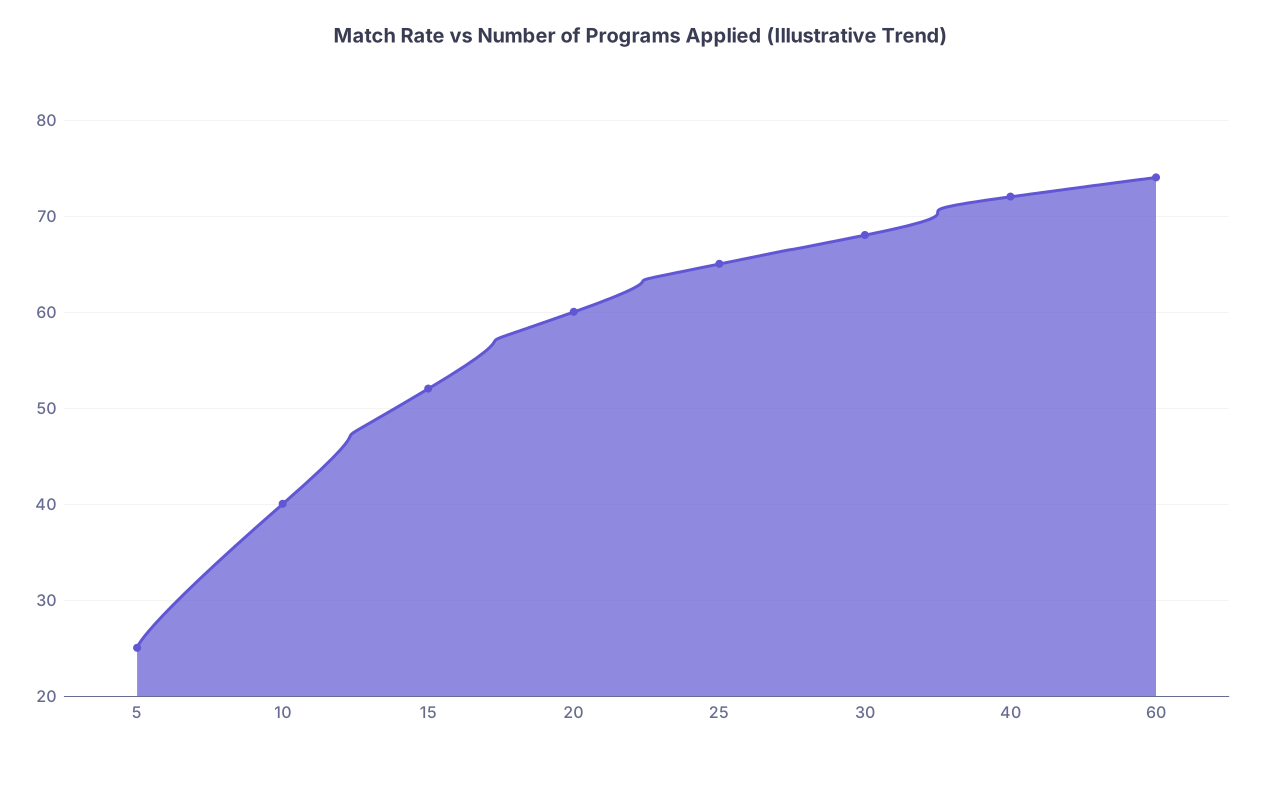
Step 3: Decide How Many Programs to Apply To (with a Global Health Lens)
The classic question—how many programs to apply—is more nuanced for global health–interested applicants.
Three key variables influence your target number:
Competitiveness of your overall application
- Strong applicant: higher board scores, strong clinical grades, research, solid letters
- Average applicant
- At-risk applicant (low scores, red flags, visa needs)
Specialty competitiveness
Global-health oriented fields like internal medicine, pediatrics, family medicine, EM, and OB/GYN range in competitiveness by region and program.Rigidity of your global health requirements
- Are you only willing to train at programs with robust global tracks?
- Or can you thrive at a solid general program and build your own path?
As rough, non-binding guidelines (for U.S. and strong international applicants):
If you’re strong and flexible on global health requirements:
- Aim for 15–20 programs total, with:
- 5–7 strong global health programs
- 5–8 moderate global health programs
- A small number of solid non-global programs in desirable locations
- Aim for 15–20 programs total, with:
If you’re average and moderately selective:
- Aim for 20–30 programs total, with:
- 5–8 strong global health programs (may be more competitive)
- 10–15 moderate programs
- 5–7 non-global programs ensuring you match somewhere you can still pursue your interests
- Aim for 20–30 programs total, with:
If your application has significant risk factors:
- It’s usually safer to apply to 30–40 programs, prioritizing programs that are:
- Friendly to diverse paths
- Supportive of underserved work even without formal global tracks
- It’s usually safer to apply to 30–40 programs, prioritizing programs that are:
Your program selection strategy should avoid a common pitfall: applying almost exclusively to highly competitive academic programs with famous global health centers without enough “safety” programs where you would still be content.

Using Interviews and Research to Distinguish Programs
Program websites can be aspirational. Interviews, resident conversations, and independent research will help you see how things really work.
1. Pre-Interview Research Checklist
For each program, try to answer:
- Does the program explicitly mention a global health residency track or concentration?
- How many residents are in it per class?
- Are there named partner sites and long-term collaborations?
- Do current residents or fellows present global health posters or publications?
- Look at recent conferences, program news pages, and PubMed.
- Does the institution house a global health center or institute?
Use this to refine how you emphasize global health in your application (personal statement, experiences, and during interviews).
2. Strategic Questions to Ask During Interviews
To get beyond the brochure, ask specific, concrete questions:
About structure and support:
- “How many residents actively participate in the global health residency track each year?”
- “Could you describe a recent global health project that a resident led from start to finish?”
- “What proportion of residents who are interested in global health actually get to do an international rotation?”
About partnerships and ethics:
- “What are your longest-standing international partnerships, and how are they governed?”
- “How do you ensure that visiting residents’ work aligns with the priorities of local partners?”
About funding and logistics:
- “What kind of financial support is available for international rotations and conferences?”
- “Do residents have to use vacation time for global health experiences, or are they counted as elective time?”
About outcomes:
- “Where have recent graduates with global health interests gone for fellowships or positions?”
- “Are there alumni working full-time in global or health equity roles that I could speak with?”
The specificity of answers (and whether they come easily) will reveal how real the global health opportunities are.
3. Talking to Current Residents
Ask to speak with residents:
- In the global health track (if one exists)
- Who have done international rotations
- Who are interested in similar regions or topics
Questions to consider:
- “How easy is it to get protected time for global health work?”
- “Have you ever had to drop a global project because of schedule or support issues?”
- “What would you change about the program’s global health offerings if you could?”
Current residents will often be candid about bottlenecks—whether call schedules, funding gaps, or over-stretched mentors.
Ranking Programs: Balancing Global Health with Reality
When it comes time to build your rank list, revisit your priorities and experiences during interviews. Strong program selection strategy is not about finding the “best” program on paper, but the program where you can best become the physician you want to be.
1. Weighting Global Health vs. Training Environment
Consider:
- Would you rather have:
- Slightly weaker general training with outstanding global opportunities? or
- Outstanding general training with modest but flexible global opportunities?
In many cases, a robust, supportive general residency where faculty value your interests may be a better long-term platform—even if the global health branding is lighter—than a flashy global center in a program where you feel unsupported clinically.
2. Avoiding Common Global Health Applicant Pitfalls
Watch out for:
- Overemphasis on prestige: A program’s global health center may be well-known, but the residency experience inside that ecosystem can still be variable.
- Underestimating your bandwidth: Residency is intense. Programs that expect you to maintain a heavy global portfolio without adjusting other demands can lead to burnout.
- Ignoring personal sustainability: Geography, family, financial constraints, and wellness matter. You’ll only be effective in global health if you’re not running on empty.
3. Evaluating Long-Term Career Fit
Ask yourself:
- From this program, could I reasonably:
- Build a competitive portfolio for a global health or health policy fellowship?
- Get hired by NGOs, academic institutions, or health systems with global footprints?
- Maintain long-term collaborations with partners introduced during residency?
If the answer is “yes” for several programs, let your day-to-day fit—culture, supportiveness, and geography—break the tie.
Frequently Asked Questions (FAQ)
1. Do I need a formal global health residency track to have a career in international medicine?
No. A global health residency track is helpful but not mandatory. Many global health leaders trained in programs without formal tracks and then:
- Sought out elective time at international sites
- Built research or advocacy portfolios with global mentors
- Pursued global health fellowships or MPH degrees after residency
A strong clinical foundation, mentorship, and demonstrated longitudinal commitment to underserved or global populations are often more important than the label of a track.
2. How many programs should I apply to if I care deeply about global health?
For most applicants to core specialties (IM, peds, FM, EM, OB/GYN), a reasonable range is:
- 15–20 programs if you’re a strong applicant and somewhat flexible
- 20–30 programs if you’re average or more selective about location and global features
- 30–40 programs if you have significant risk factors
Within that total, ensure a mix of highly global-focused, moderate, and more general programs where you can still nurture your international medicine interests.
3. Is it risky to emphasize global health heavily in my application?
If your global health story is authentic, consistent, and ethically grounded, it’s usually an asset—especially in fields and programs that value health equity. The risks arise if:
- You present global work in ways that seem superficial or “mission-trip oriented”
- You appear uninterested in core clinical training or in caring for U.S.-based underserved communities
Frame your global health interest as part of a broader commitment to high-quality, equitable care and systems improvement, both abroad and at home.
4. How can I tell if a program’s global health offerings are real or just marketing?
Look for concrete markers:
- Named partner sites and how long they’ve existed
- Resident publications and conference presentations on global topics
- Clear information on elective time, funding, and track requirements
- The number of residents actually participating in the global track
- Candid feedback from current residents who have done international work
Programs with real depth can answer detailed questions; marketing-heavy programs often stay vague or rely on aspirational language without specifics.
By approaching your search with a structured program selection strategy, you can move beyond buzzwords, identify programs that match your global health ambitions, and apply to a balanced number of residencies that keep both your match prospects and your long-term career in international medicine front and center.