Understanding the Unique Landscape of Pediatrics–Psychiatry for IMGs
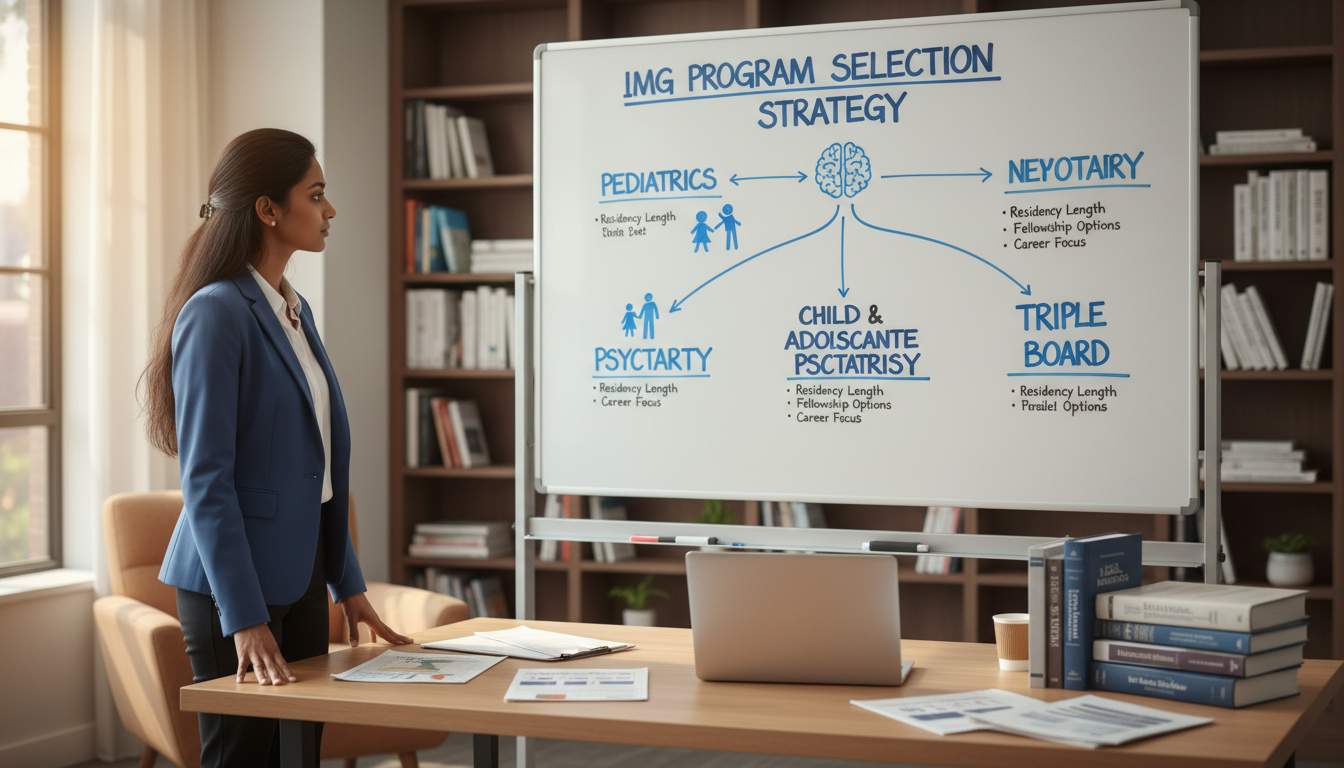
Pediatrics–Psychiatry training sits at the intersection of child health and mental health, and it is structured differently from most other residency tracks. For an international medical graduate (IMG), designing a strong program selection strategy requires first understanding the training options, competitiveness, and how your profile fits.
There are two primary pathways related to “peds psych residency” in the United States:
Combined Pediatrics–Psychiatry–Child & Adolescent Psychiatry (Triple Board) Programs
- 5-year integrated program
- Graduates are board-eligible in:
- General Pediatrics
- General Psychiatry
- Child & Adolescent Psychiatry
- Very small number of programs nationwide (usually fewer than 15, with a handful of positions per program)
- Highly structured, with a set curricular balance between pediatrics and psychiatry
Sequential Training (Traditional Pathway)
- Complete a standard Pediatrics residency (3 years) or Psychiatry residency (4 years), then pursue a Child & Adolescent Psychiatry (CAP) fellowship (2 years).
- Some residents design custom “peds psych” career paths through electives, research, and advocacy focus, even without a formal combined program.
When people say “peds psych residency,” they may mean:
- True Triple Board combined programs, or
- Intentionally designed training combinations: e.g., Pediatrics residency → CAP fellowship, or Psychiatry residency → CAP fellowship with pediatric consult liaison, school-based, or developmental focus.
For IMGs, the IMG residency guide for this niche must do more than list programs. It should help you:
- Evaluate realistic chances of interview and match
- Decide how many programs to apply to across combined and traditional tracks
- Align your program selection strategy with your visa needs, academic strengths, and long-term goals.
Before building a list, clarify your primary goal:
- “I specifically want a Triple Board pathway and am willing to accept a small number of options.”
- “I want to work at the intersection of pediatrics and psychiatry, but I’m flexible about how I get there (pediatrics, psychiatry, CAP fellowship, integrated clinics).”
- “I am primarily focused on maximizing match probability as an IMG, and I’ll build towards peds–psych interests within a more conventional training structure.”
Your answer to that question will heavily influence your program selection approach.
Step 1: Clarify Your Career Vision and Constraints
Before sorting spreadsheets or reading program websites, step back and define three things: career vision, timeline, and constraints (especially immigration/visa issues).
1. Define Your Long-Term Career Vision
Ask yourself:
- What kind of patients do I imagine working with most of the time?
- Medically complex children
- Adolescents with mood/anxiety disorders
- Neurodevelopmental conditions (ASD, ADHD, intellectual disability)
- Child protection / foster care / systems-involved youth
- Where do I want to work?
- Academic center
- Community hospital
- Outpatient clinic / integrated care
- Global mental health / NGO / policy work
- How important are these aspects?
- Research and publishing
- Teaching and medical education
- Advocacy and public health
- Leadership and administration
Your answers help differentiate:
Triple Board: best suited for those who truly want dual (or triple) clinical identities and flexibility (e.g., working as a pediatrician in integrated behavioral clinics, child psychiatrist with strong medical–pediatric skills, leadership in systems that integrate physical and mental health).
Pediatrics → CAP Fellowship: ideal if you see yourself mainly as a pediatrician who deeply understands mental health and maybe leads integrated behavioral programs.
Psychiatry → CAP Fellowship: best if you are primarily drawn to psychiatric diagnosis and therapy, but want expertise in children and adolescents, with or without close integration with pediatric medical care.
2. Recognize IMG-Specific Constraints
As an international medical graduate, your program selection strategy must account for:
Visa requirements
- Are you seeking J-1 or H-1B?
- Do you need a program with a strong history of sponsoring visas?
- Are you open to underserved / waiver-eligible positions later (e.g., J-1 waiver jobs)?
US Clinical Experience (USCE)
- Do your target programs explicitly require USCE?
- Are observerships accepted, or only hands-on rotations?
Time from graduation
- Some programs strongly prefer applicants who graduated within the last 3–5 years.
- If you’re an older graduate, you may need to target programs that explicitly consider non-traditional or more experienced applicants.
Board exam performance
- USMLE/COMLEX scores (including attempts) still heavily influence screening for many programs.
- You should tailor your list by aligning your metrics with typical matched applicants for that specialty and program type.
Step 2: Understanding Competitiveness and Niche Nature of Triple Board
The Triple Board pathway is both small and specialized, which changes how to choose residency programs and how many programs to apply to.
1. Size and Distribution of Triple Board Programs
- Very small number of programs nationwide.
- Each program has very limited positions per year (often 2–3 spots).
- Some years, total Triple Board positions in the country are fewer than many single institutions offer in general pediatrics alone.
Implications for an IMG residency guide in this area:
- A pure Triple Board-only application strategy is high-risk, especially for IMGs.
- You should almost always pair Triple Board applications with:
- General Pediatrics programs, and/or
- Psychiatry programs, with the plan to pursue CAP later.
2. IMG Friendliness of Triple Board
Triple Board programs often sit within large academic centers that may:
- Have very strong pediatric and psychiatry departments
- Attract many highly competitive American medical graduates
- Have specific policies about IMGs and visa sponsorship
Some Triple Board programs have matched IMGs; others rarely, if ever, do. You must:
- Look up current and past residents:
- Check if there are IMGs among them (from program websites, LinkedIn, institutional profiles).
- Review GME/departmental policies:
- Do they sponsor J-1 only, J-1 and H-1B, or neither?
- Note that even if the institution sponsors visas, the specific program may seldom interview IMGs due to small size.
3. Competitiveness vs. Fit
For Triple Board, competitiveness is not only numbers-based. Programs care deeply about fit:
- Demonstrated commitment to working at the pediatrics–psychiatry interface
- Clear narrative: “Why this blended path and not simply pediatrics or psychiatry + CAP?”
- Meaningful exposure to:
- Child mental health
- Pediatric care
- Interdisciplinary or systems-level work
For an IMG, this means:
- Your personal statement and experiences should clearly articulate this niche interest, not just generic “I like children” and “I like psychiatry.”
- Strong letters of recommendation from faculty in pediatrics, psychiatry, or child mental health fields are crucial.
Step 3: Building a Tiered Program List – Strategy and Numbers
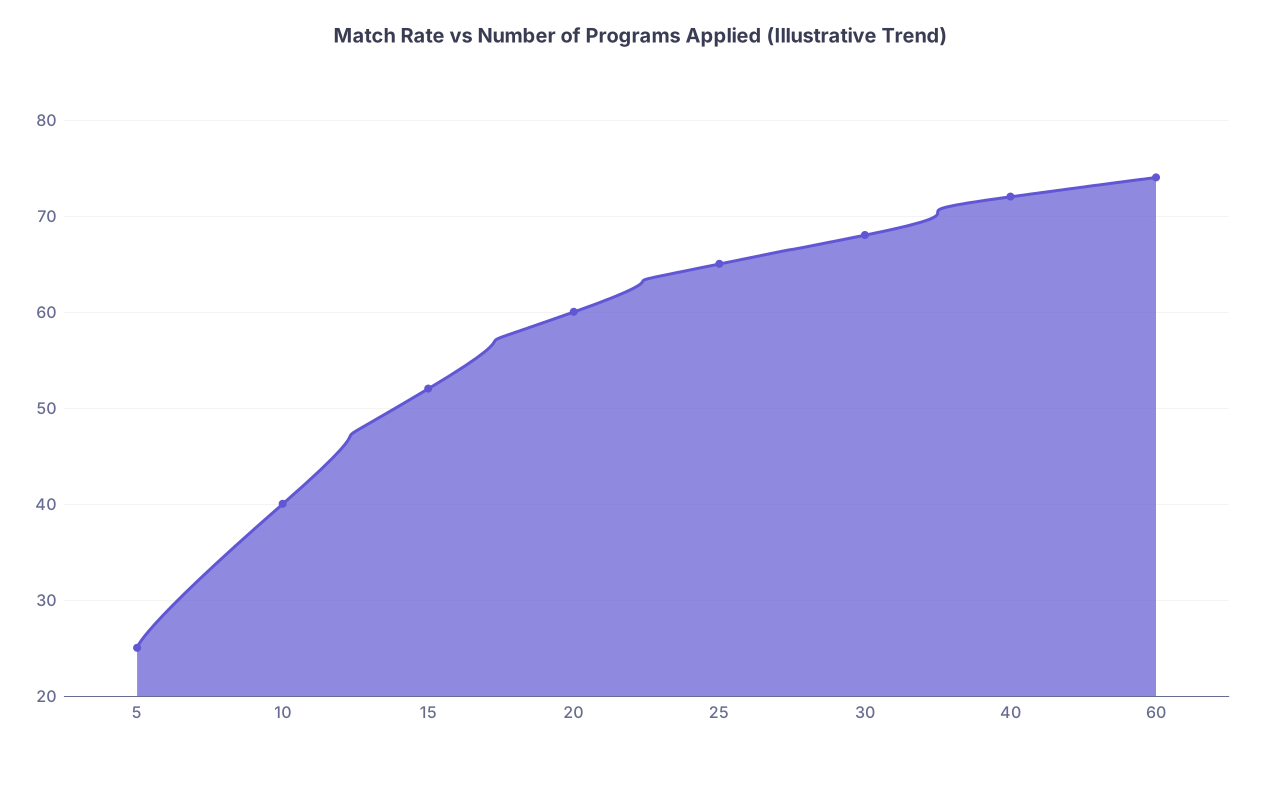
“How many programs to apply” is one of the most common and anxiety-provoking questions. The answer is personalized but can be approached systematically, especially for an IMG targeting peds–psych related paths.
1. Start with Your Risk Category
Think about yourself across three dimensions:
Objective metrics
- USMLE Step 2 CK (or equivalent) score
- Number of attempts
- Medical school type and reputation
Experiences
- US Clinical Experience (hands-on vs observership)
- Research, particularly in pediatrics, psychiatry, or child mental health
- Volunteer and leadership activities
Other factors
- Time since graduation
- Visa needs
- Specialty changes or gaps in training
Roughly, IMGs can fall into:
- Lower-risk / highly competitive: strong scores (e.g., Step 2 CK ≥ 245–250), recent grad, solid USCE, no attempts, strong letters.
- Moderate-risk: decent scores (e.g., 225–240), some attempts or older graduation, USCE present but limited.
- Higher-risk: multiple attempts, low scores, older YOG, limited to no USCE, or heavy visa constraints.
2. General Numerical Guidance (Adapted for Peds–Psych Interests)
For IMGs, typical ranges (for a single specialty) often look like:
- Pediatrics: 60–120 programs
- Psychiatry: 60–120 programs
Because Triple Board is small, you typically apply to all programs you can realistically target (often 8–15 depending on the year).
For an IMG interested in peds psych residency paths, a sample structure:
Triple Board:
- Apply to all programs that:
- Sponsor your visa type
- Show evidence of considering IMGs (current residents, inclusive policies)
- Apply to all programs that:
Pediatrics (if you lean more towards somatic pediatrics and integrated behavioral care):
- 60–100 programs, depending on your risk category.
Psychiatry (if you lean more toward psych with child focus):
- 60–100 programs.
If you are dual applying (e.g., Triple Board + Pediatrics; or Triple Board + Psychiatry; or Triple Board + both), your total number may be in the 100–160+ program range, depending on your resources and ERAS fee tolerance.
3. Example Program List Strategies
Example A: IMG with strong profile, leaning toward Triple Board + Psychiatry
- Triple Board: 10 programs
- Psychiatry: 80 programs
- Pediatrics: 20 programs (backup)
Total ~110 applications.
Example B: IMG with moderate profile, leaning toward Pediatrics + peds–psych focus
- Triple Board: 8 programs
- Pediatrics: 100 programs (broadly, including community and university-affiliated)
- Psychiatry: 40 programs
Total ~148 applications.
Example C: Higher-risk IMG focusing on match probability first
- Triple Board: selectively 5–8 programs (only those clearly IMG-friendly)
- Pediatrics: 120+ programs, particularly community and mid-tier academic centers known to take IMGs
- Psychiatry: 60 programs
Total ~185+ applications (acknowledging increased cost but prioritizing match security).
When asking “how many programs to apply,” remember:
- Triple Board alone is not enough for an IMG unless your profile is exceptionally strong and you are willing to risk not matching that year.
- Your program selection strategy should diversify across at least one larger specialty (pediatrics or psychiatry, sometimes both).

Step 4: Detailed Filters for Choosing Programs Wisely
Beyond numbers, you need a structured program selection strategy—not just mass applications. Consider these filters, especially relevant for an international medical graduate.
1. Visa and IMG Friendliness Filters
Non-negotiable early filters:
Visa sponsorship
- Confirm J-1 and/or H-1B policies on program or institutional GME websites.
- If H-1B is critical for you, this will sharply reduce the list, especially for Triple Board.
IMG track record
- Look at current residents’ medical schools.
- Search program name + “international medical graduate” online.
- Some programs clearly state on their website or FREIDA profile that they welcome IMGs.
If a Triple Board program has never listed an IMG in current or recent past residents, your chance may be significantly lower—but not necessarily zero if your application is exceptional.
2. Academic and Clinical Fit
Prioritize programs based on alignment with your peds–psych interests:
For Triple Board:
- Strength of both Pediatrics and Psychiatry departments
- Presence of Child & Adolescent Psychiatry faculty with diverse interests (developmental disorders, trauma, eating disorders, integrated care)
- Child advocacy centers, developmental clinics, school-based programs
For Pediatrics Programs:
- Existing behavioral–developmental pediatrics, child psychiatry, and psychology services
- Opportunities to rotate in child psychiatry or behavioral health clinics
- Track record of residents entering Child & Adolescent Psychiatry or Behavioral–Developmental fellowships
For Psychiatry Programs:
- Early exposure to child and adolescent psychiatry
- Dedicated child tracks, CAP fellowships in-house
- Pediatric consultation-liaison services in the same institution
- Strong connections with pediatric subspecialists or children’s hospitals
3. Geography and Lifestyle Filters
- Type of city: large city vs. mid-sized vs. smaller/underserved region
- Cost of living and family considerations
- Cultural communities and support systems (important for many IMGs)
- Proximity to airports for travel to home country
As an IMG, willingness to consider less popular states or regions (Midwest, South, certain rural areas) can significantly expand your interview opportunities.
4. Research and Academic Opportunities
If you envision an academic career or subspecialty fellowship:
- Look for:
- Ongoing research in child mental health, trauma, neurodevelopment, integrated care
- Resident research tracks or scholarly projects
- Faculty actively publishing in high-impact journals
Your program selection strategy should stratify programs into:
- “Dream” (highly academic, very competitive, strong peds–psych integration)
- “Target” (good fit, reasonable chance based on your profile)
- “Safety” (community or smaller academic programs, strong IMG track record, more modest research resources but solid clinical training)
Try to keep a healthy proportion in each tier; don’t overload only in the “dream” category.
Step 5: Structuring Your Application Narrative Across Programs
One subtlety for IMGs applying to Triple Board, Pediatrics, and Psychiatry simultaneously is narrative consistency. Programs will read your personal statement and may be aware if you are applying to multiple paths.
1. Create a Core Theme: Children, Systems, and Mental Health
Your narrative can revolve around:
- Commitment to child and adolescent well-being
- Interest in the intersection of physical and mental health
- Dedication to systems-level care (schools, child protection, community mental health, pediatric hospitals)
- Global health perspective as an international medical graduate
Then you adapt this core theme for each track:
Triple Board Personal Statement:
- Emphasize your desire to practice at the interface of pediatrics and psychiatry long-term.
- Show understanding of the unique Triple Board structure and explicitly why this integrated training is essential for your goals.
Pediatrics Personal Statement:
- Focus primarily on being a pediatrician but highlight your passion for behavioral and developmental aspects, advocating for mental health integration.
- Show openness to collaborations with psychiatry and possible future child mental health training.
Psychiatry Personal Statement:
- Center on psychiatric identity, but highlight dedication to children, adolescents, and families.
- Emphasize your understanding of developmental trajectories, pediatric collaboration, and future CAP fellowship plans.
2. Align Letters of Recommendation
Where possible, choose recommenders who can speak to:
- Your performance with children and families
- Your capacity for interdisciplinary collaboration
- Your adaptability as an IMG in a new health system
- Your curiosity about behavioral and psychiatric issues in pediatric populations
Having at least one strong letter from Pediatrics and one from Psychiatry or Child Mental Health is particularly valuable for Triple Board and peds–psych-oriented applications.
3. Communicate Clearly to Programs (When Appropriate)
Some programs (especially smaller or more personally run ones) appreciate transparency. If you’re invited to an interview, it can be appropriate to:
- Mention that you’re applying across related fields but have a consistent career vision.
- Explain how their program fits into your long-term plan (e.g., “If I train in pediatrics here, I plan to pursue CAP fellowship and work in integrated pediatric mental health”).
Use this carefully; never suggest a program is a “backup,” but do show that working with children at the medical–psychiatric interface is your clear goal, regardless of which initial residency door you enter.
Frequently Asked Questions (FAQ)
1. As an IMG, is it realistic to match into a Triple Board program?
It is possible but challenging. Triple Board programs are small, competitive, and often favor applicants with a very clear, well-documented commitment to combined pediatrics–psychiatry work. Some programs have matched IMGs, especially those with:
- Strong USMLE scores and no attempts
- Robust US clinical experience in both pediatrics and psychiatry
- Research or advocacy in child mental health or developmental fields
- Excellent letters from US faculty in relevant areas
Because of the small number of positions, you should not rely solely on Triple Board. Combine these applications with a broad list of pediatrics and/or psychiatry programs.
2. How many programs should I apply to if I want a peds–psych career as an IMG?
For most IMGs, a safe range is:
- Triple Board: all eligible programs (often 8–15)
- Pediatrics: 60–120 programs, depending on your risk profile
- Psychiatry: 60–100 programs if you are genuinely open to a psychiatry-first path
That can total 100–180+ applications, which is expensive but may be appropriate if you strongly wish to maximize match probability. If finances are tight, prioritize programs with clear IMG-friendliness, visa sponsorship, and strong child-focused training.
3. How do I know if a program is IMG-friendly?
Use multiple data points:
- Check the current resident roster for international schools.
- Review FREIDA and institutional GME pages for explicit IMG/visa statements.
- Ask prior IMGs from your school or network if they know graduates at those programs.
- Look for match lists showing graduates matching into that program from international schools.
Be cautious: absence of IMGs in one year does not always mean hostility, but a long, consistent pattern of no IMGs suggests your chances are lower.
4. If I match into Pediatrics or Psychiatry only, can I still have a peds–psych-focused career?
Yes. Many leaders in child mental health never completed Triple Board. Options include:
- Pediatrics → Child & Adolescent Psychiatry fellowship (for some trainees, with additional steps/approvals)
- Pediatrics → Behavioral & Developmental Pediatrics or Child Abuse Pediatrics
- Psychiatry → Child & Adolescent Psychiatry fellowship with strong pediatric liaison work
- Integrated care roles in children’s hospitals, school-based clinics, and community mental health centers
Your residency is a foundation; your fellowship choices, electives, research, and post-training jobs will ultimately define your peds–psych career focus.
A thoughtful program selection strategy—grounded in your long-term goals, realistic assessment of your IMG profile, and a clear understanding of Triple Board and related pathways—will help you build a balanced, targeted program list. Use data, seek mentorship, and allow flexibility in how you reach your ultimate goal of caring for children at the vital intersection of pediatrics and psychiatry.