Understanding the Big Picture: Why Program Selection Matters So Much for IMGs
For an international medical graduate (IMG) applying to neurology residency in the U.S., program selection is not just a logistics step—it is a core part of your match success strategy. Even an excellent application can underperform if your program list is poorly designed.
A smart, data-driven program selection strategy answers several key questions:
- Where am I realistically competitive?
- How many programs should I apply to?
- How do I choose residency programs that align with my background and goals?
- How can I improve my neuro match chances as an IMG with limited resources?
This IMG residency guide will walk you through a step-by-step framework tailored to neurology, focusing on:
- Understanding neurology’s competitiveness for IMGs
- Analyzing your personal profile honestly
- Building a tiered list of programs (safety/target/reach)
- Using filters: geography, IMG-friendliness, visa, research, fellowships
- Knowing how many programs to apply to (with realistic numbers and examples)
By the end, you should be able to create an individualized program selection strategy that maximizes your neuro match chances without wasting time and money.
Step 1: Understand Neurology Competitiveness and the IMG Landscape
1.1 Neurology as a Specialty for IMGs
Neurology has historically been moderately competitive and relatively welcoming to IMGs compared with some other specialties. However, competitiveness has increased in recent years due to:
- More U.S. graduates interested in neurology
- Increased awareness of stroke, epilepsy, neurocritical care, and neuroimmunology
- Growth in research and subspecialty career opportunities
For IMGs, neurology still offers good opportunity, but it is not a backup specialty—especially with Step 1 being pass/fail and more emphasis on holistic review.
Key implications for IMGs:
- Scores and CV still matter, particularly Step 2 CK and clinical performance
- Program selection needs to be more strategic than simply “apply everywhere”
- IMG-friendliness and visa policies vary widely by program
1.2 Typical Successful IMG Profiles in Neurology
While no single profile guarantees success, matched IMG neurology residents often share several features:
- Strong Step 2 CK (often ≥ 230–240; higher is better, especially for academic centers)
- Few or no exam attempts (multiple attempts are a red flag for some programs)
- U.S. clinical experience (USCE), ideally:
- At least 1–2 inpatient neurology electives or sub-internships
- Strong clinical letters from U.S. neurologists
- Reasonable time since graduation (YOG)—often < 5–7 years (but there are exceptions)
- Evidence of interest in neurology: electives, research, publications, conference posters, neurology-focused personal statement
Knowing that, your program selection strategy must align with what neurology programs commonly expect of IMGs, while also accounting for your personal strengths and gaps.
Step 2: Analyze Your Own Profile Honestly
Before you can decide how to choose residency programs, you must understand where you stand.
2.1 Core Components to Evaluate
Create a short self-assessment in four major domains:
Exams and Attempts
- Step 1: Pass/fail status (and numeric score if applicable)
- Step 2 CK: Score and number of attempts
- OET/IELTS if needed
- Step 3 (optional but can be a plus, especially for visa-seeking IMGs)
Education and Timeline
- Year of graduation (YOG)
- Type of school: international, Caribbean, U.S.-IMG, etc.
- Any gaps in training and how they are explained/worked through
Clinical Experience
- U.S. clinical experience in neurology (audition electives, observerships, externships)
- U.S. experience in internal medicine or other specialties
- Home-country neurology experience
Scholarly Work and Extras
- Neurology research, publications, abstracts, posters
- Teaching, leadership, outreach, volunteer work
- Any special skills (e.g., fluency in multiple languages, EEG/EMG exposure, telemedicine experience)
2.2 Creating a Realistic Competitiveness Category
To build your program selection strategy, it’s useful to categorize yourself:
Highly Competitive IMG for Neurology (approximate examples)
- Step 2 CK ≥ 245–250 (first attempt)
- YOG ≤ 3–5 years
- 2+ months of strong USCE, including neurology sub-internships
- At least one neurology-related research or presentation
- Strong letters from U.S. neurologists
Moderately Competitive IMG
- Step 2 CK ~ 230–245 (first attempt)
- YOG ≤ 7–8 years
- Some USCE (1–2 months; may or may not be neurology-specific)
- Limited or no publications, but clear interest in neurology
- Good letters but not necessarily from big-name academic centers
At-Risk/Underdog IMG
- Step 2 CK < 230 or multiple attempts
- YOG > 7–10 years or with training gaps
- Minimal or no USCE
- Limited neurology exposure or research
None of these categories are absolute, and you may be a hybrid. But this framework will help decide:
- How many programs to apply to
- What proportion of your list should be reach versus realistic targets
- Which filters (IMG-friendliness, visa, smaller community hospitals) to prioritize

Step 3: Determining How Many Neurology Programs to Apply To
3.1 General Numbers for IMGs in Neurology
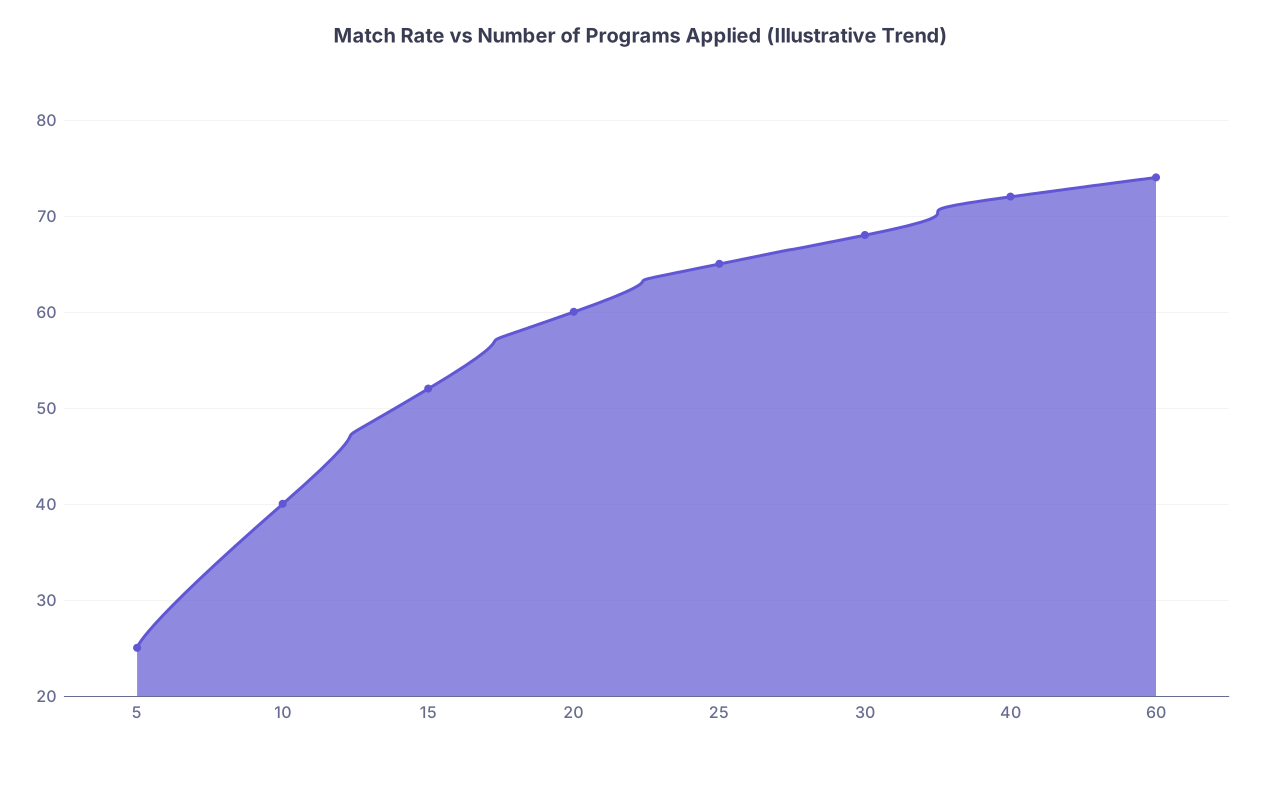
The number of applications required for IMGs in neurology is generally higher than for U.S. graduates. For most IMGs, neurology match success improves significantly with:
- 40–60 programs as a lower bound
- 60–100+ programs as a common range for many IMGs
100 programs can be reasonable for some underdog candidates, but with a smart filter, not blindly applying everywhere
ERAS applications and interview travel (or virtual interview prep) are costly. A thoughtful IMG residency guide emphasizes efficient volume: enough breadth to capture opportunities, but targeted so you avoid wasting applications on programs where you have almost no chance (e.g., strict “No IMG” policies or no visa sponsorship when you need one).
3.2 Tailoring Application Volume to Your Profile
Below are rough starting points; adjust for financial constraints and individual context:
Highly Competitive IMG
- May target ~45–70 neurology programs
- Can afford a higher percentage of academic/university-based programs
- Keeps some community programs and IMG-heavy programs as a safety net
Moderately Competitive IMG
- Often needs ~70–100 programs
- Mix of academic and community, but heavy on “IMG-friendly” programs
- Limited number of top-tier academic programs (maybe 10–15 max as “reach”)
At-Risk/Underdog IMG
- Often needs 100+ programs, if financially feasible
- Broad list, heavily weighted to programs with a track record of taking IMGs, smaller cities, and community-focused hospitals
- Focused on programs that explicitly sponsor visas and consider older YOGs
Important: More applications are not automatically better. Program selection strategy is about matching:
- Your profile
- Program requirements
- The reality of your resources (ERAS fees, time to tailor materials, mental bandwidth)
Step 4: Building a Structured Program Selection Strategy
A solid approach to how to choose residency programs in neurology is to build a tiered list using objective and practical filters.
4.1 Start with Verified Program Data Sources
Use multiple sources to cross-check information:
- ERAS / AAMC program directory
- FREIDA (AMA Residency & Fellowship Database)
- Program websites (most updated for visa, USMLE, and IMG policies)
- NRMP and specialty match data reports
- Word of mouth (current residents, seniors from your school, IMG forums—use cautiously)
Record details in a spreadsheet: program name, location, number of residents per year, IMG percentage, visa status, Step cutoffs, contact info, research expectations, neurology subspecialty strengths, and any deal-breaker criteria.
4.2 Filter 1: IMG-Friendliness
For an international medical graduate, IMG-friendliness is the first and most critical filter:
- Check if the program has current or recent IMG residents (program website, resident bios, social media)
- Look at historical match lists and resident backgrounds
- If there are no IMGs at all in the last several years, the program may be low-yield (with rare exceptions, like top-tier applicants with outstanding research)
Practical rule:
- For most IMGs, at least 70–80% of your list should be programs that have accepted IMGs in the last 3–5 years.
4.3 Filter 2: Visa Sponsorship (For Non-U.S. Citizens)
Neurology programs differ greatly in visa policies:
- Many programs sponsor J-1 visas.
- Fewer sponsor H-1B, and some restrict H-1B to those who have passed Step 3.
- Some programs do not sponsor any visas (often “U.S. citizens/green card holders only”).
Action steps:
- Check each program’s website for visa information; if unclear, email coordinators early.
- If you require H-1B, your effective program pool is smaller; you may have to apply more broadly within that subset.
- If you can accept J-1, your options expand significantly.
For many IMGs, visa sponsorship is a hard cutoff criterion: if they don’t sponsor the visa you need, don’t waste an application.
4.4 Filter 3: Geographic Strategy
Geography should be strategic, not purely personal preference.
Factors to consider:
- Regional IMG trends: Some states (e.g., New York, New Jersey, Michigan, Texas, Florida) have more IMG-heavy neurology programs.
- Competition intensity: Large coastal academic centers (Northeast, West Coast) often face intense competition.
- Lifestyle and cost of living: Smaller cities and midwestern or southern states may have more open attitudes toward IMGs and slightly fewer applicants.
If you’re an IMG with limited connections, consider being geographically flexible, especially in early training years. You can later move for fellowships or jobs.
4.5 Filter 4: Program Type and Size
Neurology residency programs vary in environment:
Academic/University-Based
- Usually large volume, strong subspecialties, and research opportunities
- Often more competitive
- May prioritize applicants with research and strong scores
Community-Based / Community-Teaching
- Often smaller, more clinically focused
- May be more open to IMGs
- Good for those wanting hands-on patient care and less pressure to publish early
Hybrid / University-Affiliated Community Programs
- Mix of academic exposure and community practice
- Often solid choices for IMGs wanting balance
Program size (number of residents per year) also matters:
- Larger programs (4–8 residents per year) => more interview slots and more flexibility in selecting diverse profiles
- Very small programs (2–3 residents per year) => higher risk because each spot is precious, but some are highly IMG-friendly
Balance your list to include:
- A core of community or hybrid programs with good IMG track record
- A smaller number of academic centers as reach or target, depending on your profile
4.6 Filter 5: Research and Subspecialty Fit
If your long-term goal is a fellowship in stroke, epilepsy, neurocritical care, movement disorders, or neuroimmunology, then the neuro match is your first step toward that pathway.
Consider:
- Does the program have subspecialty-trained faculty in your areas of interest?
- Is there accessible research, and do residents publish or present?
- Are there in-house fellowships in neurology subspecialties?
For highly research-oriented IMGs, target programs with:
- NIH funding or strong neurology departments
- A track record of residents matching into competitive fellowships
- Possibly an academic “name” that will help later (though this must be balanced against realistic competitiveness)
For clinically focused IMGs, prioritize:
- Strong general neurology training
- Stroke exposure (very common)
- Good supervision, supportive culture, and volume of common neurologic conditions

Step 5: Creating Your Tiered Program List (Safety, Target, Reach)
Once you’ve applied the main filters (IMG-friendliness, visa, geography, program type, research), you can divide your chosen programs into three tiers.
5.1 Safety Programs
Safety programs are not guaranteed matches, but you should be reasonably competitive or better based on historical intake.
Characteristics:
- Historically take multiple IMGs
- Often in smaller cities or less “popular” regions
- Scores and requirements are at or below your level
- Visa-friendly (if you need it)
For most IMGs, 40–60% of your list should be safety programs.
5.2 Target Programs
These are programs where you’re a solid, realistic candidate, but competition is moderate.
Characteristics:
- Mixed class of IMGs and U.S. graduates
- Reasonable score expectations around your range
- Decent research or subspecialty opportunities
- Often university-affiliated community or smaller academic centers
Aim for 30–40% of your list as target programs.
5.3 Reach Programs
Reach programs are more competitive than your profile suggests, but not impossible.
Examples:
- Big-name academic centers
- Programs in highly desirable locations
- Institutions preferring U.S. graduates but not closed to IMGs
These are strategic long-shots. For most IMGs, 10–20% of your list as reach is sufficient. Going beyond that may waste applications unless your profile is very strong.
5.4 A Sample Distribution
Example Candidate:
- Step 2 CK: 238 (first attempt)
- YOG: 4 years
- Two U.S. neurology electives with good letters
- Some neurology research posters but no publications
Reasonable strategy: 80 neurology programs
- ~35 safety programs (smaller, highly IMG-friendly, non-major cities)
- ~30 target programs (university-affiliated plus some academic centers open to IMGs)
- ~15 reach programs (larger academic centers in competitive regions)
This approach maximizes interview chances while still giving a few attempts at top-tier centers.
Step 6: Practical Tips to Strengthen Your Program Selection and Applications
6.1 Don’t Ignore Application Quality While Chasing Volume
Sending 100+ generic applications without tailored materials can backfire. Even with many programs, you must:
- Tailor personal statements slightly (e.g., academic vs community emphasis, geographic connection)
- Ensure your CV clearly highlights neurology interest and USCE
- Double-check each application for program-specific instructions
6.2 Leverage Connections and Networking
For an international medical graduate, relationships can amplify your program selection strategy:
- Ask attendings from your U.S. rotations where they recommend applying.
- Politely inquire if they know program directors or faculty at other institutions.
- Attend virtual open houses and neurology interest sessions; show genuine interest and ask informed questions.
Any positive interaction can increase the chance your application is truly reviewed, especially in programs with high application volume.
6.3 Use Your Unique Background as a Strength
As you build your program list, consider where your background may be particularly valued:
- Programs serving diverse populations may value your language skills and global perspective.
- Places with limited neurology access may appreciate your prior clinical experience in resource-limited settings.
- Academic centers with global neurology initiatives or international collaborations may connect with your story.
Highlight these connections in your personal statement or supplemental essays when appropriate.
6.4 Reassess and Adjust Each Season (If Reapplying)
If you don’t match the first time:
- Study your interview yield: How many interviews per number of programs applied to?
- Identify patterns: Did mostly IMG-heavy programs respond? Mostly places with your visa type?
- Adjust the next year’s program selection strategy accordingly—perhaps more safety programs, different regions, or improved USCE/research first.
For repeat applicants, consider strengthening your profile with:
- Additional neurology observerships or externships
- Step 3 (especially helpful for H-1B seekers or older graduates)
- Research positions, even unpaid, to build publications/posters
Step 7: Putting It All Together – A Structured Action Plan
Self-Assessment (Week 1–2)
- Categorize yourself: highly competitive, moderate, or at-risk IMG
- List your key metrics and assets (scores, USCE, research, languages)
Data Gathering (Week 2–3)
- Use FREIDA, ERAS, and program websites to compile all neurology programs
- Record IMG status, visa policy, location, program type, and subspecialty strengths
First-Round Filtering
- Remove programs that:
- Explicitly do not consider IMGs
- Do not sponsor your required visa
- Flag programs with strong IMG presence
- Remove programs that:
Second-Round Prioritization
- Label programs as safety, target, or reach based on your profile
- Aim for a program count consistent with your competitiveness category (e.g., 60–100+)
Finalize Your List (Week 3–4)
- Confirm you have:
- 40–60% safety
- 30–40% target
- 10–20% reach
- Cross-check that most programs have at least some IMG residents
- Confirm you have:
Prepare Tailored Application Materials
- Core neurology personal statement + minor variants (e.g., academic-focused, community-focused, geographic tie)
- Updated CV highlighting neurology activities
- Secure letters, especially from U.S. neurologists, early
Stay Flexible and Informed
- Track programs’ social media and website updates
- Attend virtual sessions; adjust your interest level list (e.g., programs you especially want to signal enthusiasm to)
This stepwise method transforms “spray and pray” into a deliberate, data-informed neuro match strategy.
FAQs: Neurology Program Selection Strategy for IMGs
1. How many neurology residency programs should I apply to as an IMG?
Most international medical graduates should consider applying to 60–100+ neurology programs, depending on profile strength and finances:
- Highly competitive IMGs: ~45–70
- Moderately competitive IMGs: ~70–100
- At-risk/underdog IMGs: 100+ if feasible
What matters is not only the number but also the quality of your program selection strategy—prioritizing IMG-friendly, visa-sponsoring programs where your profile is realistic.
2. How do I know if a neurology program is IMG-friendly?
Look for these signs:
- Current or recent residents include IMGs (check websites and social media)
- The program does not explicitly state “We do not accept IMGs”
- They clearly state they sponsor J-1 and/or H-1B visas
- Feedback from other IMGs, your mentors, or alumni supports that IMGs have matched there
While no label is perfect, IMG-friendliness is a critical filter in any IMG residency guide and should heavily influence your list.
3. Should I avoid competitive academic programs as an IMG?
Not necessarily. You should include some academic or competitive programs as reach options, especially if you have:
- Strong Step 2 CK
- Solid research and neurology exposure
- Strong U.S. letters
However, they should be a minority of your applications, not the majority. A balanced approach—safety, target, and reach—gives you the best neuro match chances.
4. If I am an older graduate or have lower scores, is neurology still possible?
It can be, but you must be realistic and strategic:
- Apply broadly to programs known to take IMGs and older graduates
- Strengthen your application with recent clinical experience, ideally in neurology
- Consider taking Step 3 and/or engaging in research or observerships
- Expect to apply to a higher number of programs (often >100) and possibly plan for more than one application cycle
Neurology is not closed to underdog IMGs, but success depends heavily on a careful program selection strategy plus active efforts to improve your profile.
By approaching neurology residency as a structured, data-driven process—understanding your profile, targeting IMG-friendly programs, and balancing your list—you significantly increase your chances of a successful neuro match as an international medical graduate.