Understanding the Big Picture: What Makes Radiology Program Selection Different for IMGs?
Diagnostic Radiology is one of the most competitive specialties in the U.S. residency match, and this is especially true for an international medical graduate (IMG). A strong program selection strategy can easily be the difference between matching and going unmatched—even when your application is solid.
This article is an IMG residency guide specifically focused on program selection strategy for diagnostic radiology. We will cover:
- How diagnostic radiology differs from other specialties in selection dynamics
- Key factors that radiology programs look for in IMGs
- How to choose residency programs realistically and strategically
- How many programs to apply to as an IMG in radiology
- How to build a balanced, targeted application list
Throughout, we will keep the discussion grounded in practical steps and realistic examples for an IMG aiming at the diagnostic radiology match.
What Radiology Programs Want – And What It Means for IMGs
Before you decide where to apply, you must understand what programs are looking for. Radiology is heavily metrics-driven, but not exclusively so.
Core Selection Factors in Diagnostic Radiology
These are the key elements most program directors in diagnostic radiology consider:
USMLE Performance
- Step 1 (now Pass/Fail) still matters indirectly: many programs screen based on whether you passed on the first attempt.
- Step 2 CK remains critical: competitive radiology applicants often have scores above the national mean. For an IMG, a strong Step 2 CK can partly compensate for other disadvantages.
- Multiple attempts are a red flag; some programs filter out applicants with any failures.
Medical School and Training Background
- LCME-accredited or well-recognized international schools may be viewed more favorably.
- Graduation year: many programs prefer recent graduates (often ≤5 years from graduation).
- Prior clinical experience, especially in U.S. settings, is valuable.
U.S. Clinical Experience (USCE) and Radiology Exposure
- Electives, observerships, or externships in radiology are ideal.
- Substantial U.S. clinical exposure (even in non-radiology specialties) demonstrates familiarity with the U.S. healthcare system.
Letters of Recommendation (LoRs)
- Strong letters from U.S. radiologists carry significant weight.
- Program directors often value letters from people they know or from reputable U.S. academic centers.
Research
- Not mandatory for all programs, but:
- Radiology is research-friendly; having radiology-related publications/posters/abstracts shows commitment and academic potential.
- For competitive or academic programs, research is often a “soft requirement.”
- Not mandatory for all programs, but:
Visas and IMG Status
- Visa policy is a major filter:
- Some programs do not sponsor visas at all.
- Some sponsor only J-1, some J-1 and H-1B.
- Your need for a visa directly influences which programs are realistic and should be on your list.
- Visa policy is a major filter:
Non-Cognitive Factors
- Evidence of professionalism, communication skills, teamwork.
- Personal statement showing genuine interest in diagnostic radiology (not generic).
- Any red flags (gaps, professionalism issues, legal problems) are heavily scrutinized.
What This Means for an IMG
Compared to U.S. grads, IMGs must be more strategic:
- You cannot afford to waste applications on programs that historically do not interview or match IMGs.
- A realistic assessment of your exam scores, graduation year, research, and USCE must guide your program selection.
- Your visa needs will significantly limit your options—this must be built into your program selection strategy from the beginning.
In other words, selecting programs is not just about preference; for an IMG in radiology it is fundamentally about probability management.

Step-by-Step Program Selection Strategy for IMGs in Diagnostic Radiology
This section outlines a structured, practical approach to how to choose residency programs and build a realistic yet ambitious list.
Step 1: Define Your Applicant Profile Honestly
You need a clear, unemotional picture of where you stand. Consider:
Exam Performance
- Step 2 CK score band:
- Highly competitive: ~255+
- Strong: ~245–254
- Moderate: ~235–244
- Below average: <235
- Any failures (Step 1 or Step 2 CK): note them clearly.
- Step 2 CK score band:
Year of Graduation (YOG)
- 0–2 years: most favorable
- 3–5 years: still realistic, especially with strong profile
5 years: more challenging; you must rely heavily on strong USCE, research, and networking.
US Clinical Experience
- Radiology-specific observerships/externships/electives?
- U.S. inpatient/outpatient experience in other specialties?
- Any formal U.S. internship or residency?
Radiology Exposure and Commitment
- Radiology rotations, home-country training, teleradiology, electives.
- Radiology-related projects, QI work, teaching, or research.
Research
- Any peer-reviewed publications (especially radiology-related)?
- Poster presentations, abstracts, case reports?
- Ongoing projects with U.S. academic faculty?
Visa Requirement
- U.S. citizen/Green Card – no visa issue.
- Require J-1 – broader options.
- Require H-1B – more limited; especially challenging for IMG in radiology.
Document this in a simple summary:
Example: “IMG, YOG 2021, Step 2 CK 247, Step 1 pass on first attempt, 2 U.S. observerships (1 in radiology), 1 radiology case report accepted, needs J-1 visa.”
This profile will guide which programs to target and which to avoid.
Step 2: Understand the Radiology Landscape for IMGs
Radiology has historically favored U.S. graduates, but IMGs do match every year. You must find the IMG-friendly radiology programs that fit your profile.
Key resources:
- NRMP’s Charting Outcomes in the Match (for Diagnostic Radiology)
- NRMP Program Director Survey
- FREIDA (AMA): search by specialty, filter by IMG data if available
- Program websites (visa policies, IMG statements, alumni lists)
- Word-of-mouth from recent residents and fellows
Important patterns:
- Many university-based academic programs take few or no IMGs, especially the top-tier, research-heavy institutions.
- Some mid-tier university-affiliated and large community programs are more open to IMG applicants, especially those with U.S. experience and strong scores.
- Some smaller or mid-sized programs may be more flexible on scores but still cautious with IMGs who lack USCE or have exam failures.
Your aim is to identify:
- Programs that have matched IMGs in the last 3–5 years.
- Programs that officially sponsor visas.
- Programs that do not explicitly exclude IMGs.
Step 3: Filter by Visa and Official Policies First
As an IMG, your first filter must be:
Visa sponsorship
- Check program websites and FREIDA:
- Does the program sponsor J-1?
- Does it sponsor H-1B?
- Does it say “No visa sponsorship” or “We only accept U.S. citizens/Green Card holders”?
- Check program websites and FREIDA:
Explicit IMG policies
- Some program websites state:
- “We do not consider international medical graduates”
- “We consider IMGs only with extensive U.S. experience”
- “We accept ECFMG-certified IMGs”
- Take these statements seriously.
- Some program websites state:
If a program:
- Does not sponsor any visa and you need a visa → exclude.
- States they do not accept IMGs → exclude.
- Has vague wording but historically has never matched an IMG (you can often see this on program social media, websites, or unofficial match lists) → consider carefully before including; only keep if you have exceptional metrics and particular interest.
This first pass will significantly reduce your initial list and save you money, time, and false hope.
Step 4: Use Data to Gauge IMG-Friendliness
Next, research each program’s track record with IMGs. Ways to do this:
- FREIDA: some programs list percentages of international graduates among residents.
- Program website:
- Resident bios (look for international medical schools).
- Alumni lists with medical schools.
- Social media (program Instagram, X/Twitter, LinkedIn):
- Photos of resident classes sometimes include bios or countries.
Categorize programs as:
- Consistently IMG-friendly: IMGs appear in multiple classes over several years.
- Occasionally IMG-friendly: 1–2 IMGs across several years.
- Rarely/never IMG-friendly: essentially no visible IMGs.
As an IMG in radiology, your core list should include a substantial proportion of consistently and occasionally IMG-friendly programs.
Step 5: Consider Competitiveness vs. Your Profile
Now that you have a list of programs that could consider you, stratify them by competitiveness:
More competitive (reach programs):
- Major academic centers with national reputations.
- Strong research output, multiple fellowships, associated medical school.
- Located in highly desirable cities.
- Typically require high scores, strong research, and robust USCE.
Moderate competitiveness (target programs):
- University-affiliated or large community programs.
- Moderate academic activity (some research, some fellowships).
- Often in mid-sized cities or less saturated markets.
- More flexible with scores if other aspects of application are strong.
Less competitive (safety programs):
- Smaller community-based programs.
- Less research focus, fewer or no fellowships.
- Sometimes in less popular geographic areas or smaller towns.
- May be more open to IMGs with modest scores or older YOG, especially with strong USCE or other strengths.
Your goal: construct a balanced list based on your profile.

How Many Programs to Apply to as an IMG in Diagnostic Radiology?
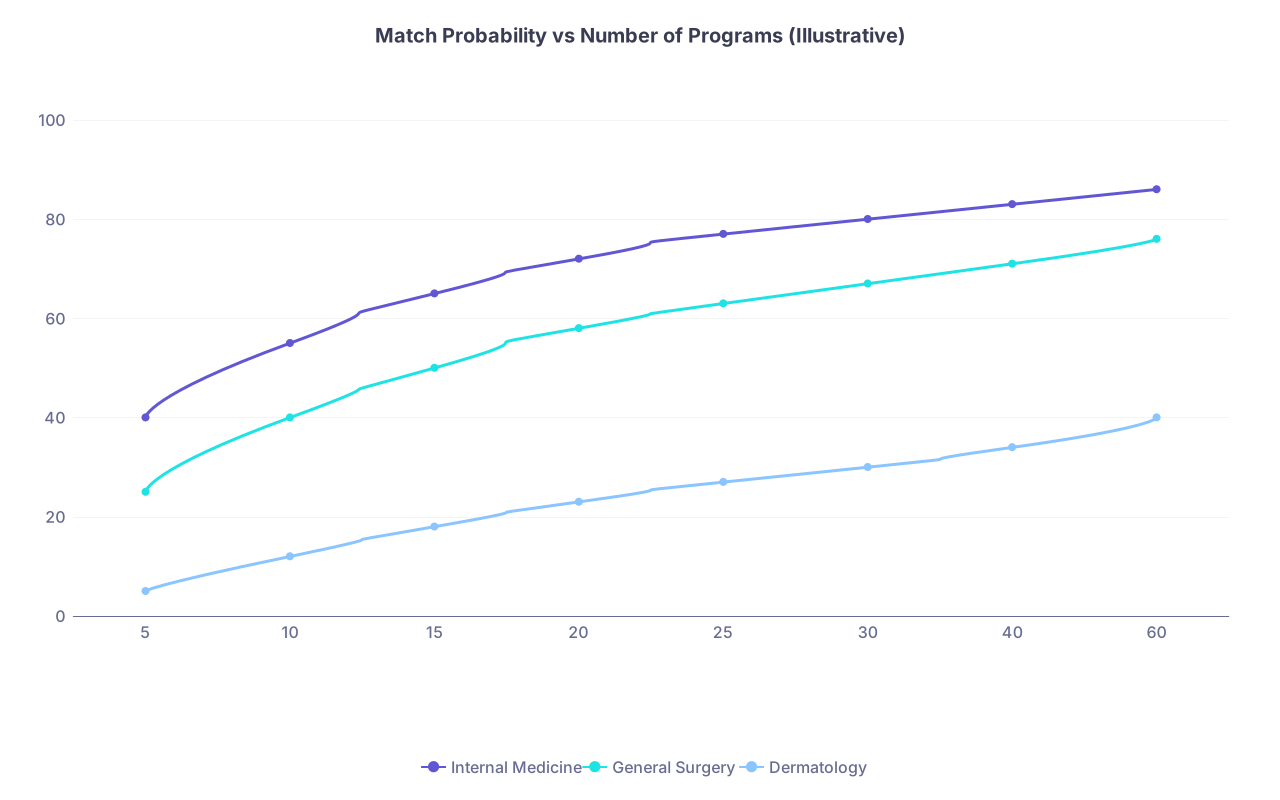
One of the most frequent—and important—questions in any IMG residency guide is: how many programs to apply to. For diagnostic radiology, this decision is critical.
General Principles
- Diagnostic radiology is competitive, especially for IMGs.
- Application fees increase significantly with each additional program.
- Quality is as important as quantity—but quantity still matters.
The optimal number depends on:
- Strength of your application
- Visa needs
- IMG-friendliness of the programs you target
- Your budget
Suggested Ranges for IMGs in Radiology
These are approximate guidance bands, not strict rules, assuming you apply mostly to realistically IMG-friendly programs:
Very Strong IMG Applicant
- Step 2 CK: ≥255, no failures
- Recent YOG (≤3 years)
- Strong U.S. radiology experience and letters
- Radiology-related research
- Needs J-1 or no visa
- Suggested range: 40–60 radiology programs
Strong but Not Exceptional IMG
- Step 2 CK: ~245–254, no failures
- YOG ≤5 years
- Some U.S. clinical exposure (ideally radiology)
- Some research or strong clinical achievements
- Needs J-1 or no visa
- Suggested range: 60–80 radiology programs
Moderate or Risk-Containing IMG
- Step 2 CK: ~235–244 OR one minor exam issue
- YOG >3–5 years
- Limited USCE or minimal radiology exposure
- Visa requirement (especially H-1B)
- Suggested range: 80–120 radiology programs, focusing heavily on IMG-friendly and less competitive programs.
High-Risk Profile
- Step 2 CK <235
- Multiple exam failures
- Older YOG (>5–7 years)
- Limited or no USCE
- Needs H-1B visa
- Radiology becomes very challenging; you should:
- Strongly consider backup specialties (e.g., IM, FM, transitional year)
- If still applying to radiology: 100+ programs, but recognize that the probability of matching is low without significantly strengthening your profile.
These numbers assume you are applying only to diagnostic radiology. If you are applying to both radiology and a backup specialty, you may:
- Apply to fewer radiology programs (e.g., 40–70) AND
- A substantial number of programs in your backup specialty (e.g., 60–100)
Quality vs Quantity: Avoiding Common Mistakes
Common mistake #1: Applying broadly but blindly
Many IMGs submit 100+ applications to every possible radiology program, including those that:
- Do not sponsor visas
- Have never taken IMGs
- State they do not review IMG applications
This wastes money and gives a false sense of security.
Better approach:
Target 60–100 appropriate programs rather than 120+ inappropriate ones. Every program on your list should be there for a reason: visa-compatible, historically IMG-friendly, and realistically within reach of your profile.
Common mistake #2: Under-applying
A strong IMG with high scores may think: “I’ll just apply to 25 top university programs.” For diagnostic radiology as an IMG, this is risky. You need volume:
- You do not know how many of those programs will actually interview IMGs in your cycle.
- Interview numbers can fluctuate year to year.
Even a strong IMG applicant should usually not apply to fewer than 40 radiology programs unless you have truly exceptional credentials and strong connections.
Building and Organizing Your Final Program List
Once you know how many programs to apply to, you need to refine and organize your list strategically.
1. Construct a Spreadsheet (Your Master Tool)
Include columns for:
- Program name and ACGME ID
- Location (city, state, region)
- University vs community vs hybrid
- Visa policy (J-1, H-1B, none)
- Historical IMG presence (none/low/moderate/high)
- Competitiveness level (reach/target/safety)
- Your personal interest level (1–5)
- Any connections (mentor, alumni, rotation)
- Application-specific notes (e.g., special tracks, research emphasis)
This spreadsheet becomes your central decision dashboard.
2. Categorize Programs: Reach, Target, Safety
For your final list, aim for a rough distribution (adjust based on your profile):
- 20–30% Reach programs
- More competitive, top academic centers, heavily research-oriented.
- 40–60% Target programs
- Reasonable match between your profile and program’s typical resident profile.
- 20–30% Safety programs
- Less competitive; often smaller or less-known programs; clearly IMG-friendly.
Example for a strong IMG applying to 70 programs:
- Reach: 15–20
- Target: 35–40
- Safety: 15–20
For a moderate-risk IMG applying to 100 programs:
- Reach: 15–25
- Target: 40–50
- Safety: 30–40
3. Add a Geographic and Lifestyle Filter (After Reality Checks)
Only after checking visa, IMG-friendliness, and competitiveness should you refine by:
- Region (Northeast, South, Midwest, West)
- Climate preferences
- Proximity to family or friends
- Cost of living
As an IMG in a competitive specialty, you generally cannot be too restrictive geographically, but it is reasonable to avoid places you truly cannot see yourself living for 4–5 years.
4. Check for Hidden Requirements or Strong Preferences
Some programs specify:
- “U.S. clinical experience required.”
- “Graduation within past 5 years preferred.”
- Minimum Step 2 CK score (e.g., 240).
- “We require at least three letters from U.S. physicians.”
If you do not meet these and the program appears otherwise not IMG-friendly, consider dropping it unless you have a compelling reason or strong internal advocate.
5. Reassess Just Before Submission
Shortly before submitting ERAS:
- Re-evaluate your list:
- Are at least 60–70% of programs clearly IMG-friendly or moderately so?
- Does every program selected actually sponsor your visa type?
- Do you have enough safety programs?
- Make final adjustments based on updated information (new resident class photos, website updates, personal contacts).
Strategic Extras: Networking, Signals, and Backups
Leveraging Networking and Mentorship
Personal connections matter more than many IMGs realize:
- Mentors in radiology (especially U.S.-based) can:
- Email program directors on your behalf.
- Advise you on which programs are realistically IMG-friendly.
- Help you decide how many programs to apply to based on your unique profile.
- Conferences and virtual open houses:
- Attending radiology conferences (RSNA, ARRS, local meetings) or virtual sessions can help you learn about program culture and sometimes get informal visibility.
When you have a connection at a program:
- You may categorize that program as slightly more achievable than its baseline competitiveness would suggest.
- Still, make sure other selection factors (visa, IMG track record) are in your favor.
Signaling and Preference Communication (If Applicable)
If in future cycles ERAS or NRMP implement or expand preference signaling for diagnostic radiology:
- Use your limited signals on:
- Programs you are genuinely interested in
- Places where your profile is competitive
- Programs known to read and respond to signals
Do not waste signals on programs that state they do not consider IMGs or do not sponsor your visa.
Backup Specialties and Parallel Planning
Because radiology is competitive, many IMGs wisely apply to a backup specialty (e.g., Internal Medicine, Family Medicine, Transitional Year).
When planning your program selection strategy:
- Decide early if you will apply to a backup.
- Allocate your budget:
- E.g., 60 radiology + 60 internal medicine programs.
- Tailor your personal statement and letters appropriately (you may need radiology-focused and IM-focused versions).
Do not view backup applications as failure; they are a risk management tool in a system that is not entirely predictable.
Frequently Asked Questions (FAQ)
1. As an IMG, can I match into diagnostic radiology without U.S. clinical experience?
It is possible but substantially harder. Most radiology program directors prefer or expect some U.S. clinical exposure—ideally radiology-related. If you lack USCE, you should:
- Emphasize any strong home-country radiology experience.
- Strengthen your profile with research, especially in radiology.
- Apply more broadly and include more safety programs.
- Consider gaining U.S. observerships or electives before applying if feasible.
2. Is research absolutely necessary for an IMG to match radiology?
Not absolutely, but it is a significant advantage, especially at academic or mid-to-high-tier programs. For program selection:
- If you have no research, weight your list more toward community and IMG-friendly programs with less academic focus.
- If you have radiology-focused research, you can reasonably include more academic or research-heavy programs as targets or reaches.
3. Should I avoid programs that have never taken an IMG?
You do not have to automatically avoid them, but they should be approached cautiously:
- If you have a very strong profile (high scores, strong USCE, research), you may include a few as reach programs.
- For most IMGs, the majority of your list should be programs that have at least some track record of matching IMGs.
- If your budget is limited, prioritize programs with known IMG-friendliness over “unknown” or historically IMG-absent programs.
4. How many interviews do I need in radiology to have a reasonable chance of matching?
While exact probabilities vary by year and profile, historical NRMP data suggest:
- Around 10–12 ranked programs often provides a reasonable chance of matching for competitive specialties.
- For IMGs in radiology, aiming for ≥10 interviews is sensible.
- Program selection strategy directly affects your interview yield: a well-researched list of 70 programs can generate more interviews than a poorly chosen list of 100.
A thoughtful, data-driven program selection strategy is essential for any international medical graduate aiming for the diagnostic radiology match. By understanding what programs value, honestly assessing your profile, and carefully choosing where and how many programs to apply to, you maximize your chances of turning your radiology ambitions into reality.