Understanding the EM Landscape for International Medical Graduates
Emergency Medicine (EM) is an exciting, fast-paced specialty—but for an international medical graduate (IMG), it is also one of the more challenging fields to match into. A thoughtful, data‑driven program selection strategy is critical to maximizing your chances.
When you’re planning your EM applications, you’re really trying to answer three big questions:
- Where do I have a realistic chance to match?
- Where will I be happy and able to thrive?
- How many programs should I apply to, and which ones?
This IMG residency guide focuses specifically on how to choose residency programs in Emergency Medicine and build a smart, individualized program selection strategy—from understanding competitiveness to constructing a targeted program list.
Why EM Is Challenging for IMGs
Key realities IMGs should know:
- EM has become increasingly competitive in recent years.
- A minority of EM programs regularly interview IMGs.
- EM places heavy emphasis on:
- US clinical experience (ideally EM rotations)
- SLOEs (Standardized Letters of Evaluation)
- USMLE performance
- Communication skills and teamwork
- Many programs have institutional or visa sponsorship limitations that directly affect IMGs.
None of this means you cannot match—many IMGs do—but it means you must be strategic in how you build your program list and where you invest your time and money.
Step 1: Honestly Assess Your Applicant Profile
Before you can decide how many programs to apply to or which ones, you must understand your own strengths and weaknesses. This self-assessment anchors your program selection strategy.
1. Academic Metrics (USMLE/COMLEX)
Programs will look first at:
- USMLE Step 1
- Pass/Fail now, but failures still matter.
- USMLE Step 2 CK
- Critical score for EM.
- For IMGs, being at or above the mean of matched EM applicants is extremely helpful.
- A significantly lower score does not make matching impossible, but you should apply more broadly and prioritize IMG‑friendly programs.
Actionable tip:
Compare your Step 2 CK score to recent NRMP Charting Outcomes in the Match data (for EM) to understand where you stand relative to matched and unmatched applicants. If your score is below average, increase the number of applications and be realistic about program competitiveness.
2. EM‑Specific Credentials
EM programs heavily value:
- SLOEs (Standardized Letters of Evaluation) from:
- ACGME‑accredited EM residency programs
- EM clerkships or audition rotations
- US EM Clinical Experience
- At least 1–2 rotations in US emergency departments is strongly preferred; 2–3 is better for IMGs.
Red flags and risk factors:
- No SLOEs from US EM programs
- Only observerships, no hands-on EM rotations
- No EM home institution or EM faculty mentor
If you lack SLOEs or US EM experience, prioritize gaining them before the application season when possible. If that’s not possible, your program selection strategy should heavily target IMG‑friendly and community-based EM programs that sometimes consider strong non‑SLOE letters.
3. Visa Status and Legal Considerations
Your visa status dramatically shapes how to choose residency programs:
- US citizen/green card holder:
- Broader options; many programs consider you similar to US grads academically.
- Requires visa (J‑1 or H‑1B):
- Some programs do not sponsor visas at all.
- Others sponsor J‑1 but not H‑1B.
- Fewer programs are willing to support H‑1B due to cost/complexity.
Actionable tip:
Create three categories in your spreadsheet:
- Programs that specifically state they accept IMGs and sponsor your required visa type
- Programs that sponsor visas but are vague regarding IMGs
- Programs that do not sponsor visas or explicitly state “No IMGs”
Focus your time and money on category 1, cautiously include category 2, and generally avoid category 3.
4. Time Since Graduation and Clinical Currency
Many EM programs have a time since graduation limit (e.g., ≤5 or ≤7 years). Others emphasize “clinical currency”—recency of active clinical work.
Consider:
- Year of medical school graduation
- Recent hands-on clinical experience (US or abroad)
- Any gap years and how they are explained
If you graduated >5 years ago, heavily prioritize programs that:
- Do not list a strict graduation-year cutoff, or
- Have matched older graduates or IMGs in recent cycles

Step 2: Understand What Makes a Program “IMG‑Friendly” in EM
In emergency medicine, not all programs are equally accessible to international medical graduates. Your program selection strategy should deliberately prioritize IMG‑friendly programs.
Key Signs a Program Is IMG‑Friendly
Look for multiple of the following:
History of Matching IMGs
- Check each program’s resident roster on their website.
- Look for:
- International medical schools in the resident bios
- Explicit mention of IMGs in “Meet Our Residents” pages
Clear Policy Statements
- Phrases such as:
- “We welcome and encourage applications from international medical graduates.”
- “We sponsor J‑1 visas” or “We sponsor J‑1 and H‑1B visas.”
- Avoid or de‑prioritize programs stating:
- “We accept applications only from LCME‑accredited schools”
- “We do not sponsor visas” (if you require one)
- Phrases such as:
Reasonable Score Requirements
- Some programs post minimum USMLE scores.
- For IMGs, meeting or exceeding these minimums is essential.
- Programs with extremely high score cutoffs may be less flexible for IMGs.
Community and Hybrid Programs vs. Highly Academic Powerhouses
- Large, highly academic, “name-brand” EM programs often:
- Have many strong US applicants
- Accept few or no IMGs
- Community‑based or hybrid community/academic sites more often:
- Have a track record of training IMGs
- May be more flexible if the rest of your application is strong
- Large, highly academic, “name-brand” EM programs often:
Program Size and Number of Positions
- Larger programs (more residents per year) have:
- More interview slots
- More potential flexibility for different types of applicants
- Small programs with 4–6 residents per year may be more conservative in selection.
- Larger programs (more residents per year) have:
Hidden IMG Barriers You Might Miss
When you research programs, note these subtle barriers:
“We require at least one SLOE from a US EM rotation.”
If you have none, your chances are low even if other factors are strong.“We only accept applications from LCME or AOA accredited schools.”
This typically excludes non‑US/Canadian schools.Silent policies:
Some programs do not openly state they exclude IMGs but never interview or rank them. Resident rosters from the last 3–5 years are your best indicator.
Actionable tip:
Create a 1–3 “IMG friendliness” score for each program:
- 3 = Clearly IMG‑friendly
- Recent IMG residents, explicit supportive language, visa sponsorship
- 2 = Possibly IMG‑friendly
- Occasional IMG residents, unclear language, or limited information
- 1 = IMG‑unfriendly
- No IMGs on roster, restrictive statements, no visa sponsorship
Prioritize 3s, selectively include 2s if other factors are favorable, and mostly avoid 1s.
Step 3: Clarify Your Personal and Professional Preferences
Beyond match probability, you must also think about fit. You’re not just trying to match anywhere—you’re trying to choose programs where you can learn, grow, and avoid burnout.
Geographic Priorities
Questions to ask yourself:
- Do you have family or support systems in specific regions?
- Are you limited to certain states due to:
- Visa sponsorship options
- Spouse/partner’s job
- Childcare or schooling
- Are there states or regions you strongly prefer or want to avoid (e.g., weather, cost of living)?
For many IMGs, geographic flexibility improves match chances. However, if you must limit geography, then your how many programs to apply calculation needs to be higher within that narrower region.
Type of Training Environment
Consider what kind of EM experience you want:
- Large academic center
- High complexity and volume
- Subspecialty exposure, research opportunities
- Often more competitive; fewer IMGs
- Community-based program
- High volume of bread‑and‑butter EM
- Possibly friendlier to IMGs
- May have fewer research opportunities but excellent clinical training
- Hybrid program
- Community hospital with academic affiliation
- Balance of research and strong clinical exposure
Your program selection strategy could, for example, include:
- 60–70% community or hybrid, IMG‑friendly programs
- 20–30% mid‑level academic programs with some IMG track record
- 0–10% highly competitive academic programs (as “reach” options)
Length of Training and Program Structure
Most EM programs are 3 years (PGY‑1 to PGY‑3), with some 4‑year programs. Consider:
- Do you want a 3‑year fast track to practice?
- Would you value an additional year of training, academic time, or leadership development?
Also evaluate:
- 24/7 in‑house attending coverage
- Pediatric EM exposure
- Trauma level (Level 1 vs. 2/3)
- Ultrasound training
- Simulation, procedures, and critical care rotations
These details matter less for getting a position and more for choosing which programs to rank highly later—but they also help you decide which programs are truly appealing and worth applying to.

Step 4: Build a Data‑Driven Program List
With your self-assessment, IMG friendliness analysis, and personal preferences defined, you’re ready to build your list and decide how many programs to apply to.
General Application Volume Guidance for IMG in EM
Specific numbers vary by year and applicant strength, but for most IMGs applying to emergency medicine:
Strong IMG applicant
- Step 2 CK at or above EM mean
- 2–3 strong SLOEs from US EM programs
- Recent graduation, no major red flags, visa not required or J‑1 OK
- Suggested range: ~45–60 EM programs
Moderate‑risk IMG applicant
- Step 2 CK slightly below EM mean
- 1–2 SLOEs or limited US EM experience
- Requires visa sponsorship
- Some older graduation or minor concerns
- Suggested range: ~60–80 EM programs
Higher‑risk IMG applicant
- Step 2 CK significantly below mean or any exam failures
- Minimal or no SLOEs
- Significant time since graduation or major red flags
- Requires H‑1B
- Suggested range: ~80+ EM programs, with a very IMG‑heavy and community‑heavy list
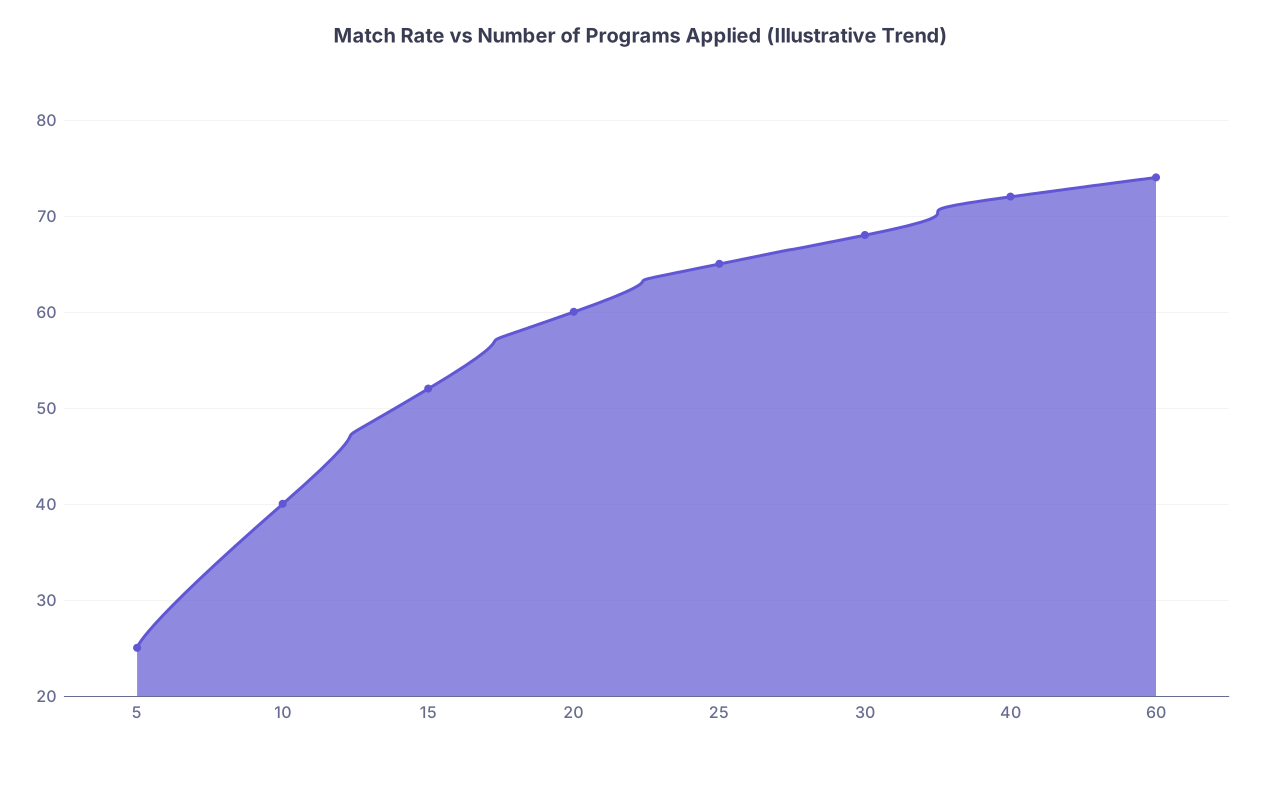
These ranges are not strict rules, but they underscore a key point: most IMGs need to apply broadly to generate enough interviews for a safe EM match.
Constructing Your List: A Practical Framework
Use a spreadsheet to systematically evaluate each program. Include at least these columns:
- Program name and ACGME code
- City, state, region
- Program type (academic / community / hybrid)
- Length (3 or 4 years)
- IMG friendliness score (1–3 as defined above)
- Visa sponsorship (none, J‑1 only, J‑1 + H‑1B)
- USMLE requirements / posted minimums
- Time since graduation limit
- EM SLOE requirements
- Resident roster notes (recent IMGs? which schools?)
- Personal interest/fit score (1–5)
- Notes from mentors or students
Stepwise Strategy
- Start with a master list of all EM programs (using FREIDA, EMRA Match, program websites).
- Filter out absolute non‑options:
- No visa sponsorship (if you need one)
- Strict US/LCME only requirement
- Incompatible graduation year limit
- Tag remaining programs by IMG friendliness.
- Align with your geographic and personal preferences.
- Aim for a balanced list, for example:
- 50–60%: IMG‑friendly community/hybrid programs (IMG score 3)
- 30–40%: Mixed or uncertain programs (IMG score 2)
- 10–15%: More competitive “reach” programs (IMG score 1–2 but highly desirable)
If, after this process, you end up with fewer programs than your target (e.g., only 40 when you’re aiming for 70), consider:
- Expanding your geographic preferences
- Including some 4‑year programs
- Re‑reviewing some “possibly open to IMGs” programs even if they have no clear IMG track record
Estimating Interview Yield
Your goal is to secure enough interviews to have a strong chance of matching. For EM:
- Many advisors suggest at least 10–12 EM interviews for a solid chance, and more is better, especially for IMGs.
- For higher‑risk applicants, aiming for 12–15+ interviews is safer.
However, interview yield varies; that’s why how many programs to apply to is a central question for IMGs. An IMG might need 60–80 applications to secure those 10–12 interviews, depending on their competitiveness and program selection.
Actionable tip:
Talk with advisors, EM mentors, or IMG graduates who successfully matched. Compare their stats and number of applications to fine‑tune your strategy.
Step 5: Refine Your Strategy with Mentorship and Ongoing Adjustments
A strong IMG residency guide is never purely theoretical—real mentorship and iterative adjustments are crucial.
Seek Specialty‑Specific Mentorship
Look for mentors who:
- Work in EM in the US (faculty or residents)
- Have experience advising IMGs
- Are affiliated with an EM residency program if possible
They can help you:
- Realistically assess your competitiveness
- Suggest specific programs known to be IMG‑friendly
- Review your program list and identify “hidden gem” programs
- Advise on reach vs. safety balance
If you don’t yet have an EM mentor, consider:
- Reaching out to faculty from your EM electives or observerships
- Connecting with EM interest groups or national organizations (e.g., ACEP, EMRA)
- Joining IMG support communities that include matched EM residents
Use Application Season Feedback to Adjust
Once interview invitations start coming (or not coming), reevaluate:
- If invitations are very few or delayed:
- Consider applying to an additional batch of IMG‑friendly programs early in the season if finances allow.
- If you receive many early interviews:
- You may not need to extend your list further, but still keep track of program characteristics for ranking later.
Keep a log of:
- Dates of invitations
- Program type/geography
- Any patterns (e.g., only community programs offering interviews)
This can inform both in‑season decisions and future cycles if you need to reapply.
Combining EM with a Backup Specialty
For some IMGs, especially higher‑risk applicants, it is prudent to:
- Apply primarily to EM programs, and
- Apply to a backup specialty where you have stronger chances such as Internal Medicine, Family Medicine, or Pediatrics.
If you pursue this strategy:
- Clearly separate your application materials (personal statements, LoRs) by specialty.
- Ensure your EM SLOEs go to EM programs, and more general letters go to your backup specialty.
- Consider how many programs to apply within each specialty according to your risk tolerance and financial limits.
Frequently Asked Questions (FAQ)
1. As an IMG, how many EM residency programs should I apply to?
For most international medical graduates, a safe range is:
- Strong IMGs: about 45–60 EM programs
- Moderate‑risk IMGs: about 60–80 EM programs
- Higher‑risk IMGs: 80+ EM programs
The exact number depends on your USMLE performance, SLOEs, recency of graduation, visa needs, and how restricted you are geographically. Your primary goal is to secure at least 10–12 EM interviews, ideally more, which usually requires broad applications.
2. How do I find IMG‑friendly emergency medicine programs?
Use a combination of:
- Program websites and resident rosters – look for IMGs among current residents.
- FREIDA and EMRA Match – filter by visa sponsorship and international graduates.
- Program policies – search for “international medical graduate” and visa information on each site.
- Word of mouth and mentorship – ask EM faculty and IMGs who have recently matched.
Give each program an “IMG friendliness score” (1–3) based on those factors and prioritize those with clear evidence of accepting IMGs and sponsoring your visa type.
3. I don’t have any US EM SLOEs. Should I still apply to EM?
You can still apply, but you should:
- Recognize you are a higher‑risk applicant, and
- Compensate by:
- Applying to more programs (often 80+)
- Focusing on community-based, IMG‑friendly programs
- Highlighting any equivalent EM exposure and strong clinical letters
- Considering doing a US EM rotation to obtain at least one SLOE before or early in the cycle, if possible
Some programs explicitly require SLOEs and will be less realistic; therefore, program selection must be very careful.
4. Should I limit myself geographically or apply everywhere?
From a pure match‑probability standpoint, geographic flexibility increases your chances. However, if you have strong reasons (family, financial, visa, or personal support considerations) to focus on certain regions, you can, but you must:
- Increase the total number of applications within those regions
- Accept that the process may be more competitive
- Consider a backup specialty if your region is especially limited in EM programs
Balancing realistic match chances with your life circumstances is central to a sound program selection strategy.
A thoughtful, data‑driven approach to program selection—grounded in honest self-assessment, careful research, and mentorship—will dramatically improve your odds in the EM match as an international medical graduate. Use this IMG residency guide as a framework, then personalize it to your unique profile, goals, and constraints.