
Understanding the Landscape: IR Residency and the IMG Perspective
For an international medical graduate (IMG), interventional radiology (IR) is both exciting and challenging. It is one of the most competitive specialties, highly procedural, and very technology-driven. A smart program selection strategy can make the difference between a successful IR match and multiple unmatched cycles.
There are three realities you must keep in mind from the outset:
- IR is among the most competitive specialties across all applicants, and even more so for IMGs.
- Program selection is not just about “how many programs to apply”—it’s about which programs you target, how you stratify them, and whether they realistically can rank you.
- Your individual profile (USMLE scores, visa status, research, US clinical experience) should directly shape your IR program list, not the other way around.
This IMG residency guide will walk you through a structured, evidence‑informed way to choose and prioritize integrated interventional radiology (and related) residency programs.
Step 1: Know Your Pathways into Interventional Radiology
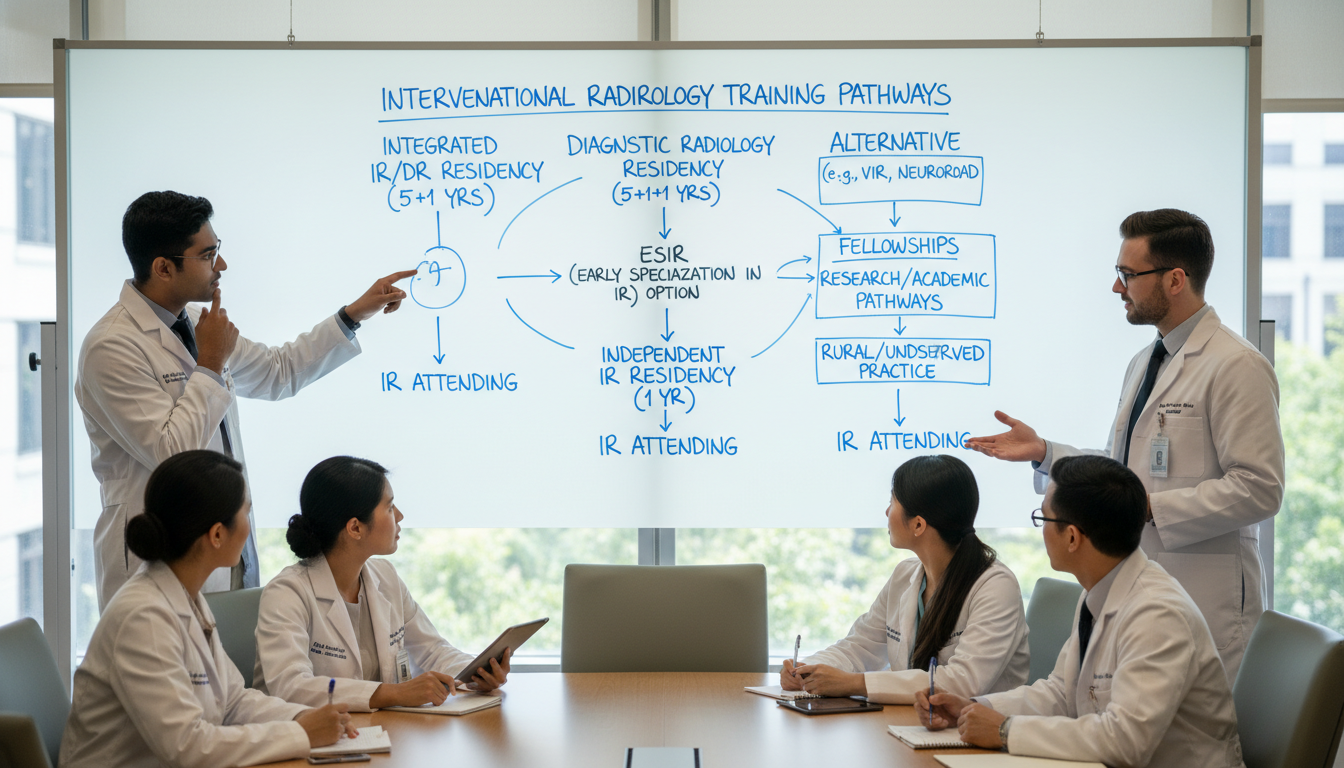
Before developing a program selection strategy, you must understand the multiple IR training pathways and how they affect your IR match options as an international medical graduate.
1. Integrated IR Residency (IR/DR)
- 6-year residency that combines diagnostic radiology (DR) and interventional radiology.
- You match directly into IR/DR from medical school (or prior training) via ERAS and NRMP.
- Extremely competitive with limited positions nationally.
- Many programs prefer or strongly favor US grads and applicants with substantial US-based IR research or rotations.
What this means for an IMG:
You can and should apply to IR/DR if that is your goal, but you must pair this with a robust backup strategy (e.g., DR or preliminary transitional/intern years plus future IR fellowship or ESIR).
2. Diagnostic Radiology (DR) Residency + ESIR + IR Fellowship
- Match into a diagnostic radiology residency (4 years).
- Apply for ESIR (Early Specialization in IR) during DR residency; ESIR shortens IR fellowship.
- Then complete a 1–2 year independent IR residency (formerly called fellowship).
For many IMGs this is a more realistic and still highly successful IR pathway:
- DR positions are more numerous than IR/DR.
- Some DR programs are IMG-friendly and also IR-strong.
- You get multiple additional chances to prove yourself before the independent IR match.
3. Transitional / Preliminary Year + Future DR or IR Entry
- Intern year (preliminary medicine/surgery or transitional year) followed by DR application, then IR.
- This is more indirect and usually lower-yield as a deliberate IR plan, but can be sensible in some situations (e.g., late USMLEs, visa delays, or a need to build US experience).
Strategic Takeaway for IMGs
Your program selection strategy should usually include:
- Primary target: Integrated interventional radiology residency (IR/DR) programs that are IMG-friendly or at least IMG-open.
- Strong backup: IMG-friendly diagnostic radiology (DR) programs, especially those with ESIR and robust IR divisions.
- Safety layer (optional): Transitional or preliminary medicine/surgery programs if your risk of going unmatched is high.
This layered approach dramatically improves your overall IR match probability compared with applying only to IR/DR.
Step 2: Assess Your Profile Honestly Before You Build a List
Before you think about how many programs to apply to, carefully evaluate your competitiveness. This will drive both the number and type of programs you select.
Key Profile Domains
USMLE / COMLEX Scores
- IR/DR programs often have higher score expectations than average DR programs.
- As an IMG, program directors may use scores as a quick screening filter.
- Step 1 pass/fail has shifted more emphasis to Step 2 CK scores, especially for IMGs.
Visa Needs
- Do you need a J-1 or H-1B visa?
- Some IR/DR and DR programs do not sponsor visas at all; others sponsor J-1 only; a minority sponsor H-1B.
- Visa policy is one of the most rigid filters in IR match decisions, particularly for IMGs.
Clinical Experience in the US
- US electives or observerships in IR, DR, or related fields strengthen your application.
- Strong US letters of recommendation from interventional radiologists or radiology faculty are invaluable.
Research and Academic Productivity
- IR is research-heavy—imaging, devices, image-guided therapies.
- Publications, abstracts, poster presentations, and QI projects in IR or radiology are strong positives.
- For less research-heavy programs, any solid clinical research still helps.
Year of Graduation (YOG)
- Many competitive IR/DR programs prefer recent graduates (≤ 3–5 years since graduation).
- If you are an older IMG graduate, program selection must be especially targeted.
Language, Communication, and Personal Attributes
- IR is highly procedural but also highly patient-facing.
- Strong interpersonal skills and clear English communication are crucial and may be assessed during interviews (and even inferred from your personal statement and letters).
Self-Categorize Your Competitiveness
You can use a simple internal scale to guide decisions about how many programs to apply to and what tiers:
Highly Competitive IMG for IR/DR
- Excellent Step 2 CK (e.g., >250), strong research in IR/radiology, recent grad, US electives, strong letters from US IR faculty, visa-neutral or US permanent resident/citizen.
Moderately Competitive IMG
- Good Step 2 CK (e.g., 235–249), some research or QI projects, some US observerships/electives, decent letters, may require visa.
At-Risk / Less Competitive IMG
- Step 2 CK <235 or multiple attempts, older YOG, limited or no US clinical experience, minimal research, definite visa requirement.
Your category is not about self-judgment; it is purely a planning tool for program selection strategy.
Step 3: How Many Programs to Apply to in IR & DR (with IMG-Specific Ranges)
The question “how many programs to apply” does not have a single correct answer—but you can use rational ranges based on your profile and specialty competitiveness.
General Principles for IR/DR as an IMG
- IR/DR is “high-risk, high-reward.”
- Fewer programs compared to DR, more competition, tight filters.
- You must avoid under-applying (too few programs) and also avoid over-applying in a random, unfocused way.
- You need a balanced list of IR/DR and DR programs to increase your chance of at least entering a radiology pathway.
Suggested Application Ranges
The numbers below are approximate guidance, not strict rules. They assume you are targeting IR as your ultimate goal and also open to DR.
For Highly Competitive IMGs
Integrated Interventional Radiology (IR/DR):
- Apply to 25–40 IR/DR programs, prioritizing those with some history of interviewing or matching IMGs (if any).
- Because IR programs are fewer, you may end up applying to nearly all that are not explicitly closed to IMGs/visas.
Diagnostic Radiology (DR):
- Apply to 40–60 DR programs, focusing on IMG-friendly, mid-tier, or academic/community hybrids with ESIR opportunities.
Total applications: Typically 65–100 programs across IR/DR and DR.
For Moderately Competitive IMGs
IR/DR:
- Apply to 20–30 IR/DR programs that do not explicitly exclude IMGs or visa holders.
- Focus especially on programs with some track record of IMGs in radiology departments.
DR:
- Apply to 60–90 DR programs.
- Your DR list is your key safety net; include a mix of academic and strong community programs with active IR sections.
Transitional / Preliminary (optional):
- Consider 10–20 prelim/transitional programs if your risk tolerance is low (you strongly prefer matching to something vs going unmatched).
Total applications: Around 80–120 programs total (IR/DR + DR + prelims).
For At-Risk / Less Competitive IMGs
IR/DR:
- Still apply to IR/DR if IR is your passion, but be realistic: 10–20 IR/DR programs that do not categorically exclude IMGs/visas.
- Understand that your probability of direct IR match is significantly lower.
DR:
- Apply broadly: 80–120 DR programs, heavily focusing on IMG-friendly programs, often community or mid-tier academic centers.
- Look for DR programs with an IR section and formal or potential ESIR track.
Preliminary / Transitional:
- Consider 15–25 prelim/transitional programs if your profile is weak and you need a foothold in the US system.
Total applications: Typically 110–150+ programs across all categories.
Financial and Time Considerations
Applying to many programs is expensive and time-consuming. Use this strategy:
- Tier your list before submitting applications (see the tiering approach below).
- Remove programs that categorically do not sponsor your visa type or explicitly state “no IMGs.”
- Avoid “aspiration-only” lists; for each program, ask:
“Is there any realistic pathway by which they would interview and rank me?”
In summary, in a high-stakes field like IR, most IMGs will need to apply to a larger number of programs than US grads, but the real power comes from smart filtering, not just volume.

Step 4: Building a Tiered, Targeted List – A Practical Framework
A strong IMG residency guide for IR must move beyond counting programs and help you decide which ones to include. This is where a tiered list and clear filters are essential.
1. Start with the Universe of IR/DR and DR Programs
Use:
- FREIDA (AMA)
- NRMP data
- Program websites
- Specialty society lists (e.g., SIR – Society of Interventional Radiology)
- IMG forums and crowd-sourced resources (with caution)
Create a spreadsheet with:
- Program name
- City/state
- IR/DR or DR only (and whether ESIR is offered)
- Visa sponsorship (J-1 only, J-1/H-1B, none)
- IMG presence (radiology department residents/fellows from international schools)
- Your notes (research strength, case volume, geography, etc.)
2. Apply Hard Filters First
Hard filters remove programs that are nearly impossible for you to match into, regardless of your strength.
Visa Policy:
- If you need a visa and the program website states “no visa sponsorship,” exclude it.
- Be conservative: if unclear and you have limited funds, deprioritize or investigate by email.
Explicit “No IMGs” or “US grads only”:
- Exclude these from your active IR match list.
Extremely Score-Selective Programs (for At-Risk IMGs):
- If a program’s average Step 2 CK range (from published data or anecdotal evidence) is far above your score and they have no IMG history, consider excluding or placing in a “long-shot” subcategory.
3. Create Tiers: Reach, Target, and Safety
For both IR/DR and DR, classify remaining programs:
Reach Programs
- Top academic centers, highly reputed IR divisions, or historically low IMG representation.
- You may be below their typical metrics or have weaker research than their average matched residents.
- Example: Major coastal academic centers with nationally known IR leaders, mostly US MD grads.
Target Programs
- Your profile generally matches their known or inferred standards.
- They may have some IMG residents in radiology or other departments.
- Program has active IR with decent case volume and possible ESIR (for DR).
Safety Programs
- Clearly IMG-friendly based on resident lists or stated policy.
- Mid-tier or community-focused with IR services, or smaller academic affiliates.
- May be less research-heavy but still provide strong clinical IR exposure.
A healthy list might look like (for DR, as an example for a moderately competitive IMG):
- 20–25% Reach
- 50–60% Target
- 20–25% Safety
For IR/DR, the proportion of “reach” may be larger, but you should still identify at least a few “target” and “relative safety” options (e.g., smaller academic centers, non-coastal locations, or programs with prior IMGs).
4. Look at IR-specific Strength within DR Programs
When deciding how to choose residency programs in DR as an aspiring interventional radiologist, you should weigh IR strength:
Key indicators:
- Presence of ESIR (Early Specialization in IR) track.
- Number of IR faculty and annual case volume.
- Separate IR call, clinics, and longitudinal IR rotations.
- History of graduates matching into independent IR residency.
- Involvement in IR research, trials, or SIR activities.
For each DR program on your list, add an “IR strength” column and rate (e.g., High / Moderate / Low). Prioritize High and Moderate for your core list, especially if IR is your long-term goal.
5. Geographic and Personal Preference Filters
Once the essentials (visa, IMG-friendliness, IR strength) are addressed, consider but do not over-prioritize:
- Preference for certain regions (Northeast vs Midwest vs South vs West).
- Cost of living and family considerations.
- Climate, support networks, airport access.
Stay flexible geographically. Many IMGs successfully match into excellent training in regions that are less saturated with applicant demand.
Example: Mini Case Study
Applicant: IMG, Step 2 CK 242, J-1 visa needed, 2 IR abstracts, 1 DR elective in the US, YOG = 2 years ago.
Strategy:
IR/DR:
- Identify all programs that sponsor J-1 and do not explicitly exclude IMGs.
- After filters, 35 viable IR/DR programs remain.
- Classify: 8 Reach, 17 Target, 10 Safety-ish (geographically less favored or mid-tier universities).
- Apply to 25–30 of these, prioritizing Target and Safety-ish.
DR:
- 120 DR programs initially identified.
- Apply hard filters (visa, no IMGs) → 80 remain.
- Sort by IR strength and IMG history.
- Final application list: 65 DR programs (15 Reach, 35 Target, 15 Safety).
Total: ~90–95 applications (IR/DR + DR).
This is a robust program selection strategy with a realistic DR safety net and a strong IR focus.
Step 5: Refining Your List Over Time and Post-Interview Strategy
Program selection is not a one-time event. It continues through the season and directly informs how you rank programs.
During the Interview Season
Track Interviews by Tier and Type
- Keep a log: IR/DR vs DR, Reach vs Target vs Safety.
- If you are receiving mostly DR interviews and very few IR/DR invites, adjust expectations; IR/DR becomes more of a bonus outcome.
Reassess Your IR vs DR Priorities
- Some IMGs discover they enjoy diagnostic radiology more than expected.
- Others remain fully committed to IR; for them, programs with ESIR and strong IR exposure become especially valuable.
Ask Targeted Questions on Interview Day
- For IR/DR:
- “How many IR/DR residents do you have per year?”
- “Have you had IMG IR/DR residents in the past?”
- “What is the typical IR case mix and autonomy for residents?”
- For DR with IR aspirations:
- “Is there ESIR, and how many residents get those spots?”
- “What proportion of residents go on to independent IR training?”
- “How integrated is IR with the rest of radiology and other services?”
- For IR/DR:
These questions help you refine your ranking list based on true IR potential, not just name recognition.
Rank List Strategy for IR-Focused IMGs
When constructing your NRMP rank list:
- Rank in the true order of your preference, not by perceived competitiveness.
- Intermix IR/DR and DR programs according to how much you value direct IR entry versus IR strength in a DR program.
- If IR is your absolute top priority:
- Rank all IR/DR programs you interviewed at above DR programs, unless a DR program offers exceptional IR opportunities and environment that you genuinely prefer over a specific IR/DR program.
- If you are risk-averse:
- After your IR/DR programs, rank DR programs with:
- Strong IR section
- ESIR track
- Clear history of graduates going into IR
- After your IR/DR programs, rank DR programs with:
Remember: The match algorithm works in favor of the applicant’s preferences. Never “game” your list to try to outsmart competitiveness.
FAQs: Program Selection Strategy for IMG in Interventional Radiology
1. As an IMG, should I apply only to IR/DR programs if my dream is interventional radiology?
No. Limiting your applications to IR/DR alone is very high risk, even for strong IMGs. A safer and equally valid pathway is DR → ESIR → independent IR residency. Your IMG residency guide strategy should include a significant number of DR programs, especially those with strong IR exposure and ESIR.
2. How do I know if a program is truly IMG-friendly for IR or DR?
Look for:
- Current or recent IMG residents listed on the department website.
- Program statements about accepting international graduates or sponsoring visas.
- Historical match data from NRMP or institutional reports.
- Feedback from prior applicants, mentors, and online communities (used cautiously).
If the radiology department has several IMGs in DR, it is more likely to be open to IMGs in IR/DR as well—though not guaranteed.
3. Is it worth applying to “top 10” academic IR programs as an IMG?
It can be, but those should usually be your Reach programs. If you have outstanding metrics (very high scores, IR research, US letters, minimal visa issues), you may be competitive at some top-tier programs. However, you must not rely solely on them. Balance your IR match strategy with mid-tier academic and strong community programs where your chances are higher.
4. If I have a low Step 2 CK score, should I still apply to IR/DR?
You may still apply, but with adjusted expectations:
- Treat IR/DR as a long-shot aspiration, not the core of your match plan.
- Strongly emphasize DR programs with IR pathways and possibly prelim/transitional programs.
- Focus on enhancing your application with research, US clinical experience, and strong letters to compensate over time, particularly if you plan for an independent IR residency later.
By approaching your applications with this structured program selection strategy—understanding IR pathways, honestly assessing your profile, calculating how many programs to apply to based on competitiveness, and carefully tiering IR/DR and DR programs—you dramatically improve your odds of building a successful IR career as an international medical graduate.