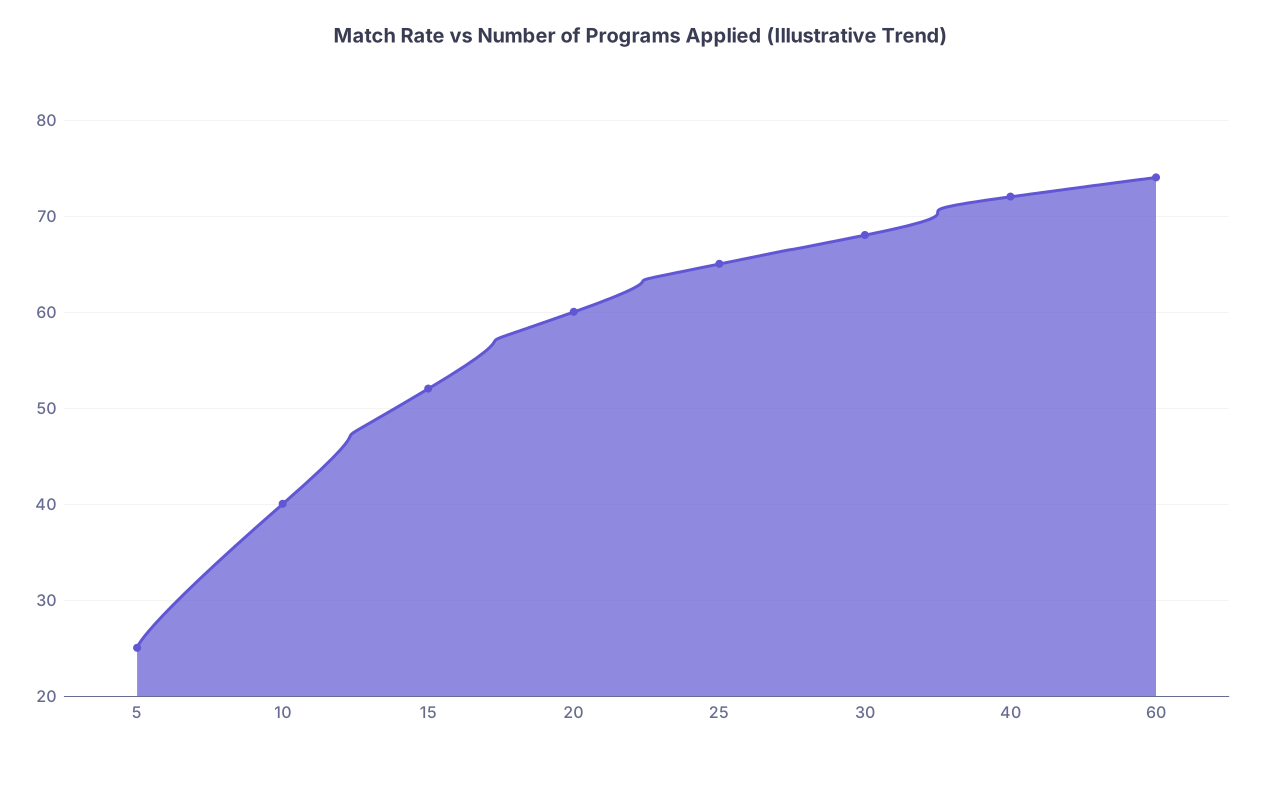
Understanding the Landscape: Medical Genetics Residency for IMGs
Medical genetics is a small, rapidly evolving specialty that sits at the intersection of clinical medicine, laboratory science, and precision health. For an international medical graduate (IMG), building a smart program selection strategy is essential to maximizing your chances in the genetics match while ensuring you land in a program that fits your goals and support needs.
A strong strategy requires you to:
- Understand the structure of medical genetics training in the U.S.
- Clarify your career goals (clinical, lab-based, academic, or mixed)
- Assess your competitiveness as an IMG (scores, visas, experience)
- Use a data-driven approach to decide how many programs to apply and which programs to prioritize
This IMG residency guide will walk you through each step, tailored specifically to medical genetics residency and the unique challenges IMGs face.
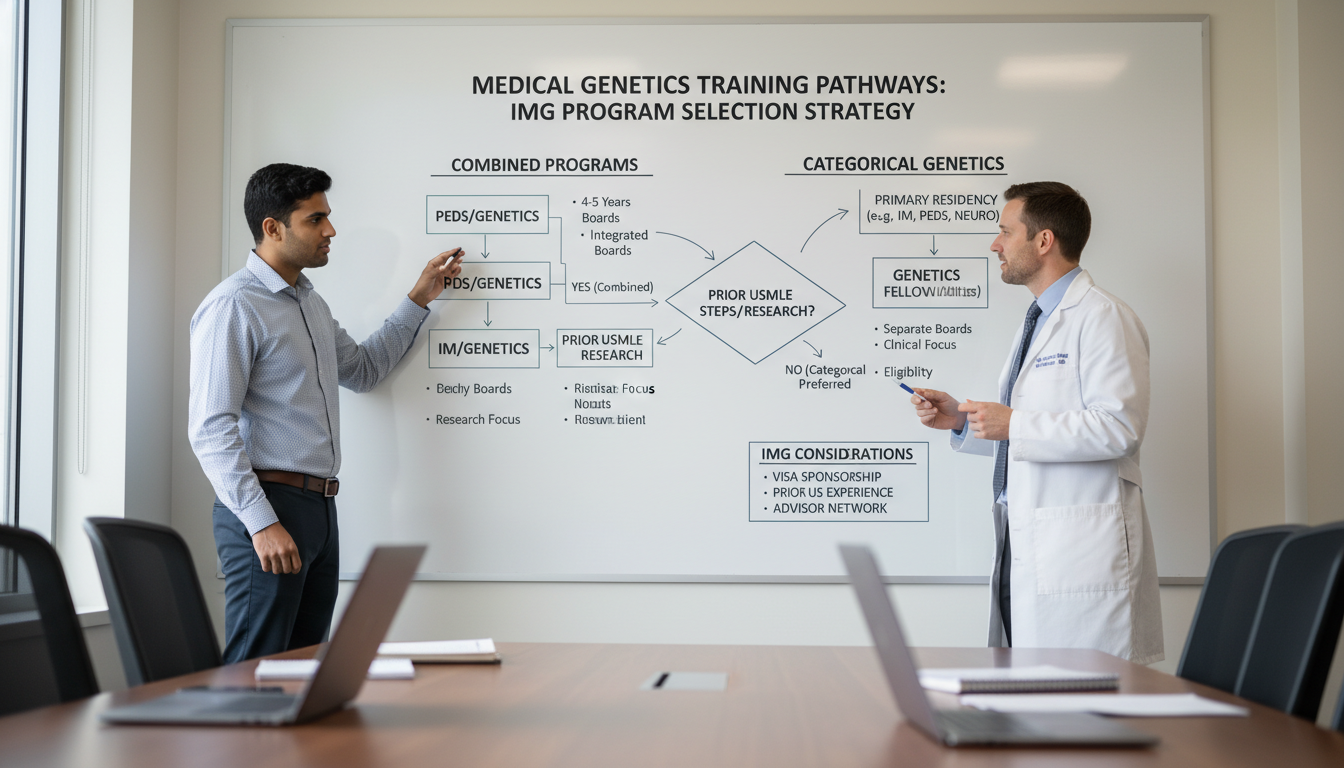
Step 1: Know the Training Pathways in Medical Genetics
Before choosing programs, you must understand what types of programs exist and which ones realistically fit your background and timing.
1.1 Core U.S. Medical Genetics Training Models
In the U.S., genetics training is accredited by the ACGME and leads to certification through the American Board of Medical Genetics and Genomics (ABMGG). The most common pathways relevant to IMGs are:
Combined Programs (Integrated Pathways)
- Internal Medicine–Medical Genetics and Genomics (IM–MGG)
- Pediatrics–Medical Genetics and Genomics (Peds–MGG)
- Duration: Typically 4–5 years total (integrated training)
- You match once into a combined program
- Graduates are eligible for both primary specialty boards (IM or Peds) and Medical Genetics
Categorical Medical Genetics and Genomics
- Standalone, typically 2 years, after completion of an ACGME-accredited prerequisite residency:
- Internal Medicine
- Pediatrics
- Obstetrics & Gynecology
- Other approved specialties in some cases
- These are often fellowship-level programs in structure, even though named "residency"
- Standalone, typically 2 years, after completion of an ACGME-accredited prerequisite residency:
Translational or Laboratory-Focused Training
- E.g., Laboratory Genetics and Genomics; Molecular Genetic Pathology
- Highly specialized; usually require prior residency (e.g., Pathology) and sometimes a PhD; less common for early-career IMGs
As an IMG, your program selection strategy must factor in where you are starting from:
- If you have no U.S. residency yet:
- Realistic targets: Combined IM–MGG or Peds–MGG programs
- If you have completed a primary residency (in the U.S. or occasionally abroad with ABMGG-recognized equivalence):
- Realistic targets: categorical Medical Genetics & Genomics programs
1.2 Clarify Which Path Is Right for You
Ask yourself:
- Do you want day-to-day clinical patient care, heavy on counseling and longitudinal management?
- Are you more interested in translational research, genomic diagnostics, or lab-based roles?
- Do you already have, or are you planning to complete, a primary specialty first (such as internal medicine or pediatrics)?
Typical IMG pathways in practice:
- IMG in home country → U.S. IM or Peds residency → Genetics residency
- Most common route; genetics is a second residency or “fellowship-like” step.
- IMG directly matching into combined Peds–MGG or IM–MGG
- Less common but growing; particularly feasible if:
- Strong academic record and USMLE scores
- Visa-supportive program
- Demonstrated interest in genetics (research, electives, publications)
- Less common but growing; particularly feasible if:
- IMG with home-country specialty and substantial genetics experience → U.S. Medical Genetics residency
- Case-by-case, depends on ABMGG prerequisites and program willingness
Your program selection strategy should begin with listing which of these pathways are realistic given your current CV and visa status.
Step 2: Assess Your Competitiveness as an IMG
Before deciding how many programs to apply and which to target, you must honestly evaluate your profile.
2.1 Core Application Metrics
Key components for an international medical graduate:
- USMLE scores (or equivalent)
- Step 1: Now Pass/Fail, but previous numeric scores still considered if available
- Step 2 CK: Heavily weighted; higher scores strengthen your application
- Clinical experience
- U.S. clinical experience (USCE) is highly valued:
- Observerships, externships, electives, sub-internships
- Genetics-specific rotations or clinics are a strong plus
- U.S. clinical experience (USCE) is highly valued:
- Research and scholarship
- Genetics, genomics, or related fields (e.g., oncology, neurology, prenatal diagnosis)
- Publications, posters, abstracts, or involvement in genomic projects
- Language and communication
- Clear English fluency and strong interpersonal skills are essential, especially in a counseling-heavy specialty
- Visa needs
- Many genetics programs are in university hospitals that sponsor J-1 and sometimes H-1B, but not all do
2.2 Competitiveness Tiers (Practical Framework)
Use a realistic tiering to guide your program selection strategy:
Tier 1 – Highly Competitive IMG Applicant
- Strong Step 2 CK (e.g., >250 in older scoring terms or top decile performance)
- Significant U.S. clinical experience, ideally including genetics exposure
- Genetics-related research or advanced degrees (MPH, MS, PhD)
- Strong letters from U.S. academic physicians, preferably geneticists
- Programs may see you similarly to strong U.S. grads interested in a niche field
Tier 2 – Solid IMG Applicant
- Respectable Step 2 CK (e.g., around national average or higher)
- Some USCE, even if not genetics-focused
- Modest research or quality improvement work
- Clear, well-articulated interest in genetics
- Competitive for many, but not all, university-based programs if visa is feasible
Tier 3 – Developing IMG Applicant
- Marginal or lower Step 2 CK; attempts or other red flags
- Limited or no USCE
- Little to no research
- Visa-dependent with few additional strengths
- More realistic to:
- First match into IM or Peds in a more IMG-friendly program
- Then apply to Genetics residency after building a stronger U.S. track record
Your tier is not permanent. It simply guides how aggressive or targeted your application list should be in this cycle.
Step 3: Building a Data-Driven Program List
Once you understand your pathway and tier, you can start constructing your list. This is where questions like how to choose residency programs and how many programs to apply become central.
3.1 How Many Programs to Apply to in Medical Genetics?
Medical genetics is a small specialty, so the usual “apply to 80–100 programs” advice for IM or Peds is not relevant.
Instead, think in terms of:
- Combined IM–MGG or Peds–MGG: Nationwide, there may be dozens, not hundreds, of integrated slots.
- Categorical Genetics (after primary residency): Also a limited number of positions, often filled by graduates from internal programs or by fellows who already have U.S. primary specialties.
For an IMG targeting integrated programs (first residency in the U.S.):
- Tier 1 IMG:
- Apply to all programs that align with your visa needs and academic goals.
- This may realistically be 15–30 programs nationwide, depending on the year.
- Tier 2 IMG:
- Apply broadly to every program that accepts IMGs and visas, aiming for coverage of:
- University-based, mid-tier, and less well-known programs
- Range: 20–35 programs, if available.
- Apply broadly to every program that accepts IMGs and visas, aiming for coverage of:
- Tier 3 IMG:
- It may be more strategic to:
- Apply broadly to IM or Peds programs (50–100 programs),
- Then later transition into Genetics.
- Apply to genetics programs only if your CV has specific strengths (e.g., prior genetics residency, PhD in genetics).
- It may be more strategic to:
Because the total pool of genetics slots is small, your decision on how many programs to apply is more about completeness (not missing viable options) than sheer volume.
3.2 Criteria for Program Selection
When searching for programs, use filters and criteria specific to the international medical graduate context and the nature of medical genetics.
Key factors:
Visa Sponsorship
- Confirm through:
- Program websites
- FREIDA listing
- Emails to program coordinators
- Verify whether they sponsor J-1 only, J-1 & H-1B, or no visas
- For many IMGs, this is an early go/no-go filter.
- Confirm through:
IMG-Friendliness
- Look at:
- Past residents: Do they include international graduates?
- Current faculty or fellows with IMG backgrounds
- Match outcomes listed publicly or on program brochures
- Programs that have never had an IMG may still consider you, but the burden is higher.
- Look at:
Clinical vs. Research Balance
- Clinical-heavy programs:
- Strong outpatient genetics and dysmorphology clinics
- Prenatal, cancer genetics, metabolic clinics
- Research-leaning programs:
- Offer dedicated research time
- Ties to genomics centers, bioinformatics, translational labs
- Choose according to your career goals (pure clinical vs. clinician–scientist).
- Clinical-heavy programs:
Subspecialty Exposure
- Cancer genetics
- Neurogenetics
- Cardiovascular genetics
- Metabolic disease
- Prenatal & preconception genetics
- Precision medicine initiatives
- A broad mix is ideal if you have not yet chosen a niche.
Program Size and Environment
- Small programs (1–2 residents per year):
- Closer mentorship
- Risk of limited peer group and backup coverage
- Large academic centers:
- More subspecialties and electives
- More research, often more bureaucracy
- Small programs (1–2 residents per year):
Location and Support Systems
- Cost of living, proximity to family or diaspora communities
- Availability of spouse/partner job opportunities
- Institutional support for international trainees:
- Visa/immigration office
- International house or IMG mentorship group
3.3 Practical Workflow to Build Your List
Create a spreadsheet
- Columns: Program name, location, pathway (IM–MGG, Peds–MGG, categorical), visa policy, IMG presence, research focus, subspecialty strengths, notes.
Start with official sources
- ACGME list of accredited programs
- FREIDA listings under Medical Genetics and Genomics
- NRMP specialty data for the latest genetics match
Visit each program website
- Confirm:
- Pathway and duration
- Visa sponsorship
- Curriculum and rotations
- Current and past residents
- Research infrastructure (biobanks, genomic labs, etc.)
- Confirm:
Categorize programs
- Reach programs (top-tier academic centers, heavy research, more U.S. grads)
- Match-range programs (solid university-affiliated with a mix of residents)
- Safety programs (smaller, less well-known, historically IMG-friendly)
Aim for a balanced list across these categories.

Step 4: Aligning Program Selection With Your Long-Term Goals
A strong program selection strategy for medical genetics must go beyond just matching; it must align with what you want your career to look like 5–10 years from now.
4.1 Clinical vs. Academic vs. Hybrid Careers
Ask yourself:
- Do you see yourself primarily:
- In academic medicine, teaching and doing research?
- In hospital-based clinical practice, focusing on patient care?
- In a hybrid role with some research, education, and clinical practice?
If you aim for academic or research-intensive careers:
- Prioritize:
- Programs with NIH-funded faculty and ongoing genetics/genomics research
- Protected research time during training
- Ties with departments like oncology, neurology, cardiology, pediatrics, pathology
- Opportunities to obtain an advanced degree (MPH, MS in genetic counseling, medical education, or clinical investigation)
If you aim for mostly clinical practice:
- Prioritize:
- High clinical volume and diverse patient populations
- Robust exposure to multiple subareas: cancer, prenatal, metabolic, adult genetics
- Strong mentorship in clinical workflows, insurance, ethics, and policy
4.2 Consider Dual Training and Future Flexibility
Some IMGs are uncertain whether they will remain in one country long-term. You should factor in:
- International recognition of your training
- Well-known academic centers may give you more options for future work globally.
- Transferable skills
- Bioinformatics, variant interpretation, genomic counseling
- Quality improvement, clinical trials, implementation science
- Options for:
- Future subspecialty fellowships (e.g., metabolic genetics, cancer genetics)
- Combined roles in industry (pharmaceuticals, biotech, genomic testing companies)
Programs with strong alumni networks and mentorship for nontraditional paths (industry, policy, global health) may be especially valuable to an international medical graduate.
4.3 Example: Two IMGs, Two Strategies
Example 1: Dr. A – Research-Oriented IMG
- Background:
- Medical school in South Asia, Step 2 CK in the high 250s
- 1-year research fellowship in a U.S. genomics lab
- Several abstracts and one genetics-related publication
- Limited direct USCE
- Strategy:
- Target combined Peds–MGG and IM–MGG programs at research-heavy centers
- Prioritize programs with clear research tracks and possible MS or PhD enrollment
- Apply to all such programs offering J-1 visas, perhaps 20–25 in total
- Rationale:
- Strong research profile and clear fit for institutions wanting clinician–scientists
Example 2: Dr. B – Clinically Focused IMG With Modest Scores
- Background:
- Caribbean graduate, Step 2 CK around national average
- 3 months of U.S. pediatric observerships, no genetics-specific research
- Needs visa sponsorship
- Strategy:
- Primary: Apply widely to pediatrics categorical programs (60–80 applications) with some IMG-friendly mid-tier and community-sponsored programs
- Genetics: Apply selectively to a smaller number of integrated Peds–MGG programs that:
- Explicitly mention openness to IMGs and visas
- Have broad clinical exposure
- Long-term plan:
- If matches into Peds:
- Build genetics exposure during residency (electives, mentorship, QI projects)
- Apply later to categorical genetics residency as a second step
- If matches into Peds:
Both strategies are valid, but each is very different. Building your own plan means accurately mapping your strengths and constraints.
Step 5: Practical Tips to Strengthen Your Application and Target Programs
Beyond just list-building, a smart IMG residency guide for medical genetics must include practical ways to enhance your competitiveness and signal good fit.
5.1 Targeted Experiences Before Applying
Genetics clinics or electives
- Seek out observerships in:
- Adult genetics clinics
- Pediatric genetics/metabolic clinics
- Cancer genetics
- This directly supports your story in the personal statement and interviews.
- Seek out observerships in:
Online coursework and certifications
- Introductory genomics courses (Coursera, edX, institutional programs)
- Variant interpretation or genomic data analysis workshops
- They show initiative and foundational knowledge.
Research or scholarly activity
- Collaborate on:
- Case reports of rare genetic syndromes
- Small retrospective reviews in genetics clinics
- Quality improvement projects in genetic testing workflows
- Collaborate on:
5.2 Optimize Application Materials for Medical Genetics
Personal Statement
- Focus on:
- Why genetics (not just “I like rare diseases”)
- How your IM/OB/Peds/other interests align with genomics
- Your exposure to genetics and how it shaped your career goals
- Your vision: Clinical specialist, academic leader, educator, or translational researcher
- Focus on:
Letters of Recommendation
- Strongest letters are from:
- Geneticists or physicians who have seen you in genetics-related contexts
- U.S. faculty attesting to your professionalism and communication skills
- At least one letter from a clinician who can directly compare you to U.S. trainees is ideal.
- Strongest letters are from:
Curriculum Vitae
- Highlight:
- Genetics-related electives, observerships, projects
- Language skills (helpful in diverse patient populations)
- Leadership or teaching roles, especially in scientific or research contexts
- Highlight:
5.3 Direct Communication With Programs
Email program coordinators if information is unclear:
- Ask specifically about:
- Visa sponsorship
- IMG eligibility
- Any prerequisites unique to their program
- Keep emails short, professional, and purposeful.
- Ask specifically about:
Network with current or recent residents
- LinkedIn, institutional websites, alumni pages
- Ask insightful questions:
- “How integrated is the genetics training with other specialties?”
- “How supportive is the program of international graduates?”
- “What kind of careers have alumni pursued?”
This kind of targeted outreach can refine your program selection strategy and sometimes yield informal advocacy.
Frequently Asked Questions (FAQ)
1. As an IMG, should I apply directly to medical genetics, or first to internal medicine/pediatrics?
For most IMGs, the more reliable path is to match first into a core specialty (Internal Medicine or Pediatrics) in a relatively IMG-friendly environment, then apply to Medical Genetics and Genomics as a second residency/fellowship. Direct application to combined IM–MGG or Peds–MGG is realistic if you have strong USMLE performance, some U.S. experience, and clear evidence of genetics interest or research.
2. How many medical genetics programs should I apply to as an IMG?
Medical genetics is a small specialty, so the goal is to apply to every viable program rather than to hit a large numerical target. A typical range for IMGs targeting integrated genetics training is 20–35 programs, depending on how many accept IMGs and sponsor your required visa. If you are also applying to a primary specialty (IM or Peds), that list will be larger (often 50–80 programs).
3. How can I tell if a medical genetics program is IMG-friendly?
Look for:
- Current or past residents who are international medical graduates
- Clear statements on the website about visa sponsorship
- Participation in the NRMP with open language about diversity and inclusion
- Responses from program coordinators confirming that they consider IMGs and describing previous successes
Programs with multiple IMGs in related departments (e.g., IM, Peds) within the same institution are also more likely to be supportive of IMGs in genetics.
4. What if I have low scores or attempt(s) on USMLE—do I still have a chance in genetics?
You may still have a pathway, but it is more indirect. Focus first on:
- Matching into a primary residency that is more open to IMGs with varied scores
- Building a strong track record in the U.S. (clinical excellence, QI projects, genetics electives)
- Developing a credible narrative and portfolio in genetics over time
Once you have strong U.S.-based evaluations and hands-on experience, a genetics residency may become a realistic second step, even if your initial exam scores were not ideal.
By approaching your program selection strategy thoughtfully—understanding training pathways, realistically assessing your competitiveness, and aligning programs with your long-term goals—you significantly improve your chances of a successful genetics match as an international medical graduate.